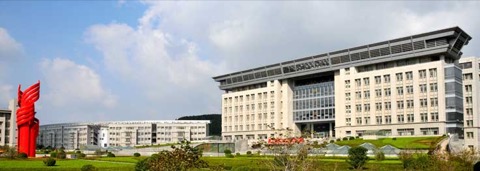
The University of Jinan (UJN; simplified Chinese: 济南大学; traditional Chinese: 濟南大學; pinyin: Jǐnán Dàxué; colloquially 济大, pinyin: Jǐdà), located in Jinan City, Shandong Province, China, is a key and comprehensive provincial university. Enrolling students from all over the world, it offers bachelor, master and doctor degree and enjoys the right to recommend postgraduates exempting admission examinations.
Vortex-induced vibration(VIV)of an underwater manipulator in pulsating flow presents a notable engineering problem in precise control due to the velocity variation in the flow.This study investigates the VIV response of an underwater manipulator subjected to pulsating flow,focusing on how different postures affect the behavior of the system.The effects of pulsating parameters and manipulator arrangement on the hydrodynamic coefficient,vibration response,motion trajectory,and vortex shedding behaviors were analyzed.Results indicated that the cross-flow vibration displacement in pulsating flow increased by 32.14%compared to uniform flow,inducing a shift in the motion trajectory from a crescent shape to a sideward vase shape.In the absence of interference between the upper and lower arms,the lift coefficient of the manipulator substantially increased with rising pulsating frequency,reaching a maximum increment of 67.0%.This increase in the lift coefficient led to a 67.05%rise in the vibration frequency of the manipulator in the in-line direction.As the pulsating amplitude increased,the drag coefficient of the underwater manipulator rose by 36.79%,but the vibration frequency in the cross-flow direction decreased by 56.26%.Additionally,when the upper and lower arms remained in a state of mutual interference,the cross-flow vibration amplitudes of the upper and lower arms were approximately 1.84 and 4.82 times higher in a circular-elliptical arrangement compared to an elliptical-circular arrangement,respectively.Consequently,the flow field shifted from a P+S pattern to a disordered pattern,disrupting the regularity of the motion trajectory.
S-1-Propenyl-L-cysteine(S1PC),a sulfur-containing amino acid naturally present in Allium sativum and first iden-tified in garlic preparations in the 1960s,plays an important role in aged garlic extract(AGE)and a key pharmacological role.Since 2016,it has been found to possess a variety of biological activities,including anti-hypertensive,anti-inflammatory and immunomo-dulatory properties.S1PC has less odour and is less toxic than whole garlic,making it a more attractive option for those looking to reap the health benefits of garlic without the adverse side effects of indigestion and bad breath.S1PC has been found to have blood pressure lowering effects in animal models of hypertension and has immunomodulatory effects both in vivo and in vitro.In addition,S1PC has anti-inflammatory effects,which may help prevent or manage diseases associated with chronic inflammation,such as gingivitis and atherosclerosis.Based on the above findings,S1PC is considered to be another important,pharmacologically active and safe component of AGE,along with its isomer S-allyl-L-cysteine(SAC).In this review,the latest research progress on the physicochemical properties and other aspects of S1PC is summarized,and the possible directions of its application development in the future are also proposed.
The application of radiation-related technologies in fields such as medical diagnosis and nuclear indus-try monitoring is becoming increasingly widespread,placing higher demands on the comprehensive performance of detection and protective materials.Traditional inorganic scintillation crystals,organic plastic scintillators,and lead-based shielding materials all suffer from inherent limitations,making it difficult to balance performance with practi-cal application requirements.High-loading transparent composites overcome the fundamental conflict between"filler loading"and"optical transparency"by utilizing a high density of functional nanounits to enhance radiation interac-tion efficiency,while maintaining excellent optical transparency to ensure signal transmission.Consequently,these composites have emerged as a major research focus in the field of radiation materials.This article systematically re-views their synthesis strategies,focusing on application progress in the three core areas of radiation detection,imag-ing and shielding.It also summarizes current challenges and future directions,aiming to provide guidance for materi-al optimization and industrial application.
Fe3+-doped near-infrared luminescent materials have drawn increasing attention due to their tunable broad-band emission,excellent biocompatibility and low toxicity,demonstrating promising applications in bioimaging and nonde-structive testing.Understanding the structure-property relationship between crystal structure and luminescence perfor-mance,along with optimization strategies,is crucial for developing novel high-efficiency Fe3+-doped materials.This review summarizes recent advances in Fe3+-doped NIR luminescent materials.Using Tanabe-Sugano diagrams,we analyze the luminescence mechanisms of Fe3+in both octahedral and tetrahedral coordination environments.A systematic compari-son of materials reported in the past five years is presented,focusing on their luminescence properties,optimization approaches and application fields.Finally,we discuss current challenges and future prospects to provide valuable insights for understanding emission mechanisms and developing high-performance Fe3+-doped NIR luminescent materials.
Selenosulfonylation has emerged as one of the most efficient and practical methods for the simultaneous construc-tion of C—Se and C—S bonds.The selenosulfone compounds prepared by this transformation not only play significant roles in drug development,natural product structural modification,and functional materials,but also serve as versatile synthetic intermediates for further transformations.Over the past two decades,radical selenosulfonylation has experienced considerable progress,characterized by its high reactivity,mild reaction conditions,and excellent functional group tolerance.The recent advances in radical selenosulfonation systematically categorized based on the types of sulfonylation reagents employed,in-cluding those derived from selenosulfonate salt,sulfonylhydrazine,sodium sulfite or sulfinic acid,aryl diazonium salt com-bined with 1,4-diazabicyclo[2.2.2]octane-1,4-diium-1,4-disulfinate(DABSO),cyclobutanone oxime ester combined with DABSO,and alkyne combined with DABSO.A concise overview of the recent developments in this field is provided accord-ingly.





