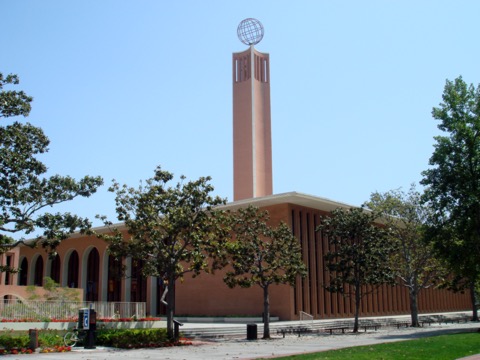
The University of Southern California (USC, SC, or Southern Cal[a]) is a private research university in Los Angeles, California. Founded in 1880 by Robert M. Widney, it is the oldest private research university in California.The university is composed of one liberal arts school, the Dornsife College of Letters, Arts and Sciences and twenty-two undergraduate, graduate and professional schools, enrolling roughly 21,000 undergraduate and 28,500 post-graduate students from all fifty U.S. states, and more than 115 countries. USC is ranked as one of the top universities in the United States and admission to its programs is considered highly selective.USC was one of the earliest nodes on ARPANET and is the birthplace of the Domain Name System. Other technologies invented at USC include DNA computing, dynamic programming, image compression, VoIP, and antivirus software.USC's notable alumni include 11 Rhodes scholars and 12 Marshall scholars. As of January 2021, 10 Nobel laureates, six MacArthur Fellows, and one Turing Award winner have been affiliated with the university. USC has conferred degrees upon 29 alumni who became billionaires, and has graduated more alumni who have gone on to win Academy and Emmy Awards than any other institution in the world by a significant margin, in part due to the success of the School of Cinematic Arts.USC sponsors a variety of intercollegiate sports and competes in the National Collegiate Athletic Association (NCAA) as a member of the Pac-12 Conference. Members of USC's sports teams, the Trojans, have won 107 NCAA team championships, ranking them third in the United States, and 412 NCAA individual championships, ranking them third in the United States and second among NCAA Division I schools. As of 2021, Trojan athletes have won 326 medals at the Olympic Games (153 golds, 96 silvers and 77 bronzes), more than any other university in the United States. In 1969, it joined the Association of American Universities. USC has had a total of 537 football players drafted to the National Football League, the second-highest number of drafted players in the country.The University of Southern California is the largest private employer in the Los Angeles area and generates an estimated $8 billion of economic impact on the state of California.S.S.S.S.S.S.S.S.S.S.S.S.

Single-cell RNA sequencing has transformed our understanding of cellular diversity, yet current single-cell foundation models (scFMs) remain limited in their scalability, flexibility across diverse tasks, and ability to natively integrate textual information. In this work, we build upon the Cell2Sentence (C2S) framework, which represents scRNA-seq profiles as textual "cell sentences," to train Large Language Models (LLMs) on a corpus comprising over one billion tokens of transcriptomic data, biological text, and metadata. Scaling the model to 27 billion parameters yields consistent improvements in predictive and generative capabilities and supports advanced downstream tasks that require synthesis of information across multi-cellular contexts. Targeted fine-tuning with modern reinforcement learning techniques produces strong performance in perturbation response prediction, natural language interpretation, and complex biological reasoning. This predictive strength enabled a dual-context virtual screen that nominated the kinase inhibitor silmitasertib (CX-4945) as a candidate for context-selective upregulation of antigen presentation. Experimental assessment in human cell models unseen during training supported this prediction, demonstrating that C2S-Scale can effectively guide the discovery of context-conditioned biology. C2S-Scale unifies transcriptomic and textual data at unprecedented scales, surpassing both specialized single-cell models and general-purpose LLMs to provide a platform for next-generation single-cell analysis and the development of "virtual cells."
We address the global-in-time existence and pathwise uniqueness of solutions for the three-dimensional incompressible stochastic Navier-Stokes equations with multiplicative noise. Under natural smallness conditions on the noise, we prove an almost sure global existence result for small initial data in L3. Specifically, we show that sufficiently small L3 data yields a pathwise unique strong solution that remains small in L3 and is global-in-time on a set of probability close to 1, with this probability increasing as the initial L3 norm decreases. Moreover, the solution decays exponentially with large probability. (c) 2025 Elsevier Inc. All rights are reserved, including those for text and data mining, AI training, and similar technologies.
To inform regulatory policy, this article summarises findings on inhalation facilitation from the ninth report of the WHO Study Group on Tobacco Product Regulation. Some additives counteract the harshness and bitterness of tobacco and nicotine product aerosols, making them easier to inhale. Additives that promote inhalability may perpetuate and increase the use of inhaled tobacco and nicotine products, especially by young people. Thus, as a class, additives that facilitate inhalation are an important regulatory target to prevent tobacco and nicotine product uptake. We defined inhalation facilitation as modifications to products during manufacturing that enhance the sensory experience and (potentially) behaviours associated with inhalation (eg, deeper puffs, faster inhalation, larger puff volume, shorter intervals in between puffs and use episodes). Evidence review showed that: (a) menthol and synthetic coolants decrease irritation caused by aerosol constituents by activating sensory perception receptors (eg, cooling receptors) and may promote dependence in inexperienced users; (b) acid additives and sugars, which lower the pH of aerosols and shift nicotine from free-base to protonated salt forms, reduce harshness and increase blood nicotine yield; (c) e-cigarette flavourings perceived as sweet or fruity reduce subjective bitterness, increase attractiveness and may escalate use, although their effects on perceived harshness are inconclusive; (d) sugars in tobacco impart sweet sensations, but limited industry-independent data preclude strong conclusions for sugars’ roles in inhalation facilitation. Given these findings, WHO policy recommendations suggest that regulators might consider banning ingredients that facilitate inhalation in all commercial inhaled tobacco and nicotine products.
This study examines information suppression mechanisms in DeepSeek, an open-source large language model (LLM) developed in China. We propose an auditing framework and use it to analyze the model's responses to 646 politically sensitive prompts by comparing its final output with intermediate chain-of-thought (CoT) reasoning. Our audit unveils evidence of semantic-level information suppression in DeepSeek: sensitive content often appears within the model's internal reasoning but is omitted or rephrased in the final output. Specifically, DeepSeek suppresses references to transparency, government accountability, and civic mobilization, while occasionally amplifying language aligned with state propaganda. This study underscores the need for systematic auditing of alignment, content moderation, information suppression, and censorship practices implemented into widely-adopted AI models, to ensure transparency, accountability, and equitable access to unbiased information obtained by means of these systems.
Let P_n be a Sylow p-subgroup of the symmetric group S_n. We investigate the number and sizes of the P_n∖ S_n / P_n double cosets, showing that most double cosets have maximal size when p is odd, or equivalently, that P_n∩ P_n^x=1 for most x∈ S_n when n is large. We also find that all possible sizes of such double cosets occur, modulo a list of small exceptions.





