Cyberbullying has become a global issue across social media platforms, where individuals switch platforms to perform such activity to evade detection. This study introduced a Cross-Platform Cyberbullying Detection Algorithm (CPCD-Alg), a state-of-the-art algorithm that combines user behaviour, network analysis, linguistic patterns, and textual data analysis to identify cyberbullying within and across different social networks. Using two synthetic datasets denoting Platform A and Platform B, the proposed algorithm CPCD-Alg finds cyberbullying on a single platform by utilising machine learning and deep learning models, integrating BERT for textual analysis and graph-based methods for network analysis. After detecting cyberbullying on a single platform, the approach is then extended to cross-platform detection by matching features like behavioural analysis, linguistic patterns and network analysis. The approach does not consider username matching because users often use different names on different platforms to evade detection. The results show that adding multidimensional features enhances accuracy, with LSTM achieving 98
Health Insurance Portability and Accountability Act (HIPAA) has laid down several ethical and legal obligations on healthcare providers to preserve the privacy and confidentiality of patient information. Digitization in healthcare has been of great help to the medical fraternity and the patients, however, digital-based services in healthcare have also widened the spectrum of vulnerabilities. In this paper, we propose a blockchain-based system to trace the data collection, storing, and sharing process for medical records. We present an Architecture of Medical Records Data Accountability and Compliance (MRDACE) which is a decentralized permissioned data-sharing platform. The Medical Images and Information of a patient will be under the sole ownership of the patient. Logs of any access made to the Medical Images and Information of a patient will be maintained and cannot be modified, leading to a transparent traceability mechanism. This architecture utilizes the Proof-of-Authority consensus algorithm and further introduces a new automated incentive function to decide upon the access rights of the Data requestors. In comparison to the existing state-of-art solutions, it performs with 56.71% less gas since the automated function introduced removes the need for the patient consent to share the health records with the Data requestors.
The study focuses on the systematic review of the best algorithms of the indexing practice in the Database Management Systems. Indexing serves as a core aspect in improving the information gathering and storing process for the big data libraries. The bedroom area of the house also has a Closet that meets the requirements of the client, a fashion designer. The closet has lots of storage space with plenty of drawers and hanging rods for the designer’s extensive wardrobe. The scope of this study is to propose a thorough comparison and investigation of these indexing algorithms. In this context, one can find the performance assessment that has been done based on data space utilisation, execution time for queries, scalability, and concurrency level. Based on simulated real-life data sets, we perform experiments to analyse each technique and its features. We also trace the performance of diverse databases over the technological landscape. Moreover, the chief features of all of them are described, and suggestions on how to improve the approaches are made. Therefore, this comparative study is planned to introduce useful insights to database experts and researchers to facilitate making decisions about selecting the appropriate strategies of indexing that are adjusted to the specific needs of the users and the goals of performance for different databases.
FMCG (Fast moving consumer goods) are economical goods sold very quickly. It can be characterized by the speedy turnover and large demand in the market because they are consumed and purchased regularly. In this aggressive area, brand awareness stands as a main issue influencing consumer's alternatives and marketplace dominance. this paper focuses on the concept brand awareness in each rural & urban areas for FMCG products in India. By analysing top 5 manufacturers based on recall, recognition, and choice of consumers. In rural areas, phrase-of-mouth and private suggestions have a large effect on brand attention. Regarding urban areas, matters are modern and different. Advertising, digital media, experiential advertising and marketing play a major role in driving brand consciousness among city consumers. It also searches to examine the mean values of these metrics in rural and concrete regions to determine if city areas showcase higher levels of logo focus. Additionally, the look at analyses the dispersion ranges, indicated via standard deviations, inside every demographic to degree the consistency of logo recognition metrics throughout special FMCG organizations. based on primary and secondary data evaluation, the descriptive statistics disclose giant versions in logo focus metrics among rural and urban regions for the pinnacle five FMCG businesses in India. Overall, city areas tend to demonstrate barely higher mean values for consideration, popularity, and desire as compared to rural areas throughout all groups. However, the usual deviations imply varying ranges of dispersion inside every demographic, suggesting that logo recognition tiers aren't continually uniform.
With the rise of healthcare digitization, it has become a critical priority to safeguard patient privacy and ensure data security. Conventional methods of data access control mechanisms have proven to be insufficient in the dynamic management of patient data access with a fine-grained access control mechanism. This research paper investigates the potential of Hashgraph as a possible solution to strengthen patient privacy within healthcare environments. This paper reviews existing literature on the access control mechanism adopted for maintaining patient privacy, thereby emphasizing the potential benefits of deploying Hashgraph into healthcare systems and proposes to term it as MedHash. By exploiting the distinctive features of Hashgraph in MedHash, such as gossip protocol and virtual voting, every node will autonomously engage in the consensus mechanism thereby solving the risk of power concentration within a few nodes of the network. Since the mining is absent in MedHash, hence the energy consumption in comparison to the proof-of-work blockchains has been greatly reduced. Furthermore, MedHash is resilient against the Sybil and double-spending attacks. MedHash, when implemented in the healthcare scenario, leads to reinforced privacy measures and thereby fortifies data security by empowering patients with greater control over sensitive information.
Deepfake videos have become a growing concern in media forensics due to their ability to manipulate information and deceive individuals. The proposed method utilises a deep learning-based CNN-MLP model to extract features from the input video frames and then classify them into real and Deepfake. The proposed system used Celeb-df, which is a publicly available deepfake dataset, and achieved a high accuracy of $81.25 \%$ in detecting deepfake videos. Comparative evaluations with an alternative algorithm demonstrate our model’s superior accuracy, reinforcing its efficacy in discerning manipulated content. The proposed method can be integrated into existing video analysis systems to enhance their security and accuracy.
Traditional crowd counting (optical flow or feature matching) techniques have been upgraded to deep learning (DL) models due to their lack of automatic feature extraction and low-precision outcomes.Most of these models were tested on surveillance scene crowd datasets captured by stationary shooting equipment.It is very challenging to perform people counting from the videos shot with a head-mounted moving camera; this is mainly due to mixing the temporal information of the moving crowd with the induced camera motion.This study proposed a transfer learning-based PeopleNet model to tackle this significant problem.For this, we have made some significant changes to the standard VGG16 model, by disabling top convolutional blocks and replacing its standard fully connected layers with some new fully connected and dense layers.The strong transfer learning capability of the VGG16 network yields in-depth insights of the PeopleNet into the good quality of density maps resulting in highly accurate crowd estimation.The performance of the proposed model has been tested over a self-generated image database prepared from moving camera video clips, as there is no public and benchmark dataset for this work.The proposed framework has given promising results on various crowd categories such as dense, sparse, average, etc.To ensure versatility, we have done self and cross-evaluation on various crowd counting models and datasets, which proves the importance of the PeopleNet model in adverse defense of society.
This unique method for recognising objects with YOLOv8 object detection will allow for the early identification of tomato diseases, which include blight, mould, and viral threats. And as this early identification is a key to global food security at this time, it is crucial. Automated technologies provide a solution to the cost and error-prone processes of classical diagnostics. Therefore, a tool based on them can improve diagnostic effectiveness. Based on YOLOv8’s fruit defect detection technique and the use of Deep Learning, it yields fast and precise results in the recognition and classification of common diseases of tomatoes. The idea of training the model by curated dataset form and hyperparameter tuning will further optimise the model performance. For instance, precision, recall, and F1-score, known as the metrics, help me in determining the efficacy. Interpretation of the results reveals that these algorithms are more accurate and efficient than previous ones, prompting scientists and farmers to use the algorithm to take preventive measures in their operations, such as agriculture, horticulture, and crop management.
With the rise of healthcare digitization, it has become a critical priority to safeguard patient privacy and ensure data security. Conventional methods of data access control mechanisms have proven to be insufficient in the dynamic management of patient data access with a fine-grained access control mechanism. In this paper, we have proposed ZeroMedChain which explores an innovative solution for enhancing the security of medical records in the field of healthcare. The proposed paper makes use of Layer 2 security measures and Zero-Knowledge Proof (ZKP) technologies. Since the basic focus of the paper is decentralized identity and access management, we have integrated Zero-knowledge Proof with a layer of privacy that permits the patients to share the necessary medical details without revealing their identity. Further, the simulation carried out of the proposed ZeroMedChain along with the conventional consensus algorithm of Proof-of-work proved that ZeroMedChain has better time complexity by 34%.
Lesbian, gay, bisexual, and transgender (LGBT) community refers to a broad group of organizations that are varied in respect to gender, sexuality, religion or ethnicity, and socio-economic status. Because of humiliation, racism, and harassment in society, young individuals who are identified as Lesbian, Gay, Bisexual, Transgender, Queer, Questioning, or Intersex (LGBTQI+) face unique challenges. This systematic review will look at qualitative studies with a focus on services for mental illnesses and the important support service policies and practices in order to better understand the challenges and issues that LGBTQ youth face. Four main themes emerged from studies are as follows: (1) Marginalization; (2) Isolation; (3) Depression; (4) Self-harm and Suicide. This detailed analysis of qualitative studies provides a lot of information to guide and assist the provision of remedies and policies that will solve the disparity in psychological health statistics for the LGBTIQQ youth group. To improve the psychological and mental health a predictive model is proposed that helps to predict the suicidal rate. Present study offers tons of information that may be used to guide the development of programmers and regulations that will narrow the statistical gap for psychological health for the group of young people who are identified as sexual and gender minorities. Statistical data represents challenges and problems faced by LGBTQ community.
This paper presents an innovative solution for enhancing the integrity, fairness, and efficiency of online job interviews conducted for campus placements. The proposed system utilizes computer vision techniques to proctor interviews, providing real-time monitoring and analysis of candidate behaviors. By leveraging this technology, companies can reduce costs associated with placement drives, ensure fairness for all candidates, and empower human proctors with valuable insights. This paper highlights the benefits of computer vision-based online job interview proctoring, referencing relevant studies and industry practices. A yolo model is fine tuned for custom object detection and it is used in the proposed algorithm. The algorithm detects the candidate’s malpractices in online interviews with fewer false positives.
Detecting Alzheimer’s disease presents a formidable challenge for neurologists due to the time-intensive and sometimes imprecise manual diagnostic procedures. Given the profound impact of Alzheimer’s on the brain, adopting a classification framework based on brain imagery could offer more accurate diagnostic outcomes. Deep Learning has gained popularity for its ability to analyze unstructured data and identify intricate patterns for sophisticated decision-making. We propose a fusion model aimed at classifying Alzheimer’s Disease (AD) utilizing sagittal MR images sourced from the ADNI dataset. Our model showcases commendable performance, achieving an impressive accuracy rate of 92%.
Diagnosing Alzheimer’s disease has a major challenge for neurologists due to the time-consuming and sometimes imprecise manual methods. Given Alzheimer’s substantial impact on the brain, employing an automatic diagnostic system using brain images could yield more precise outcomes. In this work, a spatial attention assisted improved deep network model is proposed for classifying Alzheimer’s disease with brain magnetic resonance images. Using ADNI2 dataset, the proposed model demonstrates commendable performance, achieving a accuracy rate of 86% (AD vs MCI vs CN), which is better than previous methods.
The healthcare sector has endured significant challenges due to its incapacity to exchange sensitive patient information. Throughout the battle against the global crisis of COVID-19, it became evident that the healthcare field urgently needs to embrace cutting-edge technologies for storing patients' medical history securely and sharing medical data using privacy-enhancing methods. About 32 nations developed applications that proved effective in curbing the surge of COVID-19 cases, where the paramount focus remained on saving human lives. In a densely populated country like India, there is a pressing need for systems that can promptly alert authorities and healthcare professionals about any surge in cases linked to new strains of COVID-19 or similar pandemic indicators, enabling swift countermeasures. To tackle the task of securely transmitting data while there is a rise in COVID-19 positive cases or similar pandemic signs to government entities geographically segmented, we introduce OFFCHAINMEDVIEW empowered by blockchain, which permits only specific views about the positive patient records with the government agencies. This platform can harness data on positive cases and promptly relay updates to the government while ensuring privacy. Additionally, it can securely store medical records off-chain, accessible to healthcare stakeholders solely with patient consent. This approach enhances doctors' awareness of patient histories, facilitating tailored treatments with a privacy-centric approach, with 49
The 3D Convolutional Neural Network (CNN) is used for Kinesis Recognition in this paper. The suggested model exhibits enhanced recognition accuracy of intricate hand and body movements by acquiring spatiotemporal information from kinesis sequences. The network can more reliably recognize complex motions because it can simultaneously utilize spatial and temporal information. By means of comprehensive testing and assessment, this work demonstrates the efficacy of the 3D CNN architecture in real-time kinesis categorization, indicating that it is a viable option for a variety of uses, including virtual reality, sign language interpretation, and human-computer interaction.
In the study, we describe a complete system for butterfly image classifier with the ResNet 18 architecture as the backbone structure. The very colourful wings of the butterflies, as well as their patterned structures, are faculties that make the image classification of butterflies not an easy task for image classification algorithms. Our approach, entitled “two-step methodology to deal with the challenge” is as follows: We first make the ResNet18 architecture faster to suit more contributing the specific characteristics of butterflies by the addition of techniques like attention and spatial transformer networks. The goal of this change is for the network to get more sensitive to the features at varying levels which is key for the correct classification of the image. Firstly, our parrot model undergoes fine-tuning, which works to adjust the already trained ResNet 18 model for the butterfly classification task. By taking advantage of pre-trained networks on the big dataset of butterfly pictures, we plan to make use of the extracted features to reach an optimal performance level for the specific task. Our findings prove that our model is more accurate than any currently existing approach, achieving state-of-the-art results on the butterfly image databases for global benchmarking. Besides that, we have the network of such representations and feature activations reconstructed which gives us a glimpse into the important butterfly classification features. In conclusion, our study is a starting point for a deep learning approach to butterfly image classification; it will enable keeping tabs on the biodiversity of a particular location, contribute to the conservation efforts of endangered species, and promote ecological research.
 Kumud Pant合作论文数Department of Bioinformatics, MANIT35
 Vikas Tripathi合作论文数32
 Kamal Raj Pardasani合作论文数Department of Mathematics, MANIT16
 Devesh Pratap Singh合作论文数13
 Vidit Kumar合作论文数Dept Comp Sci & Engn, Graph Era Deemed Be Univ Dehradun13Bordoloi, D.合作论文数13
 Priya Matta合作论文数13
 Vijay Singh合作论文数Computer Science and Engineering, Graphic Era Deemed to be University12
 R. H. Goudar合作论文数Department of CSE (VTU, Belagavi, Visvesvaraya Technological University10
 Tanupriya Choudhury合作论文数School of Computer Science, University of Petroleum and Energy Studies (UPES),9Surendra K. Shukla合作论文数8Santosh Kumar合作论文数8
 Devvret Verma合作论文数8
 Prabhdeep Singh合作论文数Dept Comp Sci & Engn, Punjabi Univ8
 Vivek Arya合作论文数Surface Coatings and Treatment Laboratory, BHEL8Navneet Kumar Rajpoot合作论文数7
 Deepak Upadhyay合作论文数Graphic Era Deemed to be University7
 Varsha Mittal合作论文数Graphic Era University7
 Atika Gupta合作论文数Graphic Era Deemed to be University, Graphic Era Hill University7
 Noor Mohd合作论文数Dept Comp Sci & Engn, Graph Era Deemed Univ7
 Durgaprasad Gangodkar合作论文数7Benno Mann合作论文数7
 Surendra Kumar Shukla合作论文数7Nainwal Ankita合作论文数Graphic Era Deemed to be University6
 Pallavi Tiwari合作论文数Dept Comp Sci & Engn, Graph Era Deemed be Univ6Bhupesh Kumar Dewangan合作论文数6
 Tomar, A.合作论文数6
 Manish Mahajan合作论文数State University of New Jersey - New Brunswick6
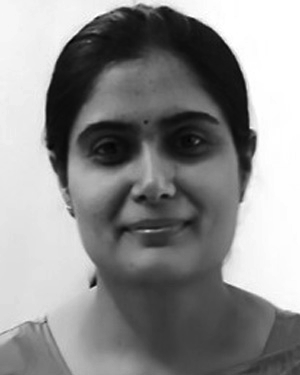 Poonam Verma合作论文数5
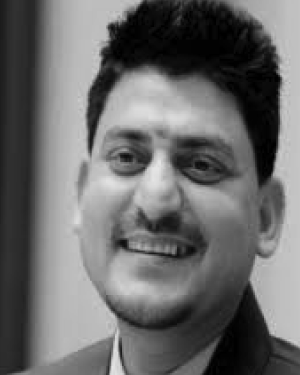 Rajesh Singh合作论文数5Vipashi Kansal合作论文数5
 Neelam Singh合作论文数UniversityDehradun5Purvika Joshi合作论文数4Sumit Aich合作论文数4
 Umesh Tiwari合作论文数4Garima Sharma合作论文数4Tejasvi Ghanshala合作论文数4
 Anita Gehlot合作论文数Uttaranchal Univ, Uttaranchal Inst Technol, Dept Res & Dev, Dehra Dun 248007, Uttarakhand, India4
 Maddikera Kalyan Chakravarthi合作论文数4
 Ashwani Kumar合作论文数Comp, Engg Indian Institute of Technology4
 Anuradha D. Thakare合作论文数4Dr. Manisha Sunil Bhende合作论文数4Anil Babu Desai合作论文数3Harsiddhi Singhdev合作论文数3Deepika Gupta合作论文数3Surya Kant合作论文数3
 Trishu Sharma合作论文数3
 Ashima Juyal合作论文数3
 Somya Sinha合作论文数Department of Biotechnology, Graphic Era (Deemed to be) University3




