From Maxwell’s equations in Riemannian geometry, the geodetic ray path is defined as the path where the electromagnetic energy efficiently travels through the medium. To validate that the electromagnetic wave fronts are determined by the geodetic lines, wave fronts are rigorously computed from an integral equation formulation in the specified case of a dielectric sphere.
Maxwell's equations are transformed from a Cartesian geometry to a Riemannian geometry. A geodetic path in the Riemannian geometry is defined as the raypath on which the electromagnetic energy efficiently travels through the medium. Consistent with the spatial behavior of the Poynting vector, the metric tensor is required to be functionally dependent on the refractive index of the medium. A symmetric nonorthogonal transformation is introduced, in which the metric is a function of an electromagnetic tension. This so-called refractional tension determines the curvature of the geodetic line. To verify the geodetic propagation paths and wavefronts, a spherical object with a refractive index not equal to one is considered. A full 3-D numerical simulation based on a contrast-source integral equation for the electric field vector is used. These experiments corroborate that the geodesics support the actual wavefronts. This result has consequences for the explanation of the light bending around the Sun. Next to Einstein's gravitational tension there is room for an additional refractional tension. In fact, the total potential interaction energy controls the bending of the light. It is shown that this extended model is in excellent agreement with historical electromagnetic deflection measurements.
Synthetic-aperture (SA) imaging is a popular method to visualize the reflectivity of an object from ultrasonic reflections. The method yields an image of the (volume) contrast in acoustic impedance with respect to the embedding. Typically, constant mass density is assumed in the underlying derivation. Due to the band-limited nature of the recorded data, the image is blurred in space, which is quantified by the associated point spread function. SA volume imaging is valid under the Born approximation, where it is assumed that the contrast is weak. When objects are large with respect to the wavelength, it is questionable whether SA volume imaging should be the method-of-choice. Herein, we propose an alternative solution that we refer to as SA interface imaging. This approach yields a vector image of the discontinuities of acoustic impedance at the tissue interfaces. Constant wave speed is assumed in the underlying derivation. The image is blurred in space by a tensor, which we refer to as the interface spread function. SA interface imaging is valid under the Kirchhoff approximation, where it is assumed that the wavelength is small compared to the spatial dimensions of the interfaces. We compare the performance of volume and interface imaging on synthetic data and on experimental data of a gelatin cylinder with a radius of 75 wavelengths, submerged in water. As expected, the interface image peaks at the gelatin-water interface, while the volume image exposes a peak and trough on opposing sides of the interface.
In the seventies, scientists observed discrepancies of the bending of light around the Sun based on Einstein's prediction of the curvature of star light due to the mass of the Sun. We claim that the interior electromagnetic properties of the Sun influence the curvature of the light path outside the Sun as well. In this paper, we investigate the additional deflection of light in the vacuum region surrounding the Sun by its electromagnetic parameters. Starting with Maxwell's equations, we show how the deflection of light passing the Sun depends on the electric permittivity and the magnetic permeability of the interior of the Sun. The electromagnetic field equations in Cartesian coordinates are transformed to the ones in an appropriately chosen Riemannian space. This coordinate transform is dictated by the introduction of a refractional potential. The geodetic lines with the shortest propagation time are constructed from this potential. As far as the deflection of light propagating along these geodetic lines is concerned, we show that the existence of a refractional potential influences the light path outside any object with a typical refractive index. Our results add new aspects to the bending of star light explained by general relativity. Some astrophysical observations, which cannot be explained by gravity in a satisfactory manner, are justified by the electromagnetic model. In particular, the frequency dependency of the light deflection is discussed. We show that the additional bending due to the refractive index is proportional to the third power of the inverse distance. The general relativity predicts that the bending due to the mass is proportional to the inverse distance.
In acoustic reflectivity imaging, we infer the internal reflectivity of an unknown object from reflected waveforms. A common assumption is that the mass density is constant and that the recorded pressure field is related to a volume contrast in the wave speed by a nonlinear volume-integral representation. This representation is typically linearized under the Born approximation and solved for the volume contrast by iterative inversion. We propose an alternative methodology, which we refer to as interface contrast imaging. In our derivation, we assume a medium with constant wave speed, which contains discontinuities of the acoustic impedance at a collection of interfaces between piecewise-homogeneous subdomains. A linear relationship is established between the recorded data and the gradient of the acoustic impedance at the interfaces, which we refer to as an interface contrast. This contrast can be solved for by iterative inversion. With this procedure, acoustic interfaces can be delineated with superior resolution compared to volume contrast imaging. Since the convergence speed is relatively fast and a reasonable image can already be obtained after a single iteration, real-time applications seem feasible. If necessary, the acoustic impedance can also be imaged by integrating the retrieved reflectivity contrast over space.
Electromagnetic logging is a technique used to probe differences in electric conductivity around a measurement device. Electromagnetic logging while drilling can contribute to proactive geosteering to improve well placement in reservoirs because such measurements can serve as an indication for the structure of the surrounding geology. We have developed a novel way of predicting the 3D conductivity distribution around a drilling tool, based on the contrast-source inversion method, in which we have replaced the full integral-equation approach by the single spherical scatterer (SSS) approximation. The approximation took into account the dominant features of the diffusive electromagnetic field. This allowed for a substantial gain in computational speed and storage of the inversion method for reconstruction of the conductivity distribution. In view of the limited range of the electromagnetic probing, the overall reconstruction can be segmented in several local windows. This reduced the computational speed requirements and the storage requirements dramatically, while safeguarding the overall 3D character of reconstruction. We have synthesized 3D electromagnetic logging data using synthetic models and conductivity maps from a hydrocarbon North Sea reservoir model. Reconstructions were made for multiple source frequencies, and the results were compared with the results obtained from the Born approximation. We have observed that reconstruction based on the SSS approximation was superior to the one based on the Born approximation. Our algorithm helped us determine the feasibility of producing reconstructions of reservoir sections in a short time frame, which allows for real-time decision making during drilling operations.
Over many years, induction logging systems have been used to create well formation logs. The major drawback for the utilization of these tools is the long simulation time for a single forward computation. We proposed an efficient computational method based on a contrast-type of integral-equation formulation, in which we applied an approximation for the 3D electromagnetic field. We assumed that the dominant contribution in the integral equation is obtained by the contribution around the singularity of Green's kernel. It is expected that the approximation yields reliable results when the (homogeneous) background conductivity around the logging tool is close to the actual conductivity at the location of the tool. We have developed a data-driven method to determine this background conductivity from the dominant part of the measured coaxial magnetic fields, which are mainly influenced by the conductivity at the tool sensors. For a synthetic model, the results were compared to the ones of a rigorous solution of the integral equation and show a good simulation response to small-scale variations in the medium. Further, the method was used to simulate the response of a realistic reservoir model. Such a model is created by a geological modeling program. We concluded that our approximate method was able to improve the approximation results in highly heterogeneous structures compared to the Born approximation and provide an effective medium-gradient around the tool. Our method, based on the wavefield approximation, also estimates the error, and hence yields a warning when the method becomes unreliable.
In marine seismic acquisition, the free surface generates seismic events in our recorded data that are often categorized as noise because these events do not contain independent information about the subsurface geology. Ghost events are considered as such noise because these events are generated when the energy generated by the seismic source, as well as any upgoing wavefield propagating upward from the subsurface, is reflected downward by the free surface. As a result, complex interference patterns between up- and downgoing wavefields are present in the recorded data, affecting the spectral bandwidth of the recorded data negatively. The interpretability of the data is then compromised, and hence it is desirable to remove the ghost events from the data. Rayleigh’s reciprocity theorem is used to derive the relevant equations for wavefield decomposition for multisensor and single-sensor data, for depth-varying and depth-independent recordings from marine seismic experiments using a single-source or dual-source configuration. A comparison is made between the results obtained for a 2D synthetic example designed to highlight the strengths and weaknesses of the various acquisition configurations. It is demonstrated that, using the proposed wavefield decomposition method, multisensor data (measurements of pressure and particle velocity components, or multidepth pressure measurements) allow for optimal wavefield decomposition as independent measurements are used to eliminate the interference patterns caused by the free surface. Single-sensor data using constant-depth recordings are found to be incapable of producing satisfactory results in the presence of noise. Single-sensor data using a configuration with depth-varying measurements are able to deliver better results than when constant-depth recordings are used, but the results obtained are not of the same quality when multisensor data are used.
For the computational solution of the acoustic scattering problem, new domain integral equations are proposed. These domain integral equations describe the acoustic wave propagation in some chosen inhomogeneous background, whereas the influence of the scattering object is viewed as a superposition of contrast sources. A stretching procedure of the inhomogeneous background to a homogeneous one leads to a domain integral equation in a stretched space, where the Green function has the same simple functionality as the one of the non-stretched homogeneous background. This leads to improved efficiency in the computation of the scattering problem at hand.
During scaled hydraulic fracturing experiments in our laboratory, the fracture growth process is monitored in a time-lapse experiment with ultrasonic waves. We observe dispersion of compressional waves that have propagated across the hydraulic fracture. This dispersion appears to be related to the width of the hydraulic fracture. This means that we can apply the dispersion measurements to monitor the width of the hydraulic fracture in an indirect manner. For a direct determination of the width, the resolution of the signal is required to distinguish the reflections that are related with two distinct fluid/solid interfaces delimiting the hydraulic fracture from its solid embedding. To make this distinction, the solid/fluid interfaces must be separated at least one eighth of a wavelength and represent sufficient impedance contrast. The applicability of the indirect dispersion measurement method however, extends to a fracture width that is in the order of 1% of the incident wavelength. The time-lapse ultrasonic measurements allow us to relate the small difference in arrival time and amplitude between two measurements solely to the small changes in the width of the fracture. Additional experimental data show that shear waves are completely shadowed by hydraulic fractures, indicating that there is no acoustic contact mechanism at the fracture interface. Therefore we think it is appropriate to use a thin fluid-filled layer model for these hydraulic fractures instead of the standard empirically oriented linear slip model. Nevertheless, the thin layer model is consistent with the linear-slip model, if interpreted correctly, A comparison of width measurements inside the wellbore and width estimates by means of dispersion measurements close to the wellbore shows that the method can be successfully applied, at least under laboratory conditions, and that small changes in the width of the fracture are directly expressed in the dispersion of the transmitted signal. This opens the way for the important new application of width monitoring of hydraulic fractures.
Maurice Ewing Medal for Anthony R. Barringer Maurice Ewing Medal for M. Nafi Toksöz Honorary Membership for Michael S. Bahorich Honorary Membership for Walter S. Lynn Honorary Membership for Bjørn Ursin Virgil Kauffman Gold Medal to Gerard Thomas Schuster Virgil Kauffman Gold Medal to Kees Wapenaar Reginald Fessenden Award to Samuel Gray Reginald Fessenden Award to Arthur Benjamin Weglein Life Membership for Bradley A. Birkelo Life Membership for Steve Danbom Life Membership for Mary L. Fleming Life Membership for John R. Sumner Distinguished Achievement Award for The Brazilian Geophysical Society Distinguished Achievement Award for Amoco Research Center J. Clarence Karcher Award for Deyan Draganov J. Clarence Karcher Award for Jeffrey Shragge
Mercerat, E.D., Wapenaar, C,P.A., Fokkema, J.T. and Dillen, M., 2002. Scaling behaviour of the acoustic transmission response of Rotliegend sandstone under varying ambient stress. In: Fokkema, J. T. and wapenaar, C. P. A. (Eds. ), Integrated 4D Seismics. Jorrna I oÍ Seismíc Exploration, lli 137' 158. Ultrasonic experimcÍrts carried out on Rotliegend reservoir sandstone samples havc shown a specific stress-dependent behaviour of the transmission response. Apart from the well-known velocity increase as ambient stress iÍEreases, the amplitude and the time are scaled when the stress is changed from onc value to another. Our hypothesis is that whcn stess changes, some mineralogical constinlents of the rock may change dleir acoustic prop€rties differently from other constitucnts. As a consequenc€, different scattering attenuation effects take place within the rock. The observed stress-dependent scaling bchaviour can be a consequence of the latter phenomenon. In order to quantiry th€ scaling behaviour, two approaches arc used. First, a heuristically derived model from thc experimental data is tested on numerically simulated data. Next, an analytically derived model from a modified version of the O'Doherty-Anstey expression for the transmission response througb finely layercd media is also analyzed and tested both on numerically simulated and experimenral data. Both scaling models prcsent two scalar pammeters that relate a wavelet lecorded at a high ambient stress with another recorded at a relatively low stress. Estimating these parameters from measurcmeDts for a range of different ambient stresses gives valuable information about the sfess-dependent behaviour of tlle reservoir roek.
PreviousNext No AccessSEG Technical Program Expanded Abstracts 2008Pressure wave‐field deghosting for non‐horizontal streamersAuthors: Christina D. RiyantiRoald G. van BorselenPeter M. van den BergJacob T. FokkemaChristina D. RiyantiPGSSearch for more papers by this author, Roald G. van BorselenPGSSearch for more papers by this author, Peter M. van den BergDelft University of Technology, The NetherlandsSearch for more papers by this author, and Jacob T. FokkemaDelft University of Technology, The NetherlandsSearch for more papers by this authorhttps://doi.org/10.1190/1.3063894 SectionsAboutPDF/ePub ToolsAdd to favoritesDownload CitationsTrack CitationsPermissions ShareFacebookTwitterLinked InRedditEmail Abstract This abstract discusses a receiver deghosting method for seismic pressure wave‐fields that have been recorded at arbitrary depth. For horizontal streamers, the deghosted pressure wave‐field can be directly constructed from the scattered pressure wave‐field in the spectral domain. For non‐horizontal streamers, a system of equations is solved using a preconditioned conjugate gradient method. The mathematical derivation of the method is shown, and implementation issues are discussed. The effectiveness of the method is demonstrated using two synthetic examples.Permalink: https://doi.org/10.1190/1.3063894FiguresReferencesRelatedDetailsCited ByClosed-aperture unbounded acoustics experimentation using multidimensional deconvolutionThe Journal of the Acoustical Society of America, Vol. 149, No. 3Evolution of deghosting process for single-sensor streamer data from 2D to 3D29 May 2018 | Geophysical Prospecting, Vol. 66, No. 5Three-dimensional receiver deghosting of seismic streamer data using L1 inversion and redundant extended radon dictionary10 April 2018 | Geophysical Prospecting, Vol. 66, No. 53D receiver deghosting for seismic-streamer data using L1 inversion in an extended Radon spaceYimin Sun and Eric Verschuur17 August 20173D deghosting using echo deblending: Synthetic and field data examplesJewoo Yoo, Rob Hegge, and Roald van Borselen17 August 2017Noise transfer in variable-depth streamer deghosting23 September 2016 | Geophysical Prospecting, Vol. 65, No. 4A closer look at hydrophone-only versus two-component deghosting in deep-tow streamer dataBjorn Olofsson, Adam Palermo, and Mehdi Aharchaou1 September 2016Rough sea estimation for phase-shift deghostingSergio Grion, Rob Telling, and Seb Holland1 September 20162D Green’s theorem receiver deghosting in the (x-omega) domain using a depth-variable cable towards on-shore and ocean-bottom application with variable topographyZhen Zhang and Arthur Weglein1 September 2016Joint 3D deghosting of multiple vintagesPing Wang*, Jingbo Liu, Jeshurun Hembd, and Suryadeep Ray19 August 2015Source deghosting for synchronized multi-level source streamer dataZhan Fu*, Nan Du, Hao Shen, Ping Wang, and Nicolas Chazalnoel19 August 2015Application of 3D source deghosting and designature to deep-water ocean bottom node dataXu Li*, Jing Yang, Hui Chen, Melanie Vu, and Ping Wang19 August 2015Wave equation processing using finite-difference propagators, Part 2: Deghosting of marine hydrophone seismic dataJohan O. A. Robertsson and Lasse Amundsen8 October 2014 | GEOPHYSICS, Vol. 79, No. 6Wavefield-separation methods for dual-sensor towed-streamer dataAnthony Day, Tilman Klüver, Walter Söllner, Hocine Tabti, and David Carlson20 March 2013 | GEOPHYSICS, Vol. 78, No. 2Premigration deghosting for marine towed streamer data using a bootstrap approachPing Wang and Can Peng25 October 2012 SEG Technical Program Expanded Abstracts 2008ISSN (print):1052-3812 ISSN (online):1949-4645Copyright: 2008 Pages: 3713 publication data© 2008 Copyright © 2008 Society of Exploration GeophysicistsPublisher:Society of Exploration Geophysicists HistoryPublished: 15 Dec 2008 CITATION INFORMATION Christina D. Riyanti, Roald G. van Borselen, Peter M. van den Berg, and Jacob T. Fokkema, (2008), "Pressure wave‐field deghosting for non‐horizontal streamers," SEG Technical Program Expanded Abstracts : 2652-2656. https://doi.org/10.1190/1.3063894 Plain-Language Summary PDF DownloadLoading ...
We formulate the theory for a direct nonlinear seismic inversion method in the acoustic approximation. It is a completely data-driven method, aiming at the determination of subsurface properties directly from the data. The theory is presented for the full three-dimensional, laterally varying case. For this situation we derive a layer replacement method based on the reciprocity theorem and we derive an imaging condition based on causality. Next we simplify the theory for the one-dimensional case and give some synthetic results for this case. We explain how the limited bandwidth of seismic data influences our method. We propose a solution method to deal with the lack of low frequencies in the data. This method uses the absolute value of the data. Finally we present a synthetic, inversion example for a laterally varying earth model using common-midpoint techniques.
 Peter M. Van Den Berg合作论文数39
 Anton Ziolkowski合作论文数The University of Edinburgh18
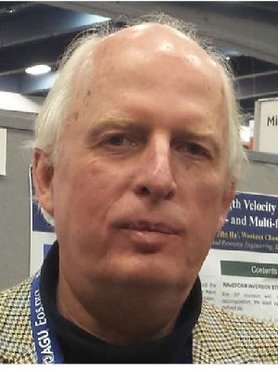 Kees Wapenaar合作论文数Department of Geoscience & Engineering, Faculty of Civil Engineering and Geosciences, Delft University of Technology18
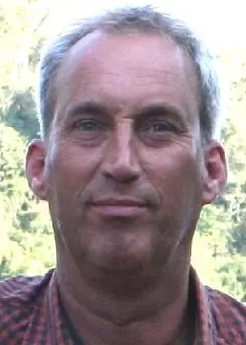 E. C. Slob合作论文数Section of Applied Geophysics and Petrophysics, Department of Geoscience & Engineering, Faculty of Civil Engineering and Geosciences, Delft University of Technology18C. P. A. Wapenaar合作论文数15
 Guy G. Drijkoningen合作论文数Department of Geoscience & Engineering, Faculty of Civil Engineering and Geosciences, Delft University of Technology12Roald Van Borselen合作论文数11
 Jeroen Groenenboom合作论文数10
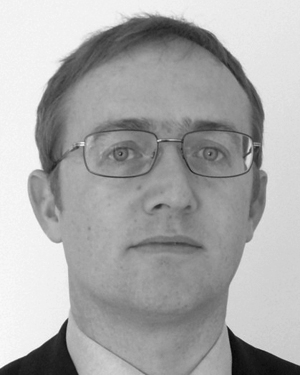 Jan Van der Kruk合作论文数Forschungszentrum Julich9Pm Vandenberg合作论文数8
 Paul Stoffa合作论文数Institute for Geophysics, Jackson School of Geosciences, The University of Texas at Austin;Department of Geological Sciences, Jackson School of Geosciences, The University of Texas at Austin8
 Mrinal K. Sen合作论文数University of Texas at Austin,Jackson School of Geosciences8M. W. P. Dillen合作论文数8
 Koen van Dongen合作论文数Department of Imaging Physics, Faculty of Applied Sciences, Delft University of Technology7Radmila Tatalovic合作论文数7J. K. Koster合作论文数5
 Aria Abubakar合作论文数Schlumberger-Doll Research5
 Sierd Cloetingh合作论文数Department of Earth Sciences, Faculty of Geosciences, Utrecht University5G. J. M. Baeten合作论文数5S. Tiğrek合作论文数5
 Jan Willem Thorbecke合作论文数Department of Geoscience & Engineering, Faculty of Civil Engineering and Geosciences, Delft University of Technology4
 Adri Duijndam合作论文数4g j m lortzer合作论文数3C.D. Riyanti合作论文数3Roald van Borselen合作论文数3Adri J. W. Duijndam合作论文数3Roustam K. Seifoullaev合作论文数3L. F. Van Zanen合作论文数3
 Felix Carlos Fernandes合作论文数Texas Instruments, Texas Instruments3m vissinga合作论文数2p a vercruijsse合作论文数2
 Edson Emanoel Starteri Sampaio合作论文数2michiel sebastiaan van oers合作论文数2berg petrus maria van den合作论文数2phillippe steeghs合作论文数2s bensdorp合作论文数2
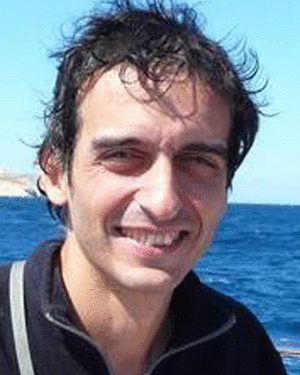 E. D. Mercerat合作论文数2Steen Petersen合作论文数2Neil V. Budko合作论文数Numerical Analysis, Delft Institute of Applied Mathematics, Faculty of Electrical Engineering, Mathematics and Computer Science, Delft University of Technology2
 Deyan Draganov合作论文数Department of Geoscience & Engineering, Faculty of Civil Engineering and Geosciences, Delft University of Technology2
 Reynam C. Pestana合作论文数Ctr Res Geophys & Geol CPGG, Fed Univ Bahia UFBA2Evert G. Den Boer合作论文数2
 Joost Van Der Neut合作论文数Department of Geotechnology, Delft University of Technology2T. P. H. Steeghs合作论文数2Frederik Rademakers合作论文数2
 Rob Remis合作论文数Department of Microelectronics, Faculty of Electrical Engineering, Mathematics, and Computer Science, Delft University of Technology2
 Hai Xiang Lin合作论文数Department of Applied Mathematical Analysis, Faculty of Electrical Engineering, Mathematics and Computer Science, Delft University of Technology;Institute of Environmental Sciences, Leiden University2Np Vandermeijs合作论文数1M Dillen合作论文数1




