The widespread use of consumer autonomous devices generates massive amounts of real-time data, which creates a pressing demand for secure, decentralized, and efficient data management. Blockchain technology has the prospect of solving problems because it has the characteristics of tamper resistance and trustlessness. However, when facing the access of a large number of devices, blockchain often has a relatively large performance bottleneck. The challenges come from the interaction between system parameters and the complex network conditions, and manual tuning is both difficult and inefficient. To solve this problem, we propose a blockchain network performance optimization framework based on reinforcement learning (RL), that is, Dual-Critic Multi-Agent Deep Deterministic Policy Gradient (DC-MADDPG). First, apply Lasso regression to find key performance-sensitive parameters to reduce the dimensionality of the tuning space. Then introduce a dual-critic architecture to suppress value overestimation and increase training stability. Also add a Prioritized Experience Replay(PER) mechanism to focus on high-impact training samples to promote convergence. The experimental results show that this framework can increase the system throughput by 343.05% and reduce the latency by 75.05% compared with the default Hyperledger Fabric configuration. In the SmallBank scenario, the throughput of DC-MADDPG is 12.5% higher than that of MADDPG base, and the latency is reduced by 21.4%.
Quantization is widely adopted to reduce the memory footprint and computational overhead of large language models (LLMs). Existing LLM serving systems typically rely on a static quantized inference kernel, overlooking the fact that real-world workloads exhibit highly dynamic request rates and batch sizes. Our empirical analysis reveals two important findings in quantized LLM serving. First, the performance of different quantized inference kernels exhibits distinct sensitivity to batch size. Second, motivated by the potential of adaptive quantized inference kernel switching to exploit this performance diversity, switching between quantized inference kernels incurs a non-negligible overhead. These findings give rise to two key challenges: optimal kernel selection under dynamic workloads is difficult, and quantized inference kernel switching is expensive. To address these challenges, we propose FlashServe, a serving system for adaptive quantized inference kernel provisioning. First, FlashServe leverages a latency cost model of both inference and switching latency to guide the optimal quantized inference kernel selection. Second, FlashServe supports finegrained asynchronous kernel switching, which overlaps kernel execution with kernel switching. Finally, FlashServe proactively prepares kernel switching, allowing each kernel switching to be triggered immediately once its corresponding kernel execution completes. We implement a prototype of FlashServe and evaluate it on representative LLM workloads. Experimental results show that FlashServe reduces inference latency by $\mathbf{9. 0 \% - 1 3. 6 \%}$ compared to static quantized baselines.
Sample-efficient policy learning from pixels is a long-standing challenge in reinforcement learning (RL). Recent dynamics-based representation learning methods have significantly improved the sample efficiency of model-free visual RL by learning dynamics-aware representations through auxiliary prediction performed either in latent space (self-prediction) or observation space (observation prediction). However, state-of-the-art methods from both categories still struggle on challenging visual control tasks when training data is limited. We posit that relying on either predictive objective alone may be insufficient. In contrast, observation prediction grounds learned representations in observation-level dynamics, but does not directly regularize the temporal predictability of latent representations over extended horizons. In this paper, we propose Observation-Grounded Self-Predictive Representations (OG-SPR), a model-free visual RL algorithm for continuous control that learns representations that are both temporally predictive in latent space and grounded in observation-level dynamics. OG-SPR incorporates two core auxiliary objectives: multi-step latent self-prediction and next-observation prediction. We empirically show that directly imposing latent self-prediction on the shared representation may over-constrain it and does not necessarily improve performance. To address this issue, OG-SPR introduces two lightweight adapters for latent self-prediction, allowing the shared representation to benefit from temporally predictive signals without being forced to directly satisfy the self-prediction objective. Experiments on 28 visual control tasks from the DeepMind Control Suite show that OG-SPR improves aggregate performance over state-of-the-art self-predictive and observation-predictive RL methods, with particularly pronounced gains in challenging domains such as dog and humanoid.
Deep Reinforcement Learning (RL) is notoriously sample inefficient. One contributing factor is that RL agents are typically initialized from scratch, forcing them to acquire task-relevant knowledge through online interaction. Existing approaches obtain informative initializations through pre-collected datasets, high-fidelity simulators, or meta-learning over related tasks, but these prerequisites may be difficult to access or even unavailable. In this paper, we propose Programmatic Dynamics Priors for Value Network Initialization (ProDVI), a framework that leverages the commonsense and domain knowledge encoded in large language models to initialize RL agents without relying on these resources. Specifically, ProDVI prompts a code-generating language model to produce executable Python functions that encode coarse hypotheses about environment dynamics. These functions are then used to generate synthetic transitions. Based on these transitions, we construct an auxiliary dynamics prediction objective to pretrain the state-action encoder of the value network in an actor-critic framework. The learned representation provides dynamics-aware inductive biases before online RL begins. Importantly, the generated programs are used only for representation pretraining and are not required to faithfully simulate the target environment. While the generated programs may be inaccurate, their induced initialization can be corrected through online learning from real transitions and rewards. Experiments on OpenAI Gym and DeepMind Control Suite tasks show that ProDVI can effectively improve the sample efficiency of model-free RL algorithms.
The Execute-Order-Validate (EOV) framework has been used to improve the scalability of blockchains by concurrently executing transactions. However, the EOV framework also poses a critical performance issue. Specifically, when multiple transactions access the same data, only one of them can be committed eventually while the others are aborted due to the strong concurrency control restriction. This inefficiency makes the EOV framework far from practicality since there always exist hotspot variables that can be frequently accessed in real-world scenarios, such as the Fungible Token (FT) and Non-Fungible Token (NFT) online marketplace. In this paper, we propose RapidSnail, a novel EOV framework that enables transactions to execute based on the uncommitted data to reduce the transaction abort rate in such scenarios with hotspot variables. We first propose a new read-write set representation and a concurrency execution schedule algorithm in the execution phase to maintain the concurrent efficiency. Then we propose an effect-based conflict graph construction algorithm in the order phase to handle the conflict transactions based on the new read-write set. Finally, we propose a concurrent commitment schedule algorithm to adopt the new read-write set to validate the transactions concurrently in the validation phase. Our experiment results show that RapidSnail increases the throughput by at least 4x compared to the state-of-the-art EOV framework under high contention workload. More specifically, RapidSnail reduces the abort rate by 50%, and achieves at least 4x speedup in the order phase and 2.94x speedup in the validation phase over the existing EOV frameworks.
Augmenting model-free reinforcement learning (RL) with representations learned through observation dynamics prediction (observation-predictive RL) can improve sample efficiency and performance, with minor modifications and limited additional computation. However, this approach still struggles in challenging tasks with low-dimensional observations. In this paper, we identify a key factor behind this problem: unbalanced reconstruction losses across observation dimensions, where dimensions with larger value ranges dominate the loss. This encourages the agent to neglect dimensions with relatively small ranges, leading to degraded performance. To address this issue, we propose a novel normalization method tailored to online RL, which normalizes low-dimensional observations and balances the resulting losses and gradients. Beyond balancing reconstruction losses, observation normalization enables dynamics prediction to be performed in a normalized observation space, thereby providing a unified treatment of low- and high-dimensional inputs (e.g., physical states and images). Building on this idea, we further introduce Normalized Observation Space Dynamics-Augmented Q-learning (NASDAQ), a framework for observation-predictive RL applicable across diverse domains. NASDAQ learns state-action representations by coupling value learning with two auxiliary tasks: short-term value prediction and next normalized observation prediction. Extensive experiments demonstrate that NASDAQ achieves competitive or superior performance compared with state-of-the-art model-based and self-predictive RL methods, while requiring significantly less training wall-time.
Despite the computational efficiency of MoE models, the excessive memory footprint and I/O overhead inherent in multi-expert architectures pose formidable challenges for real-time inference on resource-constrained edge platforms. While existing static methods struggle with a rigid latency-accuracy trade-off, we observe that expert importance is highly skewed and depth-dependent. Motivated by these insights, we propose DyMoE, a dynamic mixed-precision quantization framework designed for high-performance edge inference. Leveraging insights into expert importance skewness and depth-dependent sensitivity, DyMoE introduces: (1) importance-aware prioritization to dynamically quantize experts at runtime; (2) depth-adaptive scheduling to preserve semantic integrity in critical layers; and (3) look-ahead prefetching to overlap I/O stalls. Experimental results on commercial edge hardware show that DyMoE reduces Time-to-First-Token (TTFT) by 3.44x-22.7x and up to a 14.58x speedup in Time-Per-Output-Token (TPOT) compared to state-of-the-art offloading baselines, enabling real-time, accuracy-preserving MoE inference on resource-constrained edge devices.
Developing high-performance kernels for Neural Processing Units (NPUs) is a critical industry bottleneck, requiring developers to manually navigate implicit hardware constraints and strict memory hierarchies. While large language models offer immense automation potential, they fail catastrophically on NPUs due to a fundamental lack of hardware-specific priors. Naively transplanting code snippets from similar NPU kernels may pass the compiler, but it consistently triggers runtime crashes and performance degradation by blindly violating underlying hardware constraints. To overcome this, we introduce Hawk, a training-free framework that harnesses hardware-aware knowledge through three core modules: (1) Run-Time Knowledge Synthesis Module, which employs a Triple-Part Executable Knowledge Representation to inherently couple the error context with executable semantics; (2) Bottleneck-Aware Knowledge Retrieval Module, which implements a 2D-Retrieval paradigm to project queries into orthogonal syntactic and hardware-aligned semantic spaces; and (3) Effect-Driven Knowledge Distillation Module, which leverages LLM-driven semantic arbitration to continuously distill the knowledge by pruning errors and consolidating redundancies based on the empirical execution feedback. Extensive evaluations on real-world NPU workloads demonstrate that Hawk elevates generation accuracy from 49.4
Multi-turn conversational systems based on large language models are increasingly being integrated into web platforms and applied across a wide range of domains. However, these systems typically combine the user's current query with contextual information from previous interactions, resulting in continuously expanding input prompts. This leads to a significant increase in time-to-first-token (TTFT), causing intolerable delays in web response times. To address this issue, we introduce TransformKV, which maximizes the reuse of the KV cache from previous conversations rather than recomputing, thereby reducing TTFT latency. TransformKV first identifies the specific locations that require transformation to maximize the reuse of the KV cache with minimal operations. It then efficiently transforms the KV cache for a subset of tokens by recomputing only the KV cache that impact semantics. Additionally, TransformKV further reduces TTFT latency by performing only QKV computations in certain layers while skipping other computations that contribute less to overall performance. Experimental results demonstrate that in multi-turn conversation tasks, TransformKV can reduce inference latency by up to 30%, achieving up to a 1.8 & times; improvement in performance compared to similar approaches. Notably, as the context window size increases, the performance gains become even more pronounced.
Large Language Models (LLMs) have demonstrated impressive performance across various tasks, and their application in edge scenarios has attracted significant attention. However, sparse-activated Mixture-of-Experts (MoE) models, which are well suited for edge scenarios, have received relatively little attention due to their high memory demands. Offload-based methods have been proposed to address this challenge, but they face difficulties with expert prediction. Inaccurate expert predictions can result in prolonged inference delays. To promote the application of MoE models in edge scenarios, we propose Fate, an offloading system designed for MoE models to enable efficient inference in resource-constrained environments. The key insight behind Fate is that gate inputs from adjacent layers can be effectively used for expert prefetching, achieving high prediction accuracy without additional GPU overhead. Furthermore, Fate employs a shallow-favoring expert caching strategy that increases the expert hit rate to 99%. Additionally, Fate integrates tailored quantization strategies for cache optimization and IO efficiency. Experimental results show that, compared to Load on Demand and Expert Activation Path-based method, Fate achieves up to 4.5x and 1.9x speedups in prefill speed and up to 4.1x and 2.2x speedups in decoding speed, respectively, while maintaining inference quality. Moreover, Fate's performance improvements are scalable across different memory budgets.
Sharding is considered a promising solution for scaling blockchain systems. However, most existing sharding systems have not considered the dynamics of the environment when making a sharding strategy, including the change of pending transactions, the leaving and joining of participants, and malicious attacks, which could cause performance instability and security issues. To address it, in this paper, we propose an intelligent and efficient dynamic sharding technology to advance the blockchain system performance and security. We first propose a formal and general evaluation framework for blockchain sharding in a dynamic environment, and conclude an optimization target for the system performance and security. To achieve a long-term benefit for the optimization target, a deep reinforcement learning (DRL)-based sharding approach has been proposed to intelligently make optimal sharding strategies. Next, we propose an adaptive resharding protocol to efficiently reduce the overhead introduced by dynamic sharding. Our experimental results illustrate that our proposed dynamic sharding in a simulation testbed can achieve 2.8 times transactions per second compared to traditional static sharding systems, and guarantee high security in a dynamic environment.
Efficient state restoration in multi-turn conversations with large language models (LLMs) remains a critical challenge, primarily due to the overhead of recomputing or loading full key-value (KV) caches for all historical tokens. To address this, existing approaches compress KV caches across adjacent layers with highly similar attention patterns. However, these methods often apply a fixed compression scheme across all conversations, selecting the same layer pairs for compression without considering conversation-specific attention dynamics. This static strategy overlooks variability in attention pattern similarity across different conversations, which can lead to noticeable accuracy degradation. We present Krul, a multi-turn LLM inference system that enables accurate and efficient KV cache restoration. Krul dynamically selects compression strategies based on attention similarity across layer pairs and uses a recomputation-loading pipeline to restore the KV cache. It introduces three key innovations: 1) a preemptive compression strategy selector to preserve critical context for future conversation turns and selects a customized strategy for the conversation; 2) a token-wise heterogeneous attention similarity estimator to mitigate the attention similarity computation and storage overhead during model generation; 3) a bubble-free restoration scheduler to reduce potential bubbles brought by the imbalance of recomputing and loading stream due to compressed KV caches. Empirical evaluations on real-world tasks demonstrate that Krul achieves a 1.5x-2.68x reduction in time-to-first-token (TTFT) and a 1.33x-2.35x reduction in KV cache storage compared to state-of-the-art methods without compromising generation quality.
Industry 5.0 emphasizes consumer data sharing to drive data-driven innovation and enhance user experiences in consumer electronics. Blockchain-integrated federated learning (blockchained FL) has recently emerged as a privacy-trusted paradigm to facilitate sharing. However, most blockchained FL sharing paradigms cannot adapt to the complexity or variability of consumer data and network conditions such as: 1) inadequate balancing of the trade-off between data quality and training costs during device selection; 2) incentives are designed to maximize instantaneous profit without considering the long-term dynamics of electronic devices. These limitations lead to low-quality model training and security degradation. This paper proposes a novel blockchained FL incentive-sharing paradigm that dynamically selects consumer devices from a long-term perspective while balancing data quality and training costs. Specifically, we first present a reputation strategy to enhance security by applying a predefined threshold to prevent malicious and low-quality consumers from participating in FL. Then, to optimize device selection under complex and dynamic consumer environments with high-dimensional system states, a Proximal Policy Optimization (PPO)-based incentive mechanism is proposed, which includes: 1) building an "intelligent engine" to select the optimal consumer devices for each round of FL based on data quality and costs, and 2) implementing incentives to achieve long-term maximization of the system's social welfare. Extensive simulations show that our sharing paradigm has, on average, 46.97% higher social welfare and 77.27% lower social costs than baselines and can guarantee high data quality in a trustless environment.
Trading is an effective way to exchange resources such as energy, data, and computing services between Internet of Things (IoT) for mutual benefit. The emerging blockchain-enabled market facilitates the transparency and traceability of trading, but poses new challenges to the financial stability of the market. The existing blockchain-enabled market framework is designed as a completely free market, and due to the inherent characteristics of blockchain, it is difficult to take effective measures to maintain financial stability. To address this challenge, we propose a regulated blockchain-enabled market framework for IoT devices. Based on the heterogeneous interacting agent theory in economics, we study the price dynamics and equilibrium in the market. We establish a trading smart contract that supports trading among IoT devices, and provides the market regulator with interfaces to adjust the regulatable factors in the market to promote financial stability. A prototype system of our framework is implemented in Ethereum. The experimental results demonstrate the low execution cost of the smart contract, the correctness of our theoretical analysis for the market, and the effectiveness of the regulatory policies.
Mixture of Experts (MoE), with its distinctive sparse structure, enables the scaling of language models up to trillions of parameters without significantly increasing computational costs. However, the substantial parameter size presents a challenge for inference, as the expansion in GPU memory cannot keep pace with the growth in parameters. Although offloading techniques utilise memory from the CPU and disk and parallelise the I/O and computation for efficiency, the computation for each expert in MoE models is often less than the I/O, resulting in numerous bubbles in the pipeline. Therefore, we propose Klotski, an efficient MoE inference engine that significantly reduces pipeline bubbles through a novel expert-aware multi-batch pipeline paradigm. The proposed paradigm uses batch processing to extend the computation time of the current layer to overlap with the loading time of the next layer. Although this idea has been effectively applied to dense models, more batches may activate more experts in the MoE, leading to longer loading times and more bubbles. Thus, unlike traditional approaches, we balance computation and I/O time and minimise bubbles by orchestrating their inference orders based on their heterogeneous computation and I/O requirements and activation patterns under different batch numbers. Moreover, to adapt to different hardware environments and models, we design a constraint-sensitive I/O-compute planner and a correlation-aware expert prefetcher for a schedule that minimises pipeline bubbles. Experimental results demonstrate that Klotski achieves a superior throughput-latency trade-off compared to state-of-the-art techniques, with throughput improvements of up to 85.12x.
Sharding is a promising solution to scale blockchain by separating the system into multiple shards to process transactions in parallel. However, due to state separation and shard isolation, it is still challenging to efficiently support smart contracts on a blockchain sharding system where smart contracts can interact with each other, involving states maintained by multiple shards. Specifically, existing sharding systems adopt a costly multi-step collaboration mechanism to execute smart contracts, resulting in long latency and low throughput. This article proposes Sparrow, a blockchain sharding protocol achieving one-step execution for smart contracts. To break shard isolation, inspired by non-local hotspot data caching in traditional databases, we propose a new idea of inter-shard caching, allowing a shard to prefetch and cache frequently accessed contract states of other shards. The miner can thus use the inter-shard cache to pre-execute a pending transaction, retrieve all its contract invocations, and commit it to multiple shards in one step. Particularly, we first propose a speculative dispersal cache synchronisation mechanism for efficient and secure cache synchronization across shards in Byzantine environments. Then, we propose a multi-branch exploration mechanism to solve the rollback problem during the optimistic one-step execution of contract invocations with dependencies. We also present a series of conflict resolution mechanisms to decrease the rollback caused by inherent transaction conflicts. We implement prototypes for Sparrow and existing sharding systems, and the evaluation shows that Sparrow improves the throughput by 2.44x and reduces the transaction latency by 30% compared with the existing sharding systems.
Since the advent of decentralized financial applications based on blockchains, new attacks that take advantage of manipulating the order of transactions have emerged. To this end, order fairness protocols are devised to prevent such order manipulations. However, existing order fairness protocols adopt time-consuming mechanisms that bring huge computation overheads and defer the finalization of transactions to the following rounds, eventually compromising system performance. In this work, we present Auncel, a novel consensus protocol that achieves both order fairness and high performance. Auncel leverages a weight-based strategy to order transactions, enabling all transactions in a block to be committed within one consensus round, without cost computation and further delays. Furthermore, Auncel achieves censorship resistance by integrating the consensus protocol with the fair ordering strategy, ensuring all transactions can be ordered fairly. To reduce the overheads introduced by the fair ordering strategy, we also design optimization mechanisms, including dynamic transaction compression and adjustable replica proposal strategy. We implement a prototype of Auncel based on HotStuff and construct extensive experiments. Experimental results show that Auncel can increase the throughput by 6x and reduce the confirmation latency by 3x compared with state-of-the-art order fairness protocols.
 Incheon Paik合作论文数50
 Zibin Zheng (郑子彬)合作论文数School of Software Engineering, Sun Yat-Sen University49
 Zicong Hong合作论文数School of Data and Computer Science, Sun Yat-sen University, Guangzhou, China38
 Song Guo (郭嵩)合作论文数Department of Computer Science and Engineering, School of Engineering, The Hong Kong University of Science and Technology26
 Zhenni Li (李珍妮)合作论文数School of Automation, Guangdong University of Technology21
 Ting Cai合作论文数Chongqing Univ Posts & Telecommun, Coll Mobile Telecommun, Comp Sci, Chongqing, Peoples R China16
 Xiaoyu Qiu合作论文数School of Data and Computer Science, Sun Yat-sen University, Guangzhou, China15
 Banage T. G. S. Kumara合作论文数15
 Henry H.-N. Dai (戴弘寧)合作论文数Department of Computer Science, Faculty of Science, Hong Kong Baptist University12
 Jianting Zhang合作论文数Purdue university10
 Huawei Huang (黄华威)合作论文数School of Software Engineering, Sun Yat-sen University;Lingnan College, Sun Yat-sen University10
 Yue Yu (余跃)合作论文数National Laboratory for Parallel and Distributed Processing, College of Computer, National University of Defense Technology9
 Junyuan Liang合作论文数8
 Takazumi Tanaka合作论文数8
 Kang Liu合作论文数Sun Yat Sen Univ, Sch Data & Comp Sci, Guangzhou 510006, Guangdong, Peoples R China7
 Shengli Xie (谢胜利)合作论文数Guangdong University of Technology7Yaguchi, Yuichi (矢口)合作论文数The University of Aizu6
 Yang Yu (余阳)合作论文数School of Software Engineering, Sun Yat-sen University6
 Shuxue Ding (丁数学)合作论文数School of Artificial Intelligence, Guilin University of Electronic Technology6
 Zhongteng Cai合作论文数5
 Chuan Chen (陈川)合作论文数5
 Shenghui Li (李圣辉)合作论文数Department of Electrical Engineering, Uppsala University;Department of Information Technology, Uppsala University5
 Junbo Wang (王军波)合作论文数School of Intelligent Systems Engineering, Sun Yat-Sen University5
 Patrick Hung合作论文数Faculty of Business and Information Technology, Ontario Tech University;College of Technological Innovation, Zayed University;University of São Paulo;National Technological University5
 Weikun Zhang合作论文数School of Data and Computer Science, Sun Yat-Sen University, Guangzhou, China4
 Baichuan Liu合作论文数4
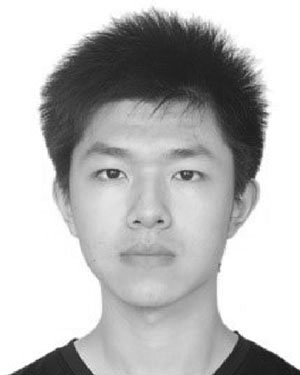 Haoli Zhao合作论文数Univ Aizu, Sch Comp Sci & Engn, Aizu Wakamatsu, Fukushima 9658580, Japan4
 Zhen Zhang合作论文数NC State Univ, Dept Forest Biomat, Raleigh, NC 27695 USA4
 Zuyuan Yang (杨祖元)合作论文数School of Automation, Guangdong University of Technology4
 Peng Li (李鹏)合作论文数School of Cyber Science and Engineering, Faculty of Electronic and Information Engineering, Xi'an Jiaotong University4
 Koswatte R. C. Koswatte合作论文数4
 Yufeng Zhan (詹玉峰)合作论文数School of Automation, Beijing Institute of Technology4
 Xu Chen (陈旭)合作论文数Institute of Advanced Networking & Computing Systems, School of Computer Science and Engineering, Sun Yat-sen University4Ryohei Komiya合作论文数4
 Tianshu Bi (毕天姝)合作论文数Stare Key Laboratory of Alternate Electrical Power System with Renewable Energy Sources, North China Electric Power University4Tetsuya Tashiro合作论文数4
 Yufei Chen合作论文数3
 Zetao Yang合作论文数3
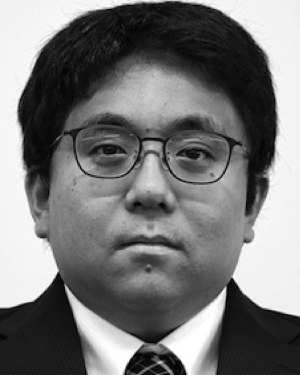 Keita NAKAMURA合作论文数3
 Enyuan Zhou合作论文数Department of Computing, The Hong Kong Polytechnic University3
 Hui Lin合作论文数3
 Qixun Yang (杨奇逊)合作论文数School of Continuing Education, North China Electric Power University;School of Electrical and Electronic Engineering, North China Electric Power University3
 Yan Zhang (张彦)合作论文数School of Information and Communication Engineering, University of Electronic Science and Technology of China3
 Keitaro Naruse合作论文数University of Aizu3Hiroki Ohashi合作论文数3
 Yutaka Watanobe合作论文数Graduate Department of Information Systems, University of Aizu3
 Yujie Li (李玉洁)合作论文数School of Artificial Intelligence, Guilin University of Electronic Technology3
 Jiajing Wu (吴嘉婧)合作论文数School of Software Engineering, Sun Yat-Sen University3Yuegui Huang合作论文数2




