Connecting Social Networks with Local and Global Consistency

发布时间:2020年9月10日

Introduction


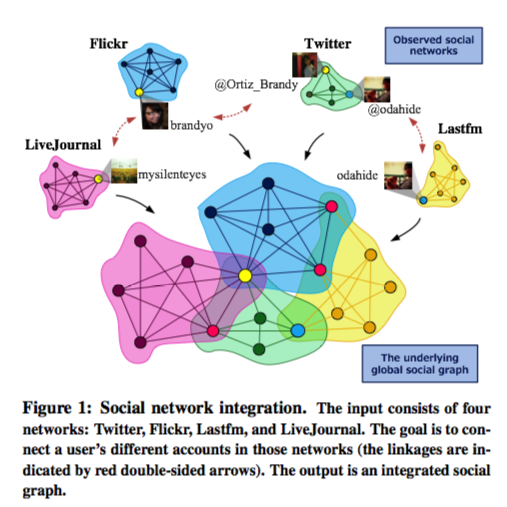
More often than not, people are active in more than one social network. Identifying users from multiple heterogeneous social networks and integrating the different networks is a fundamental issue in many applications. The existing methods tackle this problem by estimating pairwise similarity between users in two networks. However, those methods suffer from potential inconsistency of matchings between multiple networks.
 
 
In this paper, we propose COSNET(COnnecting heterogeneous Social NETworks with local and global consistency), a novel energy-based model, to address this problem by considering both local and global consistency among multiple networks. An efficient subgradient algorithm is developed to train the model by converting the original energy-based objective function into its dual form. We evaluate the proposed model on two different genres of data collections: SNS and Academia, each consisting of multiple heterogeneous social networks. Our experimental results validate the effectiveness and efficiency of the proposed model. On both data collections, the proposed \model method significantly outperforms several alternative methods by up to 10-30\% ($p\ll 0.001$, $t$-test) in terms of F1-score. We also demonstrate that applying the integration results produced by our method can improve the accuracy of expert finding, an important task in social networks. 


Problem Formulation


A social network is represented as an unweighted undirected graph $G_i = (V_i, E_i)$, where $V_i = \{v_i^1, ... , v_i^{|V_i|}\}$ is a set of accounts on the network and each edge $e_i^{k_1,k_2} \in E_i$ denotes the relationship between $v_i^{k_1}$ and $v_i^{k_2}$.
 
Multiple Network Integration Problem: Given $k$ social networks $\textbf{G} = \{G_1, G_2, ..., G_k\}$, we want to output a set of partial one-to-one mappings $\textbf{M} = \{\textbf{M}_{i,j}\}$ where $\forall i, j = 1,2,...,k; i > j$. Each $m = (v_i, v_j) \in \textbf{M}_{i,j}$ denotes the two accounts $v_i$ and $v_j$ belonging to the same person, and by partial, we mean that one person may have an account on $G_i$ but do not have account on $G_j$.
 
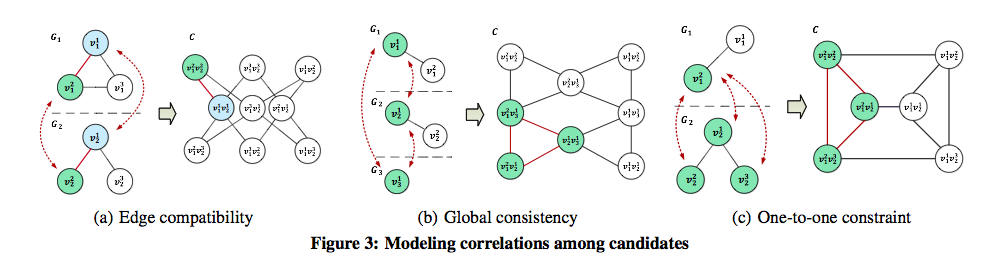
Edge compatibility: One intuition is if two persons are friends in one social network, they are likely to be friends in other social networks also. This property is usually referred to as edge compatibility in the studies of graph matching.
 
 
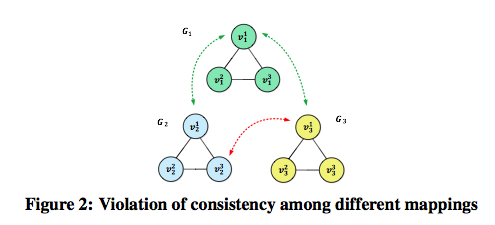
Global consistency: To find a mapping set $\textbf{M}$, a straightforword idea is to obtain an optimal mapping for each pair of networks independently. This formulation could not guarantee the consistency among different mappings.
 

Method


We define an energy function $E(\textbf{x})$ to model the integration problem. Thus, the task is formulated as a minimization of energy function $E(\textbf{x})$. The energy function is defined as a weighted sum of three terms:

where $\alpha^n$, $\alpha^e$, $\alpha^t$ are scalar weights. We define $\mathcal{V} = \cup V_i$ as the set of nodes from all the networks, $\mathcal{C} = \cup C_{i,j}, i > j$ as a set of candidates from all the graph pairs and $\mathcal{C}(v)$ as all the candidates involved $v$. 
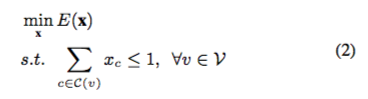
Our problem is to minimize the energy function subject to the one-to-one constraint


Dataset


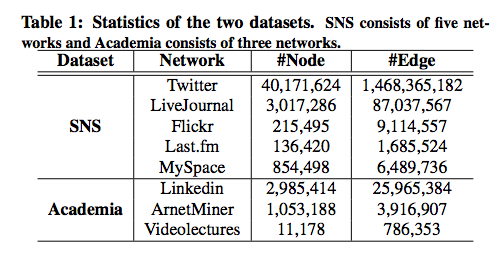
We have collected data from different social networking site. The dataset published in this page consists of two collections of social networks, where the networks within a collection are overlapped with each other (i.e. have users corresponding to the same real world person).
SNS network collection

The SNS data collection consists of five popular online social networking sites: Twitter, LiveJournal, Flickr, Last.fm, and MySpace.
 
Twitter: Twitter is a widely used social networking and micro-blogging site. Our dataset is obtained from [3], according to which it was crawled from Twitter's website.  You can download the dataset from here.
 
LiveJournal: Livejournal is a free on-line social network where users can keep a blog, journal or diary. Our dataset is crawled from its website in late 2013, which contains 3,017,286 users and 87,037,567 links. Here defines link as the friend relationship, that is,two users are linked if one exists in the other's friends list.  You can download the dataset from here.
 
Flickr: Flickr is a popular photo sharing network for users to upload photos and share photos. The Flickr dataset is crawled in early 2014, which consists of 215,495 individual users and 9,114,557 links. Like LiveJournal, the links here reflect friend relationships among users. You can download the dataset from here.
 
Last.fm: Last.fm provides a streaming radio service, where users can search music and get personalized recommendation. Last.fm builds detailed profile of users' musical taste and preference, which is the foundation for music recommendation. We crawled Last.fm in late 2013 and obtained a network that contains 136,420 users and  1,685,524 following links among them. You can download the dataset from here.
 
MySpace: MySpace is a social networking website which also has a strong music emphasis. The dataset we obtained from MySpace contains 854,498 user profiles as well as 6,489,736 directed connections among users. To reconstruct the network of these users, we treat connections as undirected and parallel links are combined into one. You can download the dataset from here.
 

Academia network collection

The Academia data collection consists of three academic or professional social networks: ArnetMiner (AM), Linkedin and Videolectures.
 
ArnetMiner: ArnetMiner is an expertise search and mining service in Computer Science domain. We obtained the entire ArnetMiner data up to the year 2013, including user profiles and co-author relationships. To construct co-author network, we create an undirected edge between two authors if they have coauthored a paper. This way we obtain a co-author network with more than 1 million nodes and nearly 4 million edges. You can download the dataset from here.
 
Linkedin: Linkedin is the world's largest professional network where users can maintain their profile page and connections. We collected approximately 3 million public profiles from Linkedin. The links between profiles are observed if two profiles are co-viewed by others . Hence we could construct an undirected network based on these "co-view" links. You can download the dataset from here.  
 
Complete dataset (with profile contents and relationships):
 

Model Code:

link: https://lfs.aminer.cn/lab-datasets/dual_decomposition.zip


Ground Truth Mapping

SNS network collection:

The group truth mapping of SNS network collections was originally collected by Perito el. al [1,2] through Google Profiles service. Please contact the original owner to obtain the data. Here, we provide a subset of the data for evaluation.

Academia network collection:

The ground truth for Academia dataset is obtained through a crowdsourcing service on ArnetMiner. On each researcher's ArnetMiner profile, users can fill in urls linking to the external accounts. This service has been running on-line for more than one year and more than 10,000 interlinks record has been collected. Here, we provide a subset of the data for evaluation.


Experimental Results


Prediction performance.
Our method consistently achieves better performance than the comparison methods. In terms of F1-score, EMNI achieves a $10-30\%$ improvement comparing with SVM and MNA. The improvement is mainly contributed by the edge compatibility and global consistency terms explicitly optimized in our model. Although these methods incorporate network-based features, they make prediction locally without considering the correlations among different candidates. Table \ref{tb:performance} lists the performance of each individual pair of networks. 
 
Effects of global consistency.
By removing the global consistency term, the model is reduced to a pairwise matching for each pair of networks independently. As it has been shown in Figure \ref{pic:sns_res}, the performance drops $2\%$ and $7\%$ for the two network collections in terms of F1-score. 
 
Candidate generation performance.
We evaluate the performance of candidate generation in terms of \emph{coverage rate} (i.e. number of known positive candidates divided by number of ground truth mappings) and \emph{negative rate} (i.e. number of known negative candidates divided by the sum of number of known positive and known negative candidates). 


Reference


[1] Yutao Zhang, Jie Tang, Zhilin Yang, Jian Pei and Philip S. Yu.  COSNET: Connecting Heterogeneous Social Networks with Local and Global Consistency. In Proceedings of the Ninteenth ACM SIGKDD International Conference on Knowledge Discovery and Data Mining (KDD'15)