Coupled Network Link Prediction Problem
We study the link prediction problem in coupled networks, where we have two networks: one source network GS and one target network GT. Basically, we have structure information of the source network GS and interactions GC between the two networks, but do not have any structure information for the target network. The objective of link prediction here is to predict the existence of links in the target network GT.
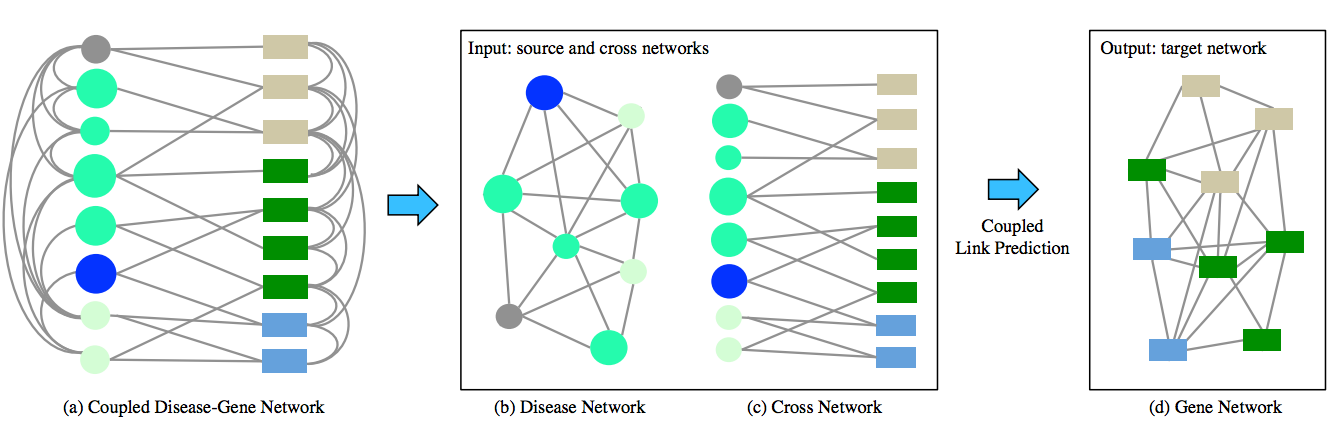
Figure: Coupled Disease-Gene Network
Fox example, the disease-gene coupled networks are decomposed as a disease network (b), a gene network (d), and a cross network that links source and target net- works together (c). Link prediction in coupled networks is then formalized as a problem of using the disease network and associations between diseases and genes to predict the relationships that exist between two genes ((b) + (c) → (d)).
Challenges. First, incompleteness, we do not have structure information between two users in the target network—that is, there is a visibility of links that go from the source network to the target network but not beyond that. Second, heterogeneity, the source and target networks with multi-typed objects are twisted and coupled with one another. This makes it difficult to directly use a supervised learning approach due to the different types of links in source and target networks. Third, asymmetry, following the heterogeneity, the two coupled networks usually present different network properties.
CoupledLP Framework
To solve the challenges of coupled link prediction, we propose a framework, CoupledLP, to first enrich the target network structure, from which we then extract features and predict the links in the target network.
At the first phase, we infer the possible links with the highest potential in the target network based on several heuristic rules. We name the inferred network as an implicit target network. The motivation is with the highly probable links inferred at first, we can extract more informative structural features for the links to be pre- dicted. Otherwise, the target network is difficult to be leveraged for extracting features.
At the second phase, based on the implicit target network, we propose a Coupled Factor Graph Model (CoupledFG) to predict the links in the target network. The idea is to use both features extracted from the implicit target network and the structural meta- paths extracted from coupled networks.
In summary, targeting at the three challenges in coupled network link prediction problem, we propose a unified framework CoupledLP that contains two phases. At the first phase, we construct an implicit target network to solve the incompleteness of the target network. At the second phase, we model attribute features by using separate sets of parameters to address the issue of the asymmetry of the source and target networks. We then incorporate informative meta-paths as the structural factors into factor graphs to untangle the heterogeneity of coupled networks.
Coupled Networks
We use three groups of coupled networks to evaluate our proposed framework.
Disease-Gene networks (DG). The dataset contains a disease network (D), a gene network (G) and the connections between diseases and genes, which are shown in previous figure.
Asian mobile networks (A). This dataset contains about 42 million call records in an Asian city from October 2005 to March 2006. To conduct our task of link prediction in coupled networks, we construct different coupled networks by treating one operator network as source network, another operator network as target network, and the connections between the two networks as the cross network. Two operators are involved in this dataset, which are denoted as Aa and Ab with the size |Aa| > |Ab|.
European mobile networks (E). This dataset contains more than 712 million call records in a European country within two months in 2011. There are three major operators in this mobile networks. We denote the communication network of each of the three operators as Ea, Eb and Ec, respectively with the size |Ea| > |Eb| > |Ec|.

Statistics of the three sets of coupled networks. k: average degree; cc: clustering coefficient; ac: associative coefficient.
Results
We evaluate the experimental results by using the area under the Receiver Operating Characteristic curve (AUROC), the area under the Precision-Recall curve (AUPR), and precision at top k%, where we change k from 1 to 10 with 1 as the interval and from 10 to 100 with 10 as the interval in our experiments. AUROC, AUPR and precision at top ranked links are typically used in the evaluation of link prediction tasks.
Comparisons: common neighbors (CN), Adamic/Adar (AA), and Jaccard Coefficient (JC), Preferential Attachment (PA), PropFlow (PF), Implicit Target Network (IT), Decision Tree (DT), Logistic Regression Classification (LRC), and the proposed CoupledLP.
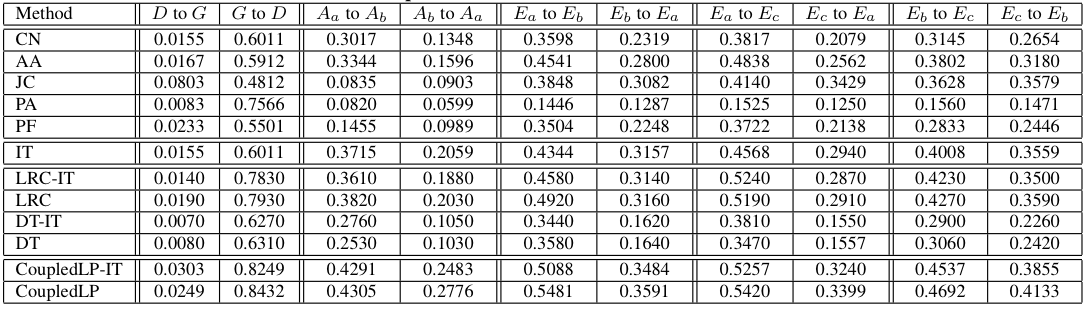
The performance of AUPR on different methods.
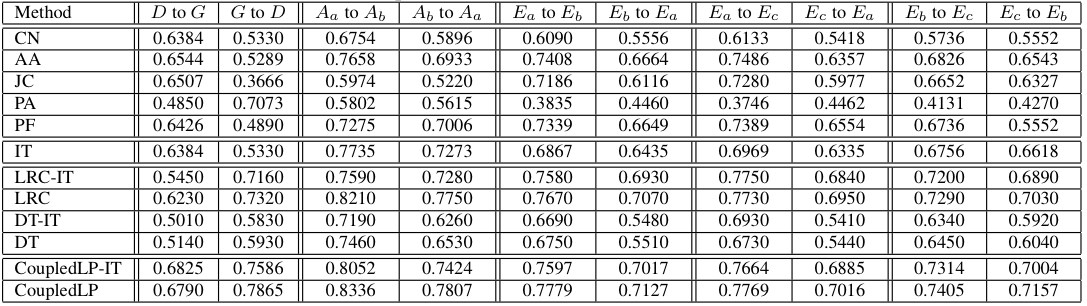
The performance of AUROC on different methods.
References
CoupledLP: Link Prediction in Coupled Networks. [Data&Code]