Overview
This dataset provides embeddings for the authors in the dblpv10 dataset. In addition, we also provide embeddings for the publication venues. We include only authors with more than 10 publications. The number of authors and venues after filtering is 157,297 and 5,078 correspondingly. The embedding is learned through 4,886,178 publication behavior extracted from the original dataset.
Data Description
Dataset Statistics
| Field | Number of Instance | File Size |
| author | 157,297 | 44MB |
| venue | 5,078 | 1.4MB |
Data format
The embedding files of all authors(entities), and conferences(actions) are stored in dblp_author.txt and dblp_venue.txt, the embedding is organized as follows:
First line has two numbers, corresponding to number of entry in the file and embedding dimensions.
For each following line, the first number corresponds to the ID of embedded author/venue, and the rest of the line is its embedding vector.
The mapping of author/venue IDs and their names are stored in author_mapping.txt and venue_mapping.txt
Downloads
Method and Evaluation
We consider publication behavior of authors as a form of social behavior, where an action is influenced by a person's behavior history and her ego-network. We built a model to learn embeddings for social behavior entities and their actions from social behavior log.
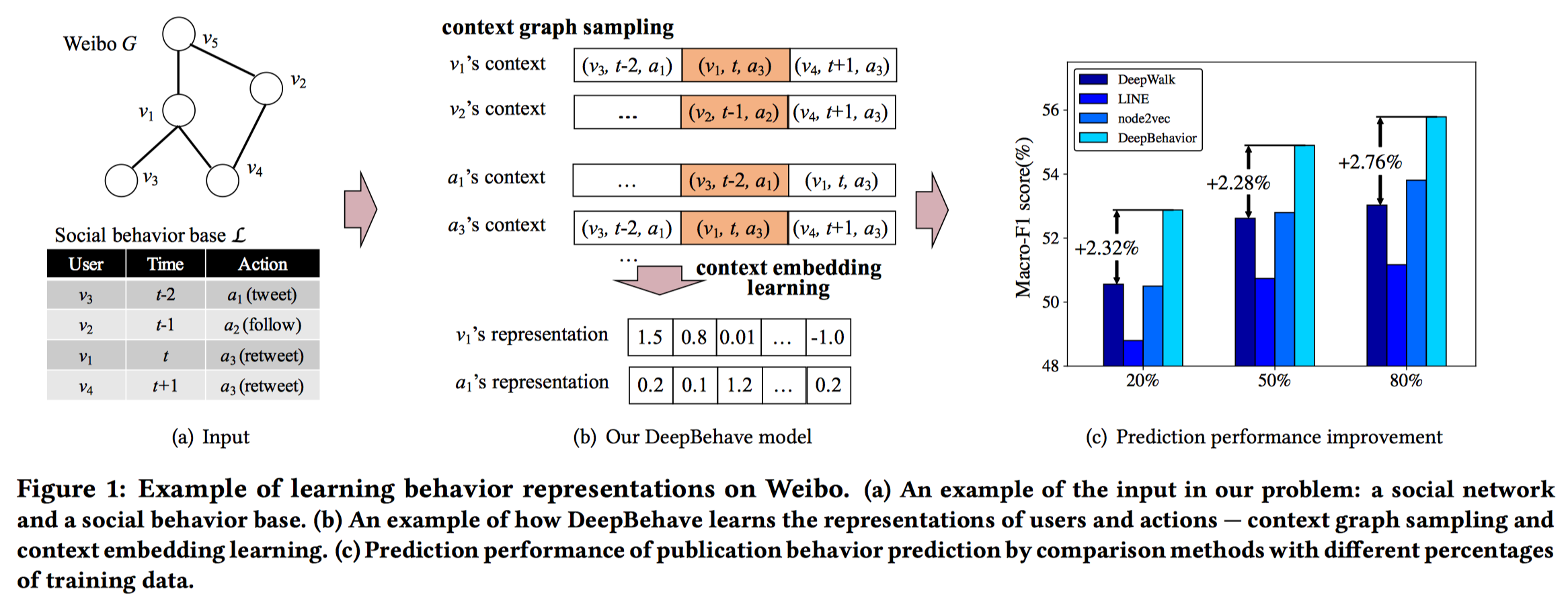
We formalize the social behavior of an entity e performing an action a at time t as a triple (e, t, a), and further use a three step method (context graph building, context graph sampling, context embedding learning) to learn embeddings.
Context Graph Building
We use social behavior triples of form (e, t, a) to construct a heterogeneous graph. Each vertex in the graph is a behavior triple. Edges are constructed according to relevance of behavior triples.
Context Graph Sampling
For each behavior triple, we sample its context by random walk on the heterogeneous graph. Its context characterizes relevant behaviors of the given behavior.
Context Graph Embedding
We built a skip-gram like model to learn embedding from sampled context sequences.
References
Refer to the following working paper for details of our method:
Jiezhong Qiu, Xinyang Zhang, Jie Tang, Tracy Xiao Liu, and Shaoxiong Wang. DeepBehave: Learning Deep Representations for Social Behavioral Data. [we will release our paper shortly]