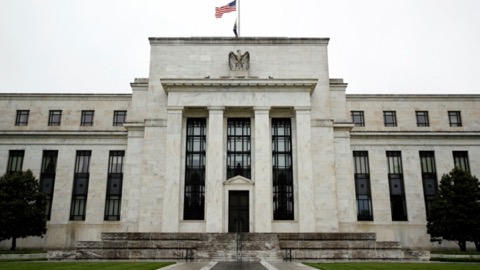
It was created on December 23, 1913, with the enactment of the Federal Reserve Act, after a series of financial panics (particularly the panic of 1907) led to the desire for central control of the monetary system in order to alleviate financial crises.[list 1] Over the years, events such as the Great Depression in the 1930s and the Great Recession during the 2000s have led to the expansion of the roles and responsibilities of the Federal Reserve System.The U.S. Congress established three key objectives for monetary policy in the Federal Reserve Act: maximizing employment, stabilizing prices, and moderating long-term interest rates. The first two objectives are sometimes referred to as the Federal Reserve's dual mandate. Its duties have expanded over the years, and currently also include supervising and regulating banks, maintaining the stability of the financial system, and providing financial services to depository institutions, the U.S. government, and foreign official institutions. The Fed also conducts research into the economy and provides numerous publications, such as the Beige Book and the FRED database.The Federal Reserve System is composed of several layers. It is governed by the presidentially-appointed board of governors or Federal Reserve Board (FRB). Twelve regional Federal Reserve Banks, located in cities throughout the nation, regulate and oversee privately owned commercial banks. Nationally chartered commercial banks are required to hold stock in, and can elect some board members of, the Federal Reserve Bank of their region.The Federal Open Market Committee (FOMC) sets monetary policy. It consists of all seven members of the board of governors and the twelve regional Federal Reserve Bank presidents, though only five bank presidents vote at a time—the president of the New York Fed and four others who rotate through one-year voting terms. There are also various advisory councils.[list 2] It has a structure unique among central banks, and is also unusual in that the United States Department of the Treasury, an entity outside of the central bank, prints the currency used.The federal government sets the salaries of the board's seven governors, and it receives all the system's annual profits, after dividends on member banks' capital investments are paid, and an account surplus is maintained. In 2015, the Federal Reserve earned a net income of $100.2 billion and transferred $97.7 billion to the U.S. Treasury and 2020 earnings were approximately $88.6 billion with remittances to the U.S. Treasury of $86.9 billion. Although an instrument of the US Government, the Federal Reserve System considers itself "an independent central bank because its monetary policy decisions do not have to be approved by the President or by anyone else in the executive or legislative branches of government, it does not receive funding appropriated by Congress, and the terms of the members of the board of governors span multiple presidential and congressional terms.S.S.S.S.S.S.S.S.S.S.S.S.S.S.S.7 billion to the U.S.S.S.S.S.S.S.S.S.S.S.S.S.S.S.S.S.S.S.S.

We examine whether the adoption of the current expected credit losses (CECL) model, which reflects forward-looking information in loan loss provisions (LLP), improves banks’ information production. Consistent with better information production, we find changes in CECL banks' financial reporting and operations. First, these banks' loan loss provisions become timelier and better reflect future local economic conditions. Second, CECL banks disclose longer, more forward-looking, and more quantitative LLP information. Lastly, they have fewer loan defaults after adopting CECL. These improvements are greater for banks that invest more in CECL-related information systems and human capital and even more salient for larger banks. Our findings suggest that banks' information production is improved under a more forward-looking accounting standard. However, these improvements are greater for banks with more resources to invest in related technology and human capital.
We examine the effects of the supplementary leverage ratio (SLR) on banks’ participation in U.S. Treasury markets. Using confidential supervisory data on banks’ Treasury exposures, we show that large shocks to banks’ balance sheets size reduce banks’ participation in Treasury markets. This effect is larger for banks with lower SLRs, but lessened when direct Treasury holdings are excluded from the computation of the SLR. These results are not driven by liquidity or risk-based capital requirements. Our findings suggest that the SLR may curtail banks’ ability to participate in Treasury markets.
Prevailing explanations of persistently low interest rates appeal to a secular decline in the natural interest rate, or r-star, due to factors outside monetary policy's control. We propose informational feedback via learning as an alternative explanation for persistently low rates, where monetary policy plays a crucial role. We extend the canonical New Keynesian model to an incomplete information setting where the central bank and the private sector learn about r-star and infer each other's information from observed macroeconomic outcomes. An informational feedback loop emerges when each side underestimates the effect of its own action on the other's inference, possibly leading to large and persistent changes in perceived r-star disconnected from fundamentals. Monetary policy, through its influence on the private sector's beliefs, endogenously determines r-star as a result. We simulate a calibrated model and show that this `hall-of-mirrors' effect can explain much of the decline in real interest rates since 2008.
This paper studies whether knowledge protection affects firm strategic alliance (SA) activity. Using the staggered adoptions and rejections of the inevitable disclosure doctrine (IDD) by U.S. state courts as exogenous changes in the level of knowledge protection, we document an increase in SA formations for firms headquartered in states that adopt the IDD. We also uncover a positive IDD treatment effect on firms’ long-run alliance-driven abnormal stock returns. The treatment effects are found to be stronger in more knowledge-oriented states, industries and firms. Finally, the increase in SA formations – occasioned by the IDD – subsequently spur local economic and employment growth.
We provide a theorem on the role of risk and risk attitudes in macroeconomic models that clarifies and extends the Tallarini (2000) separation result. Under (1) separation of intertemporal and risk preferences, (2) separation of drivers of first and higher moments in the model primitives, and (3) approximate linearity of constraints, risk aversion and time-varying risk are irrelevant for the elasticity of any endogenous variable with respect to state variables that don't drive variation in higher moments. We discuss how models generate a more prominent role for risk by “breaking” or “adapting” to the assumptions in the theorem.





