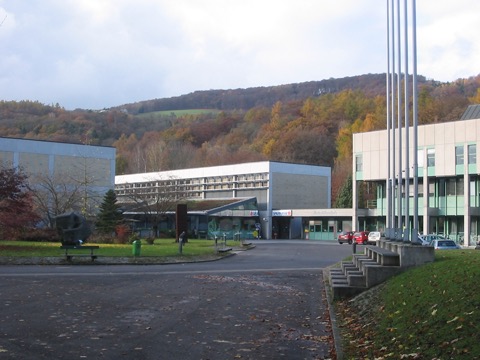
The Johannes Kepler University Linz (German: Johannes Kepler Universität Linz, short: JKU) is a public institution of higher education in Austria. It is located in Linz, the capital of Upper Austria. It offers bachelor's, master's, diploma and doctoral degrees in business, engineering, law, science, social sciences and medicine. Today, 19,930 students study at the park campus in the northeast of Linz, with one out of nine students being from abroad. The university was the first in Austria to introduce an electronic student ID in 1998. The university is the home of the Johann Radon Institute for Computational and Applied Mathematics (RICAM) of the Austrian Academy of Sciences. In 2012, the Times Higher Education ranked the JKU at # 41 and in 2015 at # 87 in its list of the top 100 universities under 50 years old. According to the 2012 ranking, the JKU was the fifth best young university in German-speaking Europe. The university attained high scores for quotations, third-party funding, and internationalization efforts.

An orthoset is a non-empty set X together with a symmetric binary relation ⊥ and a constant 0 such that x⊥̸x for any x≠0, and 0⊥x for any x. Maps f:X→Y and g:Y→X between orthosets are said to form an adjoint pair if, for any x∈X and y∈Y, f(x)⊥y is equivalent to x⊥g(y). Hilbert spaces, equipped with the usual orthogonality relation and the zero vector, provide the motivating examples of orthosets. The usual adjoints of bounded linear maps between Hilbert spaces are adjoints also in our sense.We investigate dagger categories of orthosets and maps between them, requiring that any morphism and its dagger form an adjoint pair. We indicate conditions under which such a category is unitarily dagger equivalent to a dagger category of complex Hilbert spaces and bounded linear maps.
We develop a new implementation of the Continuum Particle Method (CPM) introduced by Verma and Padding (2020), a novel approach to multiphase particle-in-cell (MP-PIC) simulations, based on a face interpolation method that aims to improve robustness and accuracy. We present a comprehensive comparison of CPM, MP-PIC, and computational fluid dynamics coupled with the discrete element method (CFD-DEM) against experimental data from the literature for fluidized and spout-fluidized systems. We evaluate the methods using two drag models and show that CPM agrees better with both experiments and CFD-DEM. We demonstrate that the unsatisfactory performance of MP-PIC does not primarily arise from the selected drag model. Instead, it results from the simplified particle stress model, which depends only on the local particle volume fraction. This model accounts only for isotropic particle pressure and neglects viscous and frictional particle stresses, thereby missing key resistance mechanisms associated with shear and elongational deformation in dense particle regions. We also examine the role of smoothing in CPM by varying the characteristic smoothing length applied to particle fields. We show that smoothing strongly affects the predicted flow behavior and that the optimal level of smoothing depends on the operating flow regime. Finally, we assess particle mixing and find that CPM predicts faster mixing than CFD-DEM under the investigated conditions. Overall, we show that CPM offers a promising and computationally efficient alternative for simulating dense gas–solid flows while retaining improved agreement with benchmark numerical and experimental results.
This paper explores how municipal utilities (MUs) in Austria and Germany adopt and integrate the United Nations’ Sustainable Development Goals (SDGs) into their strategies, strategic projects and management controls (MCs). MUs have a long tradition of delivering public infrastructure services, such as energy, water, and public transport, in the two focus countries. As important municipal enterprises, MUs must position themselves on a continuum between their public mission and their business orientation, and therefore act in a financially sustainable manner. Taking SDG adoption seriously is in line with the public mission orientation. Drawing on legitimacy theory, the study investigates whether MUs engage with the SDGs symbolically or substantively. The research is based on nineteen semi-structured interviews conducted with representatives from sixteen MUs, allowing for an in-depth qualitative analysis of strategic alignment, project implementation, and related MCs. The findings reveal considerable variation in SDG integration, showing that most MUs are still in an early, emerging stage of adoption, which is still at a symbolic level. By providing empirical insights from two countries with long-standing traditions of municipal service provision by local government-owned public utilities, the study contributes to the limited literature on SDG adoption in municipal enterprises and enhances understanding of the legitimacy dynamics shaping SDG practices in local state-owned entities.
We calculate the unpolarized and polarized three--loop anomalous dimensions and splitting functions $P_{\rm NS}^+, P_{\rm NS}^-$ and $P_{\rm NS}^{\rm s}$ in QCD in the $\overline{\sf MS}$ scheme by using the traditional method of space--like off shell massless operator matrix elements. This is a gauge--dependent framework. For the first time we also calculate the three--loop anomalous dimensions $P_{\rm NS}^{\rm \pm tr}$ for transversity directly. We compare our results to the literature.
Since the 1990s, the concept of student engagement (SE) in the higher education context has been increasingly researched in Anglo-American educational discourse. SE is operationalised as a multidimensional construct that encompasses emotional, cognitive, and behavioural components. At present, the field of research is confusing and fragmented in terms of research perspectives. There is a lack of systematic overviews in the German-speaking world. This scoping review analyses, systematises and structures international publications. A systematic literature search was conducted using the keywords 'student engagement' and 'higher education' in the EBSCO, Fachportal P & auml;dagogik, ERIC and PSYNDEX databases. Publications with a peer review were researched for the period since 2010 to 2023. Based on the PRISMA process, 64 scientific articles with fulltext available were included in this review. A quantitative analysis was conducted on the number of publications per research perspective, research design, and their regional location. For the qualitative content analysis, the thematic concept map by Zepke (2021) was used as a coding grid, differentiating psychological, psycho-social, socio-cultural, socio-ecological and socio-political perspectives. Subsequently, the articles were summarized using qualitative content analysis. The majority of the research papers (29 articles) relate to the psychological perspective. Eleven articles explore a psycho-social research perspective focusing on institutional structures. There are fewer references to a socio-ecological and socio-political perspective (six articles each). Three articles are assigned to the socio-cultural perspective. The category meta-perspective & reviews (nine articles) is inductively supplemented. The scoping review discusses these different research perspectives in detail and critically reflects on them. It shows that the research landscape is heterogeneous and that no uniform conceptualisation of the SE construct is used. The research findings are discussed with reference to implications for research, academic management and teaching in higher education.





