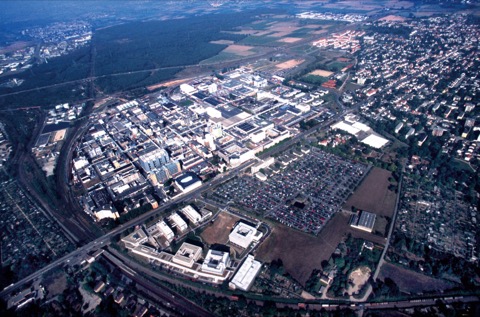
The Merck Group, branded and commonly known as Merck, is a German multinational science and technology company headquartered in Darmstadt, with about 57,000 employees and present in 66 countries. The group includes around 250 companies; the main company is Merck KGaA in Germany. The company is divided into three Businesses: Healthcare, Life Sciences and Performance Materials. Merck was founded in 1668 and is the world's oldest operating chemical and pharmaceutical company, as well as one of the largest pharmaceutical companies in the world.Merck operates in Europe, Africa, Asia, Oceania and the Americas. It has major research and development centres in Darmstadt, Boston, Tokyo and Beijing, as well as other Research and Development units in Taiwan, France, Israel, South Korea and in the UK. Merck pioneered the commercial manufacture of morphine in the 19th century and for a time held a virtual monopoly on cocaine. Merck was privately owned until going public on the Frankfurt Stock Exchange in 1995 and is listed on the DAX index of Germany's top companies. The Merck family still controls a majority of 70.3% of the company's shares. The Merck Group includes around 250 companies in 180 countries; the current main parent company of the group, since 1995, is named Merck KGaA, and is itself mainly owned by the former main parent company, E. Merck oHG, which now operates as a holding company. The American pharmaceutical company Merck & Co. was established as a subsidiary of Merck in 1891, but was nationalized by the United States in 1917, before being privatized again when George W. Merck purchased back the stock in 1919. It is known as MSD (Merck Sharp and Dohme) outside of North America. The original Merck of Darmstadt holds the rights to the name Merck in all countries except the U.S. and Canada, where it is known as EMD (Emanuel Merck, Darmstadt). In 2015 Merck adopted a new uniform brand identity for all its subsidiaries, and the company has stressed its intention to protect the brand of "the real Merck" globally and initiated litigation against its former subsidiary over use of the name.In 2018, the company celebrated their 350th anniversary. Merck has formed a strategic alliance with the Technische Universität Darmstadt, which is located in the same town as Merck.
Conventional Supply Chain Master Planning (SCMP) approaches are poorly suited to environments characterized by simultaneous supply, demand, and sales-channel disruptions particularly in dual-channel supply chains where asymmetric shifts between online and offline demand can create inventory misallocation, service deterioration, and cost escalation. Although Supply Chain Digital Twins (SCDTs) are increasingly discussed as enablers of disruption-aware planning, limited evidence exists on how SCDT frameworks support adaptive SCMP in multi-echelon dual-channel settings. This study develops a SCDT framework for adaptive SCMP that integrates demand forecasting, machine learning-based disruption detection, discrete-event simulation, and multi-objective optimization to dynamically revise sourcing, production, and inventory decisions in response to evolving system states. The framework is instantiated in a television manufacturing supply chain and evaluated against static and rolling-horizon planning approaches under supplier, demand, and channel-shift disruptions. Results show that the proposed SCDT improves service-cost performance, supports more balanced channel-level fulfillment, and enhances adaptive recovery behavior under disruption relative to benchmark approaches. The findings further show that channel-aware SCMP is especially important when demand shifts asymmetrically across sales channels.
Adenoviral (AdV) vectors are widely used in human and veterinary vaccines as well as in gene and cancer therapies; however, their manufacturing remains challenging due to the complexity of real‑time process monitoring and control arising from the dual phase nature of production, lytic production cycle, and the cell density effect. In this study, in-situ Raman spectroscopy was evaluated as a process analytical technology (PAT) for real-time monitoring of cell density and metabolites during AdV production in suspension HEK293 cells. Raman spectra were acquired every 30 min in six 3 L bioreactor runs, and partial least squares (PLS) models were developed to monitor viable and total cell densities as well as key metabolites, including glucose, lactate, glutamine, ammonium, and glutamate, across both the growth and infection phases using a global model. The performance was estimated by nested leave-one-batch-out validation, in which each batch was predicted by a model whose spectral preprocessing, spectral range and number of latent variables were selected using the other five batches only. Pooled root mean square errors of prediction over the six held-out batches were 0.63 and 0.44 × 10⁶ cells/mL for viable and total cell density (RP2 = 0.80 and 0.94) and 1.18, 2.11, 0.65 and 0.39 mM for glucose, lactate, glutamine and ammonium (RP2 = 0.99, 0.98, 0.86 and 0.83), and feeding and dilution events were reproduced in the continuous predictions. Glutamate was not predicted reliably (RP2 = −0.37), and no usable viral-titer model could be established. Compared with a full-range model, target-specific selection of the normalization reference and spectral range lowered the pooled prediction error for the cell densities, glucose and lactate, but not for glutamine, ammonium or glutamate, and the Raman shifts selected consistently across folds helped to interpret the models. Overall, the work demonstrates the feasibility of in-situ Raman spectroscopy for monitoring cell density and major metabolites in both phases of adenovirus production and supports its integration into advanced monitoring and process optimization strategies.
Fluorosurfactants are an integral part of many industrial processes due to their unparalleled surface activity and high water and oil repellency and can be found in a wide range of consumer products. However, their lack of biodegradability causes great environmental concern and has led to increased regulatory action in recent years. In the search for alternatives, perfluoropropyl vinyl ether was recently identified as a promising building block with an improved ecological profile regarding degradation and accumulation. Here, we utilized short-chain perfluoropropyl vinyl ether (PPVE) or perfluoromethyl vinyl ether (PMVE) as precursors to construct polyether-based fluorosurfactants through copolymerization with hydrophilic comonomers. Surfactant properties and overall fluorine content per molecule could be easily adjusted by changing the comonomer feed. The surface activity was investigated in aqueous solution via tensiometry and was found to be competitive with both legacy PFAS such as perfluorooctanesulfonic acid and current state-of-the-art small molecule fluorosurfactants (gamma stat >= 20.35 mN m-1). These findings illustrate the potential of amphiphilic copolymers as a modular, straightforward, and versatile platform for next-generation fluorosurfactants as an alternative to long-chain legacy PFAS.
A novel active pharmaceutical ingredient (API) exhibiting needlelike morphology displayed variable and poor solid-state bulk properties, including low flowability, strong adhesion, and high electrostatic charge, which negatively impacted formulation manufacturing. Applying a quality-by-design methodology, an improved API with enhanced flowability and reduced adhesion and electrostatic charge was obtained through batch-seeded cooling crystallization. A robust crystallization process was developed using statistical design of experiments, chemical engineering calculation-driven crystallization experiments, and process analytical technology. This process, combined with delumping via comilling, was demonstrated at the pilot scale. The solid-state properties of the API were comprehensively characterized, and it was successfully integrated into the drug product workflow. The crystallization process was optimized within approximately 9 months.
Accurately measuring compound binding affinities is key to driving the pharmaceutical development process. Rigorous physics-based in silico approaches, particularly alchemical free energy methods, have become a gold-standard tool for estimating compound affinity changes. Here we present the results of a large-scale precompetitive collaborative assessment of relative binding free energy (RBFE) calculations generated by 15 pharmaceutical companies. We evaluate an open-source and MIT-licensed RBFE protocol from the Open Free Energy (OpenFE) ecosystem across both public and blinded private datasets, encompassing over 1,700 ligands in total. For the public dataset, the weighted RMSE across the 58 systems was 1.73(1.53)(1.96) kcal/mol, with 10 of the systems reaching sub-kcal/mol accuracy. For the private dataset, the weighted RMSE across the 37 systems was 2.44(1.94)(3.06) kcal/mol, with only 2 of the systems reaching sub-kcal/mol accuracy, reflecting the increased complexity of real-world drug discovery. The protocol's performance was system-dependent, with no single dominant error source, indicating that accuracy is primarily influenced by input quality and transformation type. Overall, these benchmark results are encouraging and indicate that OpenFE is ready for large-scale industrial applications, with an "out-of-the-box" accuracy that approaches that of commercial solutions. While comparison against published FEP+ results, which were obtained after manual parameter optimization, shows comparable ranking statistics, a gap remains in error statistics, for which we outline possible paths toward improvement. The protocol meets key criteria required for production use in an industrial setting: it shows robust performance, generates reproducible results, and achieves both sufficient throughput and rapid convergence.




