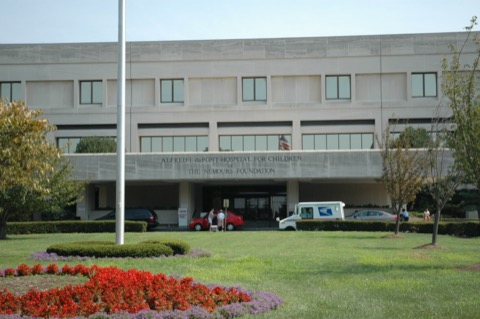
Nemours Alfred I. duPont Hospital for Children is a pediatric hospital located in Wilmington, Delaware. It is controlled by the Nemours Foundation, a non-profit organization created by philanthropist Alfred I. du Pont in 1936 and dedicated to improving the health of children. Historically, it was referred to as the A. I. duPont Institute for Crippled Children or more simply, the DuPont Institute and provides pediatric specialties and subspecialties to infants, children, teens, and young adults up to age 21.

Abstract Background “Head Start” 4 (HS-4) is a prospective clinical trial with a primary objective to determine whether tandem marrow-ablative Consolidation chemotherapy (HDCT), in a randomized comparison with single-cycle Consolidation, provides event-free and overall survival (EFS and OS) benefit for patients with non-Wnt/non-Shh medulloblastoma and Other central nervous system embryonal tumors (CNS-ETs) completing HS-4 Induction. We present the outcome of Other CNS-ETs enrolled on HS-4. Methods Fifty-one eligible patients with Other CNS-ETs, median age 2.61 years (range: 1.36-3.54), were enrolled on HS-4 (ETMR=21, PB = 13, Other CNS-ET NOS=17), and received three cycles (five cycles if < complete response) of Induction (vincristine/cisplatin/cyclophosphamide/etoposide/high-dose methotrexate) followed by randomization to either Consolidation with three tandem HDCT cycles (thiotepa/carboplatin) or single HDCT cycle (thiotepa/carboplatin/etoposide). Diagnosis was confirmed by central pathology review and DNA methylation. Twenty patients were deemed non-evaluable: progression=9, family/physician preference=8 and toxicity=3; all during induction. Results For Intent-to-Treat analysis of all 51 patients, the 2-year EFS and OS was 43.9% (95%CI: 31.6-61) and 53.6% (95%CI=41.3-69.5) overall, 39.7% (95%CI=22.4-70.3) and 38.1% (95%CI=22.1-65.7) for ETMR, 46.2% (95%CI=25.7-83.0) and 53.8% (95%CI=32.6-89.1) for PB, and 47.5% (95%CI=27.9-80.9) and 73.9% (95%CI=54.9-99.6) for Other CNS-ET NOS patients. For 31 evaluable patients completing Induction (ETMR=13, PB = 5, Other CNS ET, NOS=13), the 2-year EFS and OS were 60.1% (95%CI: 44.2-81.6) and 76.2% (95%CI=62.2-93.3) overall , 59.2% (95%CI=37.1-94.5) and 61.5% (95%CI=40.0-94.6) for ETMR, 80% (95%CI=51.6-100) and 100% for PB, and 51.9% (95%CI=28.7-93.9) and 82.1% (95%CI=62.1-100) for Other CNS-ET NOS patients. For 17 evaluable patients receiving three tandem HDCT cycles, 2-year EFS was 81.6% (95%CI=64.7-100), compared to 30% (95%CI=12-74.7) for 14 patients receiving single HDCT cycle (p = 0.0099). Conclusion We report excellent results for young children with Other CNS-ETs when treated with intensive Induction and HDCT Consolidation on HS-4 trial without irradiation, with improved EFS for patients receiving three tandem HDCT cycles.
Importance Multisystem inflammatory syndrome in children (MIS-C) is a life-threatening complication of COVID-19 infection. Data on midterm outcomes are limited. Objective To characterize the frequency and time course of cardiac dysfunction (left ventricular ejection fraction [LVEF] <55%), coronary artery aneurysms (z score >= 2.5), and noncardiac involvement through 6 months after MIS-C. Design, Setting, and Participants This cohort study enrolled participants between March 2020 and January 2022 with a follow-up period of 2 years. Participants were recruited from 32 North American pediatric hospitals, and all participants met the 2020 Centers for Disease Control and Prevention case definition of MIS-C. Exposure MIS-C after COVID-19 infection. Main Outcomes and Measures Outcomes included echocardiography core laboratory (ECL) assessments of LVEF and maximum coronary artery z scores (zMax); data collection on cardiac and noncardiac sequelae during hospitalization and at 2 weeks, 6 weeks, and 6 months after discharge; and age-appropriate Patient-Reported Outcomes Measurement Information Systems (PROMIS) Global Health Instruments at follow-up. Descriptive statistics, linear regression models, and Kaplan-Meier analysis were used. Results Of 1204 participants (median [IQR] age, 9.1 [5.6-12.7] years; 724 male [60.1%]), 325 self-identified with non-Hispanic Black race (27.0%) and 324 with Hispanic ethnicity (26.9%). A total of 548 of 1195 participants (45.9%) required vasoactive support, 17 of 1195 (1.4%) required extracorporeal membrane oxygenation, and 3 (0.3%) died during hospitalization. Of participants with echocardiograms reviewed by the ECL (n = 349 due to budget constraints), 131 of 322 (42.3%) had LVEF less than 55% during hospitalization; of those with follow-up, all but 1 normalized by 6 months. Black race (vs other/unknown race), higher C-reactive protein level, and abnormal troponin level were associated with lowest LVEF (estimate [SE], -3.09 [0.98]; R2 = 0.14; P =.002). Fifteen participants had coronary artery z scores of 2.5 or greater at any time point; 1 participant had a large/giant aneurysm. Of the 13 participants with z scores of 2.5 or greater during hospitalization, 12 (92.3%) had normalized by 6 months. Return to greater than 90% of pre-MIS-C health status (energy, sleep, appetite, cognition, and mood) was reported by 711 of 824 participants (86.3%) at 2 weeks, increasing to 548 of 576 (95.1%) at 6 months. Fatigue was the most common symptom reported at 2 weeks (141 of 889 [15.9%]), falling to 3.4% (22 of 638) by 6 months. PROMIS Global Health parent/guardian proxy median T scores for fatigue, global health, and pain interference improved significantly from 2 weeks to 6 months (fatigue, 56.1 vs 48.9; global health, 48.8 vs 51.3; pain interference, 53.0 vs 43.3; P < .001) and by the 6-week visit were at least equivalent to prepandemic population norms. Conclusions and Relevance Results of this cohort study suggest that although children and young adults with MIS-C can have severe disease during the acute phase, most recovered quickly and had a reassuring midterm prognosis.
Rationale: Delayed (>5 minutes) epinephrine during pediatric in-hospital cardiac arrest (IHCA) is associated with worse outcomes. Epinephrine is nearly always given earlier, limiting 5 minutes as a quality target. Objectives: To assess early epinephrine administration (⩽2 minutes) on outcomes and hemodynamics during cardiopulmonary resuscitation (CPR) in pediatric IHCA from pulseless, nonshockable rhythms. Methods: This study leveraged the database of the ICU-RESUS (Intensive Care Unit Resuscitation) project (clinicaltrials.gov identifier NCT02837497). Primary exposure was the time to epinephrine bolus: early versus >2 minutes. Primary outcome was survival to discharge. Secondary outcomes included the return of spontaneous circulation (ROSC), survival with favorable neurologic outcome, change from baseline to discharge Functional Status Scale (FSS) score, total FSS score at discharge, new morbidity among survivors, and invasively measured blood pressure during the first 10 minutes of CPR. Results: Among 352 CPR events, median age was 1.0 (interquartile range [IQR], 0.3-8.0) year, 186 (53%) were male, and 185 (52.6%) had cardiac disease. Early epinephrine was administered in 273 (78%), and median time to administration was 1.0 (0.0-2.0) minute. Survival to discharge was similar between patients who received early epinephrine and those who did not. Early epinephrine administration was associated with higher ROSC, a change from baseline to discharge in FSS, lower total FSS scores at discharge, and lower rates of new morbidity compared with epinephrine administration at >2 minutes. The probability of ROSC and survival to discharge with favorable neurologic outcome decreased for each minute of delay in epinephrine administration. There was no difference in the invasive blood pressure targets during the first 10 minutes of CPR. Conclusions: Early epinephrine administration was common and was associated with higher ROSC and improved functional outcomes compared with epinephrine administration at >2 minutes in pediatric IHCA.





