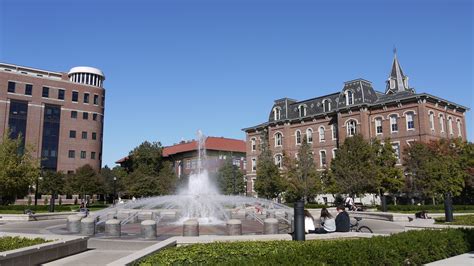
Purdue University is a public research university in West Lafayette, Indiana, and the flagship campus of the Purdue University system. The university was founded in 1869 after Lafayette businessman John Purdue donated land and money to establish a college of science, technology, and agriculture in his name. The first classes were held on September 16, 1874, with six instructors and 39 students.The main campus in West Lafayette offers more than 200 majors for undergraduates, over 69 masters and doctoral programs, and professional degrees in pharmacy and veterinary medicine. In addition, Purdue has 18 intercollegiate sports teams and more than 900 student organizations. Purdue is a member of the Big Ten Conference and enrolls the second largest student body of any university in Indiana, as well as the fourth largest foreign student population of any university in the United States.Purdue University is a member of the Association of American Universities and is classified among "R1: Doctoral Universities – Very high research activity". Purdue has 25 American astronauts as alumni and as of April 2019, the university has been associated with 13 Nobel Prizes.

Motivated by applications in tissue-wide association studies (TWAS), we develop a flexible and theoretically grounded empirical Bayes approach for integrating
Deep learning has revolutionized modern data science. However, how to accurately quantify the uncertainty of predictions from large-scale deep neural networks (DNNs) remains an unresolved issue. To address this issue, we introduce a novel post-processing approach. This approach feeds the output from the last hidden layer of a pre-trained large-scale DNN model into a stochastic neural network (StoNet), then trains the StoNet with a sparse penalty on a validation dataset and constructs prediction intervals for future observations. We establish a theoretical guarantee for the validity of this approach; in particular, the parameter estimation consistency for the sparse StoNet is essential for the success of this approach. Comprehensive experiments demonstrate that the proposed approach can construct honest confidence intervals with shorter interval lengths compared to conformal methods and achieves better calibration compared to other post-hoc calibration techniques. Additionally, we show that the StoNet formulation provides us with a platform to adapt sparse learning theory and methods from linear models to DNNs.
Large spatial datasets with non-Gaussian responses are increasingly common in environmental monitoring, ecology, and remote sensing, yet scalable Bayesian inference for such data remains challenging. Markov chain Monte Carlo (MCMC) methods are often prohibitive for large datasets, and existing variational Bayes methods rely on conjugacy or strong approximations that limit their applicability and can underestimate posterior variances. A scalable variational framework that incorporates semi-implicit variational inference (SIVI) with basis representations of spatial generalized linear mixed models (SGLMMs), which may not have conjugacy, is proposed. The proposed framework accommodates gamma, negative binomial, Poisson, Bernoulli, and Gaussian responses on continuous spatial domains. Across 20 simulation scenarios with 50,000 locations, SIVI achieves predictive accuracy and posterior distributions comparable to Metropolis–Hastings and Hamiltonian Monte Carlo while providing notable computational speedups. Applications to MODIS land surface temperature and Blue Jay abundance further demonstrate the utility of the approach for large non-Gaussian spatial datasets.
This study presents a techno-economic assessment of a conceptual 3-hydroxypropionic acid (3-HP) biorefinery integrating ionic liquid (IL) pretreatment with lignocellulosic biomass conversion. This work provides a novel comparative techno-economic assessment of corn stover (CS) and brewer's spent grain (BSG) as feedstocks for IL-based 3-HP production. A literature-based process model was developed for the continuous production of 50,000 t/year of 3-HP and evaluated using both feedstocks. IL pretreatment was selected for its recyclability and potential to reduce chemical consumption compared with conventional pretreatment methods. Biomass-to-3-HP conversion efficiencies (on a dry basis) of 25.63% and 23.31% were obtained for CS and BSG, respectively, reflecting the lower fermentable sugar recovery achieved from BSG. Economic assessment yielded break-even selling prices (BESP) of $2472/tonne 3-HP for CS and $2643/tonne for BSG, indicating that both configurations are economically competitive with literature-reported bio-based 3-HP values. Sensitivity analysis identified yeast consumption as the dominant cost driver, followed by enzyme and IL requirements. The results highlight the potential of IL-assisted lignocellulosic biorefineries for competitive 3-HP production and identify the optimisation of yeast production and recycling, enhanced IL recovery and recycling, and co-product valorisation through bioethanol and lignin recovery as key opportunities to further reduce production costs.
Acoustic features of child directed speech (CDS) in caregiver-child conversational interactions are known to capture young children’s attention to language input and facilitate language learning. Emerging evidence suggests that caregivers’ use of CDS-like features when reading to their child, known as caregiver oral reading prosody, plays an important role in supporting preschoolers’ storybook comprehension. Do associations between caregiver oral reading prosody and preschoolers’ language extend beyond real-time listening comprehension to broader language skills? Forty-one caregivers read a children’s book to their child (ages: 4–5 years) as they normally would at home. The caregivers’ oral reading prosody (i.e., intonation and timing features) was examined in relation to children’s receptive vocabulary and core language skills. Moderated mediation models then investigated possible impacts of caregiver reading skills and shared reading time on these associations. Caregiver intonation range positively related to child vocabulary and caregiver inappropriate (i.e., ungrammatical) pausing negatively related to child core language skills. Mediation models revealed that caregiver reading skills indirectly related to child language through oral reading prosody measures. Notably, the indirect effect linking caregiver reading skills to child vocabulary via caregiver intonation range was moderated by shared reading time, with the strongest effects among dyads reporting less shared reading engagement. Findings illuminate caregiver oral reading prosody as one factor linking caregiver reading skills to child language, with particular relevance among families of caregivers with reading difficulties and for those with limited shared reading opportunities.





