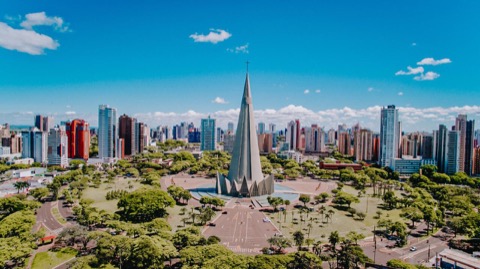
The State University of Maringá (Portuguese: Universidade Estadual de Maringá, UEM) is a public university whose main campus is in Maringá, Paraná, Brazil. It was founded in 1970 and recognized in 1976 by the Federal Government of Brazil. Its academic population is estimated in 18,000 people among professors, undergraduates, graduate students and manager technicals. UEM has 48 undergraduate courses and about 25 graduate programs. The university has 5 campuses in Maringá, Goioere, Cianorte, Cidade Gaúcha and Umuarama, all cities located in Paraná state.

We investigate the asymptotic dynamics of the two-dimensional Lamé system with linear damping and a fully coupled nonlinear vector field exhibiting exponential growth. A key analytical tool in our approach is the use of a sharp Trudinger-Moser estimate, which allows us to establish crucial quasi-stability and smoothing properties for the corresponding dynamical system. As a consequence, we prove the existence of both global and exponential-type attractors with finite fractal dimension. To the best of our knowledge, this is the first contribution addressing the 2D Lamé system in the evolution scenario with exponential nonlinearity.
This paper is concerned with the well-posedness and asymptotic behavior of a plate equation with degenerate memory and localized frictional damping in the case that the exponent of nonlinear source term is at most critical. When the memory term is non-degenerate and the memory kernel decays exponentially, the corresponding dynamical system possesses a global attractor without requiring any additional dissipation. In this paper, we address the degenerate case by introducing a supplementary frictional damping. Despite the fact that the dissipation arises from two partial damping terms of different natures, neither of which necessarily satisfies a geometric control condition, we can still prove the well-posedness of such problem based on the nonlinear semigroup theory under some suitable assumptions. Moreover, we also prove the existence of a finite dimensional global attractor by verifying the existence of a strict Lyapunov functional and establishing the desired quasi-stability inequality.
Statistical mechanics describes the behavior of the particles (atoms and molecules) that comprise solids, liquids, and gases. The dynamics of particle motion is encoded in kinetic equations (e.g., Liouville, Boltzmann, Fokker-Planck, and Langevin) that predict the hydrodynamic, magnetic, and dielectric properties of materials, the rates of chemical reactions, and the stability of plasmas. However, interest in multiscale, composite, heterogeneous, and fractal materials has stimulated the development of generalized, and in some cases, fractional calculus models in order to describe the emergence of anomalous transport of mass, momentum, and energy. Extending integer time and space derivatives to fractional order provides a concise way to incorporate memory and non-locality into the force, flow, and flux terms of each equation. This approach recasts the fundamental equations and complements the nonlinear and perturbation models commonly used to address complex dynamics and stochastic processes. In this review, we compare fractional calculus methods with other techniques, such as the assumption of time- or position-dependent diffusion coefficients, and highlight the connections between fractional-order operators, stochastic differential equations, and the asymptotic behavior of physical systems. We focus on fractional-calculus modifications of the Boltzmann, Fokker–Planck, and Langevin equations and distinguish time-fractional (memory) from space-fractional (spatial nonlocality) generalizations and their main stochastic-process mechanisms. The goal is to identify situations where mathematics and physics combine in models that not only provide better fits to data, but also animate the mathematics, allowing it to be tailored to new applications.
Laccases are multicopper enzymes capable of oxidizing a wide variety of compounds, standing out as green tools for industrial and environmental applications. However, production from native sources faces limitations that have driven advances in recombinant expression. This scoping review includes studies published between 2019 and 2025, selected from major online databases, describing recombinant fungal and bacterial laccases for environmental applications. Strategies to optimize expression are discussed, including the use of efficient vectors, codon optimization, His-tag addition, mutagenesis, and computational approaches, with an emphasis on their advantages, trade-offs, and limitations. Pichia pastoris is widely used for the expression of fungal laccases, while Escherichia coli is preferred for the expression of bacterial laccases. However, significant variability in expression efficiency and enzyme performance is observed across hosts and constructs. The use of alternative culture media, such as agro-industrial residues, is also explored as a sustainability-driven strategy; however, its applicability remains limited for certain heterologous expression systems. In the environmental field, recombinant laccases demonstrate high efficiency in the degradation of textile dyes, the treatment of lignocellulosic waste, the biodegradation of pharmaceuticals, and the degradation of various toxic compounds, often requiring redox mediators to achieve high conversion rates. Despite significant advances, challenges remain, such as inconsistent catalytic performance among studies and limited stability under extreme temperature and pH conditions. Overall, this review highlights the key challenges in developing recombinant laccase and demonstrates that advances in protein engineering, expression systems, and process optimization are crucial for environmental applications.
The development of efficient heterogeneous catalysts for Fenton-type processes is essential for advancing wastewater treatment technologies. In this study, cobalt-based catalysts supported on reduced graphene oxide (rGO) were synthesized using cetyltrimethylammonium bromide (CTAB) as a structure-directing agent. The materials were prepared via wet impregnation and characterized by multiple techniques. The results indicate that CTAB promotes improved dispersion of graphene sheets and cobalt species during synthesis, acting primarily as a structure-directing agent. Among the evaluated materials, the 15Co/rGOF catalyst exhibited the highest catalytic performance, achieving 97





