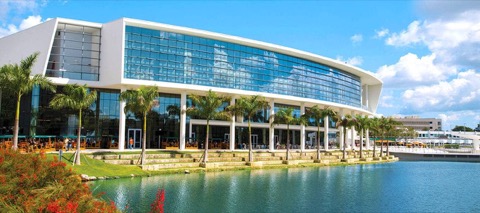
The University of Miami (informally referred to as UM, Miami, U of M, UMiami and The U) is a private research university in Coral Gables, Florida. As of 2020[update], the university enrolled 17,811 students in 12 colleges and schools across nearly 350 academic majors and programs, including the Leonard M. Miller School of Medicine in Miami's Health District, the law school on the main campus, and the Rosenstiel School of Marine and Atmospheric Science on Virginia Key with research facilities in southern Miami-Dade County.The University of Miami offers 138 undergraduate, 140 master's, and 67 doctoral degree programs. Since its founding in 1925, the university has attracted students from all 50 states and nearly 150 foreign countries. With 16,479 faculty and staff as of 2021, the University of Miami is the second largest employer in Miami-Dade County. The university's main campus in Coral Gables spans 240 acres (0.97 km2), has over 5,700,000 square feet (530,000 m2) of buildings, and is located 7 miles (11 km) south of downtown Miami, the core of the Miami metropolitan area, the nation's ninth largest and world's 34th largest metropolitan area with a population of 6.158 million people. University of Miami faculty include a sizable number of notable academics across nearly all disciplines, including four Nobel Prize winners. The university is classified among "Doctoral Universities: Very High Research Activity". The University of Miami's research expenditures in 2021 were $375 million, making it the 71st largest research university in the nation. Its undergraduate academic admissions standards are ranked the highest among Florida's 171 universities and colleges, and the university's library system ranks among the top 50 research libraries in North America with over four million volumes, including exceptional holdings in Cuban heritage and music.The University of Miami's intercollegiate athletic teams are collectively known as the Miami Hurricanes and compete in Division I of the National Collegiate Athletic Association. The University of Miami's football team has won five national championships since 1983 and its baseball team has won four national championships since 1982..

Abstract Stormwater management regulations for roadways typically allow for pavement or shoulder encroachment of runoff from rainfall events with a given return period, and also require retention of a given water quality volume. Conventional designs of terminal exfiltration trenches (ETRs) that handle roadway runoff do not account for encroachment storage, and they seldom consider all possible event durations for a given return period. To address these gaps, a novel methodology is presented that meets both the encroachment and water quality retention constraints. The methodology applies to both conventional ETRs and partially submerged ETRs that are widely used in the coastal areas of South Florida. Design examples are provided for both cases.
Retailers struggle with late deliveries, thus motivating research to improve e-fulfillment performance. Studies have primarily investigated order processing and delivery individually but have ignored the interplay between these two e-fulfillment activities. The Theory of Swift and Even Flow (TSEF) provides a useful frame for examining the e-fulfillment process, yet it neglects important behavioral factors. We elaborate the TSEF using logic from the Queue-Length Visibility and Misperception of Feedback Dynamics perspectives to unveil how behaviors in order processing and delivery contribute to delivery performance. We analyze 11,241 orders from a major Vietnamese retailer using econometric methods informed by practitioner interviews. We find a concave relationship between order processing time (OPT) ratio (defined as the proportion of planned lead time consumed by order processing) and lateness. Late orders have OPT ratios exceeding 25% of the planned lead time, and they exhibit higher OPT variance. We also find a U-shaped relationship between OPT ratio and order delivery time (ODT); expediting deliveries mitigates delays until OPT ratios reach a threshold of 58%. Finally, we argue that workers and managers prioritize the processing of focused orders. Understanding behaviors in the e-fulfillment process offers insights that extend the TSEF, new research areas, and managerial implications.
Background: Older adults with acute myeloid leukemia (AML) represent a cancer population in which disease-based risk factors, comorbidities, patient goals, and treatment risks and benefits influence treatment recommendations. Objective: These evidence-based guidelines from the American Society of Hematology (ASH) are intended to support patients, clinicians, and other health professionals in their decisions about management of AML in older adults. Methods: ASH formed a multidisciplinary guideline panel, including patient representatives, that minimized bias from conflicts of interest. Clarity Research Group at McMaster University supported the guideline development process, including updating or performing systematic evidence reviews. The panel prioritized questions and outcomes according to their importance for clinicians and patients. The panel used the grading of recommendations assessment, development and evaluation approach, including evidence-to-decision frameworks, to assess evidence and make recommendations. Results: The panel agreed on 9 critical clinical recommendations for managing AML in older adults, mirroring real-time practitioner-patient conversations: the decision to pursue antileukemic treatment vs best supportive management; traditional induction and postremission therapy vs hypomethylating agent or low-dose cytarabine, or combinations with venetoclax; the role and duration of postremission therapy; combinations with venetoclax vs monotherapy; the use of targeted therapy, including isocitrate dehydrogenase and FMS-like tyrosine kinase 3 (FLT3) inhibitors, in appropriate patients; the role of hematopoietic stem cell transplantation in nonfavorable prognosis AML; and the role of transfusion support for patients no longer receiving antileukemic therapy. Conclusions: Key recommendations of these guidelines include treatment over best supportive care; venetoclax-based regimens over monotherapies; and incorporation of FLT3 inhibitors into traditional induction and postremission therapy.
Given the growing recognition of corporate social responsibility (CSR) as a strategic initiative, especially tied to major national events like the Olympics, this study explores how corporations' sponsorship of national teams affects consumer-company identification (CCI) and subsequent positive and negative relational outcomes. Employing the social identity theory, the study examined how national identification can further translate into CCI via identity salience and reduce corporate hypocrisy via in-group bias, moderated by communal engagement on social media. To test the hypothesized relationships, an online survey (N = 755) was conducted via Dynata. Results revealed that communal engagement significantly moderated the positive relationship between national identification and CCI, strengthening this link among highly engaged individuals. Moreover, elevated CCI further reduced corporate hypocrisy perceptions among those with low and moderate engagement, whereas its effect was minimal for highly engaged individuals. Those who strongly identified with companies sponsoring Team USA perceived a strong CCI, which further resulted in increase in positive word-of-mouth intentions. Lastly, the findings uncovered the double-edged role of highly engaged publics, as their heightened scrutiny weakened the mitigating effect of national identification on corporate hypocrisy. This highlighted their potential as both powerful advocates and critical evaluators of corporate actions. The findings offer practical insights into segmenting their audiences based on cause involvement on social media and adjusting CSR strategies accordingly.
Equatorial upwelling plays a crucial role in regulating regional climate variability and biological productivity from seasonal to interannual time scales. Typically, sea surface temperature or surface chlorophyll anomalies are used as proxies for upwelling because of the challenges in directly measuring vertical velocities. Here, we show that using a synthesis product of surface drifter observations, reanalysis winds, and satellite altimetry to infer vertical velocity in the equatorial band (+/- 3 degrees; w eq) improves the representation of the spatiotemporal characteristics of w eq compared to estimates from other commonly used products. We focus on the annual mean, seasonal cycle, interannual variations, and long-term trends of vertical velocity estimates, derived by applying the continuity equation to horizontal current divergence in the upper 30 m across the tropical Pacific, Atlantic, and Indian Oceans. Mean w eq values of 0.6 +/- 0.2, 0.3 +/- 0.2 and 0.1 +/- 0.2 m day-1 are observed in the Pacific (150 degrees W-90 degrees W), Atlantic (20 degrees W-0 degrees), and Indian Ocean (60 degrees E-90 degrees E), respectively. Vertical transport across 30 m is 46 +/- 14 Sv in the Pacific and 8 +/- 4 Sv in the Atlantic. Interannual variations in w eq are primarily driven by climate modes specific to each basin and are up to +/- 0.4 m day-1 in the Pacific, +/- 0.1 m day-1 in the Atlantic, and up to +/- 0.6 m day-1 in the Indian Ocean. From 1993 to 2022, Pacific w eq significantly increased by 24 +/- 13% (0.14 +/- 0.07 m day-1). This increase in Pacific equatorial upwelling aligns with stronger trade winds and intensified upper-ocean currents.





