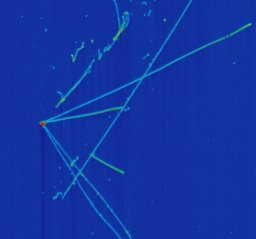
We report the measurement of the final-state products of negative pion and muon nuclear capture at rest on argon by the LArIAT experiment at the Fermilab Test Beam Facility. We measure a population of isolated MeV-scale energy depositions, or blips, in 296 LArIAT events containing tracks from stopping low-momentum pions and muons. The average numbers of visible blips are measured to be 0.74±0.19 and 1.86±0.17 near muon and pion track endpoints, respectively. The 3.6σ statistically significant difference in blip content between muons and pions provides the first demonstration of a new method of pion-muon discrimination in neutrino liquid argon time projection chamber experiments. LArIAT Monte Carlo simulations predict substantially higher average blip counts for negative muon (1.22±0.08) and pion (2.34±0.09) nuclear captures. We attribute this difference to geant4's inaccurate simulation of the nuclear capture process.
The determination of the direction of a stellar core collapse via its neutrino emission is crucial for the identification of the progenitor for a multimessenger follow-up. A highly effective method of reconstructing supernova directions within the Deep Underground Neutrino Experiment (DUNE) is introduced. The supernova neutrino pointing resolution is studied by simulating and reconstructing electron-neutrino charged-current absorption on Ar-40 and elastic scattering of neutrinos on electrons. Procedures to reconstruct individual interactions, including a newly developed technique called "brems flipping," as well as the burst direction from an ensemble of interactions are described. Performance of the burst direction reconstruction is evaluated for supernovae happening at a distance of 10 kpc for a specific supernova burst flux model. The pointing resolution is found to be 3.4 degrees at 68% coverage for a perfect interaction-channel classification and a fiducial mass of 40 kton, and 6.6 degrees for a 10 kton fiducial mass respectively. Assuming a 4% rate of charged-current interactions being misidentified as elastic scattering, DUNE's burst pointing resolution is found to be 4.3 degrees (8.7 degrees) at 68% coverage.
Large neutrino liquid argon time projection chamber (LArTPC) experiments can broaden their physics reach by reconstructing and interpreting MeV-scale energy depositions, or blips, present in their data. We demonstrate new calorimetric and particle discrimination capabilities at the MeV energy scale using reconstructed blips in data from the MicroBooNE LArTPC at Fermilab. We observe a concentration of low-energy (<3 MeV) blips around fiberglass mechanical support struts along the time projection chamber edges with energy spectrum features consistent with the Compton edge of 2.614 MeV Tl208 decay γ rays. These features are used to verify proper calibration of electron energy scales in MicroBooNE’s data to few percent precision and to measure the specific activity of Tl208 in the fiberglass composing these struts, (11.7±0.2(stat)±3.1(syst)) Bq/kg. Cosmogenically produced blips above 3 MeV in reconstructed energy are used to showcase the ability of large LArTPCs to distinguish between low-energy proton and electron energy depositions. An enriched sample of low-energy protons selected using this new particle discrimination technique is found to be smaller in data than in dedicated cosmic-ray simulations, suggesting either incorrect modeling of incident cosmic fluxes or particle transport modeling issues in eant4. Published by the American Physical Society 2025
We report the first double-differential cross section measurement of neutral-current neutral pion (NCπ^{0}) production in neutrino-argon scattering, as well as single-differential measurements of the same channel in terms of final states with and without protons. The kinematic variables of interest for these measurements are the π^{0} momentum and the π^{0} scattering angle with respect to the neutrino beam. A total of 4971 candidate NCπ^{0} events fully contained within the MicroBooNE detector are selected using data collected at a mean neutrino energy of ∼0.8 GeV from 6.4×10^{20} protons on target from the Booster Neutrino Beam at the Fermi National Accelerator Laboratory. After extensive data-driven model validation to ensure unbiased unfolding, the Wiener-singular-value-decomposition method is used to extract nominal flux-averaged cross sections. The results are compared to predictions from commonly used neutrino event generators, which tend to overpredict the measured NCπ^{0} cross section, especially in the 0.2-0.5 GeV/c π^{0} momentum range and at forward scattering angles. Events with at least one proton present in the final state are also underestimated. This data will help improve the modeling of NCπ^{0} production, which represents a major background in measurements of charge-parity violation in the neutrino sector and in searches for new physics beyond the standard model.
Charged-current neutrino interactions with final states containing zero mesons and at least one proton are of high interest for current and future accelerator-based neutrino oscillation experiments. Using the Booster Neutrino Beam and the MicroBooNE detector at Fermi National Accelerator Laboratory, we have obtained the first double-differential cross section measurements of this channel for muon neutrino scattering on an argon target with a proton momentum threshold of 0.25 GeV/c. We also report a flux-averaged total cross section of $\sigma = (11.8 \pm 1.2) \times 10^{-38}$ cm$^2$ / Ar and several single-differential measurements which extend and improve upon previous results. Statistical and systematic uncertainties are quantified with a full treatment of correlations across 359 kinematic bins, including correlations between distributions describing different observables. The resulting data set provides the most detailed information obtained to date for testing models of mesonless neutrino-argon scattering.
Neutrino-nucleus cross section measurements are needed to improve interaction modeling to meet the precision needs of neutrino experiments in efforts to measure oscillation parameters and search for physics beyond the Standard Model. We review the difficulties associated with modeling neutrino-nucleus interactions that lead to a dependence on event generators in oscillation analyses and cross section measurements alike. We then describe data-driven model validation techniques intended to address this model dependence. The method relies on utilizing various goodness-of-fit tests and the correlations between different observables and channels to probe the model for defects in the phase space relevant for the desired analysis. These techniques shed light on relevant mis-modeling, allowing it to be detected before it begins to bias the cross section results. We compare more commonly used model validation methods which directly validate the model against alternative ones to these data-driven techniques and show their efficacy with fake data studies. These studies demonstrate that employing data-driven model validation in cross section measurements represents a reliable strategy to produce robust results that will stimulate the desired improvements to interaction modeling.
A detailed understanding of inclusive muon neutrino charged-current interactions on argon is crucial to the study of neutrino oscillations in current and future experiments using liquid argon time projection chambers. To that end, we report a comprehensive set of differential cross section measurements for this channel that simultaneously probe the leptonic and hadronic systems by dividing the channel into final states with and without protons. Measurements of the proton kinematics and proton multiplicity of the final state are also presented. For these measurements, we utilize data collected with the MicroBooNE detector from 6.4 x 10(20) protons on target from the Fermilab booster neutrino beam at a mean neutrino energy of approximately 0.8 GeV. We present in detail the cross section extraction procedure, including the unfolding, and model validation that uses data to model comparisons and the conditional constraint formalism to detect mismodeling that may introduce biases to extracted cross sections that are larger than their uncertainties. The validation exposes insufficiencies in the overall model, motivating the inclusion of an additional data-driven reweighting systematic to ensure the accuracy of the unfolding. The extracted results are compared to a number of event generators and their performance is discussed with a focus on the regions of phase space that indicate the greatest need for modeling improvements.
Abstract A significant challenge in measurements of neutrino oscillations is reconstructing the incoming neutrino energies. While modern fully-active tracking calorimeters such as liquid argon time projection chambers in principle allow the measurement of all final state particles above some detection threshold, undetected neutrons remain a considerable source of missing energy with little to no data constraining their production rates and kinematics. We present the first demonstration of tagging neutrino-induced neutrons in liquid argon time projection chambers using secondary protons emitted from neutron-argon interactions in the MicroBooNE detector. We describe the method developed to identify neutrino-induced neutrons and demonstrate its performance using neutrons produced in muon-neutrino charged current interactions. The method is validated using a small subset of MicroBooNE’s total dataset. The selection yields a sample with $$60\%$$ 60 % of selected tracks corresponding to neutron-induced secondary protons. At this purity, the integrated efficiency is 8.4% for neutrons that produce a detectable proton.
We present a measurement of neutral pion production in charged-current interactions using data recorded with the MicroBooNE detector exposed to Fermilab's booster neutrino beam. The signal comprises one muon, one neutral pion, any number of nucleons, and no charged pions. Studying neutral pion production in the MicroBooNE detector provides an opportunity to better understand neutrino-argon interactions, and is crucial for future accelerator-based neutrino oscillation experiments. Using a dataset corresponding to $6.86 \times 10^{20}$ protons on target, we present single-differential cross sections in muon and neutral pion momenta, scattering angles with respect to the beam for the outgoing muon and neutral pion, as well as the opening angle between the muon and neutral pion. Data extracted cross sections are compared to generator predictions. We report good agreement between the data and the models for scattering angles, except for an over-prediction by generators at muon forward angles. Similarly, the agreement between data and the models as a function of momentum is good, except for an underprediction by generators in the medium momentum ranges, $200-400$ MeV for muons and $100-200$ MeV for pions.
We present a set of new generalized kinematic imbalance variables that can be measured in neutrino scattering. These variables extend previous measurements of kinematic imbalance on the transverse plane, and are more sensitive to modeling of nuclear effects. We demonstrate the enhanced power of these variables using simulation, and then use the MicroBooNE detector to measure them for the first time. We report flux-integrated single- and double-differential measurements of charged-current muon neutrino scattering on argon using a topolgy with one muon and one proton in the final state as a function of these novel kinematic imbalance variables. These measurements allow us to demonstrate that the treatment of charged current quasielastic interactions in GENIE version 2 is inadequate to describe data. Further, they reveal tensions with more modern generator predictions particularly in regions of phase space where final state interactions are important.
We report measurements of radon progeny in liquid argon within the MicroBooNE time projection chamber (LArTPC). The presence of specific radon daughters in MicroBooNE's 85 metric tons of active liquid argon bulk is probed with newly developed charge -based low -energy reconstruction tools and analysis techniques to detect correlated Bi-214-Po-214 radioactive decays. Special datasets taken during periods of active radon doping enable new demonstrations of the calorimetric capabilities of single-phase neutrino LArTPCs for beta and alpha particles with electron -equivalent energies ranging from 0.1 to 3.0 MeV. By applying Bi-214-Po-214 detection algorithms to data recorded over a 46 -day period, no statistically significant presence of radioactive Bi-214 is detected, and a limit on the activity is placed at <0.35 mBq/kg at the 95% confidence level. This bulk Bi-214 radiopurity limit-the first ever reported for a liquid argon detector incorporating liquid -phase purification-is then further discussed in relation to the targeted upper limit of 1 mBq/kg on bulk Rn-222 activity for the DUNE neutrino detector.
We present the first search for heavy neutral leptons (HNLs) decaying into νe^{+}e^{-} or νπ^{0} final states in a liquid-argon time projection chamber using data collected with the MicroBooNE detector. The data were recorded synchronously with the NuMI neutrino beam from Fermilab's main injector corresponding to a total exposure of 7.01×10^{20} protons on target. We set upper limits at the 90% confidence level on the mixing parameter |U_{μ4}|^{2} in the mass ranges 10≤m_{HNL}≤150 MeV for the νe^{+}e^{-} channel and 150≤m_{HNL}≤245 MeV for the νπ^{0} channel, assuming |U_{e4}|^{2}=|U_{τ4}|^{2}=0. These limits represent the most stringent constraints in the mass range 35<m_{HNL}<175 MeV and the first constraints from a direct search for νπ^{0} decays.
We present a measurement of $\eta$ production from neutrino interactions on argon with the MicroBooNE detector. The modeling of resonant neutrino interactions on argon is a critical aspect of the neutrino oscillation physics program being carried out by the DUNE and Short Baseline Neutrino programs. $\eta$ production in neutrino interactions provides a powerful new probe of resonant interactions, complementary to pion channels, and is particularly suited to the study of higher-order resonances beyond the $\Delta(1232)$. We measure a flux-integrated cross section for neutrino-induced $\eta$ production on argon of $3.22 \pm 0.84 \; \textrm{(stat.)} \pm 0.86 \; \textrm{(syst.)}$ $10^{-41}{\textrm{cm}}^{2}$/nucleon. By demonstrating the successful reconstruction of the two photons resulting from $\eta$ production, this analysis enables a novel calibration technique for electromagnetic showers in GeV accelerator neutrino experiments.
The international collaboration designing and constructing the Deep Underground Neutrino Experiment (DUNE) at the Long-Baseline Neutrino Facility (LBNF) has developed a two-phase strategy toward the implementation of this leading-edge, large-scale science project. The 2023 report of the US Particle Physics Project Prioritization Panel (P5) reaffirmed this vision and strongly endorsed DUNE Phase I and Phase II, as did the European Strategy for Particle Physics. While the construction of the DUNE Phase I is well underway, this White Paper focuses on DUNE Phase II planning. DUNE Phase-II consists of a third and fourth far detector (FD) module, an upgraded near detector complex, and an enhanced 2.1 MW beam. The fourth FD module is conceived as a "Module of Opportunity", aimed at expanding the physics opportunities, in addition to supporting the core DUNE science program, with more advanced technologies. This document highlights the increased science opportunities offered by the DUNE Phase II near and far detectors, including long-baseline neutrino oscillation physics, neutrino astrophysics, and physics beyond the standard model. It describes the DUNE Phase II near and far detector technologies and detector design concepts that are currently under consideration. A summary of key R&D goals and prototyping phases needed to realize the Phase II detector technical designs is also provided. DUNE's Phase II detectors, along with the increased beam power, will complete the full scope of DUNE, enabling a multi-decadal program of groundbreaking science with neutrinos.
We present a novel methodology to search for intranuclear neutron-antineutron transition (n⟶ n̅ ) followed by n̅ -nucleon annihilation within an 40 Ar nucleus, using the MicroBooNE liquid argon time projection chamber (LArTPC) detector. A discovery of n⟶ n̅ transition or a new best limit on the lifetime of this process would either constitute physics beyond the Standard Model or greatly constrain theories of baryogenesis, respectively. The approach presented in this paper makes use of deep learning methods to select n⟶ n̅ events based on their unique features and differentiate them from cosmogenic backgrounds. The achieved signal and background efficiencies are (70.22 ± 6.04)% and (0.0020 ± 0.0003)%, respectively. A demonstration of a search is performed with a data set corresponding to an exposure of 3.32 ×10 26 neutron-years, and where the background rate is constrained through direct measurement, assuming the presence of a negligible signal. With this approach, no excess of events over the background prediction is observed, setting a demonstrative lower bound on the n⟶ n̅ lifetime in 40 Ar of τ m ≳ 1.1×10 26 years, and on the free n⟶ n̅ transition time of τ n⟶ n̅ ≳ 2.6×10 5 s, each at the 90% confidence level. This analysis represents a first-ever proof-of-principle demonstration of the ability to search for this rare process in LArTPCs with high efficiency and low background.
We present a first search for dark-trident scattering in a neutrino beam using a dataset corresponding to 7.2×10²⁰ protons on target taken with the MicroBooNE detector at Fermilab. Proton interactions in the neutrino target at the main injector produce π0 and η mesons, which could decay into dark-matter (DM) particles mediated via a dark photon A′. A convolutional neural network is trained to identify interactions of the DM particles in the liquid-argon time projection chamber (LArTPC) exploiting its imagelike reconstruction capability. In the absence of a DM signal, we provide limits at the 90% confidence level on the squared kinematic mixing parameter ϵ2 as a function of the dark-photon mass in the range 10≤MA′≤400 MeV. The limits cover previously unconstrained parameter space for the production of fermion or scalar DM particles χ for two benchmark models with mass ratios Mχ/MA′=0.6 and 2 and for dark fine-structure constants 0.1≤αD≤1. Published by the American Physical Society 2024
We report the first double-differential neutrino-argon cross section measurement made simultaneously for final states with and without protons for the inclusive muon neutrino charged-current interaction channel. The proton kinematics of this channel are further explored with a differential cross section measurement as a function of the leading proton's kinetic energy that extends across the detection threshold. These measurements use data collected with the MicroBooNE detector from 6.4×10^{20} protons on target from the Fermilab booster neutrino beam with a mean neutrino energy of ∼0.8 GeV. Extensive data-driven model validation utilizing the conditional constraint formalism is employed. This motivates enlarging the uncertainties with an empirical reweighting approach to minimize the possibility of extracting biased cross section results. The extracted nominal flux-averaged cross sections are compared to widely used event generator predictions revealing severe mismodeling of final states without protons for muon neutrino charged-current interactions, possibly from insufficient treatment of final state interactions. These measurements provide a wealth of new information useful for improving event generators which will enhance the sensitivity of precision measurements in neutrino experiments.
We present a deep learning-based method for estimating the neutrino energy of charged-current neutrino-argon interactions. We employ a recurrent neural network (RNN) architecture for neutrino energy estimation in the MicroBooNE experiment, utilizing liquid argon time projection chamber (LArTPC) detector technology. Traditional energy estimation approaches in LArTPCs, which largely rely on reconstructing and summing visible energies, often experience sizable biases and resolution smearing because of the complex nature of neutrino interactions and the detector response. The estimation of neutrino energy can be improved after considering the kinematics information of reconstructed final-state particles. Utilizing kinematic information of reconstructed particles, the deep learning-based approach shows improved resolution and reduced bias for the muon neutrino Monte Carlo simulation sample compared to the traditional approach. In order to address the common concern about the effectiveness of this method on experimental data, the RNN-based energy estimator is further examined and validated with dedicated data-simulation consistency tests using MicroBooNE data. We also assess its potential impact on a neutrino oscillation study after accounting for all statistical and systematic uncertainties and show that it enhances physics sensitivity. This method has good potential to improve the performance of other physics analyses.
SBND is the near detector of the Short-Baseline Neutrino program at Fermilab. Its location near to the Booster Neutrino Beam source and relatively large mass will allow the study of neutrino interactions on argon with unprecedented statistics. This paper describes the expected performance of the SBND photon detection system, using a simulated sample of beam neutrinos and cosmogenic particles. Its design is a dual readout concept combining a system of 120 photomultiplier tubes, used for triggering, with a system of 192 X-ARAPUCA devices, located behind the anode wire planes. Furthermore, covering the cathode plane with highly-reflective panels coated with a wavelength-shifting compound recovers part of the light emitted towards the cathode, where no optical detectors exist. We show how this new design provides a high light yield and a more uniform detection efficiency, an excellent timing resolution and an independent 3D-position reconstruction using only the scintillation light. Finally, the whole reconstruction chain is applied to recover the temporal structure of the beam spill, which is resolved with a resolution on the order of nanoseconds.
We report on a flux-integrated multidifferential measurement of charged-current muon neutrino scattering on argon with one muon and one proton in the final state using the Booster Neutrino Beam and MicroBooNE detector at Fermi National Accelerator Laboratory. The data are studied as a function of various kinematic imbalance variables and of a neutrino energy estimator, and are compared to a number of event generator predictions. We find that the measured cross sections in different phase-space regions are sensitive to nuclear effects. Our results provide precision data to test and improve the neutrino-nucleus interaction models needed to perform high-accuracy oscillation analyses. Specific regions of phase space are identified where further model refinements are most needed.
 Andrzej Szelc合作论文数School of Physics and Astronomy, College of Science and Engineering, University of Edinburgh68
 J. Asaadi合作论文数67M. Soderberg合作论文数Yale University67
 Ornella Palamara合作论文数66
 Flavio Cavanna合作论文数Dipartimento di Fisica e INFN, Università dell'Aquila65B. Baller合作论文数64P. Green合作论文数64
 Joshua Spitz合作论文数Physics, College of Literature, Science, and the Arts, University of Michigan-Ann Arbor64P. Guzowski合作论文数63M. Stancari合作论文数62
 Tirong Yang合作论文数62
 Davide Franco合作论文数61E. Gramellini合作论文数61R. Guenette合作论文数61B. R. Littlejohn合作论文数61S. Gollapinni合作论文数61D. Schmitz合作论文数61N. McConkey合作论文数60J. Zennamo合作论文数60M. Mooney合作论文数60T. Kobilarcik合作论文数60
 William C. Louis合作论文数Physics Division, Los Alamos National Laboratory60Andrew Mastbaum合作论文数60
 Xuewu Qian (钱鑫)合作论文数Brookhaven Natl Lab60
 Camillo Mariani合作论文数Univ Manchester60
 A. Ereditato合作论文数Yale University60Toups Matthew H合作论文数60J. L. Raaf合作论文数University of Cincinnati60A. Schukraft合作论文数60J. Nowak合作论文数60
 G. Scanavini合作论文数Univ Chicago59
 D. Caratelli合作论文数59S. Gardiner合作论文数59A. P. Furmanski合作论文数59T. Strauss合作论文数59K. Duffy合作论文数59S. Balasubramanian合作论文数59
 C. W. James合作论文数Curtin University59
 Bonnie Fleming合作论文数Fermi National Accelerator Laboratory59Z. Pavlovic合作论文数59Wesley Ketchum合作论文数59M. H. Kirby合作论文数59
 Georgia Karagiorgi合作论文数Columbia University59V. Meddage合作论文数Univ Bern58M. H. Shaevitz合作论文数58
 T. Wongjirad合作论文数Department of Physics and Astronomy, Tufts University58L. Camilleri合作论文数58Hua Wei合作论文数Helios Data Inc58
 Janet M. Conrad合作论文数Department of Physics, Massachusetts Institute of Technology;Laboratory for Nuclear Science, Massachusetts Institute of Technology;Plasma Science and Fusion Center, Massachusetts Institute of Technology58




