Device-to-Device (D2D) communication is one of the most promising techniques for future wireless networks. Among various challenges that impede D2D communication, we notice the uncoordinated interference problem in multi-cell environments which can severely degrade the system performance. In this paper, we present a power allocation scheme which resolves the uncoordinated interference problem by using game-theoretic approach. The proposed scheme contributes not only to achieving good performance but also to resolving practical issues such as complexity, fairness, and overhead. System level simulations demonstrate that the proposed scheme outperforms existing schemes in terms of sum rate performance.
A four-channel WDM silicon photonic transmitter with integrated lasers and modulators driven by low-power 32nm CMOS drivers, is demonstrated to operate at a data rate of 4×28Gb/s with BER<10−12 and power consumption of 10.0pJ/bit.
Presents the President's message for this issue of the publication.
Herein are the position statements and biographies of the slate of candidates to lead the IEEE Communications Society. Your vote is very important to the individual candidates and to ComSoc as a whole. Ballots will be e-mailed or mailed to all ComSoc members on 30 May 2014. We encourage your careful consideration as you cast your vote for the future success of the Society. The election ends 25 Jul...
In this paper, we present an energy-per-bit minimized radio resource allocation scheme in heterogeneous networks equipped with multi-homing capability, simultaneously connecting to different wireless interfaces. Specifically, we formulate an optimization problem related to minimization of energy-per-bit which takes a form of nonlinear fractional programming. Then we derive a parametric optimization problem out of that fractional programming and solve the original problem by using a double-loop iteration method. In each iteration, we derive the optimal resource allocation policy by applying Lagrangian duality and an efficient dual update method. In addition, we present suboptimal resource allocation algorithms using the properties of the optimal resource allocation policy. Numerical results reveal that the optimal allocation algorithm improves energy efficiency significantly over the existing resource allocation algorithms designed for homogeneous networks and its performance is superior to suboptimal algorithms in reducing energy consumption as well as in enhancing network energy efficiency.
In this paper, we present an algorithm that performs base station (BS) switching-on/off and user terminal (UT) association jointly in heterogeneous networks composed of cellular networks and wireless local area networks (WLANs). We first formulate a general problem which minimizes a total cost function, which is designed to balance the energy consumption of overall network and the revenue of cellular networks. Given that the time scale for determining the set of active BSs is much larger than that for UT association, we decompose the problem into a UT association algorithm and a BS switching-on/off algorithm, and then obtain an optimal UT association policy for the UT association problem. Since BS switching-on/off problem is a challenging combinatorial problem, we propose two heuristic algorithms based on the total cost function and the density of access points of WLANs within the coverage of each BS, respectively. Numerical results demonstrate that the proposed algorithms can considerably reduce energy consumption compared with the case where all the BSs are always turned on.
In this paper, we propose a new feedback scheme called mode selection-based feedback by scheduling probability prediction (SPP-MF) for channel state feedback in OFDMA downlink system. We design the scheme such that it determines the more desirable feedback mode among selective feedback by scheduling probability prediction (SPP-SF) mode and bitmap feedback by scheduling probability prediction (SPP-BF) mode, by calculating and comparing the throughputs of the two modes. In both feedback modes, each user first calculates the scheduling probability of each subchannel (i.e., the probability that a user wins the scheduling competition for a subchannel) and then forms a feedback message based on the scheduling probability. Specifically, in the SPP-SF mode, each user reports the modulation and coding scheme (MCS) levels and indices of its best S subchannels in terms of the scheduling probability. In the SPP-BF mode, each user determines its scheduling probability threshold. Then, it forms a bitmap for the subchannels according to the scheduling probability threshold and sends the bitmap along with the threshold. Numerical results reveal that the proposed SPP-MF scheme achieves significant performance gain over the existing feedback schemes.
In this paper, we present a resource allocation algorithm for energy consumption minimization in multi-homed wireless networks, simultaneously connecting to different wireless interfaces. Specifically, we first formulate a general problem related to minimization of energy consumption while satisfying minimum rate requirements. Then, we solve the problem by relaxing integer value constraints and applying Lagrangian Lagrangian dualityduality. For a given set of dual variables, we derive optimal resource allocation policies by using an efficient dual update method. Numerical results reveal that the optimal allocation algorithm outperforms the existing resource allocation algorithms for homogeneous networks in terms of the energy consumption reduction as well as energy efficiency of the overall network.
he IEEE Communications Society (ComSoc), being geographically diverse, relies heavily on state of the art Information and Communication Technology (ICT) infrastructure and services for its governance, operations, and to host its community and group activities. All ComSoc activities involve participation from volunteers who live on various continents and in different time zones. So ICT infrastructure is essential in keeping such a global Society operational. The Communications Society's ICT infrastructure and services are the technological foundation for our "Communications Society On-Line."
The "Golden Triangle" vision, as introduced in the January 2010 President's Page, supports transformation of our IEEE Communications Society (ComSoc) into a truly global, vital and high-value professional society. The three vertices of the "Golden Triangle," namely Globalization, Young Leaders, and Industry, are the three fundamental concepts of transformation. Globalization enables utilization of...
Twice a year they assemble, regular as clockwork. They come from every continent, and they have met on every continent, save one (Antarctica). Their gatherings are thousands strong. They come to talk and listen, to argue and debate, to teach and learn. They represent every discipline and sub-discipline of their profession, and the excellence of their meetings is beyond dispute. No disaster, man-ma...
Determining what products and services customers find of value is a crucial aspect of marketing. Our society members are "customers," with the Society's marketing efforts having primary focus on satisfying their needs while meeting the broader goals of their Society. Since any organization must operate within the boundaries of its mission and/or goals, we revisit the goals of the IEEE Communicatio...
Time flies. At the start of my presidency, when I looked forward to the two years to come, they appeared to stretch away to the distant future. It seemed it would take forever to write 24 monthly columns. Now, at the end of my term, while writing the 24th column, I perceive that the same two years were very short! Time has flown like an arrow. It is an irony that the perception of time differs depending on our observation point. Perhaps time is designed to feel long if looking forward but short when looking back.
 Seok Chang Kim合作论文数32
 Hanbyul Seo合作论文数27
 Hojoong Kwon合作论文数26
 Dae-Young Park合作论文数19Byoung Hoon Kim合作论文数LG Electronics18
 S Kim合作论文数LG Electronics, Seoul, Korea8
 Sunghyun Choi合作论文数Samsung Electronics8
 Soomin Ko合作论文数8
 Won-Ick Lee合作论文数6
 Stan Moyer合作论文数5
 Kyung Min Byun合作论文数Department of Biomedical Engineering, Kyung Hee University5seo shin kwack合作论文数4It Lim合作论文数4Woojune Kim合作论文数4Shri Goyal合作论文数4Seung Joo Maeng合作论文数4Jeong Gyu Lee合作论文数4
 Roberto Saracco合作论文数European Institute for Innovation and Technology4Il-Taek Lim合作论文数4
 Kyeong Soo Kim合作论文数3curtis siller合作论文数3Woo Il Lee合作论文数Sch Mech & Aerosp Engn, Seoul Natl Univ3
 Min-Ho Kang合作论文数Optical Internet Research Center and Grid Middleware Research Center, Information and Communications University3Tae Hyun Kim合作论文数Division of Engineering and Applied Science, California Institute of Technology3
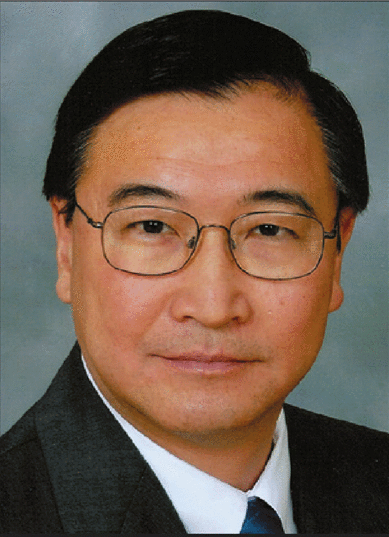 Nim Cheung合作论文数3
 Harvey Freeman合作论文数3
 Leonard Joseph Cimini (Leonard J. Cimini)合作论文数Department of Electrical and Computer Engineering, University of Delaware3j m gibson合作论文数2telcordia technologies合作论文数2celia desmond合作论文数2n ohta合作论文数2jonghee lee合作论文数2
 Saewoong Bahk合作论文数Department of Electrical and Computer Engineering, Seoul National University2
 Sergio Benedetto合作论文数2
 Seong Yong Park合作论文数2
 Jun Won Lee合作论文数Brigham Young University2Seek Chang Kim合作论文数2Won-Hyoung Park合作论文数2Stephen B. Weinstein合作论文数Theory and Technology Consultants2
 Jules A. Bellisio合作论文数Telemediators LLC2
 Hyunyong Choi合作论文数Institute of Applied Physics, Seoul National University/Department of Physics and Astronomy, Seoul National University2Raouf Boutaba合作论文数2
 Ji-Cheol Moon合作论文数2John Pape合作论文数1Eunyong Kim合作论文数1
 Elena Neira合作论文数1
 Jungsu Lee合作论文数1Es Yoon合作论文数1




