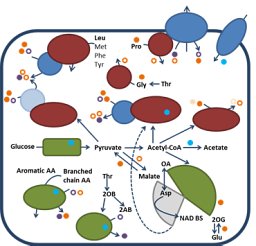
BACKGROUND:The betaproteobacterium Aromatoleum aromaticum EbN1T is a well-studied model for facultative anaerobic degradation specialists. Systems biology-level investigations increasingly require the implementation of genome-wide metabolic models, which in turn are based on an in-depth understanding of all encoded/used metabolic reactions, including biosyntheses. Here, we revisited the genome of A. aromaticum EbN1T, integrating the comprehensive proteomic datasets to reconstruct/update the anabolic network. SUMMARY:In total, A. aromaticum EbN1T devotes 11.6% of its genome's coding space for anabolic purposes, i.e., 485 predicted proteins, of which 348 (71.7% coverage) were identified by mass spectrometry. In detail, 116 proteins were assigned to central anabolism, sugars, and precursors, 111 to amino acid, 43 to nucleotide, 50 to fatty acid, membrane lipid and isoprenoid, and 165 to vitamin and cofactor syntheses. Genes related to individual anabolic pathways are often scattered across the chromosome (except for e.g. histidine or heme d1 biosynthesis). This contrasts the mostly operon-like gene arrangements in the case of the recently reported catabolic network of A. aromaticum EbN1T [Microb Physiol. 2024;1‒77]. KEY MESSAGES:Taken together, the here described anabolic network in conjunction with the recently reported catabolic network facilitate future systems biology-level investigations of the environmental model bacterium A. aromaticum EbN1T.
For many decades the existence of strict aerobic bacteria was part of every textbook. However, considering habitats like soils or surfaces, many of these microorganisms are exposed to drastic changes in oxygen tension. A simple rain shower can change oxygen diffusion rates by a factor of 10.000. Thus, for many of the so-called strict aerobic bacteria, anaerobic growth and survival strategies were discovered, mainly relying on the use of alternative electron acceptors to oxygen, redox-active metabolites, or fermentation processes generating ATP at the substrate level. Survival without growth was recognized as an important lifestyle of bacteria. With the increasing availability of genome data, many highly diverse growth and survival strategies have become apparent in bacteria. But the overall picture is far from complete. Only recently, a novel puzzle piece of the anaerobic survival strategy of the opportunistic pathogen and model bacterium Pseudomonas aeruginosa in the absence of alternative electron acceptors was elucidated. It relies on the re-wiring of carbon flux away from the Entner-Doudoroff pathway towards the pentose-phosphate pathway and use of a phosphoketolase to allow for metabolic flux while preventing nonproductive NADH formation under these fermentation conditions and for ATP generation via acetate kinase.
Bacterial membrane vesicles (BMVs) are secreted by many pathogenic bacteria and known to stimulate various host responses upon infection, thereby contributing to the pathogenicity of bacterial pathogens like Pseudomonas aeruginosa. While the effects of BMVs on host immune responses are well studied, little is known about their impact on cell metabolism and mitochondrial respiration. Here, we show that P. aeruginosa BMVs (i) reprogram cell metabolism of human lung cells, (ii) negatively affect mitochondrial respiration by (iii) specifically inhibiting complex III of the electron transport chain, leading to (iv) the activation of adenosine monophosphate-activated protein kinase (AMPK) signaling, which in turn results in (v) AMPK-dependent inhibition of global protein synthesis.
ABSTRACT The DnaK (Hsp70) protein is an essential ATP‐dependent chaperone foldase and holdase found in most organisms. In this study, combining multiple experimental approaches we determined FliC as major interaction partner of DnaK in the opportunistic bacterial pathogen Pseudomonas aeruginosa. Implementing immunofluorescence microscopy and electron microscopy techniques DnaK was found extracellularly associated to the assembled filament in a regular pattern. dnaK repression led to intracellular FliC accumulation and motility impairment, highlighting DnaK essentiality for FliC export and flagellum assembly. SPOT–membrane peptide arrays coupled with artificial intelligence analyses suggested a highly dynamic DnaK–FliC interaction landscape involving multiple domains and transient complexes formation. Remarkably, in vitro fast relaxation imaging (FReI) experiments mimicking ATP‐deprived extracellular environment conditions exhibited DnaK ATP‐independent holdase activity, regardless of its co‐chaperone DnaJ and its nucleotide exchange factor GrpE. We present a model for the DnaK‐FliC interactions involving dynamic states throughout the flagellum assembly stages. These results expand the classical view of DnaK chaperone functioning and introduce a new participant in the Pseudomonas flagellar system, an important trait for bacterial colonisation and virulence.
Pseudomonas aeruginosa is an opportunistic pathogen causing severe infections of the lung, burn wounds and eyes. Due to its intrinsic high antibiotic resistance the bacterium is difficult to eradicate. A promising therapeutic option is the use of P. aeruginosa-specific bacteriophages. Thus, the implementation of a phage therapy requires their selection, production and systematic administration using multiple strains of the bacterial target. Here, we used 25 phages and tested their susceptibility on 141 different P. aeruginosa strains isolated from patients with different types of infection. Comparative host spectrum analyses were carried out using double agar overlay plaque assay (DPA) and planktonic killing assay (PKA), which resulted in 70% of the cases in the same host range. All phages were assigned to known phage genera, but some of the phages are new species. Isolated members of the genera Pakpunavirus, Pbunavirus (myoviruses), Pawinskivirus, Elvirus (myoviruses, jumbo phages), Litunavirus and Bruynoghevirus (podoviruses) demonstrated great therapeutic potential due to strong lysis behavior on diverse strains. Seven phages were excluded for therapeutic purposes due to genetic determinants that confer lysogenicity. Due to automation with lower time expenditure in execution and analysis, PKA has the higher potential for implementation in diagnostics. Finally, different combinations of phages were tested in silico with various P. aeruginosa strains. Highly efficient phage combinations eradicating multiple P. aeruginosa strains were found. Thus, a solid basis for the development of a broad host range phage therapy was laid.
[This corrects the article DOI: 10.3389/fcimb.2025.1597009.].
Nature utilizes three distinct pathways to synthesise the essential enzyme cofactor heme. An overview of the pathways will be given. The coproporphyrin III-dependent pathway, predominantly present in Bacillaceae ,employs an oxygen-dependent coproporphyrinogen III oxidase (CgoX) that converts coproporphyrinogen III into coproporphyrin III. We report the bioinformatic-based identification of a gene called ytpQ , encoding the oxygen-independent counterpart, which we propose to term CgoN, from Priestia ( Bacillus ) megaterium . The recombinantly produced, purified, and monomeric YtpQ (CgoN) protein is shown to catalyse the oxygen-independent conversion of coproporphyrinogen III into coproporphyrin III. Minimal non-enzymatic conversion of coproporphyrinogen III was observed under the anaerobic test conditions employed in this study. FAD was identified as a cofactor, and menadione served as an artificial acceptor for the six abstracted electrons, with a K M value of 3.95 µmol/L and a k cat of 0.63 per min. for the substrate. The resulting coproporphyrin III, in turn, acts as an effective substrate for the subsequent enzyme of the pathway, the coproporphyrin III ferrochelatase (CpfC). An AlphaFold2 model of the enzyme suggests that YptQ adopts a compact triangular shape consisting of three domains. The N-terminal domain appears to be flexible with respect to the rest of the structure, potentially creating a ligand binding site that opens and closes during the catalytic cycle. A catalytic mechanism similar to the oxygen-independent protoporphyrinogen IX oxidase PgoH1 (HemG), based on the flavin-dependent abstraction of six electrons from coproporphyrinogen III and their potential quinone-dependent transfer to a membrane-localized electron transport chain, is proposed. In a second project, we describe our first steps towards the elucidation of a heme degradation pathway in bacteria. For that purpose bacteria using heme as carbon source were isolated from blood-sucking animals. Omics-based enzyme identification followed.
The development of sustainable alternatives to chemical and mechanical biofilm removal for submerged technical devices used in freshwater and marine environments represents a major technical challenge. In this context, the antibiotic impact of blue light with its low absorption underwater provides a potentially useful alternative. However, former technical limitations led to hours of treatment. Here, we applied high-power blue laser irradiation (1500 W) with a wavelength of 448 nm to demonstrate its strong antibiotic and algicidal effect on different bacteria and algae in seconds. High-power blue light treatment (139 W/cm2) for only 8.9 s led to the efficient deactivation of all tested organisms. Analyses of the underlying biological mechanisms revealed the absorption of the blue light by endogenous chromophores (flavins, tetrapyrroles) with the generation of reactive oxygen species (ROS). In agreement, Escherichia coli transcriptome analyses demonstrated a stress response at the level of DNA damage repair, respiration, and protein biosynthesis. Spectroscopic measurements of the irradiated algae indicated the irreversible damage of chlorophyll by photooxidation with the formation of singlet oxygen. In conclusion, high-power blue laser radiation provides a strong sustainable tool for the removal of biofouling in a very short time for applications in aquatic systems.
Technological advances in blue laser sources are expanding the possibilities for using high-power laser radiation, particularly in the range of 1 kW and above, in marine environments, due to the reduced absorption of laser radiation below 550 nm in water. These developments are creating new opportunities for high power laser underwater applications. One key application is the removal of biofouling from submerged technical surfaces like ship hulls by causing lethal damage to attached organisms. This research investigated the effect of radiation power density on lethal damage to organisms, focusing on naturally grown biofouling. Experiments were carried out with different power densities in the range from high-power blue light emitting diodes (LED) at 0.02 W/mm(2) to high-power blue lasers at 3.88W/mm(2). These results help to understand the relationship between radiation parameters and biological responses, which is crucial for optimizing environmentally friendly technologies. (c) 2024 The Authors. Published by Elsevier B.V. This is an open access article under the CC BY-NC-ND license (https://creativecommons.org/licenses/by-nc-nd/4.0)
Extreme acidophilic bacteria like Leptospirillum sp. require an efficient enzyme system to counteract strong oxygen stress conditions in their natural habitat. The genome of Leptospirillum sp. CF-1 encodes the thioredoxin-fold protein TFP2, which exhibits a high structural similarity to the thioredoxin domain of E. coli CnoX. CnoX from Escherichia coli is a chaperedoxin that protects protein substrates from oxidative stress conditions using its holdase function and a subsequent transfer to foldase chaperones for refolding. Recombinantly produced and purified Leptospirillum sp. TFP2 possesses both thioredoxin and chaperone holdase activities in vitro. It can be reduced by thioredoxin reductase (TrxR). The tfp2 gene co-locates with genes for the chaperone foldase GroES/EL on the chromosome. The “tfp2 cluster” (ctpA-groES-groEL-hyp-tfp2-recN) was found between 1.9 and 8.8-fold transcriptionally up-regulated in response to 1 mM hydrogen peroxide (H2O2). Leptospirillum sp. tfp2 heterologously expressed in E. coli wild type and cnoX mutant strains lead to an increased tolerance of these E. coli strains to H2O2 and significantly reduced intracellular protein aggregates. Finally, a proteomic analysis of protein aggregates produced in E. coli upon exposition to oxidative stress with 4 mM H2O2, showed that Leptospirillum sp. tfp2 expression caused a significant decrease in the aggregation of 124 proteins belonging to fifteen different metabolic categories. These included several known substrates of DnaK and GroEL/ES. These findings demonstrate that Leptospirillum sp. TFP2 is a chaperedoxin-like protein, acting as a key player in the control of cellular proteostasis under highly oxidative conditions that prevail in extreme acidic environments.
Susanne Sievers and Daniela Zühlke were not included as authors in the original publication [...].
Acinetobacter baumannii is an opportunistic human pathogen which can use host-derived L-carnitine as sole carbon and energy source. Recently, an L-carnitine transporter (Aci1347) and a specific monooxygense (CntA/CntB) for the intracellular cleavage of L-carnitine have been characterized. Subsequent conversion of the resulting malic semialdehyde into the central metabolite L-malate was hypothesized. Alternatively, L-carnitine degradation via D-malate with subsequent oxidation into pyruvate was proposed. Here we describe the in vitro and in vivo reconstitution of the entire pathway, starting from the as yet uncharacterized gene products of the carnitine degradation gene operon. Using recombinantly purified enzymes, enantiomer-specific formation of D-malate by the NAD(P)+-dependent malic semialdehyde dehydrogenase (MSA-DH) is demonstrated. The solved X-ray crystal structure of tetrameric MSA-DH reveals the key catalytic residues Cys290 and Glu256, accessible through opposing substrate and cofactor funnels. Specific substrate binding is enabled by Arg166, Arg284 and Ser447 while dual cofactor specificity for NAD+ and NADP+ is mediated by Asn184. The subsequent conversion of the unusual D-malate reaction product by an uncharacterized NAD+-dependent malate dehydrogenase (MDH) is shown. Tetrameric MDH is a β-decarboxylating dehydrogenase that synthesizes pyruvate. MDH experiments with alternative substrates showed a high degree of substrate specificity. Finally, the entire A. baumannni pathway was heterologously reconstituted, allowing E. coli to grow on L-carnitine as a carbon and energy source. Overall, the metabolic conversion of L-carnitine via malic semialdehyde and D-malate into pyruvate, CO2 and trimethylamine was demonstrated. Trimethylamine is also an important gut microbiota-dependent metabolite that is associated with an increased risk of cardiovascular disease. The pathway reconstitution experiments allowed us to assess the TMA forming capacity of gut microbes which is related to human cardiovascular health.
Bacterial membrane vesicles (BMVs) are secreted by many pathogenic bacteria and known to stimulate various host responses upon infection, thereby contributing to the pathogenicity of bacterial pathogens like Pseudomonas aeruginosa . While the effects of BMVs on host immune responses are well studied, little is known about their impact on cell metabolism and mitochondrial respiration. Here, we show that P. aeruginosa BMVs (1) reprogram cell metabolism of human lung cells, (2) negatively affect mitochondrial respiration by (3) specifically inhibiting complex III of the electron transport chain leading to (4) the activation of AMP-activated protein kinase (AMPK) signaling which in turn results in (5) AMPK-dependent inhibition of global protein synthesis. ### Competing Interest Statement The authors have declared no competing interest.
Nature utilizes three distinct pathways to synthesize the essential enzyme cofactor heme. The coproporphyrin III-dependent pathway, predominantly present in Bacillaceae, employs an oxygen-dependent coproporphyrinogen III oxidase (CgoX) that converts coproporphyrinogen III into coproporphyrin III. In this study, we report the bioinformatic-based identification of a gene called ytpQ, encoding a putative oxygen-independent counterpart, which we propose to term CgoN, from Priestia (Bacillus) megaterium. The recombinantly produced, purified, and monomeric YtpQ (CgoN) protein is shown to catalyze the oxygen-independent conversion of coproporphyrinogen III into coproporphyrin III. Minimal non-enzymatic conversion of coproporphyrinogen III was observed under the anaerobic test conditions employed in this study. FAD was identified as a cofactor, and menadione served as an artificial acceptor for the six abstracted electrons, with a KM value of 3.95 μmol/L and a kcat of 0.63 per min for the substrate. The resulting coproporphyrin III, in turn, acts as an effective substrate for the subsequent enzyme of the pathway, the coproporphyrin III ferrochelatase (CpfC). Under aerobic conditions, oxygen directly serves as an electron acceptor, but is replaced by the more efficient action of menadione. An AlphaFold2 model of the enzyme suggests that YtpQ adopts a compact triangular shape consisting of three domains. The N-terminal domain appears to be flexible with respect to the rest of the structure, potentially creating a ligand binding site that opens and closes during the catalytic cycle. A catalytic mechanism similar to the oxygen-independent protoporphyrinogen IX oxidase PgoH1 (HemG), based on the flavin-dependent abstraction of six electrons from coproporphyrinogen III and their potential quinone-dependent transfer to a membrane-localized electron transport chain, is proposed.
In this work, we investigate whether bacteria can be substantially examined in liquid environment with an ellipsometer in the visible wavelength range. For that investigation a Kretschmann type flow cell was used in which the paths of illuminated and reflected light beams are on the substrate side. To enhance the sensitivity a thin gold layer was applied on the top of glass substrate and the measurement was performed by using surface plasmon polaritons. Porphyrin functionalized coating layers were employed to analyze their performance to capture bacteria and to study the stability and repeatability of the optical response with regard to the ellipsometric measurement. Escherichia coli (E. coli) bacteria were used as first model bacteria and their deposition on the sensing surface was monitored in a real-time measurement in a liquid environment.
Pseudomonas aeruginosa (PA) is an opportunistic human pathogen, which is involved in a wide range of dangerous infections. It develops alarming resistances toward antibiotic treatment. Therefore, alternative strategies, which suppress pathogenicity or synergize with antibiotic treatments are in great need to combat these infections more effectively. One promising approach is to disarm the bacteria by interfering with their quorum sensing (QS) system, which regulates the release of various virulence factors as well as biofilm formation. Herein, this work reports the rational design, optimization, and in-depth profiling of a new class of Pseudomonas quinolone signaling receptor (PqsR) inverse agonists. The resulting frontrunner compound features a pyrimidine-based scaffold, high in vitro and in vivo efficacy, favorable pharmacokinetics as well as clean safety pharmacology characteristics, which provide the basis for potential pulmonary as well as systemic routes of administration. An X-ray crystal structure in complex with PqsR facilitated further structure-guided lead optimization. The compound demonstrates potent pyocyanin suppression, synergizes with aminoglycoside antibiotic tobramycin against PA biofilms, and is active against a panel of clinical isolates from bronchiectasis patients. Importantly, this in vitro effect translated into in vivo efficacy in a neutropenic thigh infection model in mice providing a proof-of-principle for adjunctive treatment scenarios.
Background “Red tides” are harmful algal blooms caused by dinoflagellate microalgae that accumulate toxins lethal to other organisms, including humans via consumption of contaminated seafood. These algal blooms are driven by a combination of environmental factors including nutrient enrichment, particularly in warm waters, and are increasingly frequent. The molecular, regulatory, and evolutionary mechanisms that underlie the heat stress response in these harmful bloom-forming algal species remain little understood, due in part to the limited genomic resources from dinoflagellates, complicated by the large sizes of genomes, exhibiting features atypical of eukaryotes. Results We present the de novo assembled genome (~ 4.75 Gbp with 85,849 protein-coding genes), transcriptome, proteome, and metabolome from Prorocentrum cordatum , a globally abundant, bloom-forming dinoflagellate. Using axenic algal cultures, we study the molecular mechanisms that underpin the algal response to heat stress, which is relevant to current ocean warming trends. We present the first evidence of a complementary interplay between RNA editing and exon usage that regulates the expression and functional diversity of biomolecules, reflected by reduction in photosynthesis, central metabolism, and protein synthesis. These results reveal genomic signatures and post-transcriptional regulation for the first time in a pelagic dinoflagellate. Conclusions Our multi-omics analyses uncover the molecular response to heat stress in an important bloom-forming algal species, which is driven by complex gene structures in a large, high-G+C genome, combined with multi-level transcriptional regulation. The dynamics and interplay of molecular regulatory mechanisms may explain in part how dinoflagellates diversified to become some of the most ecologically successful organisms on Earth.
 Rebekka Biedendieck合作论文数Braunschweig Institute of Microbiology, Technical University45
 Martina Jahn合作论文数33
 Max Schobert合作论文数Institute of Microbiology, Technische Universität Braunschweig, Spielmannstr. 7, 38106 Braunschweig, Germany28
 Boyke Bunk合作论文数Institute of Microbiology, Technische Universität Braunschweig25Dirk W. Heinz合作论文数24Jürgen Moser合作论文数24
 Richard Muench合作论文数18
 Elisabeth Hartig合作论文数Inst Microbiol, Tech Univ Carolo Wilhelmina Braunschweig17
 Meina Neumann-Schaal合作论文数Leibniz Inst DSMZ German Collect Microorganisms &, Braunschweig, Germany15
 Jose Manuel Borrero-de Acuna合作论文数15Gunhild Layer合作论文数14Petra Tielen合作论文数14
 Martin Warren合作论文数Department of Biochemistry, University of Southampton13
 Lothar Jansch合作论文数13Wolf-Dieter Schubert合作论文数12
 Christoph Wittmann合作论文数Institute for Systems Biotechnology, Saarland University11Karsten Hiller合作论文数Technical University of Braunschweig11Johannes Klein合作论文数10
 Marco Malten合作论文数10
 Tamara Hoffmann合作论文数9
 Manfred Rohde合作论文数Central Facility for Microscopy, Helmholtz Centre for Infection Research9Christoph Hungerer合作论文数9
 Wolf-Dieter Deckwer合作论文数Technischen Universität Braunschweig9
 Dietmar Schomburg合作论文数Systems Biology Group, Department of Bioinformatics and Biochemistry, Institut für Biochemie, Biotechnologie und Bioinformatik, Fakultät für Lebenswissenschaften, Technische Universität Braunschweig9Klaus H. Seifart合作论文数8R Munch合作论文数7
 Irene Wagner Döbler合作论文数Department of Cell Biology, Institute of Microbiology, Faculty of Life Sciences, Technical University of Braunschweig;Helmholtz Centre For Infection Research, Technical University of Braunschweig7Martin Gamer合作论文数Institute of Microbiology, Technische Universität Braunschweig7Maurice Scheer合作论文数Computing Center, Technische Universität Braunschweig7Andreas Grote合作论文数7Isam Haddad合作论文数7N Frankenberg合作论文数6M Jahn合作论文数6Stammen Simon合作论文数6Roselius Louisa合作论文数6
 Edgar Wingender合作论文数Department of Bioinformatics, Medical School, University of Göttingen/GeneXplain GmbH6
 Ilka U. Heinemann合作论文数Department of Molecular Biophysics and Biochemistry, Yale University;Department of Biochemistry, Western University;Yale University, Western University6Beatrice Benkert合作论文数6Barbara Troup合作论文数6Mareike Berges合作论文数5Daniela Breckau合作论文数5Julia Danielle Hofmann合作论文数5
 Annika-Marisa Michel合作论文数5
 Dieter Soll合作论文数Department of Molecular Biophysics and Biochemistry, Yale University5
 Ralf Rabus合作论文数Institut fur Chemie und Biologie des Meeres, Fakultat Mathematik und Naturwissenschaften, Universitat Oldenburg5Heiko Barg合作论文数5
 Wulf Blankenfeldt合作论文数Department of Chemistry, National Taiwan Normal University5
 Kenneth Timmis合作论文数Institut fur Mikrobiologie, Fakultat fur Lebenswissenschaften, Technical University Braunschweig5Gabriele Günther合作论文数4




