Deep networks face challenges of ensuring their robustness against inputs that cannot be effectively represented by information learned from training data. We attribute this vulnerability to the limitations inherent to activation-based representation. To complement the learned information from activation-based representation, we propose utilizing a gradient-based representation that explicitly focuses on missing information. In addition, we propose a directional constraint on the gradients as an objective during training to improve the characterization of missing information. To validate the effectiveness of the proposed approach, we compare the anomaly detection performance of gradient-based and activation-based representations. We show that the gradient-based representation outperforms the activation-based representation by 0.093 in CIFAR-10 and 0.361 in CURE-TSR datasets in terms of AUROC averaged over all classes. Also, we propose an anomaly detection algorithm that uses the gradient-based representation, denoted as GradCon, and validate its performance on three benchmarking datasets. The proposed method outperforms the majority of the state-of-the-art algorithms in CIFAR-10, MNIST, and fMNIST datasets with an average AUROC of 0.664, 0.973, and 0.934, respectively.
File descriptions train.zip - the training set test.zip - the test set train.csv - the ground truth for the training images with the following information: imageID, class, background, perspective, challengeType, challengeLevel test.csv - the ground truth for the training images with the following information: imageID, class, background, perspective, challengeType, challengeLevel Data fields imageID - an anonymous id unique to a given image class - the class of the object in the given image: 1-10 1: Canon camera 2: Training marker cone 3: Baseball 4: Pan 5: Toy 6: LG Cell phone 7: Hair brush 8: DYMO Label maker 9: Calcium bottle 10: Shoes background - the background of the object 1: 2D white 2: 2D living room 3: 2D kitchen perspective - the perspective/orientation of the object 1: Front 2: Left side - 90 degrees 3: Back - 180 degrees 4: Right side - 270 degrees 5: Top challengeType - the type of generated challenging conditions 01: No challenge 02: Resize 03: Underexposure 04: Overexposure 05: Gaussian blur 06: Contrast 07: Dirty lens 1 08: Dirty lens 2 09: Salt & pepper noise 10: Grayscale 11: Grayscale resize 12: Grayscale underexposure 13: Grayscale overexposure 14: Grayscale gaussian blur 15: Grayscale contrast 16: Grayscale dirty lens 1 17: Grayscale dirty lens 2 18: Grayscale salt & pepper noise challengeLevel - the level of generated challenging conditions 0: No challenge (01) and Grayscale (10) only - no challenge level 1 - 4: the degree of a challenge from least to most For more information about CURE-OR dataset, please refer to the webpage.
Learning representations that clearly distinguish between normal and abnormal data is key to the success of anomaly detection. Most of existing anomaly detection algorithms use activation representations from forward propagation while not exploiting gradients from backpropagation to characterize data. Gradients capture model updates required to represent data. Anomalies require more drastic model updates to fully represent them compared to normal data. Hence, we propose the utilization of backpropagated gradients as representations to characterize model behavior on anomalies and, consequently, detect such anomalies. We show that the proposed method using gradient-based representations achieves state-of-the-art anomaly detection performance in benchmark image recognition datasets. Also, we highlight the computational efficiency and the simplicity of the proposed method in comparison with other state-of-the-art methods relying on adversarial networks or autoregressive models, which require at least 27 times more model parameters than the proposed method.
Semantic segmentation is a scene understanding task at the heart of safety-critical applications where robustness to corrupted inputs is essential. Implicit Background Estimation (IBE) has demonstrated to be a promising technique to improve the robustness to out-of-distribution inputs for semantic segmentation models for little to no cost. In this paper, we provide analysis comparing the structures learned as a result of optimization objectives that use Softmax, IBE, and Sigmoid in order to improve understanding their relationship to robustness. As a result of this analysis, we propose combining Sigmoid with IBE (SCrIBE) to improve robustness. Finally, we demonstrate that SCrIBE exhibits superior segmentation performance aggregated across all corruptions and severity levels with a mIOU of 42.1 compared to both IBE 40.3 and the Softmax Baseline 37.5.
In this paper, we propose a model-based characterization of neural networks to detect novel input types and conditions. Novelty detection is crucial to identify abnormal inputs that can significantly degrade the performance of machine learning algorithms. Majority of existing studies have focused on activation-based representations to detect abnormal inputs, which limits the characterization of abnormality from a data perspective. However, a model perspective can also be informative in terms of the novelties and abnormalities. To articulate the significance of the model perspective in novelty detection, we utilize backpropagated gradients. We conduct a comprehensive analysis to compare the representation capability of gradients with that of activation and show that the gradients outperform the activation in novel class and condition detection. We validate our approach using four image recognition datasets including MNIST, Fashion-MNIST, CIFAR-10, and CURE-TSR. We achieve a significant improvement on all four datasets with an average AUROC of 0.953, 0.918, 0.582, and 0.746, respectively.
Deep neural networks represent data as projections on trained weights in a high dimensional manifold. This is a first-order based absolute representation that is widely used due to its interpretable nature and simple mathematical functionality. However, in the application of visual recognition, first-order representations trained on pristine images have shown a vulnerability to distortions. Visual distortions including imaging acquisition errors and challenging environmental conditions like blur, exposure, snow and frost cause incorrect classification in first-order neural nets. To eliminate vulnerabilities under such distortions, we propose representing data points by their relative positioning in a high dimensional manifold instead of their absolute positions. Such a positioning scheme is based on a data point’s second-order property. We obtain a data point’s second-order representation by creating adversarial examples to all possible decision boundaries and tracking the movement of corresponding boundaries. We compare our representation against first-order methods and show that there is an increase of more than 14% under severe distortions for ResNet-18. We test the generalizability of the proposed representation on larger networks and on 19 complex and real-world distortions from CIFAR-10-C. Furthermore, we show how our proposed representation can be used as a plug-in approach on top of any network. We also provide methodologies to scale our proposed representation to larger datasets.
Visual explanations are logical arguments based on visual features that justify the predictions made by neural networks. Current modes of visual explanations answer questions of the form ‘Why P.7’. These Why questions operate under broad contexts thereby providing answers that are irrelevant in some cases. We propose to constrain these Why questions based on some context Q so that our explanations answer contrastive questions of the form ‘Why P, rather than Q.7’. In this paper, we formalize the structure of contrastive visual explanations for neural networks. We define contrast based on neural networks and propose a methodology to extract defined contrasts. We then use the extracted contrasts as a plug-in on top of existing ‘Why P?’ techniques, specifically Grad-CAM. We demonstrate their value in analyzing both networks and data in applications of largescale recognition, fine-grained recognition, subsurface seismic analysis, and image quality assessment.
Traffic signs are critical for maintaining the safety and efficiency of our roads. Therefore, we need to carefully assess the capabilities and limitations of automated traffic sign detection systems. Existing traffic sign datasets are limited in terms of type and severity of challenging conditions. Metadata corresponding to these conditions are unavailable and it is not possible to investigate the effect of a single factor because of the simultaneous changes in numerous conditions. To overcome the shortcomings in existing datasets, we introduced the CURE-TSD-Real dataset, which is based on simulated challenging conditions that correspond to adversaries that can occur in real-world environments and systems. We test the performance of two benchmark algorithms and show that severe conditions can result in an average performance degradation of 29% in precision and 68% in recall. We investigate the effect of challenging conditions through spectral analysis and show that the challenging conditions can lead to distinct magnitude spectrum characteristics. Moreover, we show that mean magnitude spectrum of changes in video sequences under challenging conditions can be an indicator of detection performance. The CURE-TSD-Real dataset is available online at https://github.com/olivesgatech/CURE-TSD.
Abnormalities in pupillary light reflex can indicate optic nerve disorders that may lead to permanent visual loss if not diagnosed in an early stage. In this study, we focus on relative afferent pupillary defect (RAPD), which is based on the difference between the reactions of the eyes when they are exposed to light stimuli. Incumbent RAPD assessment methods are based on subjective practices that can lead to unreliable measurements. To eliminate subjectivity and obtain reliable measurements, we introduced an automated framework to detect RAPD. For validation, we conducted a clinical study with lab-on-a-headset, which can perform automated light reflex test. In addition to benchmarking handcrafted algorithms, we proposed a transfer learning-based approach that transformed a deep learning-based generic object recognition algorithm into a pupil detector. Based on the conducted experiments, proposed algorithm RAPDNet can achieve a sensitivity and a specificity of 90.6% over 64 test cases in a balanced set, which corresponds to an AUC of 0.929 in ROC analysis. According to our benchmark with three handcrafted algorithms and nine performance metrics, RAPDNet outperforms all other algorithms in every performance category.
In this paper, we analyze the statistics of error signals to assess the perceived quality of images. Specifically, we focus on the magnitude spectrum of error images obtained from the difference of reference and distorted images. Analyzing spectral statistics over grayscale images partially models interference in spatial harmonic distortion exhibited by the visual system but it overlooks color information, selective and hierarchical nature of visual system. To overcome these shortcomings, we introduce an image quality assessment algorithm based on the Spectral Understanding of Multi-scale and Multi-channel Error Representations, denoted as SUMMER. We validate the quality assessment performance over 3 databases with around 30 distortion types. These distortion types are grouped into 7 main categories as compression artifact, image noise, color artifact, communication error, blur, global and local distortions. In total, we benchmark the performance of 17 algorithms along with the proposed algorithm using 5 performance metrics that measure linearity, monotonicity, accuracy, and consistency. In addition to experiments with standard performance metrics, we analyze the distribution of objective and subjective scores with histogram difference metrics and scatter plots. Moreover, we analyze the classification performance of quality assessment algorithms along with their statistical significance tests. Based on our experiments, SUMMER significantly outperforms majority of the compared methods in all benchmark categories.
State-of-the-art algorithms successfully localize and recognize traffic signs over existing datasets, which are limited in terms of challenging condition type and severity. Therefore, it is not possible to estimate the performance of traffic sign detection algorithms under overlooked challenging conditions. Another shortcoming of existing datasets is the limited utilization of temporal information and the unavailability of consecutive frames and annotations. To overcome these shortcomings, we generated the CURE-TSD video dataset and hosted the first IEEE Video and Image Processing (VIP) Cup within the IEEE Signal Processing Society. In this paper, we provide a detailed description of the CURE-TSD dataset, analyze the characteristics of the top performing algorithms, and provide a performance benchmark. Moreover, we investigate the robustness of the benchmarked algorithms with respect to sign size, challenge type and severity. Benchmarked algorithms are based on state-of-the-art and custom convolutional neural networks that achieved a precision of 0.55 and a recall of 0.32, F0.5 score of 0.48 and F2 score of 0.35. Experimental results show that benchmarked algorithms are highly sensitive to tested challenging conditions, which result in an average performance drop of 0.17 in terms of precision and a performance drop of 0.28 in recall under severe conditions. The dataset is publicly available at this https URL.
Scene understanding and semantic segmentation are at the core of many computer vision tasks, many of which, involve interacting with humans in potentially dangerous ways. It is therefore paramount that techniques for principled design of robust models be developed. In this paper, we provide analytic and empirical evidence that correcting potentially errant non-distinct mappings that result from the softmax function can result in improving robustness characteristics on a state-of-the-art semantic segmentation model with minimal impact to performance and minimal changes to the code base.
In this paper, we introduce a portable eye imaging device denoted as lab-on-a-headset, which can automatically perform a swinging flashlight test. We utilized this device in a clinical study to obtain high-resolution recordings of eyes while they are exposed to a varying light stimuli. Half of the participants had relative afferent pupillary defect (RAPD) while the other half was a control group. In case of positive RAPD, patients pupils constrict less or do not constrict when light stimuli swings from the unaffected eye to the affected eye. To automatically diagnose RAPD, we propose an algorithm based on pupil localization, pupil size measurement, and pupil size comparison of right and left eye during the light reflex test. We validate the algorithmic performance over a dataset obtained from 22 subjects and show that proposed algorithm can achieve a sensitivity of 93.8 % and a specificity of 87.5 %.
In this paper, we utilize weight gradients from backpropagation to characterize the representation space learned by deep learning algorithms. We demonstrate the utility of such gradients in applications including perceptual image quality assessment and out-of-distribution classification. The applications are chosen to validate the effectiveness of gradients as features when the test image distribution is distorted from the train image distribution. In both applications, the proposed gradient based features outperform activation features. In image quality assessment, the proposed approach is compared with other state of the art approaches and is generally the top performing method on TID 2013 and MULTI-LIVE databases in terms of accuracy, consistency, linearity, and monotonic behavior. Finally, we analyze the effect of regularization on gradients using CURE-TSR dataset for out-of-distribution classification.
In this paper, we investigate the reliability of online recognition platforms, Amazon Rekognition and Microsoft Azure, with respect to changes in background, acquisition device, and object orientation. We focus on platforms that are commonly used by the public to better understand their real-world performances. To assess the variation in recognition performance, we perform a controlled experiment by changing the acquisition conditions one at a time. We use three smartphones, one DSLR, and one webcam to capture side views and overhead views of objects in a living room, an office, and photo studio setups. Moreover, we introduce a framework to estimate the recognition performance with respect to backgrounds and orientations. In this framework, we utilize both handcrafted features based on color, texture, and shape characteristics and data-driven features obtained from deep neural networks. Experimental results show that deep learning- based image representations can estimate the recognition performance variation with a Spearman's rank-order correlation of 0.94 under multifarious acquisition conditions.
In this paper, we generate and control semantically interpretable filters that are directly learned from natural images in an unsupervised fashion. Each semantic filter learns a visually interpretable local structure in conjunction with other filters. The significance of learning these interpretable filter sets is demonstrated on two contrasting applications. The first application is image recognition under progressive decolorization, in which recognition algorithms should be color-insensitive to achieve a robust performance. The second application is image quality assessment where objective methods should be sensitive to color degradations. In the proposed work, the sensitivity and lack thereof are controlled by weighing the semantic filters based on the local structures they represent. To validate the proposed approach, we utilize the CURE-TSR dataset for image recognition and the TID 2013 dataset for image quality assessment. We show that the proposed semantic filter set achieves state-of-the-art performances in both datasets while maintaining its robustness across progressive distortions.
Robust and reliable traffic sign detection is necessary to bring autonomous vehicles onto our roads. State-of-the-art algorithms successfully perform traffic sign detection over existing databases that mostly lack severe challenging conditions. VIP Cup 2017 competition focused on detecting such traffic signs under challenging conditions. To facilitate such task and competition, we introduced a video dataset denoted as CURE-TSD that includes a variety of challenging conditions. The goal of this challenge was to implement traffic sign detection algorithms that can robustly perform under such challenging conditions. In this article, we share an overview of the VIP Cup 2017 experience including competition setup, teams, technical approaches, participation statistics, and competition experience through finalist teams members' and organizers' eyes.
In this paper, we introduce a large-scale, controlled, and multi-platform object recognition dataset denoted as Challenging Unreal and Real Environments for Object Recognition (CURE-OR). In this dataset, there are 1,000,000 images of 100 objects with varying size, color, and texture that are positioned in five different orientations and captured using five devices including a webcam, a DSLR, and three smartphone cameras in real-world (real) and studio (unreal) environments. The controlled challenging conditions include underexposure, overexposure, blur, contrast, dirty lens, image noise, resizing, and loss of color information. We utilize CURE-OR dataset to test recognition APIs - Amazon Rekognition and Microsoft Azure Computer Vision - and show that their performance significantly degrades under challenging conditions. Moreover, we investigate the relationship between object recognition and image quality and show that objective quality algorithms can estimate recognition performance under certain photometric challenging conditions. The dataset is publicly available at https://ghassanalregib.com/cure-or/ https://ghassanalregib.com/cure-or/.
Presents a listing of the editorial board, board of governors, current staff, committee members, and/or society editors for this issue of the publication.
In this paper, we train independent linear decoder models to estimate the perceived quality of images. More specifically, we calculate the responses of individual non-overlapping image patches to each of the decoders and scale these responses based on the sharpness characteristics of filter set. We use multiple linear decoders to capture different abstraction levels of the image patches. Training each model is carried out on 100,000 image patches from the ImageNet database in an unsupervised fashion. Color space selection and ZCA Whitening are performed over these patches to enhance the descriptiveness of the data. The proposed quality estimator is tested on the LIVE and the TID 2013 image quality assessment databases. Performance of the proposed method is compared against eleven other state of the art methods in terms of accuracy, consistency, linearity, and monotonic behavior. Based on experimental results, the proposed method is generally among the top performing quality estimators in all categories.
 Ghassan Alregib合作论文数School of Electrical and Computer Engineering, College of Engineering, Georgia Institute of Technology39
 Mohit Prabhushankar合作论文数Georgia Institute of Technology11
 Gukyeong Kwon合作论文数Amazon8
 Charles Lehman合作论文数Sch Elect & Comp Engn, Georgia Inst Technol2
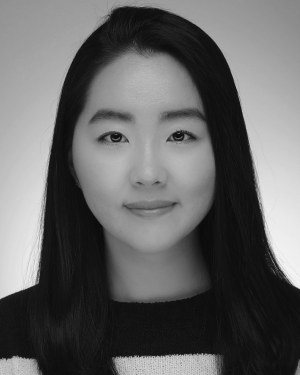 Jinsol Lee合作论文数2
 Khalifa Yousuf M合作论文数2
 Min-Hung Chen (陳敏弘)合作论文数NVIDIA2
 Mohammed A. I. Aabed合作论文数2
 Mashhour Solh合作论文数Georgia Institute of Technology2
 Muhammad Shahid合作论文数1John Edwards合作论文数1
 Tariq Alshawi合作论文数1
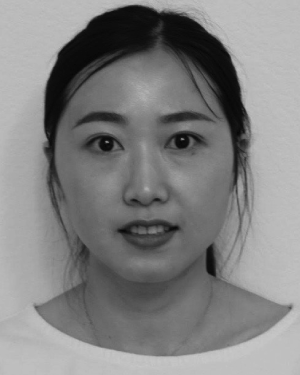 Qiongjie Lin合作论文数1
 Jacob Sogaard合作论文数1
 Lukas Krasula合作论文数1
 Zhen Wang合作论文数CeGP, Georgia Inst Technol1
 Manzoor Razaak合作论文数1
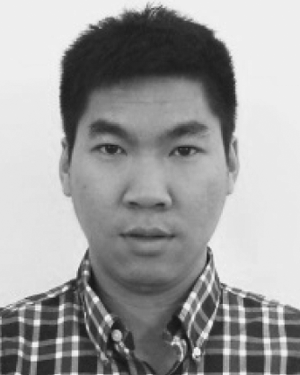 Guangcong Zhang合作论文数1Dalong Liu合作论文数1
 Robert W. Heath Jr.合作论文数Jacobs School of Engineering, University of California, San Diego;MIMO Wireless Inc.1Stephen So合作论文数1
 Kjell Brunnström合作论文数Acreo Swedish ICT AB1
 Emad S. Ebbini合作论文数Department of Electrical and Computer Engineering, University of Minnesota1Claudio Simon合作论文数1




