This study presented an algorithm for fast hardware execution of complex cube root. In this algorithm, which is based on the Laurent series of ∛z function, first, the z-plane's numbers are mapped by using a rapid scaling and rotation operation to a pre-specified limited region, and then the sequences of the series are computed. The parameters of the algorithm are thoroughly analyzed and selected to achieve high precision. The algorithm has been implemented on a field programmable gate array-based platform using the Simulink HDL Coder tool and Xilinx ISE 14.7. In addition, the resource usage and speed parameters are carefully examined for the imple-mentation of each step of the algorithm. Hardware was implemented in two 56-bit and 32-bit versions (for comparison). The 32-bit version occupies 140 slice Regs, 421 slice LUTs, and 5 DSP48s. The hardware with the capability of computing complex cube roots has appropriate specifications comparable with those of previous implementations of real cube root calculation on FPGA.
Compared to the traditional monostatic MIMO radar which uses uniform linear arrays (ULAs) for transmitting and receiving signals, sparse linear arrays (SLAs) monostatic MIMO radars can achieve greater Degrees Of Freedom (DOF) and a higher resolution. The optimal placement of sensors in both transmit and receive arrays to attain the maximum DOF is, however, a basic problem in the collocated monostatic MIMO radar. Optimum solution of such a problem is restricted to an exhaustive computer search. Some popular arrays such as nested and coprime arrays have been previously proposed as alternative solutions that can achieve a good DOF, but they do not necessarily lead to the maximum one. In this paper at first, we formulate the optimal placement of sensors in the collocated monostatic MIMO radar to improve the sum coarray as well as the difference coarray of the sum coarray. After that, we present a mathematical framework to achieve the optimal solution for both problems. Finally, we demonstrate that the proposed method yields the optimal MR-MIMO array while demanding much less computational complexity as compared with the computer search.
This article presents a new structure of image sensor that compresses the image information based on the compressive sensing (CS) technique and employing a measurement matrix. In the proposed structure to perform compression, the image related voltages on the capacitors in each neighboring pixels are summed in a specific regular pattern. Also, the high sparsity of moving objects images which obtained from the difference images has been exploited and the proposed structure compresses the image information both in the normal and difference modes. Implementation of the measurement matrix and linear combination of the pixel data is done by simple connections between the pixels. The results of 300 images and 30 difference images compressed and recovered through a deterministic measurement matrix show the PSNR values of 26.65 dB and 40.09dB respectively. The results show the effect of applying presented method on the quality of recovered images.
Magnetic Resonance Imaging as non-invasive imaging can produce detailed anatomical images. MRI is a time- consuming imaging technique. Several imaging techniques, like parallel imaging, have been suggested to enhance imaging speed. Compressive Sensing MRI utilizes the sparsity of MR images to reconstruct MR images with under-sampled k-space data. It has already been shown that convolutional neural networks work better than sparsity-based approaches in image quality and reconstruction speed. In this paper, a novel method based on very deep CNN for the reconstruction of MR images is proposed using Generative Adversarial Networks. Generative and discriminative networks are designed with improved ResNet architecture. Using improved architecture has led to deepening generative and discriminative networks, reducing aliasing artifacts, more accurate reconstruction of edges, and better reconstruction of tissues. Compared to DLMRI and DAGAN methods, we demonstrate the proposed method outperforms the conventional methods and deep learning-based approaches. Assessment is made on several datasets such as the brain, heart, and prostate. Reconstruction of brain data with a Cartesian mask of 30% in the proposed method has improved the SSIM criteria up to 0.99. Also, image reconstruction time is approximately 20 ms on GPU, which is suitable for real-time applications.
Synthetic aperture radar (SAR) tomography (TomoSAR) is an appealing tool for the extraction of height information of urban infrastructures. Due to the widespread applications of the multiple signal classification (MUSIC) algorithm in source localization, it is a suitable solution in TomoSAR when multiple snapshots (looks) are available. While the classical MUSIC algorithm aims to estimate the whole reflectivity profile of scatterers, sequential MUSIC algorithms are suited for the detection of sparse point-like scatterers. In this class of methods, successive cancellation is performed through orthogonal complement projections on the MUSIC power spectrum. In this work, a new sequential MUSIC algorithm named recursive covariance cancelled MUSIC (RCC-MUSIC), is proposed. This method brings higher accuracy in comparison with the previous sequential methods at the cost of a negligible increase in computational cost. Furthermore, to improve the performance of RCC-MUSIC, it is combined with the recent method of covariance matrix estimation called correlation subspace. Utilizing the correlation subspace method results in a denoised covariance matrix which in turn, increases the accuracy of subspace-based methods. Several numerical examples are presented to compare the performance of the proposed method with the relevant state-of-the-art methods. As a subspace method, simulation results demonstrate the efficiency of the proposed method in terms of estimation accuracy and computational load.
A great deal of attention is being paid to OFDM modulation in visible light communication systems and it because of its advantages such as reducing the intersymbol interference (ISI) and using a simple equalizer to compensate the optical channel. However, transmitted optical signals have been restricted to be real and nonnegative. Therefore, OFDM modification techniques that meet the requirement of optical signals, have played a pivotal role in wireless optical communication researches. This paper surveys and analyzes different OFDM techniques and compares them with each other.
Compared to the uniform linear array (ULA), the sparse linear array (SLA) has many advantages such as a greater degrees of freedom (DOF), a higher resolution, and robustness against mutual coupling. The optimal placement of elements to achieve the maximum DOF in SLA has been an old problem in array signal processing. Finding the optimum placement is limited to an exhaustive computer search as yet. Therefore, some familiar SLAs (such as `nested' and `coprime' arrays) have been suggested to improve DOF although none of them necessarily can achieve the maximum DOF with a certain number of sensors. In this paper, first we have proposed a novel hole-free SLA that yields the minimum number of sensors (MSA) for the desired DOF. The optimization problem associated with such an array is a nonlinear binary optimization problem. Then, the problem is transformed into a binary linear programming (BLP) problem which could be solved exactly. Using the proposed method, a fast and efficient solution to the minimum redundancy array(MRA) is found. Finally, the simulation results show that the proposed array has a higher DOF compared to the other competitive methods for a given number of sensors, which is the maximum possible DOF. This can lead to a better target resolution and DOA estimation.
An industrial process includes many devices, variables, and sub-processes that are physically or electronically interconnected. These interconnections imply some level of correlation between different process variables. Since most of the alarms in a process plant are defined on process variables, alarms are also correlated. However, this can be a nuisance to operators, for one fault might trigger a, sometimes large, number of alarms. So, it is essential to find and correct correlated alarms. In this paper, we study different methods and techniques proposed to measure correlation or similarity between alarms. The similarity indices are first analytically calculated and then studied and compared. The results are also validated using Monte-Carlo simulation.
Abstract. The erratum corrects an error in the originally published version of the article.
Energy beamforming (EB) is a key technique to enhance the efficiency of wireless power transfer (WPT). In this paper, we study the optimal EB under per-antenna power constraint (PAC) which is more practical than the conventional sum-power constraint (SPC). We consider a multi antenna energy transmitter (ET) with PAC that broadcasts wireless energy to multiple randomly placed energy receivers (ER)s within its cell area. We consider sum energy maximization problem with PAC and provide the optimal solution structure for the general case. This optimal structure implies that sending one energy beam is optimal under PAC which means that the rank of transmit covariance matrix is one similar to SPC. We also derive closed-form solutions for two special cases and propose two sub-optimal solutions for general case, which performs very close to optimal beamforming.
This paper presents a fixed point design and implementation of a low-complexity high-throughput digital predistorter (DPD) on FPGA. Based on the memory polynomial model, a parallel structure is proposed for the implementation of the DPD and the effects of the fixed-point implementation on the performance are analyzed employing fidelity metrics such as modulation error ratio and adjacent channel power ratio. According to this analysis, an optimized fixed-point hardware implementation of the proposed DPD with proper word lengths is presented. Besides some simplifications to the proposed structure, a number of effective modifications are proposed for clock enhancement. The improved clock frequency of the proposed implementation makes it a fit choice for application over communication signals with considerable bandwidth. The required hardware and the maximum clock rate corresponding to these modifications are evaluated and reported. The performance of the proposed DPD in linearization of an actual power amplifier (PA) is also experimentally evaluated, through application of an appropriate hardware setup. Experimental results show about 11 dB ACPR improvement in the PA output for a 128-QAM test signal. The moderate hardware resource requirement of the proposed high-throughput DPD is also verified through comparison with some remarkable works in the same area.
In this paper, we consider the problem of direction of arrival (DOA) estimation on a large sensor array, in the case of missing data resulting from chain failure or employed sub-sampling schemes. Since the missing measurements impair the performance of DOA estimation, we propose to recover the missing entries from the available ones, by applying matrix completion (MC) techniques. We use three well-known MC algorithms SVT, LMaFit, and OptSpace for imputation of the missing entries and then employing MUSIC algorithm to estimate the angles of impinging signals. In addition, we improve the performance of MC techniques, by employing the information theoretic based source enumeration methods, such as MDL and AIC, instead of the heuristic and imprecise rank estimator in current methods. The mean-square error (MSE) of DOA estimation is taken as an assessment criterion for comparing the performance of the aforementioned MC algorithms. Simulation results are conducted to show that in addition to performance improvement achieved by imputation of the missing measurements, the LMaFit algorithm with the proposed rank estimator has the lowest runtime and DOA MSE comparing to the other well-known MC algorithms.
Speckle noise is one of the critical disturbances that present in the radar imagery. This noise degrades the quality of synthetic aperture radar (SAR) images and needs to be reduced before using SAR images. This paper investigates a novel method for despeckling of SAR images in the distributed compressed sensing (DCS) framework. A linear matrix-based formulation is developed for the received SAR raw data and a compressive measurement and partitioning (CMP) scheme is proposed to collect and partition the SAR data into some data subsets. Then, a DCS-based despeckling method is proposed, in which, all data subsets are jointly considered in image formation and noise reduction. One of the important features of the proposed method is that the image formation and speckle reduction are done jointly. Finally, experimental results are provided to show the effectiveness of the proposed method in comparison to the previous ones.
In this paper, a novel method is proposed for designing a bike network in urban areas. Based on the number of taxi trips within an urban area, a weighted network is abstracted. In this network, nodes are the origins and destinations of taxi trips and the number of trips among them is abstracted as link weights. Data is extracted from the Taxi smart card system of a real city. Then, Communities i.e. clusters of this network are detected using a modularity maximization method. Each community contains the nodes with highest number of trips within the cluster and lowest number of trips with other clusters. Within each community, the nodes close enough to each other for being traveled by bicycle are detected as key points and some non-dominated bike network connecting these nodes are enumerated using a bi-objective optimization model. The total travel cost (distance or time) on the network and the path length are considered as objectives. The method is applied to Isfahan city in Iran and a total of seven regions with some non-dominated bike networks are proposed.
Sparse recovery methods find extensive applications in various fields such as image and audio processing, wireless communication, and spectral estimation. In this paper, a hardware architecture of iterative method with adaptive thresholding (IMAT) is presented to recover a sparse signal from its random samples. To demonstrate the effectiveness of IMAT, a comparison is performed between the IMAT algorithm and the compressive sensing recovery method, orthogonal matching pursuit, in terms of complexity and reconstruction quality. In the context of image reconstruction, as a practical case, simulation results show the advantages of IMAT in improving the performance of the signal reconstruction via peak signal-to-noise ratio and structural similarity index metrics. Since IMAT employs discrete transform as a principal operation in each iteration, using fast or fast approximate algorithms allows more efficient implementation. In this paper, two multiplication-free transforms, Walsh–Hadamard transform (WHT) and approximate discrete cosine transform (ADCT), are used to reduce computational complexity of IMAT implementation. The IMAT recovery algorithm is implemented on Virtex6 FPGA using two above transforms, and the results are compared with respect to the hardware resource utilization, power consumption, and recovery time. The results demonstrate that using WHT for IMAT implementation is more efficient than using ADCT in terms of hardware resources. Also, the comparison implies that the performance of the hardware implementation is very close to its floating point simulated counterpart. For a block size of $32 \times 32$ , the IMAT implementation using WHT provides the reconstruction time of $185~\mu \text{s}$ and the dynamic power of 123 mW.
Reconstruction algorithms of compressively sampled data include solving a sparse approximation problem. This problem requires iterative search or optimization techniques. Software implementations are not fast enough for real-time applications of recovery algorithms and these algorithms should be implemented in hardware. This paper presents a low-complexity hardware for real-time reconstruction of compressively sensed signal using orthogonal matching pursuit algorithm. The main goal of this research is to provide a deterministic alternative to the random measurement matrix. The construction of this matrix is based on the connection between the parity check matrix of low-density parity-check (LDPC) codes and the measurement matrix of compressive sensing. For efficient hardware realization, a geometric approach to the construction of LDPC codes is used for matrix generation on the fly without requiring a lot of storage. Cyclic and binary structure of this matrix leads to the lower computational complexity and hardware cost in the reconstruction side. The described hardware has been implemented and evaluated on a virtex6 field-programmable gate array from Xilinx. Implementation results show that the proposed architecture has better performance in terms of hardware utilization. Moreover, the accuracy of the recovered signal is comparable with the previous works in which the random measurement matrix is used.
This letter proposes a multiple parametric dictionary learning algorithm for direction of arrival (DOA) estimation in presence of array gain-phase error and mutual coupling. It jointly solves both the DOA estimation and array imperfection problems to yield a robust DOA estimation in presence of array imperfection errors and off-grid. In the proposed method, a multiple parametric dictionary learning-based algorithm with an steepest-descent iteration is used for learning the parametric perturbation matrices and the steering matrix simultaneously. It also exploits the multiple snapshots information to enhance the performance of DOA estimation. Simulation results show the efficiency of the proposed algorithm when both off-grid problem and array imperfection exist.
Massive MIMO systems promise high data rates by employing large number of antennas, which also increases the power usage of the system as a consequence. This creates an optimization problem which specifies how many antennas the system should employ in order to operate with maximal energy efficiency. Our main goal is to consider a base station with a fixed number of antennas, such that the system can operate with a smaller subset of antennas according to the number of active user terminals, which may vary over time. Thus, in this paper we propose an antenna selection algorithm which selects the best antennas according to the better channel conditions with respect to the users, aiming at improving the overall energy efficiency. Then, due to the complexity of the mathematical formulation, a tight approximation for the consumed power is presented, using the Wishart theorem, and it is used to find a deterministic formulation for the energy efficiency. Simulation results show that the approximation is quite tight and that there is significant improvement in terms of energy efficiency when antenna selection is employed.
In this paper, we consider an exponentially windowed sample covariance matrix (EWSCM) and propose an improved estimator for its eigenvalues. We use new advances in random matrix theory, which describe the limiting spectral distribution of the large dimensional doubly correlated Wishart matrices to find the support and distribution of the eigenvalues of the EWSCM. We then employ the complex integration and residue theorem to design an estimator for the eigenvalues, which satisfies the cluster separability condition, assuming that the eigenvalue multiplicities are known. We show that the proposed estimator is consistent in the asymptotic regime and has good performance in finite sample size situations. Simulation results show that the proposed estimator outperforms the traditional estimator, significantly.
Due to take advantage of large number of antennas, massive MIMO systems are able to serve high data rates. On the other hand, using more antennas will rise the hardware power consumption and therefore total power consumption. So, a trade-off between data rate and power consumption is made which can be reflected well in Energy-Efficiency parameter. Considering hardware power consumption results to more realistic model. In this paper, a model for Energy-Efficiency by taking hardware power consumption into account is introduced and then, an antenna selection algorithm is presented to improve Energy-Efficiency. As dimensions of system is high, this algorithm is designed simple. Next, different selection scenario will be investigated and at the end an optimization for a special case will be represented. Our simulations results show significant improvement in Energy-Efficiency for antenna selection case using proposed method.
 Saeed Gazor合作论文数Department of Electrical and Computer Engineering, Queen's University5
 Mohammad Sadegh Fazel合作论文数Isfahan Univ Technol, Fac Elect & Comp Engn, Esfahan, Iran4
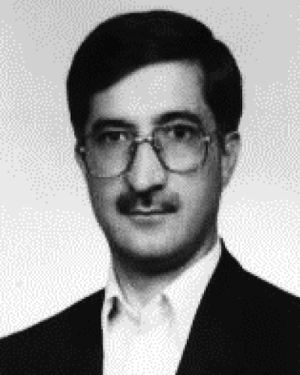 Sayed Masoud Sayedi合作论文数Department of Electrical and Computer Engineering, Isfahan University of Technology3
 Mojtaba Beheshti合作论文数From the Departments of Surgery (Division of Urology), Pathology, and Pediatrics (Division of Endocrinology),, The Hospital for Sick Children3
 Mohammad Ebrahimi合作论文数2
 Masoud Arash合作论文数Institute of Information and Communication Technologies, Université Catholique de Louvain2
 Ahmad Naghavi合作论文数Department of Electrical and Computer Engineering, Isfahan University of Technology2
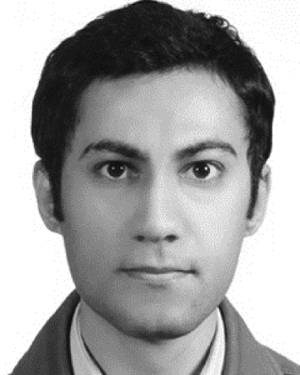 Mohammad Fardad合作论文数Dept Elect & Comp Engn, Isfahan Univ Technol2
 Mohammad Reza Pakravan合作论文数Department of Electrical Engineering, Sharif University of Technology;Advanced Communication Research Institute, Sharif University of Technology2
 Mohammad Hasan Bastani合作论文数2
 Foroogh S Tabataba合作论文数Dept .;Sharif University of Technology;Sharif University of Technology2
 Mahmoud Modarres-Hashemi合作论文数Cryptography & System Security Research Laboratory, Isfahan University of Technology2
 Amir Hossein Kargaran合作论文数Centrum für Informations- und Sprachverarbeitung, Ludwig-Maximilians-Universität München1Elias Rajaby合作论文数1Neshastegaran Amir合作论文数1Shahabuddin Rahmanian合作论文数1alireza setayesh合作论文数1Zahra Rezaei合作论文数Department of Electrical and Computer Engineering, Isfahan University of Technology, Isfahan, Iran1
 Sina Mohri合作论文数Dept Infrastruct Engn, Univ Melbourne1Bastani, H.合作论文数1Sepehri Zahra合作论文数1
 Jawad A. Salehi合作论文数Optical Networks Research Laboratory, Department of Electrical Engineering, Sharif University of Technology1
 Mohammad Javad Omidi合作论文数Department of Electrical and Computer Engineering, Isfahan University of Technology1
 Mohammad Hossein Bateni合作论文数Google Research1
 Farhad Akhoundi合作论文数1
 Hadi Zayyani合作论文数Electrical engineering department1
 Iman Izadi合作论文数Department of Electrical and Computer Engineering, University of Alberta1
 Ali M. Doost-Hoseini合作论文数1
 Meisam Akbarzadeh合作论文数1
 Hamid Hosseinianfar合作论文数1
 Mohammad Hassan Bastani合作论文数1
 Aliakbar Tadaion合作论文数1
 Mahmoud Farhang合作论文数1
 Mohammad Reza Ahmadzadeh合作论文数Electrical & Computer Engineering Department, Isfahan University of Technology1
 Mohsen Sharifi Tabar合作论文数Sharif University of Technology1
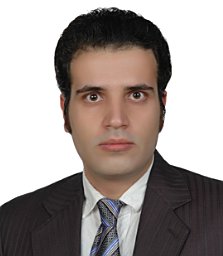 Morteza H. Shoreh合作论文数1
 Mohammadreza Malek-Mohammadi合作论文数Department of Electrical Engineering, Sharif University of Technology1
 Glauber Brante合作论文数CPGEI, Federal University of Technology (UTFPR),1
 Mahmoud Reza Ahmadi合作论文数1




