The term hydrobatics is inspired by aerobatics and refers to a new class of highly dynamic maneuvers performed by Autonomous Underwater Vehicles (AUVs) with maximum agility and precision. Due to the complex interaction with the ocean environment, advanced control systems are required, which allow for precise maneuvering despite model uncertainties and external disturbances such as ocean currents. In addition, time-critical maneuvers often demand formal timing guarantees, such as fixed-time or finite-time convergence. Nonlinear Model Predictive Control (NMPC) is one of the dominant approaches for tracking control, due to its ability to handle nonlinear models and its constraint satisfaction guarantees. However, classical control strategies - including Sliding Mode Control (SMC), Backstepping, and Incremental Nonlinear Dynamic Inversion (INDI) also remain relevant, due to their robustness to model uncertainties and lower computational demands. This work provides an overview of the recent advances in control strategies for hydrobatic AUVs, with a focus on robustness, performance guarantees, and timing-aware control design.
Learning-based methods have enabled robots to acquire bio-inspired movements with increasing levels of naturalness and adaptability. Among these, Imitation Learning (IL) has proven effective in transferring complex motion patterns from animals to robotic systems. However, current state-of-the-art frameworks predominantly rely on Proximal Policy Optimization (PPO), an on-policy algorithm that prioritizes stability over sample efficiency and policy generalization. This paper proposes a novel IL framework that combines Adversarial Motion Priors (AMP) with the off-policy Soft Actor-Critic (SAC) algorithm to overcome these limitations. This integration leverage replay-driven learning and entropy regularized exploration, enabling naturalistic behavior and task execution improving data efficiency and robustness. We evaluate the proposed approach (AMP+SAC) on quadruped gaits involving multiple reference motions and diverse terrains. Experimental results demonstrate that the proposed framework not only maintains stable task execution but also achieves higher imitation rewards compared to the widely used AMP+PPO method. These findings highlight the potential of an off-policy IL formulations for advancing motion generation in robotics.Code and supplementary material are available at: url{https://github.com/nayariml/AMP_SAC.git}
State estimation is a key component in model-based control of walking robots and, more broadly, applicable wherever hidden variables must be inferred. The Kalman filter is widely used to estimate floating-base position and velocity by fusing multiple sensing modalities. However, tuning noise parameters is challenging and typically requires expert knowledge. Moreover, fixed noise parameters are unsuitable for varying gaits and environments. We propose an online adaptation strategy for the process noise covariance matrix Q and the measurement noise covariance matrix R. Specifically, we introduce a filter residual and innovation-based covariance adaptation method for legged robot state estimation and evaluate it against a baseline approach relying on IMU and foot force measurements. The proposed adaptation is implemented within an Invariant Extended Kalman Filter (InEKF) fusing IMU and leg kinematics. Experiments on indoor and outdoor datasets with a Unitree Go2 quadruped show that adapting R is sufficient and improves accuracy by 25
Dynamical Movement Primitives (DMPs) provide a stable and generalizable framework for learning from demonstration, but their classical formulation is limited to pose trajectories with predefined temporal dynamics, reducing their applicability to contact-rich manipulation tasks. We present 3C- DMP (Composite, Contextual, and Compliant Dynamical Movement Primitives), an extension that enables multi-modal and adaptive skill reproduction. The framework introduces: (i) a composite representation that synchronizes Cartesian pose, wrench trajectories, and gripper actions through a shared canonical system over segmented trajectories; (ii) a compliant wrench encoding that directly represents forces and torques in the forcing-term space, ensuring spatio-temporal coupling with motion; and (iii) a contextual phase adaptation mechanism in which a neural modulation network adjusts execution speed online based on task context and tracking error. The framework is implemented in ROS 2 and evaluated on a KUKA LBR iiwa across four tasks: electrical plug insertion, gear assembly, Push-T, and human-to-robot object handover. Using a single demonstration per task, 3C-DMP improves pose–wrench and gripper synchronization over standard DMPs in direct baseline comparisons, generalizes to changed Push-T boundary conditions with success rates of up to 80%, and supports contact-triggered handover timing. These results demonstrate the potential of 3C-DMP as a sample-efficient foundation for compliant, context-aware robot skill learning.
Autonomous underwater vehicles are required to perform multiple tasks adaptively and in an explainable manner under dynamic, uncertain conditions and limited sensing, challenges that classical controllers struggle to address. This demands robust, generalizable, and inherently interpretable control policies for reliable long-term monitoring. Reinforcement learning, particularly multi-task RL, overcomes these limitations by leveraging shared representations to enable efficient adaptation across tasks and environments. However, while such policies show promising results in simulation and controlled experiments, they yet remain opaque and offer limited insight into the agent's internal decision-making, creating gaps in transparency, trust, and safety that hinder real-world deployment. The internal policy structure and task-specific specialization remain poorly understood. To address these gaps, we analyze the internal structure of a pretrained multi-task reinforcement learning network in the HoloOcean simulator for underwater navigation by identifying and comparing task-specific subnetworks responsible for navigating toward different species. We find that in a contextual multi-task reinforcement learning setting with related tasks, the network uses only about 1.5
Introduction:Modern manufacturing demands flexible, robust robotic assembly systems capable of handling variable part geometries and dynamic task configurations. Current approaches often suffer from limited generalization, high sample complexity, and the need for extensive reconfiguration or retraining when task parameters change. This paper addresses these limitations by introducing a novel framework that enables adaptive reproduction of kinesthetically taught, contact-rich assembly policies, using only force/torque and proprioceptive sensing. Methods:The approach combines three components: i. synchronized wrench-motion Dynamic Movement Primitives (wDMPs) that encode coupled motion and wrench profiles from a single demonstration; ii. an uncertainty-aware Model Predictive Controller (MPC) that updates its model online to enable compliant and adaptive contact handling using uncertainty estimated via a Gaussian Mixture Model (GMM); and iii. a neural contact classifier based on Adaptive Resonance Theory (ART) that distinguishes intended contacts from unintended misalignments and coordinates transitions between assembly stages. Results and Discussion:Trained on just two demonstrations, one kinesthetic teaching and one assisted successful reproduction, the framework was evaluated on standard benchmarks and real-world industrial scenarios, including peg-in-hole, plug insertion, and disc brake assemblies. Across 47 assemblies, our framework increased the success rate from 29.8% to 83% in comparison to a classic, nonadaptive compliant controller, and demonstrated improved robustness and transferability over baseline controllers under geometric and pose variations. This contributes towards enabling agile, customizable production with minimal reprogramming effort.
In robotics, many different approaches ranging from classical planning over optimal control to reinforcement learning (RL) are developed and borrowed from other fields to achieve reliable control in diverse tasks. To get a clear understanding of their individual strengths and weaknesses and their applicability in real-world robotic scenarios, it is important to benchmark and compare their performances not only in a simulation but also on real hardware. The second AI Olympics with RealAIGym competition was held at the 2024 IEEE/RSJ International Conference on Intelligent Robots and Systems (IROS 2024) to contribute to this cause and evaluate different controllers according to their ability to solve a dynamic control problem on an underactuated double-pendulum system (Figure 1) with chaotic dynamics. This article describes the four different RL methods submitted by the participating teams; presents their performance in the swing-up task on a real double pendulum, measured against various criteria; and discusses their transferability from simulation to real (sim-to-real) hardware and their robustness to external disturbances.
Motion planning for robot manipulators in a cluttered environment is one of the most researched areas in the field of robotics.For high degrees of freedom (DOF) robotic systems, optimization-based motion planners are often preferred for trajectory planning, as they are computationally efficient and provide a smooth, locally optimal solution.To converge to an optimal solution, an optimization-based motion planner needs a good initial trajectory. Finding an initial trajectory, which is not far away from the basin of attraction of the optimum is not a trivial task. In this work, we propose an Initial Trajectory Prediction Network (ITPNet), a deep neural network framework for predicting an initial trajectory to warm start optimization-based motion planners.Given a planning task in the form of task and environment features, the ITPNet predicts the best initial trajectory for warm starting an optimization-based motion planner. Two different task features: joint and Cartesian features, and three types of environment features extracted using: Principal Component Analysis (PCA), Variational Autoencoder (VAE), and Signed Spatial Distance (SSD) techniques are compared.The learned models are evaluated on an upper-torso humanoid system in two different scenarios. The results show that the model, using the Cartesian task and the SSD-based environment features, efficiently learns the mapping between the planning tasks and the optimal trajectories. Warm-starting the planner with the predicted initial trajectory, even for an unseen environment results in a higher success rate and requires fewer iterations.
INDI-QP extends Incremental Nonlinear Dynamic Inversion (INDI) with a quadratic program to prioritize critical degrees of freedom during actuator failure. While the algorithm has gained significant attention within the aerial vehicle community, it has not yet been studied for underwater systems. In this work, we adapt INDI-QP for the 6-DOF autonomous underwater vehicle “Cuttlefish”, which is equipped with eight thrusters and evaluate it on a 360$^{\circ }$ inspection trajectory. To generate the inspection motion, a circular motion controller maintains a constant radius and attitude relative to a fixed object while keeping the line of sight aligned with the sensor axis. Our experiments show that, by prioritizing critical degrees of freedom, the proposed INDI-QP controller safely executes the inspection trajectory and maintains a significantly smaller line-of-sight off-axis error than a non-prioritized INDI baseline, even with fewer than six functional thrusters, at the cost of increased positional tracking error. Passive fault-tolerant control is enabled without thruster speed measurements by integrating a parallel thruster model into the control architecture.
Although autonomous underwater vehicles promise the capability of marine ecosystem monitoring, their deployment is fundamentally limited by the difficulty of controlling vehicles under highly uncertain and non-stationary underwater dynamics. To address these challenges, we employ a data-driven reinforcement learning approach to compensate for unknown dynamics and task variations.Traditional single-task reinforcement learning has a tendency to overfit the training environment, thus, limit the long-term usefulness of the learnt policy. Hence, we propose to use a contextual multi-task reinforcement learning paradigm instead, allowing us to learn controllers that can be reused for various tasks, e.g., detecting oysters in one reef and detecting corals in another. We evaluate whether contextual multi-task reinforcement learning can efficiently learn robust and generalisable control policies for autonomous underwater reef monitoring. We train a single context-dependent policy that is able to solve multiple related monitoring tasks in a simulated reef environment in HoloOcean. In our experiments, we empirically evaluate the contextual policies regarding sample-efficiency, zero-shot generalisation to unseen tasks, and robustness to varying water currents. By utilising multi-task reinforcement learning, we aim to improve the training effectiveness, as well as the reusability of learnt policies to take a step towards more sustainable procedures in autonomous reef monitoring.
Marine ecosystem degradation necessitates continuous, scientifically selective underwater monitoring. However, most autonomous underwater vehicles (AUVs) operate as passive data loggers, capturing exhaustive video for offline review and frequently missing transient events of high scientific value. Transitioning to active perception requires a causal, online signal that highlights significant phenomena while suppressing maneuver-induced visual changes. We propose DINO-Explorer, a novelty-aware perception framework driven by a continuous semantic surprise signal. Operating within the latent space of a frozen DINOv3 foundation model, it leverages a lightweight, action-conditioned recurrent predictor to anticipate short-horizon semantic evolution. An efference-copy-inspired module utilizes globally pooled optical flow to discount self-induced visual changes without suppressing genuine environmental novelty. We evaluate this signal on the downstream task of asynchronous event triage under variant telemetry constraints. Results demonstrate that DINO-Explorer provides a robust, bandwidth-efficient attention mechanism. At a fixed operating point, the system retains 78.8
This work investigates uncertainty decomposition and explainability in a deep learning-based framework for gyroscope bias correction. A 1-D Convolutional Neural Network is trained to predict residual angular rate corrections from multi-sensor inputs, including gyroscope and star tracker measurements. The bias corrections are sent to a flight-representative Gyro-Stellar Estimator. The network produces both mean corrections and input-dependent (heteroscedastic) aleatoric uncertainty, while epistemic uncertainty is estimated via an ensemble of independently trained models. The proposed approach is trained under nominal conditions and evaluated in both nominal and structured perturbations that include additive and temporally correlated noise. Gradient-based attribution methods are applied to both the correction and uncertainty outputs, enabling a decomposition of the evidence that drives state updates and uncertainty estimates. By aggregating attribution patterns across rotational axes and regimes, we reveal axis-specific behaviors and characterize how structured perturbations influence the collaboration between aleatoric and epistemic uncertainty. Uncertainty analysis shows that aleatoric uncertainty increases with perturbation intensity, but the distributions overlap and the calibration is not consistent across regimes. On the other hand, epistemic uncertainty gives a clear signal that gets clearer as the distributional shift happens, showing that the models disagree more. These results show that aleatoric and epistemic uncertainty work well together and that epistemic uncertainty is better at distinguishing between nominal and perturbed operating conditions. The results provide insight into the behavior of hybrid learning-based state estimation components and motivate the use of uncertainty for downstream monitoring and fault detection.
This work proposes a method for learning features from a batch of 2D sonar images to predict a multi-view point-cloud for achieving a dense 3D-reconstruction. In comparison to vision-based sensors, acoustics are considered a reliable sensing modality in underwater environments. The output of sonars is a 2D image which is unable to represent the scanned scene in all three dimensions. Estimation of this missing information, known as the elevation angle, is the key to performing 3d-reconstruction from acoustic images. One of the approaches is to predict a depth-map from the 2D sonar image, and transforming it into a point-cloud. In this paper, this idea is further improved into learning features from a batch of 2D acoustic images and predicting multiple depthmaps of the scanned object which covers it from different viewpoints. For training the deep learning model, and due to the lack of datasets from real environments, data was generated synthetically. For reducing the simulation-to-real gap, a Cycle-GAN was trained on real images for transferring the realistic style into the synthetically generated images. The conducted experiments in simulation showed that the proposed method is able to perform dense 3D reconstruction. The approach was then further tested in a real environment using an underwater vehicle, which accurately 3d-reconstructed the scanned objects achieving an average chamfer distance error of 0.06 meters when compared to a laser-scanned ground-truth.
Autonomous lunar missions require real-time per- ception under three coupled constraints: extreme low-light conditions, limited onboard compute, and radiation-induced hardware faults that can silently corrupt inference. We present a deployment-oriented instance segmentation framework for resource-constrained lunar robotics that jointly addresses quan- tization calibration and system-level fault exposure under strict compute constraints. First, we introduce Activation Variance Informative Sampling (AVIS), a label-free calibration strategy that deterministically selects calibration samples based on activation variance statistics. Second, we deploy a YOLO-based segmentation model on a Deep Learning Processor Unit (DPU) with architectural modifications that reduce CPU fallback paths and enable statically compiled execution with bounded latency in low-lighting conditions. We further introduce a software-level criticality analysis to estimate fault exposure and guide mitigation under radiation-constrained operation. On a lunar micro-rover platform, AVIS with bias correction recovers 69.8
Humanoid robots have seen significant advancements in both design and control, with a growing emphasis on integrating these aspects to enhance overall performance. Traditionally, robot design has followed a sequential process, where control algorithms are developed after the hardware is finalized. However, this can be myopic and prevent robots to fully exploit their hardware capabilities. Recent approaches advocate for co-design, optimizing both design and control in parallel to maximize robotic capabilities. This paper presents the Evolutionary Continuous Adaptive RL-based Co-Design (EA-CoRL) framework, which combines reinforcement learning (RL) with evolutionary strategies to enable continuous adaptation of the control policy to the hardware. EA-CoRL comprises two key components: Design Evolution, which explores the hardware choices using an evolutionary algorithm to identify efficient configurations, and Policy Continuous Adaptation, which fine-tunes a task-specific control policy across evolving designs to maximize performance rewards. We evaluate EA-CoRL by co-designing the actuators (gear ratios) and control policy of the RH5 humanoid for a highly dynamic chin-up task, previously unfeasible due to actuator limitations. Comparative results against state-of-the-art RL-based co-design methods show that EA-CoRL achieves higher fitness score and broader design space exploration, highlighting the critical role of continuous policy adaptation in robot co-design.
Quadratic Programs (QPs) are widely used in the control of walking robots, especially in Model Predictive Control (MPC) and Whole-Body Control (WBC). In both cases, the controller design requires the formulation of a QP and the selection of a suitable QP solver, both requiring considerable time and expertise. While computational performance benchmarks exist for QP solvers, studies comparing optimal combinations of computational hardware (HW), QP formulation, and solver performance are lacking. In this work, we compare dense and sparse QP formulations, and multiple solving methods on different HW architectures, focusing on their computational efficiency in dynamic walking of four-legged robots using MPC. We introduce the Solve Frequency per Watt (SFPW) as a performance measure to enable a cross-hardware comparison of the efficiency of QP solvers. We also benchmark different QP solvers for WBC that we use for trajectory stabilization in quadrupedal walking. As a result, this paper recommends a starting point for practitioners on the selection of QP formulations and solvers for different HW architectures in walking robots and indicates which problems should be devoted the greater technical effort.
Exploration of the underwater domain has always been a challenging task for researchers to tackle. Perception being a major part of this exploration, requires robust systems and sensors to perform accurate mapping, detection, tracking, and 3d-reconstruction of the underwater medium. Although many use optical sensors for such tasks, they get highly affected by the reduced visibility and high turbidity causing the loss of essential features in captured scenes. This work proposes the use of a deep-learning model for acoustic-based 3D object detection. The idea is to detect regions of interest/objects in sparse multibeam echo sounder 3D maps which are low in resolution and consist of minimum amount of features. Since acquiring data from a real environment is hard, the model was trained on a synthetically generated datasets consisting of several objects. Simulation experiments showed promising results performing successful 3D object detection, which is then further tested in a real experiment on seven different objects. The system performed accurate 3D detection achieving an mAP of 0.75.
Exploration of lava caves on the surface of planetary bodies near Earth is of high importance for scientific research and space exploration. The natural shielding that these caves offer against radiation and small meteorites makes them well suited for preserving exobiological signatures and protecting human-made facilities. The use of a robot team arises as the safest and most cost-efficient way to explore extraterrestrial lava caves because they are difficult to access. Although the approach has been demonstrated in similar scenarios on Earth, its adaptation to space conditions needs further research. Here, we define a lava cave exploration mission concept, including four mission phases that are performed by a heterogeneous team of three robots equipped with the required hardware and software. This mission concept was validated in a relevant scenario, a lava cave on Lanzarote island (Spain), where the team of robots was able to build a three-dimensional model of the surrounding area and skylight, introducing a scout rover through rappelling and exploring the inner part of the cave. The results obtained demonstrate the proposed mission concept's feasibility, including three next-generation planetary exploration rovers that were coordinated to obtain meaningful information about the lava cave's external and internal morphology.
In robotics, structural design and behavior optimization have long been considered separate processes, resulting in the development of systems with limited capabilities. Recently, co-design methods have gained popularity, where bi-level formulations are used to simultaneously optimize the robot design and behavior for specific tasks. However, most implementations assume a serial or tree-type model of the robot, overlooking the fact that many robot platforms incorporate parallel mechanisms. In this paper, we present a first co-design formulation that explicitly incorporates parallel coupling constraints into the dynamic model of the robot. In this framework, an outer optimization loop focuses on the design parameters, in our case the transmission ratios of a parallel belt-driven manipulator, which map the desired torques from the joint space to the actuation space. An inner loop performs trajectory optimization in the actuation space, thus exploiting the entire dynamic range of the manipulator. We compare the proposed method with a conventional co-design approach based on a simplified tree-type model. By taking advantage of the actuation space representation, our approach leads to a significant increase in dynamic payload capacity compared to the conventional co-design implementation.
 Shivesh Kumar合作论文数German Res Ctr Artificial Intelligence DFKI GmbH, Robot Innovat Ctr, D-28359 Bremen, Germany41
 Elsa A. Kirchner合作论文数Robotics Innovation Center, University of Duisburg-Essen;German Research Centre for Artificial Intelligence34
 Jose De Gea Fernandez合作论文数30
 Jan Albiez合作论文数26
 Jan Hendrik Metzen合作论文数Aleph Alpha Research23
 Yohannes Kassahun合作论文数University of Bremen21
 Daniel Kuehn合作论文数20
 Florian Cordes合作论文数DFKI Robotics Innovation Center20
 Sebastian Bartsch合作论文数19
 Hendrik Woehrle合作论文数Robotics Innovation Center, German Research Center for Artificial Intelligence (DFKI), Robert-Hooke-Str. 5, 28359 Bremen, Germany19
 Alexander Dettmann合作论文数18
 Dirk Spenneberg合作论文数DFKI - German Research Center for Artificial Intelligence18
 Peter Kampmann合作论文数Robotics Innovation Center (RIC),, DFKI GmbH18Shubham Vyas合作论文数17
 Dennis Mronga合作论文数17Mark Edgington合作论文数16
 Wiebke Brinkmann合作论文数Robotics Innovation Center DFKI GmbH15
 Hildebrandt, M.合作论文数Underwater Robot. Dept., DFKI RIC Bremen;c;Underwater Robot. Dept., DFKI RIC Bremen15
 Leif Christensen合作论文数14
 Su Kyoung Kim合作论文数14
 Mehmed Yüksel合作论文数the DFKI Robotics Institute, University of Bremen14
 Felix Grimminger合作论文数the DFKI Robotics Institute, University of Bremen13
 Jakob Schwendner合作论文数Robotics Lab, DFKI12Jens Hilljegerdes合作论文数12Bertold Bongardt合作论文数DFKI German Research Center for Artificial Intelligence Bremen11
 Mario Michael Krell合作论文数Graphcore10
 Jochen Kerdels合作论文数10
 Marc Simnofske合作论文数10
 Andreas Müller合作论文数Institute of Robotics, Johannes Kepler University Linz10Raul Dominguez合作论文数9
 Marko Jankovic合作论文数Robotics Innovation Center, DFKI GmbH9
 Bilal Wehbe合作论文数Dept. of Mech. Eng., American Univ. of Beirut;c;Dept. of Mech. Eng., American Univ. of Beirut9
 Markus Eich合作论文数German Res Ctr Artificial Intelligence, Robot Innovat Ctr, D-28359 Bremen, Germany9Anett Seeland合作论文数9
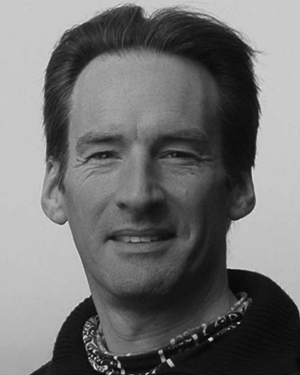 Johannes Lemburg合作论文数9
 Alexander Fabisch合作论文数Fachbereich 3 - Mathematik und Informatik, University of Bremen9
 Thomas M. Roehr合作论文数DFKI Robotics Innovation Center9
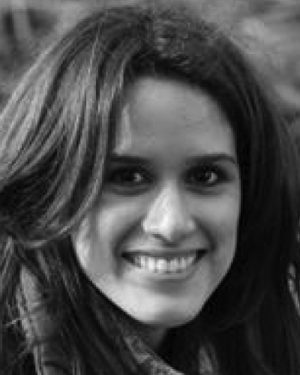 Mariela De Lucas Alvarez合作论文数8Octavio Arriaga合作论文数8
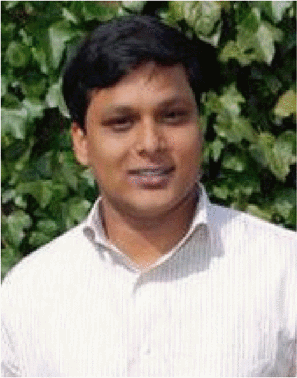 Sankaranarayanan Natarajan合作论文数German Research Center for Artificial Intelligence (DFKI GmbH), Robotics Innovation Center, Bremen, Germany8
 Steffen Planthaber合作论文数8
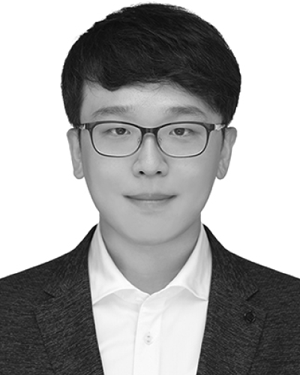 Yong-Ho Yoo合作论文数8Felix Wiebe合作论文数7
 Roland U. Sonsalla合作论文数Robotics Innovation Center, German Research Center for Artificial Intelligence (DFKI GmbH)7
 Johannes Teiwes合作论文数7
 Joachim Hertzberg合作论文数Institute of Computer Science, School of Mathematics/Computer Science, University of Osnabrück;Robotics Innovation Center, German Research Center for Artificial Intelligence7
 Timo Birnschein合作论文数DFKI Robotics Innovation Center7Malte Römmermann合作论文数7
 Folgheraiter Michele合作论文数Department of Robotics and Mechatronics, School of Engineering and Digital Sciences, Nazarbayev University;Robotics Department, School of Science and Technology, Nazarbayev University7




