The twisted stacked tape cable (TSTC) configuration, which employs high-temperature superconducting (HTS) tapes, is among the most promising conductor designs for fusion applications, particularly in Tokamak reactors. This study proposes an alternative approach to finite element method (FEM) models to analyze such a realistic TSTC geometry while significantly reducing the computational cost of conventional 3D finite element method (FEM) modeling. The analysis is performed using CALYPSO, a non-linear 3D circuit model originally developed for the study of no-insulation HTS (NI-HTS) coils. In this work, CALYPSO is applied to investigate the electromagnetic behavior of a twisted stack of superconducting tapes over one twist pitch. In this configuration, the stack of HTS tapes is twisted around the cable axis, rather than its own. The model provides a detailed representation of the stack geometry, capturing both the current distribution within individual tapes and the coupling currents between them. The results obtained from CALYPSO, in terms of instantaneous power losses, are benchmarked with numerical simulations based on alternative modeling approaches.
Offshore wind generators are expected to exceed 15 MVA in the coming years, necessitating compact and light-weight step-up transformers. While high-temperature superconducting (HTS) transformers offer high efficiency and compact size, their complex AC loss behavior in large-scale devices is still not sufficiently understood. In this work, we present a comprehensive investigation on practical strategies for reducing AC loss in a 15 MVA HTS transformer based on the primary industrial criteria of efficiency, weight, and cost. We employed an efficient numerical method to model up to thousands of HTS tapes in low-voltage (LV) and high-voltage (HV) windings in detail. Using this framework, we evaluated the influence of key design and operating parameters on the AC loss, including winding height, axial gap between the cables, radial distance between HV and LV windings, winding height difference, number of parallel conductors, voltage per turn, magnetic flux diverters, and temperature. These analyses enable the development of four improved transformer designs at operating temperatures of 20 K, 70 K, and two configurations at 77 K that balance AC loss reduction with conductor cost and core weight. The results provide validated design principles and practical guidelines for developing next-generation HTS transformers that are compact, light-weight, cost-effective, and suitable for large-scale offshore wind energy systems.
Abstract Distributed windings offer significant electromagnetic advantages for fully superconducting rotating machines, especially higher power density. Non-planar REBCO coils are required for the realization of it but remain challenging to design and fabricate due to the limited strain tolerance of the REBCO layer. In this work, we extend a previously proposed single-turn segmented non-planar coil design to a 20-turn configuration, deriving the geometric parameters of each turn analytically to account for the finite tape thickness. Based on the parameterized coil geometry, we develop a robotic winding procedure using a discrete representation of the tool trajectory and orientation to enable controlled and repeatable tape placement. We validate the approach by manufacturing a no-insulation REBCO test coil and characterizing its electromagnetic performance at 77 K. A critical current of 70 A is measured, in good agreement with the modified load-line estimate of 74.5 A, and the measured central magnetic flux density deviates by less than 1 % from the Biot–Savart calculation.
Conductor-on-round-tube (CORT) cables are a potential solution for carrying AC power in a small cross-section. Due to the geometry of the cable and the helical arrangement of the coated conductors (CC), the current follows a non-trivial pattern inside each CC. For instance, for the case of a single-layer cable, the current flow is mostly axial along the outer face of the CCs and mostly azimuthal along their inner face. Such a current distribution, known as the Garber current pattern, affects the transport AC losses. In numerical models, commonly adopted simplifications are either based on straight conductors or infinitely thin CCs. Such approaches neglect the Garber current pattern and thus misrepresent both the detailed current flow within the CC and the resulting 3D distribution of the fields. In this work, the detailed 3D current distribution in the CCs is investigated in a one-layer CORT cable, as a function of the cable geometrical parameters such as the conductor thickness, the pitch angle, and the gap between adjacent CCs. In particular, the impact of the Garber current pattern is studied on the two largest contributions to the AC losses, namely the surface losses (associated with the penetration of the component of the magnetic field parallel to the wide faces of the superconducting layer) and the edge losses (associated with the penetration of the perpendicular component of the magnetic field occurring in the vicinity of the gaps between the CCs). The detailed distribution of the currents in the CCs is examined and its relationship with the different AC loss mechanisms is established. This study is carried out by means of an effective 2D model that uses a system of coordinates conforming with the helical structure of the cable.
Abstract Superconductivity was discovered more than a century ago, and it has achieved full commercialization for MRI and NMR applications. Superconducting technology has got on spotlight recent years for transportation, power network, and fusion energy, due to the significant advantages offered against its counterpart technologies, including lighter weight, compacter size, lower losses, higher efficiency, and higher power density. Therefore, many superconducting applications are moving towards higher technology readiness levels, with a fast pace. The accelerated research around superconducting applications for modern transportation is due to unique features of this technology towards decarbonisation via electrified systems. Meeting the Net Zero targets to decelerate global warming issue is the main driver of implementing the superconducting technology for aerospace, marine, and railway transport. However, many challenges still remain to be addressed for superconducting devices and applications, which will in turn pave the way for the commercialization of superconducting technology. In this article, a roadmap on electrification of transportation systems for aerospace, marine, and railway application is presented, covering challenges and solutions in design analysis, modelling, monitoring, and operation. A series of short articles are presented to outline the potential applications and solutions. These potential futuristic routes and their materials/technologies are considered/suggested for a 10-20 years time-frame.
High-temperature superconducting (HTS) CORC cables are promising candidates for next-generation high-field fusion and energy-storage magnets because of their compact geometry, mechanical flexibility, and high current-carrying capability. However, when such conductors are bent into coils, the curvature alters the local magnetic-field distribution and may influence the AC losses. This work presents a three-dimensional finite-element model based on the T-A formulation to investigate the electromagnetic behavior of CORC cables under controlled bending. Systematic simulations for bending radii between 90 and 192 mm reveal a non-monotonic dependence of AC transport and magnetization losses on curvature. The initial increase arises from curvature-enhanced normal fields, the subsequent dip from interlayer magnetic cancellation, and the final rise from current concentration near the inner arc. Under ramp-current excitation, the peak loss per unit length exhibits a weak sensitivity to bending. These results suggest that CORC cables retain stable electromagnetic performance even in compact coil geometries.
This work presents an efficient computational framework based on the J-A-phi formulation for the numerical modeling of high-temperature superconducting (HTS) cable-in-conduit conductors (CICCs). The formulation separates the magnetic vector and scalar potentials across conducting and non-conducting domains, significantly reducing computational cost without compromising accuracy. Three cable geometries configurations with varying levels of complexity and tape width reduction were analyzed under magnetization cycles to compute AC losses and evaluate computational performance. Two modeling strategies-thin strip and homogenized-were implemented using the J-A-phi formulation and validated against a full T-A formulation taken as reference. Results show excellent agreement between formulations, with relative error coefficients R-2 exceeding 0.99in all cases, and computation time reductions reaching up to 57%. The critical current anisotropy of the HTS tapes was accurately captured using an empirical angular-dependent I-c(B, theta) model. The proposed methodology demonstrates high potential for accelerating the simulation of large-scale superconducting cable systems, especially in applications involving fusion magnets and high-field devices.
Among the numerical models based on the finite element method used to investigate the current density and magnetic field distributions inside high-temperature superconducting wires and their applications, the T-A formulation has become a widely used option. Typically, in applications with rotating parts, such as motors and generators, the superconducting wires are assumed to be in the stationary part of the geometry. In this contribution, we discuss the possibility of using the T-A formulation to model a rotating superconducting coil in a stationary magnetic field. In particular, we look at different ways of imposing the boundary conditions, in order to obtain induced currents flowing in opposite directions in each branch of the coil. First, we describe the case of an individual rotating cylinder of constant conductivity in a uniform magnetic field, for which analytical solutions exist. Then, we describe the case of a rotating superconducting coil in a uniform magnetic field, which requires the implementation of the proper conditions that ensure the correct coupling of the T and A parts. The results are validated against those obtained with the widely used H formulation for the equivalent case of a fixed coil in a rotating magnetic field.
In next-generation rapid-cycling synchrotrons (RCSs), high-temperature superconductor (HTS)-based accelerator magnets are typically energized by AC current with a DC offset. HTS coils coupled with auxiliary coils can be employed to improve the uniformity of magnetic fields generated by the magnets. However, AC losses in HTS coils with auxiliary coils carrying AC current with DC offsets have not been investigated, and it is important to address this research gap. In this work, AC loss simulations of a REBCO double pancake coil (1DPC) without and with auxiliary coils transporting AC current with DC offsets were carried out using the T-A formulation. The configuration of the HTS coils coupled with auxiliary coils consists of a central 40-turn 1DPC and two 5-turn REBCO single pancake coils attached to both ends of the 1DPC to serve as auxiliary coils. For both the 1DPC assembly without and with auxiliary coils carrying AC current with DC offsets, small DC offsets have negligible influence on coil AC losses compared to the cases without DC offsets. When the 1DPC assembly is coupled with auxiliary coils, the AC loss of this coil configuration is dominated by the auxiliary coils. In addition, dynamic resistance is observed in the auxiliary coils when the combined coil assembly carries AC current with DC offsets.
Conductor-on-round-core (CORC (R)) cables composed of rare-earth-barium-copper-oxide high-temperature superconducting (HTS) tapes are of great interest for power transmission applications due to their many advantages such as high power density, light weight, and low loss. Closed circulation loops of cryogenic helium gas can be used to cool HTS cables down to low temperatures to significantly improve their current-carrying capacity. Coupled circuit-electromagnetic-thermal finite element simulations implemented in the COMSOL Multiphysics package were developed, validated, and then used for simulating the fault current limiting (FCL) performance and the cooling processes of an 8-layer CORC (R) cable cooled with a flow of cryogenic helium gas. In the simulations, the temperature dependence of the electrical and thermal properties of all component materials is implemented for improved accuracy. To overcome computational challenges caused by the considerable difference in geometrical scales (i.e. few-mu m-thick HTS layers versus 10 m-long HTS cable), the model is divided into two separate simulations. The first simulation is performed on the transverse cross-section of the cable to calculate the electric field, heating power and temperature rise in each component of a CORC (R) cable during FCL operation. The heating power calculated in the first simulation is transferred to the second model to simulate the cooling of a 10 m-long cable after the fault is cleared. The effect of the helium gas flow rate on the cooling process is also investigated to develop strategic approaches for optimizing cooling systems for HTS cables with FCL capability. The simulations indicated that a 40 ms fault with a voltage drop of 20 V m(-1) along the cable can result in a temperature increase from 60 K to about 165 K inside the cable, and it takes about 500 s to cool the cable back to nearly 60 K with a flow of cold helium gas at a rate of 5 g s(-1).
The integral equation formulation of Maxwell’s equations proposed by Brandt provides an alternative to the H and T-A formulations for modelling high-temperature superconducting (HTS) tapes. A modified version of Brandt’s method in the literature models ferromagnetic domains near the tapes by considering the ferromagnetic domains as equivalent surface current. This paper extends this method by including the effect of external magnetic field acting on the ferromagnetic and HTS domains. The proposed method is used on a benchmark problem, which considers an HTS tape with a ferromagnetic substrate under an external time-varying magnetic field. The results agree closely (error in average ac loss less than 3%) with the widely-used T-A formulation implemented in COMSOL down to 2 mT. In addition, the proposed method is also applied to HTS tapes carrying transport ac current in a slot of a machine’s stator iron core, and HTS tapes in a stator iron slot in a machine under working conditions. It is found that ac loss calculated by the proposed method increases as the discretization size of the ferromagnetic material’s boundary decreases, and overshoots the value calculated by the T-A formulation in COMSOL when using very fine discretization.
Superconducting magnetic bearings (SMBs) are among the possible new technologies to be incorporated in maglev vehicles. Stacks of high-temperature superconductor (HTS) tapes can be used as an alternative to bulks, because stacks offer better mechanical properties, a better thermal conductivity and a simpler production process. Numerical modeling has been employed as a cost-effective, fast and reliable tool for improving the performance of SMBs. Several scenarios can be simulated with fast and relatively simple 2D models; however, in some cases using 3D models is inevitable. In this study, we use a full 3D model to solve the problem of magnetization of the tape stacks and obtaining the hysteresis force loop between a permanent magnet and the tape stacks. For this purpose, we employ an energy minimization-based method called minimum electromagnetic entropy production in 3D, combined with a homogenization technique and the J c ( B , theta ) dependence of the HTS tape as input. The modeling results agree very well with the experiment both in the zero-field cooled and field-cooled conditions. The presented approach offers significant computational advantages, delivering faster and more efficient results compared to previously proposed 3D methods.
High-temperature superconducting coils are used in various large-scale applications, like rotating machines and high-field magnets. However, modeling these coils is a complicated and time-consuming process, especially due to the non-linearity of the current-voltage characteristics of the superconductors and the complex multiphysics involved. In this work, we used a fast homogenized method to model the coupled electromagnetic and electrothermal properties of racetrack and pancake coils for different applications. For this purpose, various formulations wielding homogenization methods are used and benchmarked with each other, as well as with models considering the detailed structure of the HTS tapes. We observe a very good agreement between different models (homogenized and detailed), and we discuss the pros and cons of the inclusion of insulating layers between the turns in homogenization. This work was performed under the collaboration of the COST action modeling teams and can be used as a review of the state-of-the-art superconductor modeling techniques, and a source for the development and benchmark of future numerical methods.
In many advanced applications, such as Tokamak fusion reactors, the twisted stacked tape cable (TSTC) configuration based on high-temperature-superconducting (HTS) tapes is one of the most promising one. Among the various designs proposed for the European DEMOnstration Fusion Power Plants (DEMO) magnets, several options include conductors based on the HTS-TSTC technology, especially for an Insert of the Central Solenoid (CS). An important main design criterion to be fulfilled by superconducting magnets in operation is related to the temperature margin, which should be lower than a given threshold. For a pulsed magnet as the CS, properly determining its value is only possible with a reliable knowledge of the instantaneous losses entering the superconducting cable. Previous works presented an analytical formulation for the computation of instantaneous magnetisation losses in a HTS-TSTC conductor during a generic cycle of transport current and external magnetic field in phase with each other. Further validation of these formulae is presented by comparison with a 2D numerical model. A complete analysis of a plasma scenario is impossible with this formulation, considering that transport current and external magnetic field are not jointly in phase during the plasma breakdown. This work presents an extension of the previously developed analytical formulae to the more realistic case where the magnetic field and the transport current are not in phase with each other. The new formulae are validated in a case study of technical interest, by comparison with a 1D numerical model suited for the computation of magnetisation losses in these conductors.
Swirling spin textures, including topologically nontrivial states, such as skyrmions, chiral domain walls, and magnetic vortices, have garnered significant attention within the scientific community due to their appeal from both fundamental and applied points of view. However, their creation, controlled manipulation, and stability are typically constrained to certain systems with specific crystallographic symmetries, bulk or interface interactions, and/or a precise stacking sequence of materials. Recently, a new approach has shown potential for the imprint of magnetic radial vortices in soft ferromagnetic compounds making use of the stray field of YBa2Cu3O7-δ superconducting microstructures in ferromagnet/superconductor (FM/SC) hybrids at temperatures below the superconducting transition temperature (TC). Here, we explore the lower size limit for the imprint of magnetic radial vortices in square and disc shaped structures as well as the persistence of these spin textures above TC, with magnetic domains retaining partial memory. Structures with circular geometry and with FM patterned to smaller radius than the superconductor island facilitate the imprinting of magnetic radial vortices and improve their stability above TC, in contrast to square structures where the presence of magnetic domains increases the dipolar energy. Micromagnetic modeling coupled with a SC field model reveals that the stabilization mechanism above TC is mediated by microstructural defects. Superconducting control of swirling spin textures, and their stabilization above the superconducting transition temperature by means of defect engineering holds promising prospects for shaping superconducting spintronics based on magnetic textures.
Within the framework of magnetic confinement fusion, several projects worldwide are demonstrating the possibility of integrating high-temperature superconductors (HTS) in the coil systems. HTS-based technologies are highly attractive for practical applications because they can extend the operating margins of fusion coils in terms of higher temperatures, transport currents and magnetic fields. Based on the results achieved with the twisted-stacked tape cable, we have designed a novel low-loss HTS sector cable-in-conduit conductor, with a target of 60 kA at 4.5 k, 18 T, which is presently of interest for the DEMO Central Solenoid coil. In HTS cables, the AC losses can represent a significant limiting factor, therefore they must be taken into consideration both in the design phase and in the assessment of the overall magnet thermal budget. In this work, to assess the loss behavior and to optimize the cable design, we have explored different aspect ratios and arrangements of the stacked tapes within the cable layout. The magnetization losses are calculated with a 2D finite-element model based on the T-A formulation and analytical approximations based on the Brandt-Halse critical state model. Specifically, we have developed an analytical formulation that allows for the calculation of the instantaneous power losses in HTS stacked cables with a limited number of tapes per stack, achieving sufficient accuracy at high fields. The analytical model enables a sufficiently accurate assessment of the heat deposited on the conductor during those particular instants of a plasma scenario where the variation of the field is very high, such as during the critical initial discharge period of the plasma initiation.
High-temperature superconducting (HTS) coils are generally operated in a closed-loop persistent current mode, which is crucial for ensuring long-term stability and minimizing heat generation in various applications. However, factors such as joint resistance, flux creep, and losses due to external fields can lead to accelerated decay of the coil's current, making it challenging to achieve an effective persistent current mode. To gain insight into the current decay characteristics of HTS coils, we built a finite element method based model coupled with a lumped parameter electric circuit model. The model is initially verified against the experiment of an inductive magnetized HTS coil subject to a magnetic field perpendicular to the tape surface. The results indicate that the proposed model is highly effective in predicting the current decay behavior of this magnetized HTS coil and is able to provide high accuracy. With the help of this model, we have experimentally and numerically studied the behavior of a current-carrying closed-loop HTS coil subject to external alternating fields. The HTS coil is charged by a DC power supply and then shorted using a thermally-controlled persistent current switch. The current decay behavior of the HTS coil is examined under various scenarios. The simulation results show excellent agreement with experimental data, further validating the effectiveness and versatility of the modeling strategy. The influence of both local and global screening currents on the current decay performance of the closed-loop HTS coils has been investigated. For every case examined, rapid demagnetization occurred in the initial cycle of the applied alternating field. Furthermore, the current decay rate demonstrated a slight dependence on the frequency of the applied fields. Additionally, the resulting resistance has been thoroughly characterized. These insights contribute to the knowledge of the behavior and performance of closed-loop HTS coils, facilitating their practical application.
Conductors made of high-temperature (HTS) wires helically wound in one or more layers on round tubes (CORT) are compact, flexible, and can carry a large amount of current. Although these conductors were initially developed for DC applications, e.g. in magnets, it is worth considering their use for AC, e.g. in underground cables for medium voltage grids and with currents in the kA-range. In these cases, the major challenge is reducing AC losses. In contrast to a straight superconducting wire, in a helical arrangement, due to superconducting shielding, the current does not follow the direction of the wires, but takes a non-trivial zig-zag path within the individual HTS wires (Garber pattern). This includes current components across the thickness of the superconducting layers, so that the often used thin-shell approximation does not hold. In this contribution, we studied a one-layer three-wire CORT by means of fully three-dimensional simulations, based on the H-formulation of Maxwell's equations implemented in the commercial software package COMSOL Multiphysics. As a result of our simulations, the peculiar current profiles were confirmed. In addition, the influence of current, pitch angle, and frequency on the AC losses was studied. We found an optimum for the pitch angle and that the current profiles strongly depend on frequency.
High-temperature superconducting tapes can be stacked together to form cables which are then wound into coils for potential use in electrical machines. The tapes in the cable can either be uncoupled (insulated from each other), coupled at ends (coupled at the terminals of the cable), or fully coupled (electrically connected with each other along the whole length of the cable). The integral method can readily model the uncoupled scenario, and this article extends the integral method to model the coupled-at-ends and fully coupled scenarios. We find that the proposed method has a time advantage over the well-established T-A formulation of Maxwell's equations.
The application of High-Temperature Superconductor (HTS) coils made of coated conductors has been investigated for many years. A possible configuration for such coils is the jointless loop, also known as the ring coil. The double crossed loop coil (DCLC) has been successfully applied in superconducting magnetic bearings (SMBs). The design of SMBs with DCLCs requires flexible modelling to allow all parts of the device to be represented. This work proposes the T-A formulation with a thin-film approximation for modelling SMB with DCLCs in the finite element analysis framework. A 2D representation of the system is coupled with an external electric circuit to model the continuity of the lines that represent the parts of each jointless loop. To couple the T-A formulation and the circuit, an average of the total electric field, with both resistive and inductive components, is applied to the circuit. The total current computed by the circuit is applied to the T-A formulation. The proposed methodology was validated by comparison with levitation force experimental data. Two types of tests were simulated: five levitation force tests and three guidance force tests. It is shown that there is a limit to the behaviour of the levitation force related to the high-loss state. Below this limit, the stack of DCLCs behaves as an equivalent bulk. Beyond this limit, a high-loss state appears as a linear growth of the levitation force. It is also shown that this high-loss state in vertical displacement influences the lateral force.
 Victor Manuel Rodriguez Zermeno合作论文数42
 Frédéric Sirois合作论文数Department of Electrical Engineering, Polytechnique Montréal35
 Bertrand Dutoit合作论文数Ecole Polytechnique Federale of Lausanne32
 Michal Vojenciak合作论文数Institute of Electrical Engineering, Slovak Academy of Sciences23
 Enric Pardo合作论文数Departament de Física, Universitat Autònoma de Barcelona22
 Roberto Brambilla合作论文数22
 Anna Kario合作论文数19
 Nicolo Riva合作论文数MIT Plasma Science and Fusion Center, MA, USA15
 Svetlomir Stavrev合作论文数14
 Frederic Trillaud合作论文数14
 Luciano Martini合作论文数13
 S.P. Ashworth合作论文数13
 Edgar Berrospe-Juarez合作论文数Polytech Montreal12Rainer Nast合作论文数Technik und Umwelt, Forschungszentrum Karlsruhe11
 Asef Ghabeli合作论文数Inst Tech Phys, Karlsruhe Inst Technol10
 Wilfried Goldacker合作论文数10
 Eduard Demencik合作论文数10M. Noe合作论文数9
 Yingzhen Liu (刘迎珍)合作论文数School of Electrical Engineering and Automation, Harbin Institute of Technology9
 Antonio Morandi合作论文数Dipartimento di Ingegneria9
 Alexandra Jung合作论文数8
 Antti Stenvall合作论文数Tampere Univ Technol8Carlos Roberto Vargas-Llanos合作论文数7
 Pengbo Zhou合作论文数State Key Lab Tract Power, Southwest Jiaotong Univ7
 Gabriel dos Santos合作论文数Department of Electrical Engineering, Universidade Federal Fluminense7
 Mark Ainslie合作论文数Department of Engineering, Faculty of Natural, Mathematical & Engineering Sciences, King's College London;Robinson Research Institute, Victoria University of Wellington7
 Doan Nguyen合作论文数Los Alamos Natl Lab, Superconduct Technol Ctr, Los Alamos, NM 87545 USA7
 Min Zhang合作论文数Department of Electronic and Electrical Engineering, University of Strathclyde6Roland Gyuraki合作论文数6
 Christian Lacroix合作论文数Dept. of Electr. Eng., Polytech. Montreal;c;Dept. of Electr. Eng., Polytech. Montreal6
 Giovanni Grasso合作论文数6
 Boyang Shen (沈博洋)合作论文数National Maglev Transportation Engineering R&D Center, Tongji University6
 Tim Coombs合作论文数Electrical Engineering Division, Department of Engineering, University of Cambridge;Magdalene College, University of Cambridge;Magnifye Ltd6Jan Souc合作论文数6Joseph Duron合作论文数6Andrea Kling合作论文数6Andrej Kudymow合作论文数6V. Zermeño合作论文数5
 Fabian Schreiner合作论文数5
 Hongye Zhang合作论文数State Key Lab Elect Insulat & Power Equipment, Xi An Jiao Tong Univ5
 Loic Queval合作论文数Dept. of Adv. Energy, Univ. of Tokyo;c;Dept. of Adv. Energy, Univ. of Tokyo5Shengnan Zou (邹圣楠)合作论文数5
 Timothy Haugan合作论文数Power and Controls Division, Aerospace Systems Directorate, The Air Force Research Laboratory5
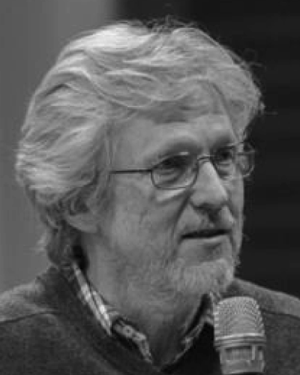 Fedor Gömöry合作论文数Institute of Electrical Engineering, Slovak Academy of Sciences5
 S. Elschner合作论文数5B. Ringsdorf合作论文数4Ø. Fischer合作论文数4Aurelien Godfrin合作论文数4




