Access Layer Instance (ALI) selection is essential for ensuring reliable performance in vehicular networks under multi-channel operation. Standardized mechanisms rely on limits to decide whether an ALI can handle traffic coming from a service with a set of requirements. These limits may refer to, e.g., channel utilization, data rate or transmit power. Following a policy, a node selects one of the available ALIs to send traffic through it. This selection can be performed based on using all suitable available ALIs equally (i.e., load balancing) or by turning them on in a sequence of prioritized ALIs that are to be filled sequentially. This paper introduces two congestion-aware mechanisms for ALI selection that consider not only channel occupancy, which is measured through the interval between transmissions allowed by Decentralized Congestion Control (DCC), but also local queue conditions. These measurements are reflected in a metric based on the waiting time before a message can get access to the medium, enabling more accurate and responsive ALI selection. Our results demonstrate that one of our proposed mechanisms, CALIS, significantly improves radio resource usage and application performance; and the other, CASF, improves the performance of the sequential filling mechanism while maintaining the ability to disable radios when traffic load allows it.
This article presents a holistic approach to the design of an architecture for remote driving. After describing the main challenges of the remote driving service, the proposed architecture is explained, including the components necessary to provide this service. Details are provided about the control center, remotely driven vehicles, remote driving station, and video codec. Furthermore, the flexibility of the architecture to adapt to network quality of service conditions and the role of the network-aware route planner are explained. Experimental results illustrate the safe remote driving of a vehicle and the effectiveness of the route planner.
Time-sharing of Quantum Key Distribution (QKD) transceivers with the help of optical switches and a central Software-Defined Networking (SDN) controller is a promising technique to better amortize the large investments required to build a Quantum Key Distribution Network (QKDN). In this work, we investigate the implications of introducing Time-Division Multiplexing (TDM) in trusted-relay QKDNs at the wide-area network scale in terms of performance and cost-saving. To this end, we developed both a Mixed Integer Linear Programming (qTDM-MILP) model and a Heuristic Algorithm (qTDM-HA) to solve the allocation of QKD transceivers and network resources for a novel switched QKDN operating scheme: qTDM-QKDN. Our heuristic method provides a close-to-optimal resource planning for the offline problem that computes the minimum number of QKD transceivers and optical switch ports at each node, as well as the number of quantum channels on each link required to satisfy a target set of end-to-end secret-keyrate demands. Moreover, both the model and the heuristic provide the time fractions that each QKD transceiver needs to peer with each neighbor QKD transceiver. We compared our proposed model and heuristic algorithm for cost minimization with non-time sharing QKD transceivers (nTDM) as baseline. The results show that qTDM can achieve substantial cost-savings in the range of 10%–40% compared to nTDM. Furthermore, this work sheds light on the selection of the value for the working cycle T and its influence on network performance.
Network slicing has emerged as a key network technology, providing network operators with the means to offer virtual networks to vertical users over a single physical network infrastructure. Recent research has resulted mainly in techniques for managing and deploying network slices, but the implementation of network slices on a real physical transport network infrastructure has received much less attention. Standardization bodies, such as the Internet Engineering Task Force (IETF), have provided some implementation recommendations. Still, there is a lack of mechanisms to implement network slices capable of handling traffic bursts while simultaneously meeting the Quality of Service (QoS) requirements of the traffic flows associated with the slices. In this paper, we propose a novel fine-grained resource control mechanism to implement transport network slices that meet traffic QoS requirements while both accepting limited traffic bursts, and enabling efficient bandwidth sharing within and across slices. The mechanism is executed at the edge of the transport network. The proposed model aligns with current standards on network slicing and has been tested on an experimental platform. Using this platform, we have conducted an extensive experimental campaign that demonstrates that our proposal can effectively control traffic bursts generated within the network slices while maximizing bandwidth utilization across the network.
Quantum key distribution (QKD) combined with quantum-safe encryption algorithms offers a practical path to future-proof communication security. Currently, the BB84 QKD protocol is mature and can be deployed over legacy optical fiber infrastructure using commercial products, with trusted key relaying as a workaround for its distance limitations. However, designing cost-effective QKD networks is essential for widespread adoption by end users and telecom operators (Telcos). To address this challenge, we propose and study a novel, to our knowledge, strategy: periodic time sharing of QKD transceivers. This strategy, especially cost saving at low and medium workloads, allows for generating keys for pairs of nodes at deterministic rates decided a priori. This work presents an offline solution for allocating and scheduling QKD transceivers that are shared by the aforementioned time-division multiplexing (TDM) scheme in a QKD network. We propose a mixed-integer linear programming (MILP)-based scheduling (MBS) method to solve this problem, which is computationally expensive, even for small network topologies. As an alternative, we introduce allocation-driven scheduling (ADS), an algorithm that internally breaks the problem into two steps: allocate first and schedule later. The scheduling can be handled by either a relaxed-MBS (rMBS) or a round-robin scheduling (RRS) approach (ADS-rMBS and ADS-RRS, respectively). Both methods yield results comparable to MBS for small networks. Furthermore, simulations illustrate that both ADS-rMBS and ADS-RRS enable a pay-as-you-grow model, reducing the initial capital expenditure in low-load scenarios. Compared with the non-TDM baseline (i.e., QKD transceivers are non-shared), the cost savings range from 30% to 50%, making QKD deployment more economically viable. Moreover, ADS-rMBS generally outperforms ADS-RRS, but requires a higher runtime, reaching up to 2500 s in large networks. Conversely, ADS-RRS maintains a stable 1 ms runtime across all conditions, making both approaches viable depending on the traffic matrix update interval.
Tele-operated Driving (ToD) is a challenging use case for mobile network operators. Video captured by the built-in vehicle cameras must be streamed meeting a latency requirement of 5 ms with a 99% reliability. Although 5G offers high bandwidth, ultra-low latencies and high reliability; ToD service requirements are violated due to bad channel conditions. Ignoring the channel state may lead to over-estimating the number of ToD vehicles that can meet the service requirements, hence compromising the vehicle security. To fill this gap, in this letter we propose TOVAC, an algorithm that guarantees ToD service requirements by taking adequate admission control and routing decisions. This is achieved by using a channel-based capacity graph that determines the maximum number of vehicles that can be tele-operated in any road section. We evaluate TOVAC considering cellular deployments from Turin and show that, unlike a state of the art solution, TOVAC guarantees the ToD service requirements.
This paper evaluates the performance of the two ETSI non-area forwarding algorithms in the GeoNetworking specification: Greedy Forwarding and Non-Area Contention-Based Forwarding (CBF). Non-area forwarding occurs when a packet is sent to a geographical Destination Area from a node located outside of this area, e.g., when a vehicle wants to alert of hazardous events to other vehicles located in a distant geographical area. The evaluation has been carried out both in urban and highway scenarios and takes into account the complete ETSI Architecture, including the interaction with the Decentralized Congestion Control (DCC) mechanism. We have also compared ETSI-defined mechanisms with optimizations found in the literature. Our main findings are that Greedy Forwarding, when combined with DCC, is extremely ineffective even with optimizations, and Non-Area CBFs (both ETSI CBF and an optimized version called S-FoT+) outperform Greedy Forwarding both in highway and urban scenarios.
The gap between technology readiness level in Cooperative Intelligent Transport Systems (C-ITS) and its adoption and deployment has caused a phenomenon where at least two types of network access technologies have to coexist. Furthermore, for the case of ETSI Intelligent Transport Systems protocols, work is being completed in Release 2 of the specification while Release 1 deployments are still underway. This, coupled with industry and consumer trends in the vehicle industry, is bound to cause a scenario where fully C-ITS-enabled vehicles have to coexist with non-C-ITS road users and, at the very least, with different versions of C-ITS. In this paper, we analyze the performance in terms of efficiency and safety of two releases of the ETSI GeoNetworking protocol, as well as a discussion on possible paths to tackle the upcoming compatibility and coexistence problems.
This paper evaluates the performance of ETSI ITS Contention-Based Forwarding (CBF) and ETSI Simple GeoBroadcast forwarding while disseminating warning messages over a Geographical Area in highway and urban scenarios. Our experimental evaluation considers the complete ETSI ITS architecture including the Decentralized Congestion Control (DCC) mechanism. We propose an enhanced CBF mechanism, named S-FOT+, which combines several improvements to the ETSI CBF algorithm. S-FoT+ has a similar or better performance than the ETSI forwarding algorithms regarding both reliability and end-to-end delay while requiring much fewer transmissions. The improvements are equally effective and efficient in both urban and highway scenarios with large Destination Areas. Finally, we evaluate the trade-offs that stem from using multi-hop broadcast mechanisms in urban settings with smaller Destination Areas when compared to single-hop broadcast. Results show that multi-hop mechanisms significantly improve coverage at the cost of an increased number of transmissions.
In recent years, the use of cellular network technologies to provide communication-based applications to vehicles has received considerable attention. 3GPP, the standardization body responsible for cellular networks specifications, is developing technologies to meet the requirements of vehicular communication applications, and the research community is testing and validating the ability of those technologies to implement different applications. This survey presents the body of work dealing with the use of cellular technologies to implement communication-based applications for the connected vehicle. We focus on basic and advanced road safety and traffic efficiency applications, which are critically important for the future of vehicular networks. We start by describing the different cellular-related technologies that have a role to play in providing services to the connected vehicle, propose a classification of types of communication used in vehicular applications, and then apply this classification to organize and present recent research work on the topic. Finally, we identify the main challenges in the use of cellular technologies to develop applications for the connected vehicle.
This paper evaluates the performance of the ETSI Contention-Based Forwarding (CBF) GeoNetworking protocol for distributing warning messages in highway scenarios, including its interaction with the Decentralized Congestion Control (DCC) mechanism. Several shortcomings of the standard ETSI CBF algorithm are identified, and we propose different solutions to these problems, which are able to reduce the number of transmissions by an order of magnitude, while reducing the message end-to-end delay and providing a reliability close to 100% in a large area of interest.
Multimedia streaming services can benefit from the capabilities that Multi-access Edge Computing (MEC) platforms bring to networks. High availability of multimedia content at the edge of the network makes it possible to reduce both service disruptions and service latency. However, the network of edge caches needs to be synchronized to guarantee that the content is always available at the cache that is the closest to the user terminal location, especially after a cell handover. In this paper, the standard MEC application mobility service is extended to support cache prefetching based on mobility predictions. This prefetching mechanism allows to pre-store the multimedia content at a MEC site before the handover, in order to improve service latency and service continuity.
Vehicular networks use Decentralized Congestion Control (DCC) mechanisms to operate effectively, but this mechanism may introduce queuing delays. Freshness of Cooperative Awareness Messages (CAMs) is critical for their usefulness. In this letter we explore how the presence of other types of traffic additional to CAMs, even with lower priorities, has an impact on the freshness of CAM messages due to DCC queuing. Finally, we propose Generate-on-Time (GoT), which is a simple mechanism that reduces DCC queuing delays for CAM messages without introducing any downside in other performance metrics.
Decentralized Congestion Control (DCC) mechanisms have been a core part of protocol stacks for vehicular networks since their inception and standardization. The ETSI ITS-G5 protocol stack for vehicular communications considers the usage of DCC not only in the network or access layers, but also as a part of the cross-layer architecture that influences how often messages are generated and transmitted. ETSI DCC mechanisms have evolved from a reactive approach based on a finite state machine, to an adaptive approach that relies on a linear control algorithm. This linear control algorithm, called LIMERIC, is the basis of the mechanism used in the ETSI DCC Adaptive Approach. The behavior of this algorithm depends on a set of parameters. Different values for these parameters have been proposed in the literature, including those defined in the ETSI specification. A recent proposal is Dual-α, which chooses parameters to improve convergence and fairness when the algorithm has to react to fast changes in the use of the shared medium (transitory situations). This article evaluates, by means of simulations, the performance of the ETSI DCC Adaptive Approach and related algorithms, considering both steady state and transitory situations. Results show that a bad selection of parameters can make a DCC algorithm ineffective, that the ETSI DCC Adaptive algorithm performs well in steady state conditions, and that Dual-α performs as well in steady state conditions and outperforms the ETSI DCC Adaptive Approach in transitory scenarios.
There are different proposals in the literature on how to protect pedestrians using warning systems to alert drivers of their presence. They can be based on onboard perception systems or wireless communications. The evaluation of these systems has been focused on testing their ability to detect pedestrians. A problem that has received much less attention is the possibility of generating too many alerts in the warning systems. In this paper, we propose and analyze four different algorithms to take the decision on generating alerts in a warning system that is based on direct wireless communications between vehicles and pedestrians. With the algorithms, we explore different strategies to reduce unnecessary alerts. The feasibility of the implementation of the algorithms was evaluated with a deployment using real equipment, and tests were carried out to verify their behavior in real scenarios. The ability of each algorithm to reduce unnecessary alerts was evaluated with realistic simulations in an urban scenario, using a traffic simulator with vehicular and pedestrian flows. The results show the importance of tackling the problem of driver overload in warning systems, and that it is not straightforward to predict the load of alerts generated by an algorithm in a large-scale deployment, in which there are multiple interactions between vehicles and pedestrians.
 Maria Calderon合作论文数33
 Ivan Vidal合作论文数Departamento de Ingeniería Telemática;Universidad Carlos III de Madrid;Departamento de Ingeniería Telemática, Universidad Carlos III de Madrid26
 Carlos J. Bernardos合作论文数University Carlos III of Madrid21
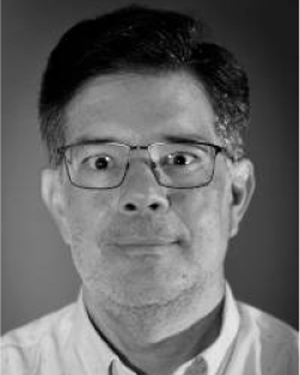 Jaime Garcia-Reinoso合作论文数21
 Antonio De La Oliva合作论文数Universidad Carlos III de Madrid20
 Arturo Azcorra合作论文数Departamento de Ingenieria Telematica, Universidad Carlos III de Madrid;IMDEA Networks Institute17
 Albert Banchs合作论文数IMDEA Networks;Universidad Carlos III de Madrid12
 Manuel Urueña合作论文数Universidad Carlos III de Madrid12
 Marcelo Bagnulo合作论文数University Carlos III of Madrid12
 David Larrabeiti合作论文数Universidad Carlos III de Madrid11
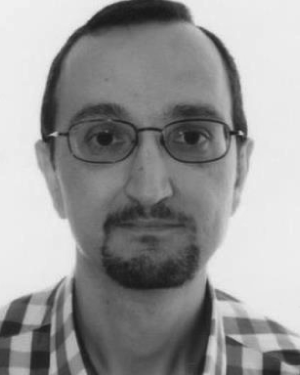 Alberto García-Martínez合作论文数10Ivan Lozano合作论文数10G Camarillo合作论文数10
 Jose Ignacio Moreno合作论文数Departamento de Ingeniería Telemática;Universidad Carlos III de Madrid;Departamento de Ingeniería Telemática, Universidad Carlos III de Madrid10
 Francisco Valera合作论文数Departamento de Ingeniería Telemática;Universidad Carlos III de Madrid9
 Oscar Amador合作论文数Sch Informat Technol, Halmstad Univ8Telemaco Melia合作论文数NEC Network Laboratories, Heidelberg, Germany8A. Banchs合作论文数Universidad Carlos III de Madrid. Avda de la Universidad, 307
 David Fernández合作论文数6Albert Vidal合作论文数6Carlos J Bernardos合作论文数Univ. Carlos III de Madrid, Leganes, Spain6T. Melia合作论文数5
 Luis M. Contreras合作论文数Telefonica;Universidad Carlos III de Madrid5
 Pablo Serrano合作论文数Universidad Carlos III de Madrid5
 Carlos Jesus Bernardos合作论文数5
 Antonio Cuevas合作论文数5
 Carlos M. Lentisco合作论文数4
 Carlos García合作论文数Departamento de Ingeniería Telemática;Universidad Carlos III de Madrid;Departamento de Ingeniería Telemática, Universidad Carlos III de Madrid4
 Isaias Martinez-Yelmo合作论文数Departamento de Telematica;Universidad Carlos III de Madrid;Departamento de Telematica, Universidad Carlos III de Madrid4Victor Sandonis合作论文数4Emmanuel Riou合作论文数3
 Luis Bellido合作论文数3
 Susana Sargento合作论文数Universidade de Aveiro3
 Rui Aguiar合作论文数Instituto de Telecomunicacoes;University of Aveiro;Networld Europe3
 Rafael Estepa合作论文数Área de Ingeniería Telemática, Universidad de Sevilla3
 Piotr Pacyna合作论文数AGH University of Science and Technology3Dirk Von Hugo合作论文数3
 Marco Liebsch合作论文数3
 Marco Gramaglia合作论文数Institute IMDEA Networks, Universidad Carlos III de Madrid3
 Daniel Corujo合作论文数Universidade de Aveiro3
 Antonio Estepa合作论文数Área de Ingeniería Telemática, Universidad de Sevilla3Peter Morrogh合作论文数3
 Juan M. Vozmediano合作论文数3Ji Moreno合作论文数2Patrick Stupar合作论文数2Julien Abeillé合作论文数2J.I. Moreno合作论文数2Eberhard Zangger合作论文数2




