The high-resolution vertically pointed Doppler FMCW radar PARSAX was used for the investigation of turbulence in isolated convective clouds. The radar measures reflectivity, the mean Doppler velocity, and the spectrum width in clouds that are crossing the radar beam due to horizontal wind. The measured spectrum width is used to separate the air velocity from the sedimentation velocity of cloud drops in every reflecting volume. The transverse structure functions and the vertical velocity spectra were estimated for convective clouds which have different evolution stages and cloud top heights. The slopes of these structure functions and spectra, characterizing the kinetic energy transfer, were obtained. Three layers with different regimes of cascade energy transfer were found with an increase in the height. The first layer with a spectra slope of -1 was observed in the atmospheric boundary layer up to the height of 2 km. A layer with a classic Kolmogorov slope of -5/3 was observed above this layer, at a height of 2....5 km. At the upper part of the cloud appears a layer that tends to the Bolgiano-Obukhov slope of -11/5 generated by buoyancy forces influencing that part of the cloud. The measured spectra also made it possible to non-rigorously estimate the profiles of the turbulence kinetic energy, turbulent dissipation rate, and associated with velocity fluctuations turbulent diffusion coefficient.
This study summarizes and generalizes findings from recent studies, focusing on the connection between Cu dynamic properties, such as velocity field, entrainment/detrainment, and cloud microphysical properties, such as cloud dilution rate and droplet size distribution parameters. Special attention is paid to the mechanisms of cloud-surrounding interactions. In particular, we focus on numerical and analytical derivations from the results of 10-m-resolution Large Eddy Simulations (LES) with spectral bin microphysics and statistical analysis of the motion of passive tracers. We used wavelet filtration to separate the cloud's dynamic and microphysical fields into turbulent and convective ones. The main parameters of cloud turbulence and convective motions were evaluated. Turbulence was shown to form an interface zone of a few tens of meters between the cloud and the surrounding air. Convection-scale motions are responsible for dynamic and microphysical properties' formation in the cloud interior. The special role of the vortex ring (toroidal vortex, TV) arising in the upper part of developing clouds is stressed. This TV is responsible for dynamic and microphysical cloud structure formation. It determines the cloud's size, internal dynamics, and ascent velocity of the cloud top. It is demonstrated numerically and analytically that the TV-related cloud circulation leads to a mean adiabatic fraction of 0.4-0.5. The close relationship between this value and the shapes of the size distribution functions is demonstrated. The TV determines the width of the cloud core and disappears as soon as the core becomes diluted. Knowledge of the effects TV has on cloud microphysics and dynamics allows us to propose parameterization of the main dynamic and microphysical properties of small Cu using sounding data and aerosol concentrations. Significance statement: a) Turbulence forms a narrow interface zone along the cloud's edges and is not responsible for the dilution of the cloud body. b) The entrainment and detrainment in growing Cu are closely related to a convective-scale ring vortex (toroidal vortex, TV). The air circulation related to the TV is the main reason of cloud body dilution leading to the decrease in the adiabatic fraction. c) The mechanisms of entrainment related to the TV resolve "cloud top-liquid water paradox" and explain formation of relatively high cloud top under strong average cloud dilution. d) One of the main deficiencies of most convective parameterizations is the assumptions of cloud horizontal homogeneity and the coincidence of the altitudes of maximum entrainment and maximum vertical velocity. Due to existence of the TV, the entrainment level is located below the level of maximum velocity. The altitude of the maximum entrainment ascends together with the ascent of TV. e) The TV controls microphysical properties like adiabatic fraction (AF). There is a high correlation of properties of droplet size distributions and the value of AF.
Shallow convective clouds play a crucial role in Earth's energy budget, as they modulate the radiative transfer in the atmosphere and participate in the vertical transport of aerosols, energy, and humidity. The parameterizations representing these complex, vital players in weather and climate models are mostly based on a description of steady-state plumes and are a source of major uncertainty. Recently, several studies have shown that buoyant thermals are inherent in atmospheric convection and contain a toroidal (ring) vortex. This work studies those vortices in growing shallow cumulus (Cu) clouds using high-resolution (10 m) Large Eddy Simulations that resolve these vortices in much detail. Recent analysis of such data showed that small-scale turbulent diffusion is unable to explain the large diluted portion of the cloud. Here we advocate for the important role of the Cu toroidal vortex (TV) in cloud dilution and present the complex dynamics and structure of a Cu TV. Nevertheless, since the vortex dominates the cloud's dilution, simplicity emerges when considering the cloud's lateral mass flux profile. The cloud mixing is quantified using direct flux calculations and Eulerian tracers. In addition, Lagrangian tracers are used to identify the origin of the entrained air and its thermodynamic properties. It shows that most of the air entrained by the vortex is not recycled by the vortex, yet is significantly more humid than the environment. We suggest that the development of new models describing thermals, together with their toroidal vortices, might improve cloud parameterizations in weather and climate models. Shallow convective clouds play a crucial role in climate as they transfer heat in the vertical dimension and affect radiation transfer in the atmosphere. These clouds are much smaller than climate models' resolution, and so they are represented by simplified equations in weather and climate models (parameterizations). This simple representation of such important processes is one of the largest sources of uncertainty in climate models. In particular, the process of clouds mixing with their dry surroundings is known to have a large contribution to the uncertainty reflected by clouds in climate prediction. In this work, we use high-resolution simulations of cumulus clouds to investigate the toroidal (ring) vortex that is located at the top of a rising thermal (a known property of cumulus dynamics). We show that cloud-scale vortices dominate cloud dilution and are at least as important as stochastic turbulent motions which are often considered in mixing parameterizations. These ideas can serve for future parameterizations of shallow cumulus clouds in coarse-resolution models. Coherent and turbulent toroidal (ring) vortices are presented in 10 m resolution LES of shallow cumulus clouds The toroidal vortex dominates the cloud's dilution, as shown by the cloud's lateral mass flux profile and Eulerian tracers analysis Lagrangian tracers reveal that most entrained air is environmental (not recycled by the vortex) with high relative humidity
Velocity field in a nonprecipitating Cu under BOMEX conditions, simulated by SAM with 10-m resolution and spectral bin microphysics is separated into the convective part and the turbulent part, using a wavelet filtering. In Part II of the study properties of convective motions of this Cu were investigated. Here in Part III of the study, the parameters of cloud turbulence are calculated in the cloud updraft zone at different stages of cloud development. The main points of this study are (i) application of a fine-scale LES model of a single convective cloud allowed a direct estimation of turbulence parameters using the resolved flow in the cloud and (ii) the separation of the resolved flow into the turbulence flow and the nonturbulence flow allowed us to estimate different turbulent parameters with sufficient statistical accuracy. We calculated height and time dependences of the main turbulent parameters such as turbulence kinetic energy (TKE), spectra of TKE, dissipation rate, and the turbulent coefficient. It was found that the main source of turbulence in the cloud is buoyancy whose contribution is described by the buoyancy production term (BPT). The shear production term (SPT) increases with height and reaches its maximum near cloud top, and so does BPT. In agreement with the behavior of BPT and SPT, turbulence in the lower cloud part (below the inversion level) is weak and hardly affects the processes of mixing and entrainment. The fact that BPT is larger than SPT determines many properties of cloud turbulence. For instance, the turbulence is nonisotropic, so the vertical component of TKE is substantially larger than the horizontal components. Another consequence of the fact that BPT is larger than STP manifests itself in the finding that the turbulence spectrum largely obeys the -11/5 Bolgiano-Obukhov scaling. The classical Kolmogorov -5/3 scaling dominates for the low part of a cloud largely at the dissolving stage of cloud evolution. Using the spectra obtained we evaluated an "effective" dissipation rate which increases with height from nearly zero at cloud base up to 20 cm(2) s(-3) near cloud top. The coefficient of turbulent diffusion was found to increase with height and ranged from 5 m(2) s(-1) near cloud base to 25 m(2) s(-1) near cloud top. The possible role of turbulence in the process of lateral entrainment and mixing is discussed. Significance Statement1) This study investigates the turbulent structure of Cu using a 10-m-resolution LES model with spectral bin microphysics, 2) the main source of turbulence is buoyancy, 3) turbulence in cumulus clouds (Cu) is nonisotropic, 4) turbulence reaches maximum intensity near cloud top, 5) turbulence spectrum obeys largely the -11/5 Bolgiano-Obukhov scaling, and 6) the main turbulent parameters are evaluated.
A developing cumulus cloud (Cu) was modeled, and dynamic, thermodynamic, and microphysical properties of an ascending head bubble reproducing the upper part of a developing Cu were investigated. The data for analysis are taken from 10-m-resolution LES of trade wind Cu under BOMEX conditions. The detection of a rising bubble is carried out using wavelet filtering of the velocity fields and microphysical fields, while a low-frequency signal of the filtering is associated with the convective-scale structure of cloud. We substantiate and discuss the representation of the bubble as a vortex ring, and estimate the parameters of this vortex ring. The simplest Hill's vortex was chosen as a model of a vortex ring inside cloud. Analytical approximations of the radial profiles of the vertical velocity and of conservative quantities (such as total water mixing ratio and liquid water potential temperature inside and outside the bubble) are obtained. The spatial structure of these quantities is investigated using analytical expressions. Analytical models for spatial distributions of liquid water content (LWC) and adiabatic fraction (AF) are also designed and analyzed. The results demonstrate the existence of a cloud core with high values of LWC and AF up to the height of 1800 m. The horizontally averaged value of the adiabatic fraction, calculated analytically using the Hill's vortex concept, is evaluated as 0.39, which is the typical AF value in the upper parts of such Cu. The vertical profiles of different important quantities characterizing cloud structure are presented. The analysis performed in this study allows us to conclude that a rising vortex ring plays the dominating role in formation of the thermodynamic and microphysical structure of developing Cu.SIGNIFICANCE STATEMENT: 1) Dynamic and thermodynamic fields of a developing cumulus cloud simulated by high-resolution LES with spectral bin microphysics are separated into convective and turbulent components by means of the wavelet technique. 2) The analysis of convective component of the cloud revealed the existence of a vortex ring at the developing stage of the cloud and evaluate its parameters. 3) The analysis performed in this study allows us to conclude that a rising vortex ring plays the important role in formation of the thermodynamic and microphysical structure of developing Cu. 4) The study provides a novel insight into the cloud-environment interaction. 5) The approximating equations describing the vortex ring can be usefully applied for developing new schemes of convective parameterization.
The dynamic structure of a small trade wind cumulus (Cu) is analyzed using a novel approach. Cu developing in a shear-free environment is simulated by 10-m-resolution LES model with spectral bin microphysics. The aim is to clarify the dynamical nature of cloud updraft zone (CUZ) including entrainment and mixing in growing Cu. The validity of concept stating that a cloud at developing state can be represented by a parcel or a jet is tested. To investigate dynamical entrainment in CUZ performed by motions with scales larger than the turbulence scales, the modeled fields of air velocity were filtered by wavelet filter that separated convective motions from turbulent ones. Two types of objects in developing cloud were investigated: small volume ascending at maximal velocity (point parcel) and CUZ. It was found that the point parcel representing the upper part of cloud core is adiabatic. The motion of the air in this parcel ascending from cloud base determines cloud-top height. The top-hat (i.e., averaged) values of updraft velocity and adiabatic fraction in CUZ are substantially lower than those in the point parcel. Evaluation of the terms in the dynamical equation typically used in 1D cloud parcel models show that this equation can be applied for calculation of vertical velocities at the developing stage of small Cu, at least up to the heights of the inversion layer. Dynamically, the CUZ of developing cloud resembles the starting plume with the tail of nonstationary jet. Both the top-hat vertical velocity and buoyancy acceleration linearly increase with the height, at least up to the inversion layer. An important finding is that lateral entrainment of convective (nonturbulent) nature has a little effect on the top-hat CUZ velocity and cannot explain the vertical changes of conservative variables qt and ul. In contrast, entrained air lifting inside CUZ substantially decreases top-hat liquid water content and its adiabatic fraction. Possible reasons of these effects are discussed.
This DOE-funded joint project had the over-arching goal of understanding the reasons for observed size distributions of ice particles in cold clouds. Its approach involves the use of cloud models and field observations by radar and aircraft of real storms. The project addresses three major research objectives: (1) Utilize a novel polarimetric radar technique to retrieve size distributions and amounts of ice from radar data collected during the previous DOE ARM field campaigns. (2) Evaluate the results of ice microphysical retrievals using available in situ aircraft measurements and other remote sensors (e.g., vertically pointing cloud radars and wind profilers). (3) Improve the treatment of microphysical processes leading to cloud glaciation and ice multiplication in numerical cloud models. The study was performed by three research organizations: University of Oklahoma, The Hebrew University of Jerusalem, Israel, and Lund University, Sweden. The Israel and Swedish partners were funded by the sub-awards from the University of Oklahoma. Cloud modeling studies have been performed by the research teams at The Hebrew University of Jerusalem (HUJ) and Lund University to identify the origins of high concentrations of cloud ice in areas of high ice water content (HIWC). The Hebrew University Cloud Model (HUCM) with full spectral bin microphysics and the Lund University aerosol-cloud (AC) model with a hybrid bin / bulk microphysics scheme complementing HUCM were utilized for simulations. Both research teams had particular focus on secondary ice production (SIP) as one of the possible sources of enhanced ice concentration. The HUJ group suggested a novel concept of ice multiplication during droplet freezing. It is assumed that splintering and droplet fragmentation during droplet freezing takes place because of dendritic growth within a supercooled drop. The resulting simulations of SIP generated small ice in concentrations exceeding hundreds per liter similar to what was observed in the HIWC regions of the tropical storms. The Lund team explored the SIP mechanisms such as breakup of ice particles due to ice-ice collisions and ice sublimation that are expected to dominate the continental storms. They also quantified the impact of homogeneous nucleation of cloud droplets on the total number concentration of ice at very low temperatures near the tops of the clouds. Additionally, the Lund AC model is able to simulate the effect of aerosols of various types (including biological) on the cloud life cycle and the corresponding ice production. The HUCM / AC model was used to simulate one of the “golden” cases of the DOE MC3E campaign on 20 May 2011. The model output was converted into the fields of polarimetric radar variables using the polarimetric radar forward operator developed at the University of Oklahoma and compared with radar observations and in situ microphysical measurements onboard research aircraft. It was demonstrated that specific differential phase KDP is the best radar parameter to identify the HIWC areas and quantify the corresponding ice parameters. For the first time, the shape of the vertical profile of KDP was realistically reproduced by the cloud model with the KDP maximum in the dendritic growth layer (DGL) centered at the -15°C isotherm. The University of Oklahoma team has developed a methodology for polarimetric radar retrievals of such microphysical parameters of ice as ice water content (IWC), mean volume diameter (Dm), and total number concentration (Nt) of ice particles. These retrievals have been validated using in situ aircraft measurements during 6 field campaigns and proved to be quite robust and reliable. This allowed to build the first climatology of the vertical profiles of polarimetric radar variables and retrieved microphysical parameters for the three types of weather systems: continental MCSs, maritime MCSs, and tropical cyclones / hurricanes (Hu and Ryzhkov 2022). The data were collected by a multitude of the WSR-88D radars in 13 continental and 10 maritime MCSs and 11 landfalling hurricanes. The HIWC areas were identified within the examined storms and the corresponding “HIWC statistics” was compared with the “background” one without HIWC. An overarching conclusion of the study is that maritime tropical storms (MCSs and hurricanes) are characterized by smaller size ice in higher concentration compared to the continental MCSs. High ice water content in the HIWC areas is primarily caused by a strong jump in a number concentration of ice particles rather than the increase of their size compared to the “background” environment. This may point to the homogeneous nucleation of excessive amounts of supercooled droplets and / or secondary ice production as the possible origins of HIWC. Such a climatology provides a good observational reference for the modelers to evaluate the performance of their models. As an example, the in-depth analysis of the 20 May 2011 MC3E case shows that the advanced cloud models developed in the course of this study still tend to underestimate the number concentration of ice in the HIWC areas although they succeed in reproducing realistically looking vertical profiles of IWC and Nt. (Patade et al. 2022). The results of the project research are summarized in 13 journal papers.
Shallow convective clouds are important players in Earth's energy budget and hydrological cycle, and are abundant in the tropical and subtropical belts. They greatly contribute to the uncertainty in climate predictions due to their unresolved, complex processes that include coupling between the dynamics and microphysics. Analysis of cloud structure can be simplified by considering cloud motions as a combination of moist adiabatic motions like adiabatic updrafts and turbulent motions leading to deviation from adiabaticity. In this work, we study the sizes and occurrence of adiabatic regions in shallow cumulus clouds during their growth and mature stages, and use the adiabatic fraction (AF) as a continuous metric to describe cloud processes and properties from the core to the edge. To do so, we simulate isolated trade wind cumulus clouds of different sizes using the System of Atmospheric Modeling (SAM) model in high resolution (10 m) with the Hebrew University spectral bin microphysics (SBM). The fine features in the clouds' dynamics and microphysics, including small near-adiabatic volumes and a thin transition zone at the edge of the cloud (similar to 20-40 m in width), are captured. The AF is shown to be an efficient measure for analyzing cloud properties and key processes determining the droplet-size distribution formation and shape during the cloud evolution. Physical processes governing the properties of droplet size distributions at different cloud regions (e.g., core, edge) are analyzed in relation to AF.
The process of glaciation in mixed-phase stratiform clouds was investigated by a novel Lagrangian-Eulerian model (LEM) in which thousands of adjoining Lagrangian parcels moved within a turbulent-like velocity field with statistical parameters typical of the Arctic boundary layer. We used detailed bin microphysics to describe the condensation/evaporation processes in each parcel, in which droplets, aerosols, and ice particles were described using size distributions of 500 mass bins. The model also calculated aerosol mass inside droplets and ice particles. Gravitational sedimentation of droplets and ice particles was also accounted for. Assuming that droplet freezing is the primary source of ice particles, the Arctic clouds observed in Indirect and Semi-Direct Aerosol Campaign (ISDAC) were successfully simulated. The model showed that at a low ice particle concentration typical of ISDAC, large vortices (eddies) led to a quasi-stationary regime, in which mixed-phase St existed for a long time. The large eddies controlled the water partitioning in the mixed-phase clouds. Droplets formed and grew in updrafts, typically reaching the cloud top, and evaporated in downdrafts. Ice particles grew in updrafts and downdrafts. The Wegener-Bergeron-Findeisen (WBF) mechanism was efficient in downdrafts and some parts of updrafts, depending on ice concentration and vertical velocity. At low ice concentrations, the effect of ice on the phase partitioning was negligible. In this regime, liquid droplets were found near the cloud top, whereas ice particles precipitated through the cloud base. When ice concentration exceeded about 10 L-1, the WBF mechanism led to glaciation of almost the entire cloud, with the exception of narrow cloud regions associated with strong updrafts. At ice particle concentrations of a few tens per liter, the oscillatory regime took place due to the ice-liquid interaction. The microphysical structure of mixed-phase St forms as a combined effect of cloud dynamics (large eddies) and the WBF mechanism.
The process of mixing in warm convective clouds and its effects on microphysics are crucial for an accurate description of cloud fields, weather, and climate. Still, they remain open questions in the field of cloud physics. Adiabatic regions in the cloud could be considered non-mixed areas and therefore serve as an important reference to mixing. For this reason, the adiabatic fraction (AF) is an important parameter that estimates the mixing level in the cloud in a simple way. Here, we test different methods of AF calculations using high-resolution (10 m) simulations of isolated warm cumulus clouds. The calculated AFs are compared with a normalized concentration of a passive tracer, which is a measure of dilution by mixing. This comparison enables the examination of how well the AF parameter can determine mixing effects and the estimation of the accuracy of different approaches used to calculate it. Comparison of three different methods to derive AF, with the passive tracer, shows that one method is much more robust than the others. Moreover, this method's equation structure also allows for the isolation of different assumptions that are often practiced when calculating AF such as vertical profiles, cloud-base height, and the linearity of AF with height. The use of a detailed spectral bin microphysics scheme allows an accurate description of the supersaturation field and demonstrates that the accuracy of the saturation adjustment assumption depends on aerosol concentration, leading to an underestimation of AF in pristine environments.
Atmospheric motions in clouds and cloud surroundings have a wide range of scales, from several kilometers to centimeters. These motions have different impacts on cloud dynamics and microphysics. Larger-scale motions (hereafter referred to as convective motions) are responsible for mass transport over distances comparable with cloud scale, while motions of smaller scales (hereafter referred to as turbulent motions) are stochastic and responsible for mixing and cloud dilution. This distinction substantially simplifies the analysis of dynamic and microphysical processes in clouds. The present research is Part I of the study aimed at describing the method for separating the motion scale into a convective component and a turbulent component. An idealized flow is constructed, which is a sum of an initially prescribed field of the convective velocity with updrafts in the cloud core and downdrafts outside the core, and a stochastic turbulent velocity field obeying the turbulent properties, including the -5/3 law and the 2/3 structure function law. A wavelet method is developed allowing separation of the velocity field into the convective and turbulent components, with parameter values being in a good agreement with those prescribed initially. The efficiency of the method is demonstrated by an example of a vertical velocity field of a cumulus cloud simulated using the System for Atmospheric Modeling (SAM) with bin microphysics and resolution of 10 m. It is shown that vertical velocity in clouds indeed can be represented as a sum of convective velocity (forming zone of cloud updrafts and subsiding shell) and a stochastic velocity obeying laws of homogeneous and isotropic turbulence.
The strong coupling between dynamic, thermodynamic, and microphysical processes and the numerous environmental parameters on which they depend makes clouds a highly complex system. Adiabatic regions (i.e., undiluted core) in the cloud allow to approximate in a simple way thermodynamic and microphysical profiles and provide local boundary conditions (i.e. core is a source of adiabatic values in each level). Mixing of the cloud with its environment affects both the cloud and the environmental properties. While environmental humidity, temperature and aerosol loading affect the clouds’ buoyancy and droplets size distribution (DSD), clouds simultaneously affect their surrounding via detrainment of droplets, humid air, and processed aerosols. Mixing occurs within a large spectrum of scales and leads to deviation of parts of the cloud from adiabaticity. The level of adiabaticity can be represented continuously by the adiabatic fraction (AF; defined as the ratio of the liquid water content to the theoretical adiabatic value). In this work we used the System of Atmosphere Modeling (SAM) with the Hebrew University Spectral Bin Microphysics to simulate a few isolated non-precipitating trade cumulus clouds (in different sizes and aerosol loading) in high resolution (10m). Passive tracer was added to all the simulations. We found cloudy volumes that contain both high tracer concentration and high AF (up to the clouds’ top), compared these two measures of mixing, and discuss their differences. The accuracy of AF calculations, based on different known methods is tested. For example, we show that the saturation adjustment assumption that is often used in AF calculations can lead to an underestimation of AF in pristine environments. This will mask microphysical effects and cause biases when comparing the adiabaticity of clouds under different aerosols loading. We show that the space spanned by the AF versus height in the cloud is a good measure for describing changes in cloud’s key variables in space and time (like temperature, updraft, and DSD properties). This space of AF vs height demonstrates how certain processes (e.g. in-cloud nucleation, mixing, evaporation, etc.) dominate different regions in the cloud (core, edge), and cause different dependence of the DSD on AF under different aerosols loading.
This study investigates the microphysical parameters and shapes of droplet size distributions (DSDs) along three aircraft traverses of developing convective clouds during Cloud Aerosol Interactions and Precipitation Enhancement EXperiment (CAIPEEX) 2015 at a sampling frequency of 25 Hz. The droplet number concentration ( N c , cm −3 ), and liquid water content (LWC, gm −3 ) present steep gradients within a few tens of meters’ zones near the cloud edges and relatively gentle gradients in the strong updraft zones. Sometimes, the horizontal LWC distribution resembles a trapezoid-like shape with steep LWC and N c gradients near the cloud edges. The LWC maximums (LWC max ) are lower than the adiabatic LWC, but the high adiabatic fractions in the cloud core indicate low dilution. High LWC/LWC max , largest droplets, and narrow and similarly-shaped DSDs are found in the regions of high updrafts. Zones of low LWC/LWC max are found close to the cloud edges, where DSDs are highly diverse, containing both large and small droplets. Finally, we analyze the mixing diagrams. Significant in-phase turbulent fluctuations in LWC and N c were found. The effective radii change slightly across cloud updraft zones but decrease at the low LWC/LWC max ratio zone close to cloud edges. The spectra of LWC and N c obey Kolmogorov -5/3 turbulence law. The radii of the correlation of LWC and N c in updraft zones are of several tens of meters. Filaments up to 120-175 m in size are also noticed.
The utilization of polarimetric weather radars for optimizing cloud models is a next frontier of research. It is widely understood that inadequacies in microphysical parameterization schemes in numerical weather prediction (NWP) models is a primary cause of forecast uncertainties. Due to its ability to distinguish between hydrometeors with different microphysical habits and to identify “polarimetric fingerprints” of various microphysical processes, polarimetric radar emerges as a primary source of needed information. There are two approaches to leverage this information for NWP models: (1) radar microphysical and thermodynamic retrievals and (2) forward radar operators for converting the model outputs into the fields of polarimetric radar variables. In this paper, we will provide an overview of both. Polarimetric measurements can be combined with cloud models of varying complexity, including ones with bulk and spectral bin microphysics, as well as simplified Lagrangian models focused on a particular microphysical process. Combining polarimetric measurements with cloud modeling can reveal the impact of important microphysical agents such as aerosols or supercooled cloud water invisible to the radar on cloud and precipitation formation. Some pertinent results obtained from models with spectral bin microphysics, including the Hebrew University cloud model (HUCM) and 1D models of melting hail and snow coupled with the NSSL forward radar operator, are illustrated in the paper.
Evolution of nonprecipitating cumulus clouds (Cu) at the developing stage under the influence of lateral entrainment and mixing is studied analytically using a minimalistic analytical model. We present a model of an ascending cloud volume (a model of developing Cu) whose structure is determined by the processes of droplet diffusion growth/evaporation and entrainment mixing in the horizontal direction. Spatial and time changes of liquid water content, the adiabatic fraction, droplet concentration, and the mean volume droplet radius are calculated. It is shown that the existence of a nondiluted core in a growing cumulus cloud significantly depends on the cloud width and vertical velocity. While at the updraft velocity of 2 m s−1 the core of a 400-m-wide cloud becomes diluted at distances of a few hundred meters above cloud base, the core of a cloud of 1000-m width remains nondiluted at distances up to 1500 m above cloud base. The explanation of this result is simple: the increase in cloud width and the decrease in the updraft velocity increase the time during which the cloud is diluted due to mixing. Since lateral mixing synchronously decreases both the cloud water content and droplet concentration, the variation of the mean volume droplet radius is low inside the cloud. The approximate quantitative condition for cloud formation in updraft is derived. It is shown that a cloud can arise when its vertical velocity exceeds a critical value. To produce clouds, narrow turbulent plumes should ascend at higher velocity as compared to wider plumes. High humidity of the environment air is favorable for formation of clouds from plumes. The comparison of the obtained results with previously published observational data indicates a reasonable agreement. The results can be useful for parameterization purposes.
 Alexander Khain合作论文数Department of Atmospheric Sciences|Hebrew University of Jerusalem128
 David Avnir合作论文数Institute of Chemistry, The Hebrew University of Jerusalem15
 Alexei V. Korolev (A. V. Korolev)合作论文数Environment Canada13
 Eshkol Eytan合作论文数a Department of Earth and Planetary Science, Weizmann Institute of Science10
 A. Pokrovsky合作论文数10Yaron Segal合作论文数10M. Shapiro合作论文数9
 Ilan Koren合作论文数Center for Health Sciences, Ben-Gurion University of Negrev8
 Oleg A. Krasnov合作论文数Department of Microelectronics, Faculty of Electrical Engineering, Mathematics and Computer Science, Delft University of Technology8
 Orit Altaratz Stollar合作论文数Department of Environmental Sciences, Faculty of Chemistry, Weizmann Institute of Science8
 Herman.W.J. Russchenberg合作论文数Department of Geoscience & Remote Sensing, Faculty of Civil Engineering and Geosciences, Delft University of Technology7Ehud Gavze合作论文数7
 Jacob Shpund合作论文数7
 Leehi Magaritz合作论文数7
 Yaroslav Ryabov合作论文数6
 Vladimir Ivanovich Arkhipov合作论文数6l magaritzronen合作论文数5
 Daniel Rosenfeld合作论文数Fredy & Nadin Herrman Institute of Earth Sciences, Hebrew University of Jerusalem5
 Alexander Ryzhkov合作论文数School of Meteorology, University of Oklahoma;Cooperative Institute of Mesoscale Meteorological Studies, University of Oklahoma5B. Grits合作论文数5
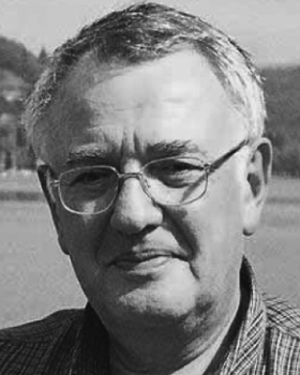 Alexander Puzenko合作论文数5Carynelisa Erlick合作论文数5
 Vaughan Phillips合作论文数Department of Physical Geography and Ecosystem Science, Lund University4
 Yuri D Feldman合作论文数School of Mechanical Engineering;Tel-Aviv University;School of Mechanical Engineering, Tel-Aviv University4
 Santiago Alvarez合作论文数Electronic Structure Group, Inorganic Chemistry Department, Facultat de Química, Universitat de Barcelona4Anna Sterkin合作论文数Research Institute;Tel-Aviv University;Sheba Medical Center3
 Shahar Keinan合作论文数Department of Chemistry and the Materials Research Center, Northwestern University3
 Chaim Dryzun合作论文数3Miquel Llunell合作论文数3
 Alexander Sterkin合作论文数Institute of Chemistry;Center for Computational Quantum Chemistry;Hebrew University of Jerusalem3N Benmoshe合作论文数2Pavel Khain合作论文数2
 Pere Alemany合作论文数Department of Physical Chemistry, University of Barcelona2
 Tov Elperin合作论文数Department of Mechanical Engineering, The Faculty of Engineering Sciences, Ben Gurion University of the Negev2Casanova David合作论文数2
 Nathan Kleeorin合作论文数Department of Mechanical Engineering;Ben-Gurion University;Department of Mechanical Engineering, Ben-Gurion University2
 Jun A. Zhang合作论文数Hurricane Research Division-CIMAS, NOAA's Atlantic Oceanographic and Meteorological Laboratory;University of Miami2
 Jeffrey R. French合作论文数NOAA;Field Research Division;Field Research Division, AOML2
 Barry Lynn合作论文数2
 Igor Rogachevskii合作论文数Department of Mechanical Engineering;Ben-Gurion University;Department of Mechanical Engineering, Ben-Gurion University2Dina Yogev-Einot合作论文数2H. Krugliak合作论文数2
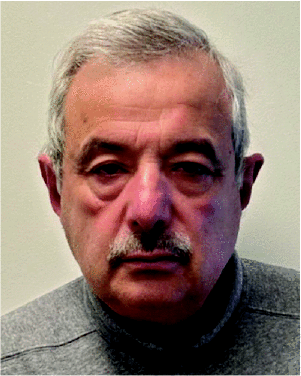 Alexander B. Kostinski合作论文数Department of Physics;Michigan Technological University;Department of Physics, Michigan Technological University2
 Jordi Figueras I Ventura合作论文数2T Prabhakaran合作论文数1S. Giangrande合作论文数1k d beheng合作论文数1R Lahav合作论文数1I. Koren合作论文数1




