Human gait recognition (HGR) has received a lot of attention in the last decade as an alternative biometric technique. The main challenges in gait recognition are the change in in-person view angle and covariant factors. The major covariant factors are walking while carrying a bag and walking while wearing a coat. Deep learning is a new machine learning technique that is gaining popularity. Many techniques for HGR based on deep learning are presented in the literature. The requirement of an efficient framework is always required for correct and quick gait recognition. We proposed a fully automated deep learning and improved ant colony optimization (IACO) framework for HGR using video sequences in this work. The proposed framework consists of four primary steps. In the first step, the database is normalized in a video frame. In the second step, two pre-trained models named ResNet101 and InceptionV3 are selected and modified according to the dataset's nature. After that, we trained both modified models using transfer learning and extracted the features. The IACO algorithm is used to improve the extracted features. IACO is used to select the best features, which are then passed to the Cubic SVM for final classification. The cubic SVM employs a multiclass method. The experiment was carried out on three angles (0, 18, and 180) of the CASIA B dataset, and the accuracy was 95.2, 93.9, and 98.2 percent, respectively. A comparison with existing techniques is also performed, and the proposed method outperforms in terms of accuracy and computational time.
Background: In medical image analysis, the diagnosis of skin lesions remains a challenging task. Skin lesion is a common type of skin cancer that exists worldwide. Dermoscopy is one of the latest technologies used for the diagnosis of skin cancer. Challenges: Many computerized methods have been introduced in the literature to classify skin cancers. However, challenges remain such as imbalanced datasets, low contrast lesions, and the extraction of irrelevant or redundant features. Proposed Work: In this study, a new technique is proposed based on the conventional and deep learning framework. The proposed framework consists of two major tasks: lesion segmentation and classification. In the lesion segmentation task, contrast is initially improved by the fusion of two filtering techniques and then performed a color transformation to color lesion area color discrimination. Subsequently, the best channel is selected and the lesion map is computed, which is further converted into a binary form using a thresholding function. In the lesion classification task, two pre-trained CNN models were modified and trained using transfer learning. Deep features were extracted from both models and fused using canonical correlation analysis. During the fusion process, a few redundant features were also added, lowering classification accuracy. A new technique called maximum entropy score-based selection (MESbS) is proposed as a solution to this issue. The features selected through this approach are fed into a cubic support vector machine (C-SVM) for the final classification. Results: The experimental process was conducted on two datasets: ISIC 2017 and HAM10000. The ISIC 2017 dataset was used for the lesion segmentation task, whereas the HAM10000 dataset was used for the classification task. The achieved accuracy for both datasets was 95.6% and 96.7%, respectively, which was higher than the existing techniques.
Globally, Pakistan ranks 4th in cotton production, 6th as an importer of raw cotton, and 3rd in cotton consumption. Nearly 10% of GDP and 55% of the country's foreign exchange earnings depend on cotton products. Approximately 1.5 million people in Pakistan are engaged in the cotton value chain. However, several diseases such as Mildew, Leaf Spot, and Soreshine affect cotton production. Manual diagnosis is not a good solution due to several factors such as high cost and unavailability of an expert. Therefore, it is essential to develop an automated technique that can accurately detect and recognize these diseases at their early stages. In this study, a new technique is proposed using deep learning architecture with serially fused features and the best feature selection. The proposed architecture consists of the following steps: (a) a self-collected dataset of cotton diseases is prepared and labeled by an expert; (b) data augmentation is performed on the collected dataset to increase the number of images for better training at the earlier step; (c) a pre-trained deep learning model named ResNet101 is employed and trained through a transfer learning approach; (d) features are computed from the third and fourth last layers and serially combined into one matrix; (e) a genetic algorithm is applied to the combined matrix to select the best points for further recognition. For final recognition, a Cubic SVM approach was utilized and validated on a prepared dataset. On the newly prepared dataset, the highest achieved accuracy was 98.8% using Cubic SVM, which shows the perfection of the proposed framework..
Human Action Recognition (HAR) is an active research topic in machine learning for the last few decades. Visual surveillance, robotics, and pedestrian detection are the main applications for action recognition. Computer vision researchers have introduced many HAR techniques, but they still face challenges such as redundant features and the cost of computing. In this article, we proposed a new method for the use of deep learning for HAR. In the proposed method, video frames are initially pre-processed using a global contrast approach and later used to train a deep learning model using domain transfer learning. The Resnet-50 Pre-Trained Model is used as a deep learning model in this work. Features are extracted from two layers: Global Average Pool (GAP) and Fully Connected (FC). The features of both layers are fused by the Canonical Correlation Analysis (CCA). Then features are selected using the Shanon Entropy-based threshold function. The selected features are finally passed to multiple classifiers for final classification. Experiments are conducted on five publicly available datasets as IXMAS, UCF Sports, YouTube, UT-Interaction, and KTH. The accuracy of these data sets was 89.6%, 99.7%, 100%, 96.7% and 96.6%, respectively. Comparison with existing techniques has shown that the proposed method provides improved accuracy for HAR. Also, the proposed method is computationally fast based on the time of execution.
In the USA, each year, almost 5.4 million people are diagnosed with skin cancer. Melanoma is one of the most dangerous types of skin cancer, and its survival rate is 5%. The development of skin cancer has risen over the last couple of years. Early identification of skin cancer can help reduce the human mortality rate. Dermoscopy is a technology used for the acquisition of skin images. However, the manual inspection process consumes more time and required much cost. The recent development in the area of deep learning showed significant performance for classification tasks. In this research work, a new automated framework is proposed for multiclass skin lesion classification. The proposed framework consists of a series of steps. In the first step, augmentation is performed. For the augmentation process, three operations are performed: rotate 90, right-left flip, and up and down flip. In the second step, deep models are fine-tuned. Two models are opted, such as ResNet-50 and ResNet-101, and updated their layers. In the third step, transfer learning is applied to train both fine-tuned deep models on augmented datasets. In the succeeding stage, features are extracted and performed fusion using a modified serial-based approach. Finally, the fused vector is further enhanced by selecting the best features using the skewness-controlled SVR approach. The final selected features are classified using several machine learning algorithms and selected based on the accuracy value. In the experimental process, the augmented HAM10000 dataset is used and achieved an accuracy of 91.7%. Moreover, the performance of the augmented dataset is better as compared to the original imbalanced dataset. In addition, the proposed method is compared with some recent studies and shows improved performance.
Crops diseases can create a major economic loss for a state-run. Overcoming on that issue is the main requirement. In this work, we propose an automated system for recognition of potato and corn leaf diseases. Three core phases architecture includes handcrafted features are extracted such as histogram-oriented gradient (HOG), Segmented Fractal Texture Analysis (SFTA) and local ternary patterns (LTP). In the second phase, principal component analysis (PCA) along entropy Skewness based score values are computed and resolve the problem of curse of dimensionality. In the last phase, classification is performed using various classifiers. The Plant Village dataset is utilized for validation and classify selected potato and corn diseases. Competent results are obtained in the range of 92.8% to 98.7% on chosen crops diseases which are better as compare to existing techniques.
Melanoma is the most common and deadly kind of malignancy among all the existing types of cancers, worldwide. Globally, the incidence rate of melanoma rising in recent decades. Responses on a survey, in USA about 192,310 new cases are diagnosed while 7,230 deaths have been occurred due to melanoma in 2019. This ratio can be decreased if it is detected at an early stage. A novel systematic approach for skin cancer detection based on optimal feature selection is proposed in this work. In the normalization step, it differentiates the lesion region from the surrounding skin region by using a linear contrast stretching technique. Later, various type features are computed and put to optimal feature selection approach name higher entropy value features (HEVF). Optimized and best features are selected and classified using SVM classifier and evaluated on ISBI 2017 dataset. As a result, the proposed systems get a performance of 96.2% which is improved as compared to existing techniques.
Human motion analysis has received a lot of attention in the computer vision community during the last few years. This research domain is supported by a wide spectrum of applications including video surveillance, patient monitoring systems, and pedestrian detection, to name a few. In this study, an improved cascaded design for human motion analysis is presented; it consolidates four phases: (i) acquisition and preprocessing, (ii) frame segmentation, (iii) features extraction and dimensionality reduction, and (iv) classification. The implemented architecture takes advantage of CIE-Lab and National Television System Committee colour spaces, and also performs contrast stretching using the proposed red-green-blue* colour space enhancement technique. A parallel design utilising attention-based motion estimation and segmentation module is also proposed in order to avoid the detection of false moving regions. In addition to these contributions, the proposed feature selection technique called entropy controlled principal components with weights minimisation, further improves the classification accuracy. The authors claims are supported with a comparison between six state-of-the-art classifiers tested on five standard benchmark data sets including Weizmann, KTH, UIUC, Muhavi, and WVU, where the results reveal an improved correct classification rate of 96.55, 99.50, 99.40, 100, and 100%, respectively.
Real-time applications like object detection, fire detection, face recognition and cancer detection are solely or partially relying on deep learning algorithms. Any tempering in these models can cause huge damages in many ways, therefore an utter need to secure these deep learning models is critically required. Blockchain technology has gained a wide popularity in tractability and security. In this article, the properties of blockchain are applied on the CNN models to produce secure CNN models. Each layer of a CNN model relates to a block, which contains the hash keys, public and private keys of their neighbors, while there exists a ledger block, which contains the detailed information about each layer of the model. The proposed SCNN model is tested using SVGG19 and SInceptionV3 models on publicly available datasets, which provides satisfactory results.
Malignant melanoma is considered as one of the most deadly cancers, which has broadly increased worldwide since the last decade. In 2018, around 91,270 cases of melanoma were reported and 9,320 people died in the US. However, diagnosis at the initial stage indicates a high survival rate. The conventional diagnostic methods are expensive, inconvenient and subject to the dermatologist's expertise as well as a highly equipped environment. Recent achievements in computerized based systems are highly promising with improved accuracy and efficiency. Several measures such as irregularity, contrast stretching, change in origin, feature extraction and feature selection are considered for accurate melanoma detection and classification. Typically, digital dermoscopy comprises four fundamental image processing steps including preprocessing, segmentation, feature extraction and reduction, and lesion classification. Our survey is compared with the existing surveys in terms of preprocessing techniques (hair removal, contrast stretching) and their challenges, lesion segmentation methods, feature extraction methods with their challenges, features selection techniques, datasets for the validation of the digital system, classification methods and performance measure. Also, a brief summary of each step is presented in the tables. The challenges for each step are also described in detail, which clearly indicate why the digital systems are not performing well. Future directions are also given in this survey.
In this paper, a new approach for the detection and classification of potato plant disease is implemented using computer vision techniques. Most of the existing algorithms based on plant disease detection and classification are limited to common types of feature extraction methods. However, feature extraction is an important area as the classification of diseases of any leaf. The proposed method is based on color and texture features. The implemented method processed in four steps- In the preprocessing and segmentation, LAB color space and Delta E color difference method are applied. Later, features are extracted based on RGB, HSV and Local Binary Patterns (LBP). The extracted patterns are finally classified by Multi Support Vector Machine (SVM). Moreover, we compare the results of feature subsets of RGB and HSV color features with the addition of LBP texture features and found a classification difference of 3.6% between RGB and HSV color feature extractors. The overall results show our method outperforms as compared to existing techniques.
Mobile ad-hoc networks (MANETs) comprise a large number of mobile wireless nodes that can move in a random fashion with the capability to join or leave the network anytime. Due to the rapid growth of devices on the Internet of Things (IoT), a large number of messages are transmitted during information exchange in dense areas. It can cause congestion that results in increasing transmission delay and packet loss. This problem is more severe in larger networks with more network traffic and high mobility that enforces dynamic topology. To resolve these issues, we present a bandwidth aware routing scheme (BARS) that can avoid congestion by monitoring residual bandwidth capacity in network paths and available space in queues to cache the information. The amount of available and consumed bandwidth along with residual cache must be worked out before transmitting messages. The BARS utilizes the feedback mechanism to intimate the traffic source for adjusting the data rate according to the availability of bandwidth and queue in the routing path. We have performed extensive simulations using NS 2.35 on Ubuntu where TCL is used for node configuration, deployment, mobility and message initiation, and C language is used for modifying the functionality of AODV. The results are extracted from trace files using Perl scripts to prove the dominance of the BARS over preliminaries in terms of packet delivery ratio, throughput and end-to-end delay, and the probability of congested node for static and dynamic topologies.
MANETs contain mobile nodes that can join or leave the network during the operations intended by the network. During massive communication scenarios, congestion causes increase in transmission delay and packet loss which ultimately leads to waste of resources upon recovery. The current available routing algorithms are not congestion adaptive. Existing surveys on routing include the congestion occurrence and then its control-based techniques in a reactive manner. In this paper, we have focused to further include the congestion avoidance schemes where congestion aware and congestion adaptive protocols for MANETs are discussed. Congestion avoidance-based schemes are further subcategorized under cross-layer and rate control-based protocols. We have also categorically evaluated the existing schemes and presented in a tabular form to highlight the role of end-to-end delay, packet drop ratio, throughput, energy efficiency, data rate, and related metrics. It provides a comprehensive collection of related schemes to overview the contributions in this area and pinpoint the weaknesses for mitigating the unresolved issues.
Melanoma skin cancer is one of the most deadly forms of cancer which are responsible for thousands of deaths. The manual process of melanoma diagnosis is a time taking and difficult task, therefore researchers introduced several computerized methods for recognition. Through computational methods, improves the accuracy of diagnostics process which is helpful for dermatologists. In this paper, we proposed an automated system for skin lesion classification through transfer learning based deep neural network (DCNN) features extraction and kurtosis controlled principle component (KcPCA) based optimal features selection. The pre-trained ResNet deep neural network such as RESNET-50 and RESNET-101 are utilized for features extraction. Then fused their information and selects the best features which later fed to supervised learning method such as SVM of radial basis function (RBF) for classification. Three datasets name HAM10000, ISBI 2017, and ISBI 2016 are utilized for experimental results and achieved an accuracy of 89.8%, 95.60%, and 90.20%, respectively. The overall results show that the performance of the proposed system is reliable as compared to existing techniques.
A biometric classification system is utilized to judge the features of human expression by recognizing distinct parameters. Human Gait Recognition (HGR) is a current research area which is mostly used for various security applications such as video surveillance etc. HGR is also utilized in medical imaging for the investigation of several diseases such as Parkinson disease which is identified by gait features. Still, various challenges occur in this domain that affects system accuracies such as shoe type, change in angle, load carriage and change in walking speed. In this research, a new approach for HGR is proposed which is based on Quartile Deviation of Normal Distribution (QDoND) for human extraction and Bayesian model along with Binomial Distribution for features fusion and best features selection. Initially, in the pre-processing step, the most excellent channel is selected and its motion flow is estimated. The motion regions are extracted by QDoND that are later utilized for shape and texture feature extraction. Afterward, the extracted features are fused by a Bayesian model based on their similarity index. Finally, BDs based best features are selected and recognition is performed on the basis of best features using multi-class support vector machine. Four publicly and famous datasets are utilized for the evaluation of proposed system such as AVA multi-view gait (AVAMVG), CASIA A, CASIA B and CASIA C having an accuracy rate of 100%, 98.8%, 87.7%, and 91.6% respectively. The results reveal that the proposed method outperforms in contrast to existing methods.
Human activity recognition (HAR) has significance in the domain of pattern recognition. HAR handles the complexity of human physical changes and heterogeneous formats of same human actions performed under dissimilar subjects. This research contributes a unique method focusing on the changes in human movement. The purpose is to identify and categorise human actions from video sequences. The interest points (IPs) are extracted from the subject video and motion history images (MHIs) are constructed and analysed after image segmentation. Discriminative features (DFs) are selected and the visual vocabulary is learned from the extracted DF (EDF). The EDF are then quantised by using visual vocabulary and images are represented based upon frequencies of visual words (VW). VW are formed from the EDF and then, a histogram of VW is developed based on the feature vectors extracted from MHI. These feature vectors are used for training support vector machine (SVM) for the classification of actions into various categories. Benchmark datasets like KTH, Weizmann and HMDB51 are used for evaluation and comparison with existing action recognition approaches depicts the better performance of adopted strategy.
Nowadays, risk management considered being the most important part of the software development enterprise. Risk analysis and risk management in entrepreneurial business considered as a key contribution towards the business success. The majority of the businesses fall back due to lack of risk management methodology. This paper presents a comprehensive analysis of risk factors affecting software development. An extensive list of risk factors produced. The list reflects the most common risk factors which frequently affect the software products in different phases of software development. After identification of risk factors, an optimized model is developed in order to manage the identified risks and to provide risk control in order to improve the success chance of entrepreneurial organizations.
In agriculture, plant diseases are primarily responsible for the reduction in production which causes economic losses. In plants, citrus is used as a major source of nutrients like vitamin C throughout the world. However, `Citrus' diseases badly effect the production and quality of citrus fruits. From last decade, the computer vision and image processing techniques have been widely used for detection and classification of diseases in plants. In this article, we propose a hybrid method for detection and classification of diseases in citrus plants. The proposed method consists of two primary phases; (a) detection of lesion spot on the citrus fruits and leaves; (b) classification of citrus diseases. The citrus lesion spots are extracted by an optimized weighted segmentation method, which is performed on an enhanced input image. Then, color, texture, and geometric features are fused in a codebook. Furthermore, the best features are selected by implementing a hybrid feature selection method, which consists of PCA score, entropy, and skewness-based covariance vector. The selected features are fed to Multi-Class Support Vector Machine (M-SVM) for final citrus disease classification. The proposed technique is tested on Citrus Disease Image Gallery Dataset, Combined dataset (Plant Village and Citrus Images Database of Infested with Scale), and our own collected images database. We used these datasets for detection and classification of citrus diseases namely anthracnose, black spot, canker, scab, greening, and melanose. The proposed technique outperforms the existing methods and achieves 97% classification accuracy on citrus disease image gallery dataset, 89% on combined dataset and 90.4% on our local dataset.
 Muhammad Almas Anjum合作论文数College of EME, NUST, Pakistan19
 Muhammad Attique Khan合作论文数Department of Computer Science, College of Computer Engineering and Science, Prince Mohammad Bin Fahd University19
 M. Usman Akram合作论文数College of Electrical and Mechanical Engineering, National University of Sciences and Technology16
 Muhammad Sharif合作论文数Department of Computer Science, COMSATS University Islamabad14
 Abdul Basit合作论文数13
 Aasia Khanum合作论文数College of Electrical and Mechanical Engineering, National University of Sciences and Technology (NUST),10
 Faiza Iqbal合作论文数Coll. of E&ME, Nat. Univ. of Sci. & Technol. (NUST),;c;Coll. of E&ME, Nat. Univ. of Sci. & Technol. (NUST),9
 Usman Qamar合作论文数Knowledge and Data Science Research Centre, Department of Computer & Software Engineering, National University of Sciences and Technology (NUST)8Tanzila Saba合作论文数College of Computer and Information Sciences, Prince Sultan University7Shoab Ahmed Khan合作论文数6Anam Tariq合作论文数6
 Usman Qayyum合作论文数School of Engineering, Australian National University6
 Amjad Rehman合作论文数5Saima Shaheen合作论文数Department of Computer Engineering, National University of Sciences and Technology5Sumaira Kausar合作论文数College of Electrical and Mechanical Engineering, National University of Sciences and Technology (NUST),5
 Farhan Hassan Khan合作论文数College of Electrical and Mechanical Engineering, National University of Sciences and Technology (NUST),5
 Saba Bashir合作论文数College of Electrical and Mechanical Engineering, National University of Sciences and Technology (NUST),5
 Usman Tariq合作论文数College of Computer Engineering & Sciences, Prince Sattam Bin Abdulaziz University;College of Business Administration In Alkharj, Prince Sattam Bin Abdulaziz University5
 Mussarat Yasmin合作论文数Department of Computer Science, COMSATS University Islamabad5
 Nousheen Akhtar合作论文数4
 Tallha Akram合作论文数COMSATS Univ Islamabad, Dept EE, Wah Cantt, Pakistan4
 Sheeraz Akram合作论文数4
 Yunyoung Nam合作论文数Department of Computer Science and Engineering, Soonchunhyang University4
 Umar Mahmud合作论文数Military College of Signals, National University of Sciences & Technology(NUST),4Yasir Fayyaz合作论文数4nazish asad合作论文数3
 Rehan Nemati合作论文数Natl Univ Sci & Technol NUST3
 Ammar Armghan合作论文数Jouf Univ, Coll Engn, Dept Elect Engn, Sakaka 72388, Saudi Arabia3
 Ata Ullah合作论文数3
 Ali Hassan合作论文数3
 Naveed Khattak合作论文数3
 Nabeel Khan合作论文数University of Otago3
 Aamer Nadeem合作论文数Mohammad Ali Jinnah University3Nazir A. Malik合作论文数Information Security Group, University of London3
 Shaleeza Sohail合作论文数School of Computer Science and Engineering;University of New South Wales;School of Computer Science and Engineering, University of New South Wales3
 Muazzam A. Khan Khattak合作论文数3
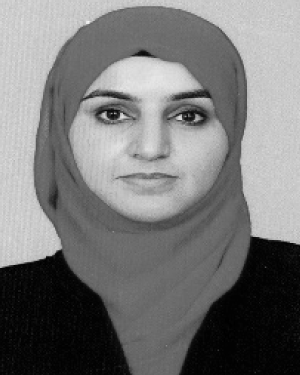 Samabia Tehsin合作论文数Military College of Signals, NUST3
 Shehzad Khalid合作论文数Department of Computer Science and Engineering, Bahria University3Ifrah Farrukh Khan合作论文数3
 Asif Sohail Abid合作论文数3
 Ayesha Altaf合作论文数3
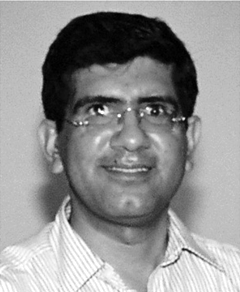 Muid Mufti合作论文数3
 Seifedine Kadry合作论文数Noroff;Lebanese American University;FIBAA Qualitätssicherung3Naveed S. Khattak合作论文数2
 Hashim Ali合作论文数2
 Muhammad Iqbal合作论文数2Habiba Arshad合作论文数2
 Memoona J. Anwar合作论文数School of Computer Science, The University of Technology Sydney2
 Faisal Azam合作论文数Department of Computer Science, COMSATS University2




