Instance-level data augmentation methods, exemplified by “copy-paste”, serve as a conventional strategy for improving the performance of small object detectors. The core idea involves leveraging background redundancy by compositing object instances with suitable backgrounds—drawn either from the same image or from different images—to increase both the quantity and diversity of training samples. However, existing methods often struggle with mismatches in background, scale, illumination, and viewpoint between instances and backgrounds. More critically, their predominant reliance on background information, without a joint understanding of instance-background characteristics, results in augmented images lacking visual realism. Empirical studies have demonstrated that such unrealistic images not only fail to improve detection performance but can even be detrimental. To tackle this problem, we propose a scene-understanding-driven approach that systematically addresses these mismatches via joint instance-background understanding. This is achieved through a unified framework that integrates image inpainting, image tagging, open-set object detection, the Segment Anything Model (SAM), and pose estimation to jointly model instance attributes, background semantics, and their interrelationships, thereby abandoning the random operation paradigm of existing methods and synthesizing highly realistic augmented images while preserving data diversity. On the VisDrone dataset, our method improves the mAP@0.5:0.95 and mAP@0.5 of the baseline detector by 1.6% and 2.2%, respectively. Both quantitative gains and qualitative visualizations confirm that the systematic resolution of these mismatches directly translates into significantly higher visual realism and detection performance improvements.
Mobile Manipulation (MM) involves long-horizon decision-making over multi-stage compositions of heterogeneous skills, such as navigation and picking up objects. Despite recent progress, existing MM methods still face two key limitations: (i) low sample efficiency, due to ineffective use of redundant data generated during long-term MM interactions; and (ii) poor spatial generalization, as policies trained on specific tasks struggle to transfer to new spatial layouts without additional training. In this paper, we address these challenges through Adaptive Experience Selection (AES) and model-based dynamic imagination. In particular, AES makes MM agents pay more attention to critical experience fragments in long trajectories that affect task success, improving skill chain learning and mitigating skill forgetting. Based on AES, a Recurrent State-Space Model (RSSM) is introduced for Model-Predictive Forward Planning (MPFP) by capturing the coupled dynamics between the mobile base and the manipulator and imagining the dynamics of future manipulations. RSSM-based MPFP can reinforce MM skill learning on the current task while enabling effective generalization to new spatial layouts. Comparative studies across different experimental configurations demonstrate that our method significantly outperforms existing MM policies. Real-world experiments further validate the feasibility and practicality of our method. The source code is available at https://csu-hero-lab.github.io/SG-MM Web.
Object navigation (ObjcetNav), which enables an agent to seek any instance of an object category, has shown great advances. However, current agents are built upon occlusion-prone visual observations or compressed 2-D maps, which hinder their embodied perception of 3-D scene geometry. Furthermore, existing methods usually decouple ObjectNav into the exploration and exploitation subtasks, easily leading to ambiguous object localization and blind exploration. To address these issues, we first propose an embodied contrastive learning (ECL) method with geometric consistency (GC) and behavioral awareness (BA), which motivates agents to encode 3-D scene layouts and semantic cues actively. The BA is modeled by predicting navigational actions based on multiframe visual images, as behaviors causing differences between adjacent visual sensations are crucial for learning correlations among continuous visions. The GC is modeled by aligning the behavior-aware visual stimulus with 3-D semantic shapes through unsupervised contrastive learning. Then, based on the above ECL pretraining, a coarse-to-fine ObjectNav policy with explorer and discriminator cooperation is proposed, inspired by the treasure-hunting mindset. Concretely, the explorer is designed to adaptively switch the action spaces, thereby switching the global and local exploration thoughts according to the accumulated scene priors. The discriminator is designed to discriminate the target’s authenticity using behavior-aware visual features and geometric invariance priors, which permits mimicking the human behavior of “approaching to confirm” when distinguishing objects from a distance. As expected, our ECL method performs well on object detection (ObjDet) and instance segmentation (InstSeg) tasks. Our ECL-enhanced ObjectNav strategy outperforms state-of-the-art (SOTA) methods on Matterport3D (MP3D), Gibson, and HM3D datasets.
Aligning the decision-making process of deep learning models with that of experienced sonographers is essential for ultrasound-based reliable disease diagnosis. Although existing methods have made significant progress in this aspect, their alignments are primarily associational rather than causal, leading to pseudo-correlations between features and diagnostic results. Such a biased diagnosis blindly models the sonographer's diagnostic skills and attention to specific patterns, which we argue hardly produces an AI diagnoser that is comparable to human experts. To address this issue, we propose a causality-based diagnostic framework to align the model's diagnostic behaviors with those of experts. Specifically, by delving into both conspicuous and inconspicuous confounders within the ultrasound images, the back-door and front-door adjustment causal learning modules are proposed to promote unbiased learning by mitigating potential pseudo-correlations. In addition, we integrate causal inference into a well-designed dual-branch model with feature interaction bridges for compatibility with multimodal ultrasound inputs. To fully evaluate our method, we conduct comparative studies on different diseases and ultrasound modalities. In particular, we publish a carefully constructed multimodal ultrasound dataset for breast lesion diagnosis and segmentation. Sufficient comparative and ablation studies on this dataset emphasize that our method outperforms state-of-the-art methods.
Visual Floorplan Localization (FLoc) struggles with severe structural aliasing caused by repetitive minimalist layouts. This occurs because physically distant poses share highly similar visual-geometric features, which degrades spatial separability and angular discriminability. While existing methods attempt to mitigate these ambiguities by relying on costly semantic annotations, the resulting performance gains remain inherently limited. To address the above issues, we propose DisCo-FLoc, a semantic-free method for visual-geometric Contrastive Disambiguation. First, we introduce a depth-aware Ray Regression Predictor (RRP) that serves as a dense-to-ray geometric projector. By explicitly suppressing visual clutter along the vertical dimension, RRP projects monocular RGB images into 2D ray primitives, which are matched with floorplans to produce geometry-aware FLoc candidates. Second, to resolve the remaining ambiguity among these candidates, we propose a spatially perturbed contrastive objective to align RGB images with local floorplan structures and formulate a visual-geometric compatibility function. In particular, we meticulously construct positive and negative samples at both positional and directional levels through SE(2) pose perturbations for contrastive learning, effectively achieving pose smoothness, spatial separability, and angular discriminability. The compatibility function enables DisCo-FLoc to disambiguate FLoc by using richer visual context beyond pure geometric layouts, without requiring any semantic annotations. Extensive experiments on two challenging visual FLoc benchmarks demonstrate that DisCo-FLoc significantly outperforms state-of-the-art semantic-based methods, especially narrowing the performance gap between positional and directional FLoc accuracy.
Benefiting from mobility and dexterity, Mobile Manipulation (MM) systems are expected to assist humans with diverse tasks in everyday life. However, since MM tasks (e.g., tidying up a room) require learning multi-stage heterogeneous behaviors (e.g., picking, placing, and opening), existing Reinforcement Learning (RL) agents often face sample inefficiency and progress reversal issues. In addition, such MM agents are limited to learning customized tasks, thus not allowing for the extrapolation to new tasks and real-world scenes. In this work, we propose a Hierarchical Policy Distillation (HPD)-based RL framework to explicitly address these issues, which outperforms existing curriculum learning-based and hierarchical RL-based methods. Specifically, Sub-Skill Distillation (SSD) allows learning both the main MM task and easier sub-skills in a single training loop, facilitating exploration and mitigating process reversal by distilling the relevant sub-skills' experience into the main task. Self-boosting Policy Distillation (SPD) is designed to enhance generalization and address the information asymmetry between MM tasks in a principled way, i.e., distilling the experience of a prior task to a new one. Comparative and ablation studies on different robotic platforms demonstrate that our method significantly outperforms existing methods. Finally, real-world experiments validate the practicality of our method.
Severe image degradation under low-light nighttime conditions constitutes a core bottleneck preventing all-day applications for UAV-based single object tracking. Existing image enhancement methods often struggle to distinguish between target and background regions, which can easily lead to amplified background noise or compromise target features. To overcome this limitation, we propose TAE, a target-aware low-light enhancement framework tailored for nighttime object tracking. Guided explicitly by weak supervisory signals from tracking bounding boxes, the framework performs region-aware enhancement to ensure operations focus on the target area. It further adopts an adaptive RGB multi-curve fusion mechanism to achieve refined modeling and adaptive adjustment across different regions. To facilitate research in this domain, we also contribute DarkSOT, a new benchmark for nighttime UAV tracking, comprising 268 sequences across 9 target categories. Experimental results on the DarkSOT and UAVDark135 demonstrate that TAE significantly improves tracking performance in low-light nighttime scenarios, exhibiting strong robustness and generalization. The DarkSOT dataset is available at https://github.com/Fu0511/DarkSOT-Dataset.
This paper focuses on Single-Domain Generalized Object Detection (Single-DGOD), aiming to develop an object detector trained on a single source domain that generalizes well to multiple unseen target domains. However, learning a robust detector that relies solely on single-domain data is challenging due to limited data diversity. To address this issue, we propose an Adversarial Spectral Perturbation (AdvSP) approach to improve Single-DGOD generalization. Specifically, we first conduct a comparative analysis of the Fourier spectra of multiple images, revealing that image color, texture, and semantic content are characterized by three distinct Fourier spectral components. On this basis, we develop a spectral perturbation module (SPM) containing three learnable perturbation factors to jointly disrupt the Fourier spectra, simulating diverse variations in image attributes. Furthermore, we introduce an adversarial learning objective to optimize the SPM, and the learned SPM is then employed to construct adversarial images for detector training. Visual analysis of style features demonstrates that AdvSP greatly diversifies source images, while encouraging results on three benchmark datasets further confirm the effectiveness of AdvSP. Moreover, AdvSP features a plug-and-play design and can be easily integrated into different detection frameworks.
Social robot navigation presents a significant and complex challenge within indoor environments characterized by numerous obstacles and dynamic changes. Reinforcement learning (RL) serves as a potent approach for addressing this issue. However, the primary attributes of such environments-their diversity and complexity-pose substantial challenges to the generalization capabilities of RL-based social robot navigation systems. In this article, we propose a meta-reinforcement learning framework for social robot navigation that empowers robots to adapt to a variety of environments. Furthermore, we introduce the concept of utilizing social norms to guide social navigation for the first time. We employ field modeling to represent interactions among the environment, pedestrians, and robots. Historical pedestrian motion data are utilized as training input for physical information neural networks, which generate pedestrian movement vector fields within the environment. We then incorporate the similarity between the robot's predicted motion state and its actual motion state into the reward function, guiding the robot's learning process in alignment with social norms. Simulation results demonstrate that our proposed method enhances the robot's social navigation capabilities.
Fine-grained ship recognition in remote sensing imagery is essential for maritime applications. However, its development is hindered by two challenges: 1) the limited granularity of existing ship detection datasets, and 2) the disturbance of complex maritime conditions as well as the arbitrary ship orientations and distributions. To address the first issue, we annotated a large-scale fine-grained ship instance detection dataset (LAFI), comprising 48,717 ship instances worldwide with 49 categories. To tackle the challenges of marine disturbance and diverse ship status, we proposed a controllable generative knowledge-driven ship detection framework (COSD). It employs a controllable diffusion model guided by ship-marine textual prompt to generate millions of synthetic images that not only preserve ship structures but also cover diverse sea and weather conditions for robust pretraining. The pretraining stage then utilizes masked reconstruction to learn component-level cues under occlusion, clutter, fog, and illumination changes. Furthermore, a heterogeneous feature alignment decoder is designed to align multi-modal metrics of orientation and distribution features in the latent space, allowing for accurate representation of diverse ship status. Extensive experiments on two benchmark datasets showed that our method respectively increased 0.011 and 0.030 mean average precision (mAP@50) over SOTA methods, particularly in scenarios involving small, densely packed and arbitrary oriented ships.
Detecting weak underwater targets in hyperspectral imagery (HSI) is challenging due to strong background interference, water-induced spectral distortions, and the inherently low responses of submerged materials. Current methods typically rely on target-oriented strategies, attempting to strengthen weak signals by embedding limited target priors. However, they remain constrained by two critical issues: the scarcity of target pixels and the absence of physically grounded constraints, both of which undermine weak-signal preservation and result in unreliable detections. To address these limitations, this study introduces rejection-guided residual reasoning network (R(3)Net), a rejection-guided residual reasoning framework built upon the principle that rejection is the best protection. The main idea is to shift focus from target-oriented formulations toward a background-oriented paradigm that leverages the abundance of background information as a stable and reliable reference. Building on this idea, R(3)Net first establishes a background-oriented representation by explicitly suppressing target contributions, allowing the residuals between the input and its reconstruction to naturally reveal candidate target signals. Since such residuals inevitably encompass background noise and nontarget weak responses, they are subsequently refined through a physics-aware reasoning stage grounded in the underwater imaging model, which validates candidate signals based on physical consistency. In this way, R(3)Net unifies residual learning with physics-guided refinement, enabling robust preservation of weak targets while effectively suppressing false alarms, thus achieving reliable and physically interpretable underwater detection. Extensive experiments on real-world datasets demonstrate that R(3)Net outperforms state-of-the-art (SOTA) methods in both detection accuracy and robustness. All data and source code used in the experiments will be publicly available at https://github.com/qjh1996/HUTD
Building flexible and efficient robotic platforms is essential for bridging the gap between simulation and real-world reinforcement learning (RL) applications. In this work, we introduce a hybrid robotic platform that integrates a three-axis linear slide with an OpenManipulator arm. This unified system is accurately modeled in simulation and seamlessly transferred to physical hardware, enabling consistent training and deployment of reinforcement learning policies across both domains. Based on this platform, we propose a novel RL framework named Enhanced Hindsight Experience Replay (EHER) to tackle the sparse reward problem in goal-conditioned tasks. EHER extends the standard DDPG+HER baseline by incorporating a two-fold training enhancement: subtask decomposition and expert experience replay. Specifically, we leverage the structure of the robot to decompose tasks into two coordinated subtasks: (1) using the linear slide to bring the end-effector near the goal region, followed by (2) fine-tuning the arm’s motion to precisely reach the target. Successful trajectories from both subtasks are selectively reused as expert demonstrations to guide future learning. Experimental results in simulation environments demonstrate that our method significantly improves sample efficiency and accelerates policy convergence, achieving high success rate in reaching and pushing tasks. The trained policy was subsequently deployed on a real-world robotic system to validate its sim-to-real transfer performance. These emphasize the necessity of co-designing reinforcement learning algorithms in conjunction with the physical and control capabilities of robotic systems to facilitate effective real-world deployment.
In recent years, end-to-end congestion control algorithms or flow pausing mechanisms are proposed to achieve high throughput and low latency in datacenter networks. However, prior end-to-end congestion control works without complex signals fail to achieve fast convergence to a stable equilibrium state and effectively handle the transient congestion, while existing flow pausing mechanisms are decoupled from congestion control, which leads to long convergence time after transient states and incomplete queue elimination in equilibrium states. To address these issues, we present FAR, a rate control protocol that combines the advantages of flow pausing and congestion control. At its heart, FAR couples the bandwidth-estimation-based congestion control and the end-to-end flow pausing mechanisms. After flow pausing, FAR quickly explore the available bandwidth with a binary-search probe to achieve high throughput and low latency. Meanwhile, FAR employs a probe staggering mechanism to address the queue oscillation issue in high-concurrency scenarios. We implement the prototype of FAR using DPDK. Extensive evaluation results demonstrate that our protocol achieves accurate bandwidth estimation and reduces the tail flow completion time (FCT) by up to 67% compared with the state-of-the-art designs.
Visual Floorplan Localization (FLoc) has emerged as a promising solution for indoor localization by matching egocentric images against minimalist structural maps. However, due to cross-modal information asymmetry and repetitive indoor layouts, visual FLoc is fundamentally challenged by multimodal pose distributions, where visually identical observations map to distinct, spatially separated locations. Existing ray-matching-based methods tackle this by explicitly predicting sparse geometric or semantic rays, which inherently incur information loss and demand resource-intensive preprocessing alongside exhaustive matching during inference. In this paper, we bypass the intermediate ray-matching paradigm and propose a coarse-to-fine visual FLoc framework that progresses from uncertainty to determinism. In the coarse stage, we design an image-conditioned pose diffusion model to parameterize the continuous multimodal pose distribution, effectively routing stochastically initialized pose particles toward distinct candidate modes. In the refinement stage, we propose a localized refiner that predicts bounded sub-meter pose residuals from candidate-centered floorplan crops, where structural ambiguities are largely eliminated. Our method effectively balances global multi-hypothesis tracking and local sub-meter refinement without requiring any offline map preprocessing or test-time lookup tables. Comprehensive results on the S3D (full) and ZInD benchmarks demonstrate that our approach achieves state-of-the-art accuracy and robustness.
Mobile manipulation requires robots to identify Floor Affordance (FloAff) that maximizes downstream manipulation success rather than merely ensuring navigation feasibility. FloAff prediction is a target-conditioned local spatial reasoning problem, yet existing methods suffer from representation ambiguity caused by irrelevant spatial context and arbitrary object orientations, while entangling shared and task-specific knowledge across heterogeneous manipulation skills. To address these challenges, we propose a unified framework for FloAff prediction from egocentric multimodal perception, consisting of canonical representation learning and progressive affordance prior learning. Specifically, we introduce a Canonical Floor Affordance Representation (CFAR), which learns canonical interaction geometry by preserving affordance-relevant local structure while eliminating nuisance spatial variations unrelated to robot base placement. We further propose Progressive Floor Affordance Learning (PFAL), which learns transferable FloAff priors from a foundation manipulation task and progressively adapts them to heterogeneous downstream manipulation skills. To facilitate systematic evaluation, we establish the first cross-scene, multi-view FloAff-Kitchen benchmark covering diverse manipulation skills, scene layouts, furniture styles, and viewpoints. Extensive experiments on three benchmark settings demonstrate that our method consistently outperforms strong baselines, while ablation studies validate the contribution of each proposed component. Project page: https://csu-hero-lab.github.io/FloAff-Kitchen_Web/
Semantic segmentation and stereo matching, respectively analogous to the ventral and dorsal streams in our human brain, are two key components of autonomous driving perception systems. Addressing these two tasks with separate networks is no longer the mainstream direction in developing computer vision algorithms, particularly with the recent advances in large vision models and embodied artificial intelligence. The trend is shifting towards combining them within a joint learning framework, especially emphasizing feature sharing between the two tasks. The major contributions of this study lie in comprehensively tightening the coupling between semantic segmentation and stereo matching. Specifically, this study makes three key contributions: (1) a tightly coupled, gated feature fusion strategy, (2) a hierarchical deep supervision strategy, and (3) a coupling tightening loss function. The combined use of these technical contributions results in TiCoSS, a state-of-the-art joint learning framework that simultaneously tackles semantic segmentation and stereo matching. Through extensive experiments on the KITTI, vKITTI2, and Cityscapes datasets, along with both qualitative and quantitative analyses, we validate the effectiveness of our developed strategies and loss function. Our approach demonstrates superior performance compared to prior arts, with a notable increase in mean intersection over union by over 9%.
Wildfires can cause significant damage to the environment, ecosystems, and social economics. The timely and accurate identification of wildfire areas is critically important for post-fire assessment and emergency response. Using Synthetic Aperture Radar (SAR) to generate optical-style images for wildfire detection enables reliable imagery under cloudy conditions. Traditional Generative Adversarial Network based methods are prone to mode collapse. In this study, we propose a Spectral-Feature-Guided Controllable Diffusion (SCDiff) model, which consists of two key components: (1) a spectral feature guidance stage, where the Normalized Burn Ratio is introduced as a spatial attention mechanism to guide translation and enforce spectral consistency in burned areas; and (2) a hierarchical structure guidance stage, where a hierarchical fusion strategy combines global low-resolution context with local high-resolution details to alleviate patch-based artifacts. SCDiff employs a resolution-agnostic design, enabling high-quality reconstruction at the full-image level across large-scale wildfire scenes, ensuring structural continuity and spatial consistency. Experiments on 58 major wildfires in Canada demonstrate that SCDiff generates more detailed and realistic fire-disturbed areas from Sentinel-1 SAR to Sentinel-2 multi-spectral images, outperforming the baselines in both spectral similarity and downstream wildfire detection.
Vision-and-language navigation in continuous environments (VLN-CE) requires the agent to jointly understand visual scenes and natural language instructions. When dealing with complex environments and diverse instructions, existing approaches often adopt end-to-end learning strategies or unitary environmental representation models. However, these approaches often lack interpretability and struggle to generalize to unseen scenes due to incomplete scene modeling. To address these limitations, we propose a Semantic Grid Hybrid Map (SGHM) and a Knowledge-Guided Instruction Alignment (KGIA) module to facilitate the agent’s capability of grounding instructions with the environmental representation. SGHM initially expands the map representation by incorporating fine-grained grid environmental features alongside explicit semantic priors and spatial layouts to construct a hybrid map. And KGIA integrates external commonsense knowledge from a knowledge base to provide fact knowledge features related to each view, which play a role in bridging the map representation with the instruction. Extensive experiments on the R2R-CE and RxR-CE benchmarks demonstrate that our approach substantially improves navigation performance and generalization in complex environments.
Uncrewed aerial vehicles (UAVs) are increasingly equipped with dual-modal sensors, making visible-infrared image alignment a task of significant practical value. However, precise cross-modal alignment remains a challenge due to disparities in field of view, radiation characteristics, and other factors. Existing image-based alignment methods often overlook the imaging mechanisms of dual-modal sensors and struggle to balance efficiency with accuracy. In this article, by investigating the imaging mechanism of a fixed visible-infrared sensor, we demonstrate that when its visible and infrared imaging planes are coplanar (a practical and feasible approximation), an ideal deformation field exists that can warp the visible image into alignment with the infrared image. This deformation field remains nearly invariant with respect to both UAV state (e.g., altitude, longitude, and latitude) and sensor pose (e.g., pitch, yaw, and roll). To accurately estimate this ideal deformation field, we propose PDFNet, an end-to-end pixelwise dense matching network. Unlike traditional methods that rely on sparse feature matching or parametric transformations, PDFNet directly learns a dense displacement field from visible to infrared images, enabling it to address complex geometric distortions and nonrigid deformations. In our alignment pipeline, images are first roughly aligned through manual annotation before being fed into the network. Then, by integrating complementary information from multiple rounds of manual annotation, the network effectively suppresses subjective errors and stably converges to a globally optimal deformation field that is invariant to input variations. This enables direct application of a single precomputed deformation field at inference, requiring no network forward pass and reaching 33 frames/s. Experiments on real-world UAV datasets demonstrate that our method outperforms existing learning-based methods such as RoMa and SuperGlue in alignment accuracy.
 Jianxin Wang (王建新)合作论文数School of Computer Science and Engineering, Central South University19
 Bolei Chen (陈铂垒)合作论文数School of Computer Science and Engineering, Central South University17
 Yiming Zhang (张一鸣)合作论文数School of Computer Science, Shanghai Jiao Tong University;NICE Lab, Department of Computer Science and Engineering, Shanghai Jiao Tong University;Peng Cheng Laboratory17
 Jiahao Qi合作论文数15
 Hu, X.合作论文数11
 Aikun Xu合作论文数10
 Jiawei Huang (黄家玮)合作论文数School of Computer Science and Engineering, Central South University10
 Yingwen Chen (陈颖文)合作论文数College of Computer Science and Technology, National University of Defense Technology9
 Fu Ruigang (傅瑞罡)合作论文数8
 Wanchun Jiang (蒋万春)合作论文数School of Computer Science and Engineering, Central South University8Yongzheng Cui合作论文数7Siyi Lu合作论文数7Xiaoyan Kui合作论文数7
 Yixiong Liang (梁毅雄)合作论文数School of Information Science and Engineering, Central South University7
 Jianliang Gao (高建良)合作论文数School of Computer Science and Engineering, Central South University6
 Guihua Duan (段桂华)合作论文数School of Computer Science and Engineering, Central South University6
 Zhiqiang Gong合作论文数5
 Shengyun Liu (刘盛云)合作论文数School of Cyber Science and Engineering, Shanghai Jiao Tong University4
 Zhaoyi Li合作论文数4
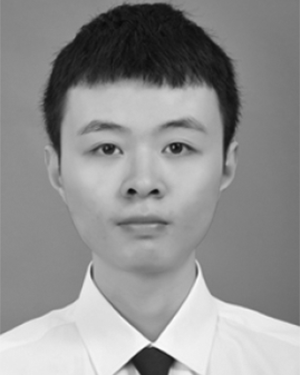 Yiwen Zhang合作论文数Anhui University, Anhui University4
 Shigeng Zhang (张士庚)合作论文数School of Computer Science and Engineering, Central South University4
 Fangxiang Wu合作论文数Division of Biomedical Engineering, College of Engineering, University of Saskatchewan4
 Dongsheng Li (李东升)合作论文数School of Computer Science, National University of Defense Technology4
 Huiba Li (李慧霸)合作论文数Meituan4Jiaxu Kang合作论文数3Hui Xiao合作论文数3Shengwen Zhou合作论文数3Yating Li合作论文数3
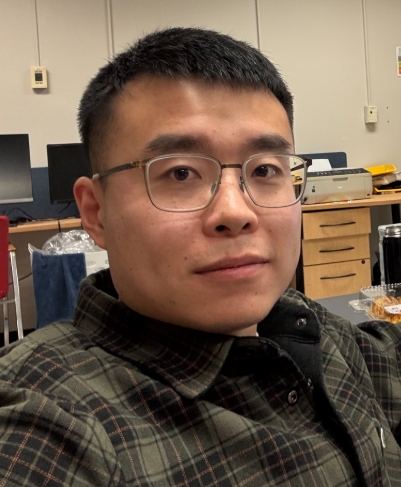 Hao Zheng (郑浩)合作论文数Sun Yat-sen University3Qiao Zhou合作论文数3Xinyu Zhang合作论文数3
 Feng Gao合作论文数3
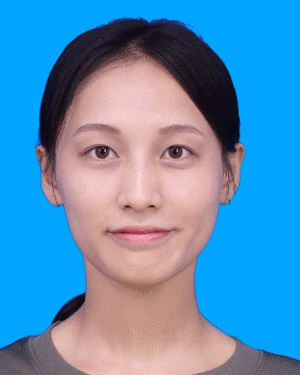 Xingyue Liu合作论文数3
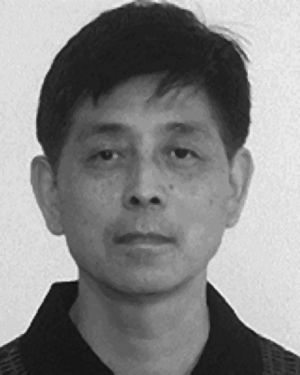 Runsheng Wang合作论文数3
 Jiazhi Xia (夏佳志)合作论文数School of Computer Science and Engineering, Central South University3
 Rui Fan (范睿)合作论文数College of Electronics & Information Engineering, Tongji University3Huakun Du (杜华坤)合作论文数School of Geosciences and Info-physics, Central South University3
 Keqin Li (李克勤)合作论文数Department of Computer Science, State University of New York;College of Computer Science and Electronic Engineering, Hunan University3
 Meiguang Zheng (郑美光)合作论文数School of Computer Science and Engineering, Central South University3
 Xiao Zheng (郑啸)合作论文数安徽工业大学计算机科学与技术学院3
 Zhigang Hu (胡志刚)合作论文数Central South University3
 Yilin Kang合作论文数3Zihao Chen合作论文数2Xianting Feng合作论文数2Sitan Li合作论文数2Jing Shao合作论文数2
 Wei Xue合作论文数2Shuaihua Ma合作论文数2Yichuang Zhang合作论文数2




