The growing demand for wearable electronics and smart textiles has intensified research into flexible, miniaturized, high-performance, and safe energy storage devices. Lithium-sulfur (Li-S) batteries, with their high theoretical energy density supported by sulfur's multielectron chemistry and cost-effectiveness, are highly promising, yet they face critical bottlenecks. These challenges include low long-cycle capacity retention and inadequate cycling durability during bending. Conventional materials such as graphene and conductive polymers fall short in interface stability or scalable synthesis, failing to balance electrical conductivity with mechanical strength simultaneously. MXene emerges as a breakthrough, offering metal-grade conductivity, tunable surface chemistry, abundant functional groups, and exceptional mechanical resilience. Its layered structure not only anchors polysulfides but also withstands repeated deformations. This review systematically examines the design strategies for Li-S batteries that integrate flexibility, high energy density, and cycling stability. Firstly, synthesis, structure, properties, and analysis of advantages of MXene used in Li-S batteries are summarized. Subsequently, computational and simulation approaches are employed to analyze MXene's role in addressing shuttle effects and lithium dendrite growth. Applications of MXene-based materials in various components of flexible Li-S batteries are then discussed. Finally, insights are provided on challenges and future developments for MXene-based flexible Li-S batteries.
ABSTRACT Compared with conventional solid‐solution alloy nanoparticles with disordered atomic structures, platinum (Pt)‐based intermetallic compounds (IMCs) are recognized as highly promising electrocatalysts for practical fuel cell applications, on account of their long‐range periodically ordered atomic arrangements. Nevertheless, the rational development of Pt‐based catalysts featuring both high intrinsic activity and long‐term durability remains a key challenge in this field. In this work, by simultaneously introducing manganese (Mn) with low‐electronegativity into both the active component and the support, we report an efficient electrocatalyst toward the oxygen reduction reaction (ORR), composed of L1 2 ‐ordered Pt 3 Mn nanoparticles on Mn single‐atom nitrogen‐doped carbon support (L1 2 ‐Pt 3 Mn@Mn–N–C). The incorporation of Mn, the strong anchoring effect arising from the hierarchically porous structure of the support, and the directional interfacial electron transfer between L1 2 ‐Pt 3 Mn and Mn–N–C synergistically mitigate the adsorption strength of key oxygen intermediates and suppress the dissolution of surface Pt sites. Superior catalytic performance and durability are validated in proton exchange membrane fuel cells (PEMFCs), achieving a peak power density of 1.15 W cm −2 under H 2 /air conditions. After 30 000 square‐wave cycles, the voltage loss at 0.8 A cm −2 is only 19 mV, ranking it among the top‐performing Pt‐based cathode catalysts reported to date.
Layered Ni-rich lithium transition metal oxides exhibit high specific capacities and broad application potential in various advanced energy storage systems. However, even trace amounts of water in the electrolyte can trigger irreversible phase transitions and detrimental interfacial reactions, such as transition metal ions (TMs) dissolution and HF-induced corrosion, ultimately leading to premature battery failure. Herein, natural clay mineral halloysite (7 & Aring; HNT) acts as a multifunctional additive and is applied in the LiNi0.6Mn0.2Co0.2O2 (NCM622) electrode to improve its cycling stability. The external Si-O-Si surface and internal Al-OH lumen of HNT can effectively scavenge H2O/HF and suppress TMs dissolution, thereby preventing cathode microstructural degradation and mitigating crosstalk side reactions. Additionally, the negatively charged outer surface of HNT promotes the accumulation of Li+ near the electrode interface, which helps to alleviate concentration polarization and enhance interfacial lithium-ion transport, thereby improving the rate capability. As a result, the assembled HNT-LiNi0.6Mn0.2Co0.2O2//Li (HNT-NCM) cell displays a high capacity retention of 86.6% after 500 cycles at 2 C. Even at 55 degrees C, the HNT-NCM//Li cell retains 79.5% of its original capacity after 150 cycles, exhibiting a 22.1% enhancement in capacity retention compared to the pristine NCM//Li cell. In this work, a straightforward yet efficient approach for constructing a protective barrier to mitigate the hazards of H2O, TMs, and HF in modern battery systems is proposed.
Covalent organic frameworks (COFs) are considered promising catalysts for photocatalytic CO2 reduction reaction (pCO2RR) due to facilitated regulations. However, the instability of COFs with dynamic reversible covalent bonds and the limited modifiability of COFs with irreversible covalent bonds restricted the enhancement of the pCO2RR performance. Herein, three phthalocyanine-based COFs with ether-linked, CoOP, CoPOP, and CoBOP, were successfully prepared via in situ polycondensation using modifiable bis-phthalonitrile. CoBOP achieved a record of syngas performance in pCO2RR systems with photosensitizers and sacrificial agents (CO 83.7 mmol g−1 h−1 and H2 54.7 mmol g−1 h−1), surpassing most COF photocatalysts. Additionally, CoOP, CoPOP, and CoBOP exhibit stabilities in extreme environments owing to their irreversible covalent bonds. Experimental and density functional theory analyses confirm that the optimally matched the lowest unoccupied molecular orbital of the linking unit between the photosensitizer and active unit endowed CoBOP with the highest photoelectron transfer efficiency among the three catalysts, boosting its pCO2RR activity. This work is highly instructive for designing COFs with structure-adjustable and irreversible covalent bonds.
Flow batteries are a leading large-scale energy storage technology, valued for inherent safety and scalability. However, active species cross over the membrane-beyond intended charge carriers- resulting in rapid capacity decay and hindering further development. Traditional approaches to mitigate capacity decay focus on increasing membrane ion selectivity, but this typically compromises power density. Here, we introduce a balanced-state electrolyte strategy that departs from traditional symmetric electrolyte designs by independently tuning both concentration and valence. This approach enables precise control over transmembrane ion flux, thereby maintaining the dynamic equilibrium of active species and effectively reducing capacity decay. Vanadium flow battery tests demonstrate that this approach overcomes the traditional trade-off between proton conductivity and ion selectivity: a battery employing a 15 μm-thick Nafion membrane with balanced-state electrolytes achieves a 75.4% reduction in capacity decay rate- from 0.061% to 0.015% per cycle over 1,000 cycles -compared to a system using a 183 μm-thick Nafion membrane with traditional electrolytes. This method shows the potential to lower the capital cost of a 1 MW/4 MWh flow battery system by over 41.7%. Crucially, the balanced-state electrolyte approach circumvents existing membrane-related constraints in redox flow battery development and establishes a framework for advanced electrolyte design.
Abstract Monitoring the evolution of molecules during photo and thermal synergistically induced physical and chemical processes is of paramount interest in fields including chemical, material, and energy research. Surface-enhanced Raman spectroscopy (SERS) is a highly promising technology in this regard, offering advantages of sensitivity, real-time, and label-free detection. However, the application of conventional SERS in high-temperature environments has faced challenges due to the inevitable loss of activity and decline in sensitivity. Herein, we synthesize Au-TiO2 nanoarrays as SERS substrates, and an anomalous enhancement of Raman signal with increasing temperature is observed. The signal intensity increases by 11.41 times at 180 °C compared to that at 22 °C. This high-temperature enhancement in Raman activity is attributed to an underlying mechanism: heat-assisted hot-hole transfer, which enables 785 nm photon-induced hot-hole transfer from Au to TiO2. Our work expands the application of the SERS technique for high-temperature chemical analysis and molecular diagnostics.
The nonspin-polarized state electron occupancy of the Ni in the conventional NiN4 coordination site cannot form an effective Ni-S bond with lithium polysulfides, failing to elucidate the intrinsic origin of the experimentally observed high catalytic activity of the single Ni catalyst (SANi) arising from Ni-S interactions. Accordingly, a deep understanding of the true effective catalytically active sites is essential for the rational design of single-atom catalysts (SACs) for lithium sulfur batteries (LSBs). Herein, we constructed and evaluated a series of Ni-N-C coordination models that represent the diverse local environments likely formed during catalyst synthesis to identify the true catalytically active sites. Density functional theory calculations show that in-plane electronic metal-support interaction emerging from specific Ni-N-C coordination configurations can activate Ni-S bond formation by inducing spin-polarized delocalization of Ni d electrons and constructing an electron-relay channel. Seven coordination configurations were found to form effective Ni-S bonds, providing a plausible explanation for the efficient Ni-S coupling observed in SANi. Among them, a low-coordination NiN2 site was identified as the most active center for catalyzing sulfur redox reactions, owing to its optimal anchoring capability and low redox reaction barrier. Our results open new avenues for fundamentally understanding the role of metal coordination in governing the catalytic performance of SACs for LSBs.
ABSTRACTTo mitigate the supercooling behavior of hydrate salt phase-change microcapsules, three types of hydrate salts, i.e., disodium hydrogen phosphate dodecahydrate (DSP), monosodium dihydrogen phosphate monohydrate (SPM), and sodium carbonate decahydrate (SCD), used as the nucleating agents were encapsulated in the sodium acetate trihydrate (SAT) microcapsules, prepared by the classic water-in-oil inverse emulsion polymerization. The SAT composite @ polyurethane (PU) phase-change microcapsules demonstrate high thermal storage density (220.7 J/g) with the phase‑change enthalpy efficiency being 95.5%, ultra-low supercooling degree (1.7 °C), strong thermal stability and thermal cycling stability (after 200 thermal cycles, the residual enthalpy ratio remains higher than 95.6%). When the microcapsules were applied to thermally manage the chip’s temperature, the microcapsules not only delay the duration of the temperature rise from 25 °C to 70 °C of the chip by 462.6%, but also the temperature drop period by 212.7%, compared to the blank test situation, which demonstrates the extraordinary ability of the microcapsules to balance temperature variations, beneficial for maintaining the working ability of the chip. This work has successfully realized the preparation of ultra-low supercooling SAT phase-change microcapsules which demonstrate significant potential for applications in the field of chip thermal management.
Lithium-sulfur batteries offer high energy density but suffer capacity fade from lithium polysulfide dissolution and sluggish redox kinetics. We fabricate phosphorus-doped carbon nanotubes (P-CNTs) by a simple, low-cost vapor-diffusion route and use them as sulfur-host cathodes. Phosphorus incorporation and increased defect density create abundant sites for chemisorption and catalytic conversion of polysulfides, suppressing the shuttle and accelerating kinetics. The conductive, tubular architecture also preserves electron pathways and buffers volume changes, enabling fast charge transfer and structural integrity during cycling. The P-CNTs cathodes deliver an initial specific capacity of 1153.8 mAh g-1 at 0.2 C and sustain 500 cycles at 1.0 C with an average per-cycle decay of only 0.095%. Under a high sulfur loading of 6.55 mg cm-2, an areal capacity of 7.73 mAh cm-2 at 0.2 C is achieved with 66.1% retention after 100 cycles. Spectroscopic and electrochemical analyses indicate strong adsorption of sulfur species on P-CNTs, effectively anchoring LiPSs intermediates and improving coulombic efficiency. These results establish P-CNTs as effective, scalable cathode hosts for long-life, high-loading Li-S batteries and highlight a practical strategy coupling physical confinement with catalytic regulation of polysulfides.
Commercialization of lithium-sulfur (Li-S) batteries is largely limited by polysulfide shuttling and sluggish kinetics. Herein, 2D nanochannel interlayer composed of alternatively-stacked porous silica nanosheets (PSN) and Ti3C2Tx-MXene are developed. The 2D nanochannels with selective cation transport characteristics facilitate lithium ion rapid transport, while reject the translocation of polysulfide anions across the separator. The hydroxylated MXene shifts the p-band center of the surface O on PSN closer to the Fermi level, leading to strong absorptive/catalytic effect for polysulfides and thus fast polysulfide transformation kinetics. Together with the ion/electron bi-conduction function of PSN/MXene, the Li-S batteries deliver high initial capacity of 1443 mAh g-1 at 0.1 C, low-capacity decay rate of 0.049% per cycle over 800 cycles at 2 C, and excellent rate capability. At a high sulfur loading of 5.2 mg cm-2, the cells present higher areal specific capacity than commercial lithium ion batteries. The pouch cells with lean electrolyte (E/S = 3.9 µL mg-1) yield a capacity of 2-Ah at 100 mA, high energy density and excellent cycling stability. This contribution opens up new avenues for expanding application of 2D nanofluidics in electrochemical energy storage and conversion.
P- block metal carbon-supported single-atom catalysts (C-SACs) have emerged as a promising candidate for high-performance room-temperature sodium-sulfur (RT Na−S) batteries, due to their high atom utilization and unique electronic structure. However, the ambiguous electronic-level understanding of Na-dominant s-p hybridization between sodium polysulfides (NaPSs) and p- block C-SACs limits the precise control of coordination environment tuning and electro-catalytic activity manipulation. Here, s-p orbital overlap degree (OOD) between the s orbitals of Na in NaPSs and the p orbitals of p- block C-SACs is proposed as a descriptor for sulfur reduction reaction (SRR) and sulfur oxidation reaction (SOR). Compared to NG and NG-supported InN 4 (NG-InN 4 ) SACs, the nitrogen-doped graphene-supported InN 5 (NG-InN 5 ) SACs show the largest s-p OOD, demonstrating the weakest shuttle effect and the lowest reaction energy barriers in both SRR and SOR. Accordingly, the designed catalysts allow the Na−S pouch batteries to retain a high capacity of 490.7 mAh g −1 at 2 A g −1 with a Coulombic efficiency of 96 % at a low electrolyte/sulfur (E/S) ratio of 4.5 μl mg −1 . This work offers an s-p orbital overlap descriptor describing the interaction between NaPSs and p- orbital-dominated catalysts for high-performance RT Na−S batteries.
Hydroxyl-terminated-polybutadiene (HTPB)-based composite solid propellants are extensively used in aerospace and defense applications due to their high energy density, thermal stability, and processability. However, the presence of highly sensitive energetic components in their formulations leads to a significant risk of accidental ignition under electrostatic discharge, posing serious safety concerns during storage, transportation, and handling. To address this issue, this study explores the prediction of electrostatic sensitivity in HTPB propellants using machine learning techniques. A dataset comprising 18 experimental formulations was employed to train and evaluate six machine learning models. Among them, the Random Forest (RF) model achieved the highest predictive accuracy (R2 = 0.9681), demonstrating a strong generalization capability through leave-one-out cross-validation. Feature importance analysis using SHAP and Gini index methods revealed that aluminum, catalyst, and ammonium perchlorate were the most influential factors. These findings provide a data-driven approach for accurately predicting electrostatic sensitivity and offer valuable guidance for the rational design and safety optimization of HTPB-based propellant formulations.
Lithium (Li) hydride (LiH) is widely observed in both the solid electrolyte interphase (S-LiH) and Li dendrites (D-LiH) on Li metal anodes (LMAs). Although considerable research has been devoted to LiH, its role in the LMA remains controversial. In this work, we utilize theoretical calculations to disentangle the chemical components in the solid electrolyte interphase (SEI) and dendrites, systematically analyzing the physicochemical properties of each component. Our results exhibit fundamentally opposite roles for S-LiH and D-LiH: S-LiH enhances cycling stability and suppresses dendrite growth due to its electron-blocking capability, robust Li+ conductivity across crystal sizes, and its role as an active stabilizer at the Li/LiH interface. Conversely, D-LiH, with its electronic insulation and extreme brittleness, is identified as the primary cause of capacity decay and anode pulverization. Furthermore, by analyzing electrochemical windows, we explore the thermodynamic mechanisms underpinning the formation, transformation, and decomposition of SEI and dendrite components, providing theoretical explanations for experimental anomalies associated with LiH. Building on these insights, we propose strategies to optimize LiH management, harnessing the advantages of S-LiH while mitigating the adverse impacts of D-LiH. Overall, our work offers a deeper understanding of LiH, laying a foundation for advancing Li battery technologies.
Despite tremendous efforts in catalyzing the sulfur reduction reaction (SRR) in high-capacity lithium-sulfur (Li-S) batteries, understanding the universal and quantitative structure-property relationships (UQSPRs) of SRR remains elusive. Such an unclarity results from the limitations of first-principle calculations in analyzing vast, high-dimensional, and heterogeneous data. Here, we present a collaborative data-driven model for heterogeneous catalytic knowledge fusion, detecting over 2,900 articles on SRR published between 2004 and 2024. By using sure independence screening and sparsifying operator, we surprisingly identified a composite descriptor, D, dominated by the dispersion factor. In contrast to the classical electronic state analysis framework, the dispersion factor directly established UQSPRs between atom topological arrangement and catalyst-polysulfide interaction intensity, accurately predicting the catalytic activity of over 800 types of catalysts. Combined with a volcano plot linking the overpotential to the interaction intensity, we determined the D value range of high catalytic activity, facilitating the discovery of tens of novel SRR catalysts from 374,833 candidates, many of which escaped previous human chemical intuition. As a representative, CrB2 demonstrated superior catalytic activity under high sulfur loadings of 12.0 mg cm-2 and low temperatures of -25 °C. Pouch cells with CrB2 achieved a gravimetric specific energy of 436 Wh kg-1 under a high sulfur content of 76.1% and lean-electrolyte conditions of 2.8 μL mg-1. Our data-driven method enables new opportunities to fundamentally identify UQSPRs using vast and heterogeneous data, suggesting the promise of revisiting under-exploited knowledge from the historical literature for novel catalyst discovery.
Electrochemical conversion of CO2 into formate stands as a compelling pathway toward carbon neutrality, where the attainment of high selectivity under industrial-current-density electrolysis conditions represents a pivotal milestone toward scalable implementation. In this work, dual orbital hybridizations (s-p hybridization of Sn 5s and O 2p orbitals and p-p hybridization of Sn 5p/Bi 6p and O 2p orbitals) are introduced to synergistically regulate charge transfer dynamics between active sites and oxygenated intermediates via integrating p-block metals into bismuth nanosheets. The resulting Sn-doped Bi catalyst (Sn1Bi) achieved a record-breaking partial current density of -2.56 A cm(-2) for formate production, sustaining 85.4% Faradaic efficiency even at -3 A cm(-2), along with an unprecedented robustness at 2 A for 280 h in a membrane electrode assembly. Ongoing mechanistic studies aim to elucidate that dual orbital hybridizations facilitate CO2 activation and stabilize the critical *OCHO intermediate, thereby optimizing reaction kinetics and formate selectivity. This study advances the rational design of dual p-p and s-p orbital hybridization-engineered electrocatalysts for the selective and efficient valorization of CO2.
Electrolyte chemistries are crucial for achieving high cycling performance and high energy density in lithium metal batteries. The localized high-concentration electrolytes (LHCEs) exhibit good performance in lithium metal batteries. However, understanding how the intermolecular interactions between solvents and diluents in the electrolyte regulate the solvation structure and interfacial layer structure remains limited. Here, we reported a new LHCE in which strong hydrogen bonding between diluents and solvents alters the conformation and polarity of “flexible” solvent molecules, thereby effectively regulating the solvation structure of Li + ion and promoting the formation of robust electrode interfaces. The endpoint H of the “flexible” chain O-CH-CH 3 of the 2,5-dimethyltetrahydrofuran (2,5-THF) solvent and the F of the benzotrifluoride (BTF) diluent can form strong hydrogen bonds, which expand the maximum bond angle of the 2,5-THF molecule from 119° to 123°. The expanded bond angle increases the steric hindrance of the 2,5-THF molecule and decreases its polarity. This leads to an increase in the anion content within the solvation structure, which in turn enhances the performance of both the lithium metal anode and the sulfurized polyacrylonitrile (SPAN) cathode. As a result, the lithium metal anode shows a Coulombic efficiency (CE) of as high as 99.4 %. The assembled Li||SPAN battery based on our developed LHCE exhibits impressive stability with an average CE of 99.8 % over 700 cycles. Moreover, the Li||SPAN pouch cell can be stably cycled with a high energy density of 301.4 Wh kg −1 . This molecular-level understanding of the correlation between molecular interactions and solvation structures provides new insights into the design of advanced LHCEs for high-performance lithium metal batteries.
Carbon-supported single-atom catalysts (C-SACs) have been demonstrated as a strategy to promote the reversible conversion reaction of metal sulfide anodes in sodium-ion batteries (SIBs). However, the design principle of promising C-SACs remains lacking for obtaining highly reversible metal sulfide anodes. We designed a phosphorus-doped carbon-supported single-atom Mn catalyst (PC-SAMn) with an asymmetrical dual active center. The sulfiphilic Mn and sodiophilic P active centers adsorb discharged Na2S through Mn-S d-p and P-Na s-p orbital hybridizations. The asymmetrical dual active center induced the asymmetrical adsorption configuration of Na2S, which efficiently weakened Na-S bond strength and facilitated the decomposition of Na2S during charging. As a result, the designed catalyst enables typical MoS2 with a record-high compositional reversible degree of 89.61% and a low capacity decay ratio of only 0.18% per 100 cycles during 2000 cycles. The research establishes the "orbital hybridization-molecular structure-catalytic activity" relationship for guiding the design of highly reversible conversion-type materials.
All-vanadium flow batteries(VFBs) are one of the most promising large-scale energy storage technologies.Conducting an operando quantitative analysis of the polarizations in VFBs under different conditions is essential for developing high power density batteries.Here,we employ an operando decoupling method to quantitatively analyze the polarizations in each electrochemical and chemical reaction of VFBs under different catalytic conditions.Results show that the reduction reaction of V 3+ presents the largest activation polarization,while the reduction reaction of VO 2 + primarily contributes to concentration polarizations due to the formation of the intermediate product V 2 O 3+ .Additionally,it is found that the widely used electrode catalytic methods,incorporating oxygen functional groups and electrodepositing Bi,not only enhance the reaction kinetics but also exacerbate concentration polarizations simultaneously,especially during the discharge process.Specifically,in the battery with the high oxygen-containing electrodes,the negative side still accounts for the majority of activation loss(75.3%) at 200 mA cm -2 ,but it comes down to 36,9% after catalyzing the negative reactions with bismuth.This work provides an effective way to probe the limiting steps in flow batteries under various working conditions and offers insights for effectively enhancing battery performance for future developments.
The localized high-concentration electrolyte based on the low-cost, low-density, low-viscosity, and low-fluorine-substitution fluorobenzene diluents and 1,2-dimethoxyethane solvents has been successfully demonstrated in high-performance lithium metal batteries. However, it requires high salt-to-solvent molar ratio, which causes high production costs and great environmental burden. Decreasing the salt-to-solvent molar ratio without sacrificing its electrochemical performance remains a challenge. Herein, we reveal that as the salt-to-solvent molar ratio is decreased, the compatibility of the fluorobenzene-diluted 1,2-dimethoxyethane-based electrolyte with lithium metals transitions from compatible to incompatible. We elucidate the degradation mechanism of the fluorobenzene-diluted 1,2-dimethoxyethane-based electrolyte undergoing severe side reactions with lithium metals. Inspired by these findings, we develop a fluorobenzene-diluted dimethyl acetal-based electrolyte, which enhances the stability of the electrolyte under a reduced lithium-salt concentration, making it show good compatibility with lithium metal (Coulombic efficiency: 99.43% at 25 °C, 97.74% at -40 °C). Moreover, the assembled Li | |SPAN battery displays a high capacity retention of 83% after cycling 500 cycles and can operate at -60 °C. Besides, a high specific energy of 334.53 Wh kg-1 (excluding package) can be achieved for the Li | |SPAN pouch cell. This work prompts us to re-examine the applicability of fluorobenzene as diluents in ether-based electrolytes for lithium metal batteries.
 Qianfan Zhang (张千帆)合作论文数School of Materials Science and Engineering, Beihang University28
 Guangmin Zhou (周光敏)合作论文数Tsinghua Shenzhen International Graduate School15
 Dominik Legut合作论文数Ctr IT4Innovat, VSB Tech Univ Ostrava15
 Tianshou Zhao (赵天寿)合作论文数Department of Mechanical and Energy Engineering, College of Engineering, Southern University of Science and Technology13
 Qiuyu Zhang (张秋禹)合作论文数School of Chemistry and Chemical Engineering, Northwestern Polytechnical University13
 Hepeng Zhang (张和鹏)合作论文数School of Chemistry and Chemical Engineering, Northwestern Polytechnical University12
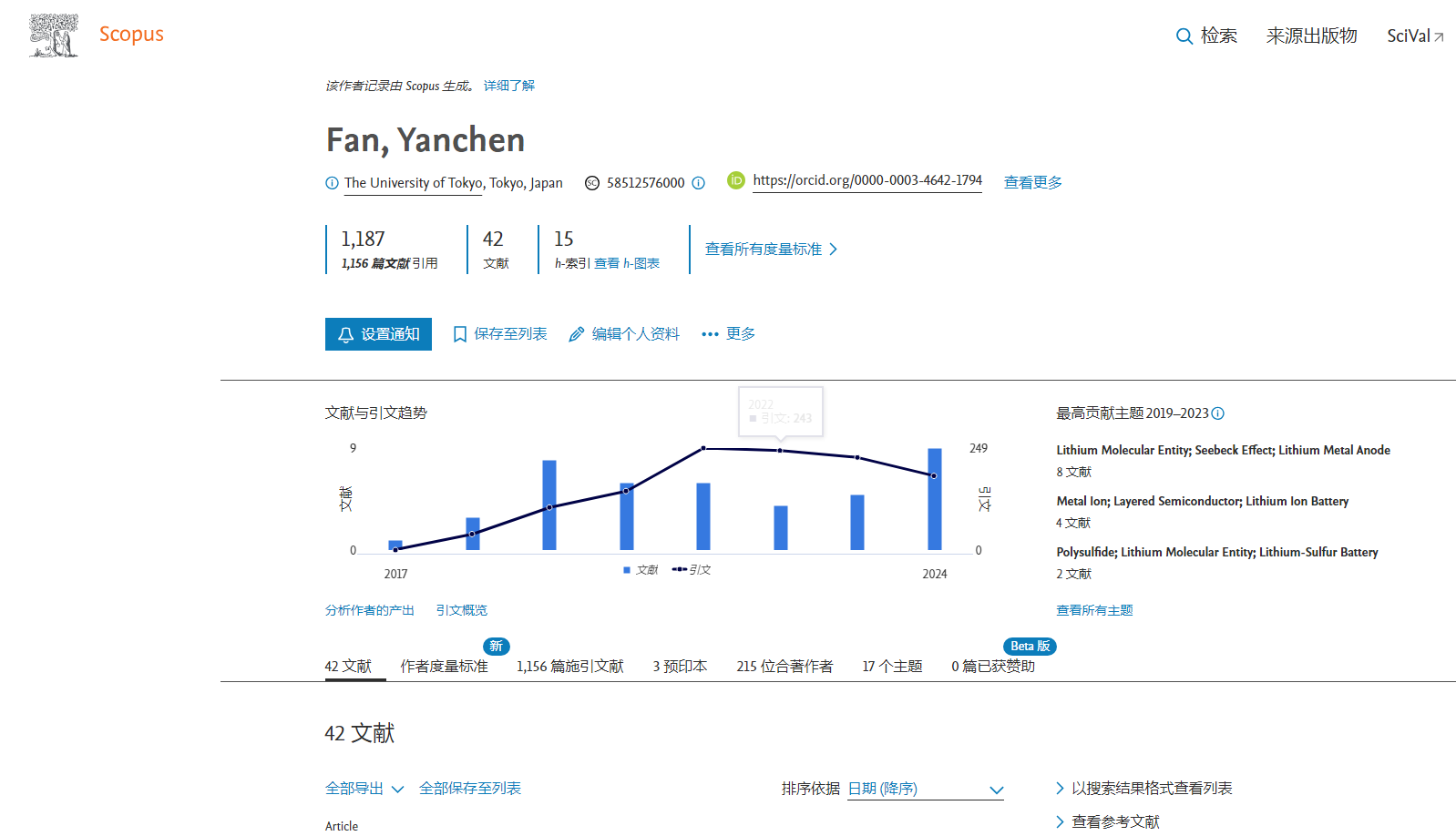 Fan Yanchen (樊晏辰)合作论文数Sch Mat Sci & Engn, Beihang Univ11
 Xiaofan He (贺小帆)合作论文数School of Aeronautic Science and Engineering, Beihang University11
 Yuhai Li (李玉海)合作论文数Department of Engineering Mechanics, Faculty of Vehicle Engineering and Mechanics, Dalian University of Technology11
 Yiju Li (李一举)合作论文数Department of Mechanical and Energy Engineering, College of Engineering, Southern University of Science and Technology9Xiaopeng Liu合作论文数8Xiang Feng合作论文数School of Materials Science and Engineering, Beihang University8Jiale Qu合作论文数Beihang Univ, Sch Mat Sci & Engn, Beijing 100191, Peoples R China8
 Jiewen Xiao合作论文数Department of Condensed Matter Physics, Weizmann Institute of Science8
 Yongji Gong (宫勇吉)合作论文数Department of Materials Science and Engineering, School of Materials Science and Engineering, Beihang University8
 Haidong Shen合作论文数7
 Yang Shaowei合作论文数Xian Key Lab Funct Organ Porous Mat, Northwestern Polytech Univ7
 Jing Sun (孙静)合作论文数School of Energy and Environment, Southeast University6
 Pengbo Zhai合作论文数6
 Zhi Wei Seh合作论文数Institute of Materials Research and Engineering, Agency for Science Technology & Research6Enzuo Liu (刘恩佐)合作论文数6
 Naiqin Zhao (赵乃勤)合作论文数School of Materials Science and Engineering, Tianjin University6Chao Lin (蔺超)合作论文数北京航空航天大学
国防科技大学5
Naiqin Zhao (赵乃勤)合作论文数School of Materials Science and Engineering, Tianjin University6Chao Lin (蔺超)合作论文数北京航空航天大学
国防科技大学5 Ying Guo (郭莹)合作论文数School of Chemistry and Chemical Engineering, Northwestern Polytechnical University5
 Hetian Chen (陈和田)合作论文数Sch Mat Sci & Engn, Beihang Univ5
 Yalan Xing (邢雅兰)合作论文数School of Materials Science and Engineering, Beihang University5
 Shichao Zhang (张世超)合作论文数School of Materials Science and Engineering, Beihang University5
 Chunnian He (何春年)合作论文数School of Materials Science and Engineering, Tianjin University5
 Biao Chen (陈彪)合作论文数School of Materials Science and Engineering, Tianjin University4Runze Gao合作论文数4Hao Jiang合作论文数4
 Bin Liu合作论文数4
 Kai Cui合作论文数4Jun Xia合作论文数4
 Zhou Jingwen合作论文数School of Materials Science and Engineering and Tianjin Key Laboratory of Composites and Functional Materials, Tianjin University4
 Yueling Cao (曹月领)合作论文数School of Chemistry and Chemical Engineering, Northwestern Polytechnical University4
 Fang He (何芳)合作论文数School of Materials Science and Engineering, Tianjin University4
 Jian Qin合作论文数Department of Chemical Engineering, Stanford University4Zhoujie Lao合作论文数3Gangyi Xiong合作论文数3Dingcheng Tang合作论文数3Zhanwei Chen合作论文数3Anjun Hu合作论文数3
 Yang Puheng合作论文数3
 Qinping Jian合作论文数Department of Mechanical and Aerospace Engineering, The Hong Kong University of Science and Technology3
 Yuecheng Xiong (熊岳城)合作论文数Key Lab Yangtze River Water Environm, Tongji Univ3Heliang Zhou合作论文数3
 Runhua Gao合作论文数Tsinghua Berkeley Shenzhen Inst & Tsinghua Shenzhe, Tsinghua Univ3
 Jiayou Ren (任嘉友)合作论文数3




