Current SSM-based light field super-resolution (LFSR) methods often fail to fully leverage the complementarity among various LF representations, leading to the loss of fine textures and geometric misalignments across views. To address these issues, we propose RASLF, a representation-aware state-space framework that explicitly models structural correlations across multiple LF representations. Specifically, a Progressive Geometric Refinement (PGR) block is created that uses a panoramic epipolar representation to explicitly encode multi-view parallax differences, thereby enabling integration across different LF representations. Furthermore, we introduce a Representation Aware Asymmetric Scanning (RAAS) mechanism that dynamically adjusts scanning paths based on the physical properties of different representation spaces, optimizing the balance between performance and efficiency through path pruning. Additionally, a Dual-Anchor Aggregation (DAA) module improves hierarchical feature flow, reducing redundant deeplayer features and prioritizing important reconstruction information. Experiments on various public benchmarks show that RASLF achieves the highest reconstruction accuracy while remaining highly computationally efficient.
Current anomaly detection methods primarily focus on structural anomalies, while paying insufficient attention to anomalies that violate logical constraints. Conversely, top-performing logical anomaly detection approaches address this by modeling global semantic consistency, but perform poorly on subtle structural anomalies due to inadequate detection granularity. In this paper, we propose LogiCo, a unified framework for Logical and structural anomaly detection via Component-level feature reconstruction. Unlike existing methods that rely on explicit global semantic modeling, LogiCo employs a novel component-level feature reconstruction technique to capture inter-component logical constraints. Specifically, LogiCo maps pre-trained image features into a discrete component-level feature space and performs collaborative feature reconstruction at both component and patch levels, enabling it to effectively detect both logical and structural anomalies. Furthermore, to address the specific challenge of count-related logical anomalies, we integrate a segmentation-map discriminator that extends the model's capability to identify quantitative inconsistencies. LogiCo achieves state-of-the-art performance on both logical and structural anomaly detection across four benchmarks, including MVTec-LOCO, MVTec-AD, VisA, and Real-IAD, demonstrating its superiority and practical feasibility. The code is available at https://github.com/cnulab/LogiCo.
Defect synthesis, as a core technology for addressing the problem of few-shot defect classification, has been widely adopted in industrial scenarios. It helps alleviate the problem of insufficient model generalization capability owing to data scarcity by establishing a data augmentation pipeline. Recently, remarkable progress has been achieved in both explicit defect image generation and implicit defect feature synthesis approaches. However, the existing methods are always conducted in Euclidean space. Constrained by the flatness of Euclidean space, it is difficult to synthesize defect data containing complex structures. In this paper, we attempt to explore the defect generation in hyperbolic space and propose a hyperbolic defect feature synthesis (HypDFS) method. By modeling the potential defect distribution via a small number of hyperbolic defect prototypes and further optimizing the synthetic defect features with the hierarchical defect contrastive loss in hyperbolic space, our HypDFS method can obtain a better generalized defect representation that is more conducive to downstream few-shot defect classification task. Extensive experiments conducted on the MVTec-FS benchmark and standard MTD dataset under the few-shot settings demonstrate that the proposed HypDFS surpasses the Euclidean baseline by a large margin, showing the promising prospects for defect synthesis in hyperbolic space.
Trustworthy depression prediction based on deep learning, incorporating both predictive reliability and algorithmic fairness across diverse demographic groups, is crucial for clinical application. Recently, achieving reliable depression predictions through uncertainty quantification has attracted increasing attention. However, few studies have focused on the fairness of uncertainty quantification (UQ) in depression prediction. In this work, we investigate the algorithmic fairness of UQ, namely Equal Opportunity Coverage (EOC) fairness, and propose Fair Uncertainty Quantification (FUQ) for depression prediction. FUQ pursues reliable and fair depression predictions through group-based analysis. Specifically, we first group all the participants by different sensitive attributes and leverage conformal prediction to quantify uncertainty within each demographic group, which provides a theoretically guaranteed and valid way to quantify uncertainty for depression prediction and facilitates the investigation of fairness across different demographic groups. Furthermore, we propose a fairness-aware optimization strategy that formulates fairness as a constrained optimization problem under EOC constraints. This enables the model to preserve predictive reliability while adapting to the heterogeneous uncertainty levels across demographic groups, thereby achieving optimal fairness. Through extensive evaluations on several visual and audio depression datasets, our approach demonstrates its effectiveness.
Light Field Super-Resolution (LFSR) seeks to enhance the spatial resolution of light field images while preserving angular consistency. Existing convolution-based networks struggle to capture long-range spatial-angular dependencies, and although Transformer-based methods address this limitation, they incur prohibitive quadratic complexity when processing high-resolution 4D light field data. In contrast, Mamba-based architectures can efficiently capture long-range dependencies but have limited capacity for contextual modeling. To overcome these challenges, we introduce LFTransMamba, a hybrid architecture that integrates Transformer-based global context modeling with Mamba-based efficient long-range dependency capture. Specifically, we propose a Masked Light Field Image Modeling (MLFIM) training strategy, which enhances the modeling of spatial-angular relationships through masked reconstruction without introducing additional modules or loss functions. Furthermore, we present an enhanced Position-Sensitive Windowing mechanism (EPSW), employing Gaussian-weighted aggregation to emphasize central pixels, thereby improving reconstruction quality and mitigating structural artifacts. Our method achieves state-of-the-art performance in the NTIRE 2025 Light Field Image Super-Resolution Challenge, ranking 1st in both the Classic and Large-Model tracks, and 2nd in the Efficiency track. The code is available at https://github.com/OpenMeow/LFTransMamba.
In this paper, we introduce a novel task termed unified anomaly detection and classification, which aims to simultaneously detect anomalous regions in images and identify their specific categories. Existing methods typically treat anomaly detection and classification as separate tasks, thereby neglecting their inherent correlations and limiting information sharing, which results in suboptimal performance. To address this, we propose UniADC, a model designed to effectively perform both tasks with only a few or even no anomaly images. Specifically, UniADC consists of two key components: a training-free Controllable Inpainting Network and an Implicit-Normal Discriminator. The inpainting network can synthesize anomaly images of specific categories by repainting normal regions guided by anomaly priors, and can also repaint few-shot anomaly samples to augment the available anomaly data. The implicit-normal discriminator addresses the severe challenge of the imbalance between normal and anomalous pixel distributions by implicitly modeling the normal state, achieving precise anomaly detection and classification by aligning fine-grained image features with anomaly-category embeddings. We conduct extensive experiments on four anomaly detection and classification datasets, including MVTec-FS, MTD, WFDD and Real-IAD, and the results demonstrate that UniADC consistently outperforms existing methods in anomaly detection, localization, and classification. The code is available at https://github.com/cnulab/UniADC.
This report summarizes the 3rd NTIRE challenge on light field (LF) image super-resolution (SR), focusing on novel methods and their outcomes. This challenge aims to super-resolve LF images degraded by bicubic downsampling, and comprises three tracks: a classical track, an efficiency track, and a large model track. In total, 308 participants registered, and 13 teams submitted results that outperformed the baseline methods. The challenge has established a new state-of-the-art in LF image SR, e.g., the winning method in Track 1 achieves a 0.36 dB PSNR improvement over last year's champion on the test set. We present the submitted solutions, analyze their common trends, and highlight practical techniques. We hope this challenge will inspire further advancements in LF image SR.
Dynamic 3D reconstruction presents a critical challenge for autonomous driving applications. While significant progress has been made in static scene modeling, existing methods often struggle to accurately represent dynamic objects within complex traffic environments. To address this limitation, we introduce a novel factorized neural radiance field (NeRF) framework specifically tailored for autonomous driving scenarios. Our approach utilizes a Signed Distance Function (SDF)-based representation to capture fine geometric details while simultaneously learning 4D dynamic NeRFs, thereby obviating the need for difficult-to-annotate 3D bounding boxes. Specifically, we decompose the scene into static foreground, dynamic foreground, and background components, assigning a 4D spatio-temporal representation only to the dynamic foreground. To enhance sampling efficiency, we introduce a dual-branch proposal network that concurrently guides sampling for both dynamic and static elements. During rendering, SDF values are transformed into volume densities, which are then fused from the dynamic and static fields. Extensive experiments demonstrate that our method achieves high-fidelity street-scene rendering, accurately reconstructing both static structures and dynamic objects.
Combining different planes of multi-contrast anisotropic Magnetic Resonance Imaging (MRI) into high-resolution isotropic and multi-contrast MRI can provide richer diagnostic information. However, this is challenging due to the inherent inconsistencies in image features and other aspects across different views. This challenge can be referred to as the inter-slice interpolation problem of multi-modal and multi-planar anisotropic MRI.Currently, Implicit Neural Representations (INR) offer the advantage of handling arbitrary up-sampling scales (integer or fractional). However, existing INR-based super-resolution methods often suffer from limitations, including poor generalization ability, inadequate multi-modal information interaction, and limited capacity for image feature modulation.To address these limitations, we propose Zero-X21, a novel image feature-conditioned INR framework specifically designed for the inter-slice interpolation problem of anisotropic MRI. Leveraging the inherent continuity of INRs, the Zero-X21 framework excels in achieving high-quality results across arbitrary up-sampling scales, surpassing other volumetric super-resolution methods.Experimental results on a brain MRI dataset demonstrate that the Zero-X21 framework achieves state-of-the-art performance for inter-slice interpolation. Notably, a single trained Zero-X21 model can effectively handle arbitrary up-sampling scales, making it a versatile and efficient solution for this challenging task.
3D plane recovery from monocular images constitutes a fundamental task in indoor scene understanding. Recent methods formulate this problem as 2D pixel-level segmentation through convolutional networks or query-based architectures, which purely rely on 2D pixel features while neglecting the inherent 3D spatial nature of planar surfaces. To address this limitation, we propose an end-to-end Plane Reconstruction, Aggregation, and Splatting (PlaneRAS) framework that explicitly leverages 3D geometric reasoning combined with online planar primitive reconstruction. Our framework introduces two core components: 1) a reconstruction module utilizing customized planar primitives to compactly represent 3D scene, and 2) a recovery module that aggregates local primitives to derive globally consistent plane instances. The proposed 3D-aware representation enables direct integration of pretrained geometric priors, significantly enhancing performance beyond conventional 2D-centric approaches. Extensive experiments on ScanNet and NYUv2 datasets demonstrate state-of-the-art results across various evaluation metrics, resulting from our explicit 3D geometric modeling and effective fusion of cross-dimensional features.
Deep learning-based methods have shown substantial promise in visual depression severity estimation. Nonetheless, their effectiveness is limited by the scarce availability of labeled depression data, potentially leading to overfitting during representation learning. One feasible approach to address this issue is to incorporate, in the training objective, regularization that considers the unique characteristics of depression data. Typical regularization includes the similarity ranking through ordered consistency between visual features and their target scores. However, previous ranking methods are limited to using only samples within a mini-batch, resulting in a decreased regularization effect in depression representation learning. To address this limitation, we propose MemRank, a global similarity ranking method that operates not only on mini-batch samples but also on a well-designed feature memory, which stores smoothed and dynamically updated feature prototypes at diverse levels of depression during training. Furthermore, we show that incorporating the feature memory in the regression loss enhances the stability of training a deep regressor, leading to improved depression predictions. Empirically and analytically, we show that our MemRank outperforms alternative ranking methods and achieves state-of-the-art results on two benchmark datasets.
Limited by the scarcity of training samples and annotations, weakly supervised medical image segmentation often employs data augmentation to increase data diversity, while randomly mixing volumetric blocks has demonstrated strong performance. However, this approach disrupts the inherent anatomical continuity of 3D medical images along orthogonal axes, leading to severe structural inconsistencies and insufficient training in challenging regions, such as small-sized organs, etc. To better comply with and utilize human anatomical information, we propose JanusNet}, a data augmentation framework for 3D medical data that globally models anatomical continuity while locally focusing on hard-to-segment regions. Specifically, our Slice-Block Shuffle step performs aligned shuffling of same-index slice blocks across volumes along a random axis, while preserving the anatomical context on planes perpendicular to the perturbation axis. Concurrently, the Confidence-Guided Displacement step uses prediction reliability to replace blocks within each slice, amplifying signals from difficult areas. This dual-stage, axis-aligned framework is plug-and-play, requiring minimal code changes for most teacher-student schemes. Extensive experiments on the Synapse and AMOS datasets demonstrate that JanusNet significantly surpasses state-of-the-art methods, achieving, for instance, a 4% DSC gain on the Synapse dataset with only 20% labeled data.
Fire is characterized by its sudden onset and destructive power, making early fire detection crucial for ensuring human safety and protecting property. With the advancement of deep learning, the application of computer vision in fire detection has significantly improved. However, deep learning models often exhibit a tendency toward overconfidence, and most existing works focus primarily on enhancing classification performance, with limited attention given to uncertainty modeling. To address this issue, we propose transforming the Expected Calibration Error (ECE), a metric for measuring uncertainty, into a differentiable ECE loss function. This loss is then combined with the cross-entropy loss to guide the training process of multi-class fire detection models. Additionally, to achieve a good balance between classification accuracy and reliable decision, we introduce a curriculum learning-based approach that dynamically adjusts the weight of the ECE loss during training. Extensive experiments are conducted on two widely used multi-class fire detection datasets, DFAN and EdgeFireSmoke, validating the effectiveness of our uncertainty modeling method.
In recent years, increasing research has shown that fine-grained local alignment is crucial for the cross-modal medical image-report retrieval task. However, existing local alignment learning methods suffer from the misalignment of semantically non-overlapping features between different modalities, which in turn negatively affects the retrieval performance. To address this challenge, we propose a Global-Feature Guided Cross-modal Local Alignment (GFG-CMLA) method. Unlike prior methods that rely on explicit local attention or learned weighting mechanisms, our approach leverages global semantic features extracted from the cross-modal common semantic space to implicitly guide local alignment, adaptively focusing on semantically overlapping content while filtering out irrelevant local regions, thus mitigating misalignment interference without additional annotations or architectural complexity. We validated the effectiveness of the proposed method through ablation experiments on the MIMIC-CXR and CheXpert Plus dataset. Furthermore, comparisons with state-of-the-art local alignment methods indicate that our approach achieves superior cross-modal retrieval performance.
Recent advances in generative latent space sampling for enhanced generation quality have demonstrated the benefits from the Energy-Based Model (EBM), which is often defined by both the generator and the discriminator of off-the-shelf Generative Adversarial Networks (GANs) of many types. However, such latent space sampling may still suffer from mode dropping even sampling in a low-dimensional latent space, due to the inherent complexity of the data distributions with rugged energy landscapes. Motivated by the success of Wang-Landau (WL) sampling in statistical physics, we propose WL-GAN, a collaborative learning framework for generative latent space sampling, where both the invariant distribution and the proposal distribution of the Markov chain are jointly learned on the fly, by exploiting the historical statistics behind the simulated samples. We show that the two learning modules work together for better balance between exploration and exploitation over the energy space in GAN sampling, alleviating mode dropping and improving the sample quality of GAN. Empirically, the efficacy of WL-GAN is demonstrated on both synthetic datasets and real-world image datasets, using multiple GANs. Code is available at https://github.com/zeyihou/collaborative-learn.
The limited data annotations have made semi-supervised learning (SSL) increasingly popular in medical image analysis. However, the use of pseudo labels in SSL degrades the performance of decoders that heavily rely on high-accuracy annotations. This issue is particularly pronounced in class-imbalanced multi-organ segmentation tasks, where small organs may be under-segmented or even ignored. In this paper, we propose SKCDF, a semantic knowledge complementarity based decoupling framework for multi-organ segmentation in class-imbalanced medical images. SKCDF decouples the data flow based on the responsibilities of the encoder and decoder during model training to make the model effectively learn semantic features, while mitigating the negative impact of unlabeled data on the semantic segmentation task. We also design a semantic knowledge complementarity module that adopts labeled data to guide the generation of pseudo labels and enriches the semantic features of labeled data with unlabeled data, which improves the quality of generated pseudo labels and the robustness of the overall model. Furthermore, we design an auxiliary balanced segmentation head based training strategy to further enhance the segmentation performance of small organs. Experimental results on the Synapse and AMOS datasets show that our method significantly outperforms existing methods.
Current anomaly detection methods primarily focus on low-resolution scenarios. For high-resolution images, conventional downsampling often results in missed detections of subtle anomalous regions due to the loss of fine-grained discriminative information. Despite some progress, recent studies have attempted to improve detection resolution by employing lightweight networks or using simple image tiling and ensemble methods. However, these approaches still struggle to meet the practical demands of industrial scenarios in terms of detection accuracy and efficiency. To address the above issues, we propose HiAD, a general framework for high-resolution anomaly detection. HiAD is capable of detecting anomalous regions of varying sizes in high-resolution images under limited computational resources. Specifically, HiAD employs a dual-branch architecture that integrates anomaly cues across different scales to comprehensively capture both subtle and large-scale anomalies. Furthermore, it incorporates a multi-resolution feature fusion strategy to tackle the challenges posed by fine-grained texture variations in high-resolution images. To enhance both adaptability and efficiency, HiAD utilizes a detector pool in conjunction with various detector assignment strategies, enabling detectors to be adaptively assigned based on patch features, ensuring detection performance while effectively controlling computational costs. We conduct extensive experiments on our specifically constructed high-resolution anomaly detection benchmarks, including MVTec-HD, VisA-HD, and the real-world benchmark RealIAD-HD, demonstrating the superior performance of HiAD. The code is available at https://github.com/cnulab/HiAD.
Network security situation (NSS) prediction has attracted significant attention in recent years due to its potential to preemptively mitigate various types of network attacks. However, existing methods still suffer from several drawbacks, including slow convergence, susceptibility to local optima, and limited generalization ability, particularly when dealing with non-stationary and non-linear NSS data. In this paper, we propose a novel iterative optimized RBF-NN method for NSS prediction. Our proposed method leverages a resource allocation network (RAN) to dynamically determine the optimal number of neurons in the hidden layer, ensuring a balance between model complexity and prediction accuracy. Moreover, we introduce a cross-model method with a genetic algorithm to compute the optimal weights for the RBF-NN model. Specifically, we come up with a chaos search strategy during the iterative optimization process to prevent the RBF-NN model from falling into a local extreme point. Experimental results demonstrate that our method achieves a significant improvement in prediction accuracy, with an increase of up to 86.6%, while reducing the training time by up to 29.2% compared to existing techniques. These improvements are achieved within a tolerable training time, making our method both efficient and effective for real-world NSS prediction tasks.
Cardiovascular diseases typically cause specific changes in cardiac structure, but these disease-induced variations are often less pronounced than those introduced by multi-source data acquisition or noise in the images, such as fluctuations in image brightness, contrast, and field of view. This makes it more difficult to extract key details about organs and diseases, posing significant challenges to traditional segmentation and domain generalization methods. To address these challenges, we propose MM-MoE, a disease-oriented multi-task and multi-view framework designed for more accurate generalized cardiac structure segmentation. Specifically, we introduce a Mixture-of-Experts based Multi-Task Joint and Adversarial Learning Strategy (MTMoE-J&A) to enable the model to learn more general and domain-invariant disease-specific features, and employ a Multi-View Feature Fusion Network (MVFusion) to effectively integrate complementary spatial information from different views, leading to improved segmentation accuracy and completeness. Additionally, we develop a parallel Channel-Spatial-Slice Attention Module (CSS-Attn) to mitigate crucial detail loss caused by the anisotropic nature of medical images. Extensive experiments conducted on the M&Ms-2 dataset demonstrate that MM-MoE outperforms state-of-the-art segmentation models and domain generalization methods in terms of segmentation generalization performance.
Recent advances in automated radiology report generation from chest X-rays using deep learning algorithms have the potential to significantly reduce the arduous workload of radiologists. However, due to the inherent massive data bias in radiology images, where abnormalities are typically subtle and sparsely distributed, existing methods often produce fluent yet medically inaccurate reports, limiting their applicability in clinical practice. To address this issue effectively, we propose a Semantically Informed Salient Regions-guided (SISRNet) report generation method. Specifically, our approach explicitly identifies salient regions with medically critical characteristics using fine-grained cross-modal semantics. Then, SISRNet systematically focuses on these high-information regions during both image modeling and report generation, effectively capturing subtle abnormal findings, mitigating the negative impact of data bias, and ultimately generating clinically accurate reports. Compared to its peers, SISRNet demonstrates superior performance on widely used IU-Xray and MIMIC-CXR datasets.
 Yuanyuan Shang (尚媛园)合作论文数Information Engineering College, Capital Normal University29
 Min Xu (徐敏)合作论文数Information Engineering College, Capital Normal University20
 Jiwen Lu (鲁继文)合作论文数Department of Automation, Tsinghua University16
 Kai Jin合作论文数13
 Hui Ding (丁辉)合作论文数Information Engineering College, Capital Normal University11
 Guodong Guo合作论文数Department of Computer Science and Electrical Engineering, Benjamin M. Statler College of Engineering and Mineral Resources, West Virginia University;Computer Vision Laboratory, Center for Identification Technology Research, West Virginia University11
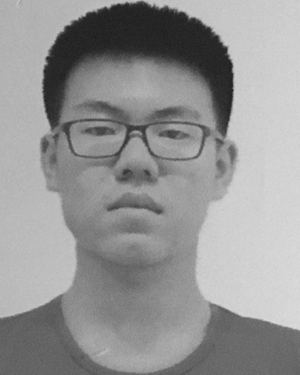 Zeqiang Wei合作论文数10
 Yao Lu (陆耀)合作论文数Shenzhen MSU-BIT University8
 Xiaoyan Fu (付小雁)合作论文数Information Engineering College, Capital Normal University8
 Zheng Zhang (张征)合作论文数School of Intelligent Engineering and Automation, Beijing University of Posts and Telecommunications8
 Haibin Yan (闫海滨)合作论文数School of Intelligent Engineering and Automation, Beijing University of Posts and Telecommunications8Ximiao Zhang合作论文数6Angulia Yang合作论文数Bigo Technology Pte. Ltd.6
 Bo Zhang (张波)合作论文数School of Computer Science, Beijing University of Posts and Telecommunications6
 Junlin Hu (胡峻林)合作论文数College of Information Science and Technology, Beijing University of Chemical Technology6
 Ning Lang (郎宁)合作论文数Department of Radiology, Peking University Third Hospital6Ruixin YAN (颜瑞馨)合作论文数5
 Jie Zhou (周杰)合作论文数Department of Automation, Tsinghua University5
 Sha Guo合作论文数Institute of Digital Media, Peking University4Zhong Luan (栾中)合作论文数4Mingzhi Gao合作论文数3
 Yap-Peng Tan合作论文数School of Electrical and Electronic Engineering, Nanyang Technological University3
 Radu Timofte合作论文数Computer Vision Laboratory, Institute of Computer Science, Faculty of Mathematics and Computer Science, Julius Maximilians University of Würzburg;ETH Zurich3
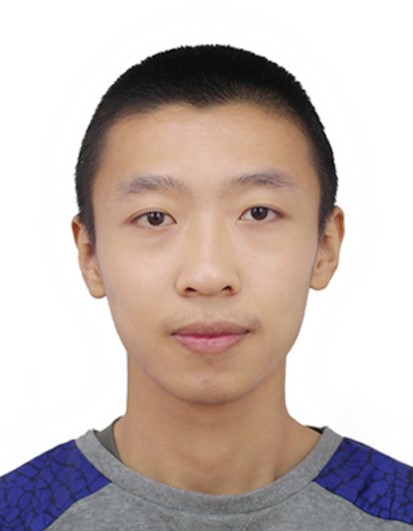 Longguang Wang (王龙光)合作论文数Aviation University of Air Force3
 Yingqian Wang (王应谦)合作论文数College of Electronic Science and Technology, National University of Defense Technology3
 Yulan Guo (郭裕兰)合作论文数School of Electronics and Communication Engineering, Sun Yat-sen University3
 Wu Liu (刘武)合作论文数Department of Electronic Engineering and Information Science, School of Information Science and Technology, The Division of Information and Intelligence, University of Science and Technology of China3
 Weihong Deng (邓伟洪)合作论文数School of Information and Communication Engineering, Beijing University of Posts and Telecommunications3Zhengyu Liang合作论文数National University of Defense Technology2Sihua Niu合作论文数2
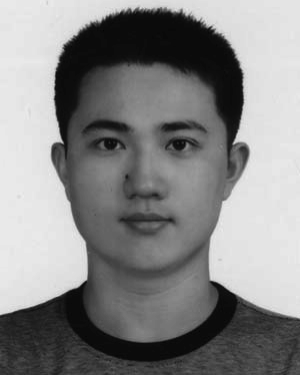 Lu Kou合作论文数2
 Juncheng Li (李俊诚)合作论文数School of Computer Science and Technology, East China Normal University2
 Venice Erin Liong合作论文数Motional2
 Xiangyang Gong (龚向阳)合作论文数School of Computer Science, Beijing University of Posts and Telecommunications2
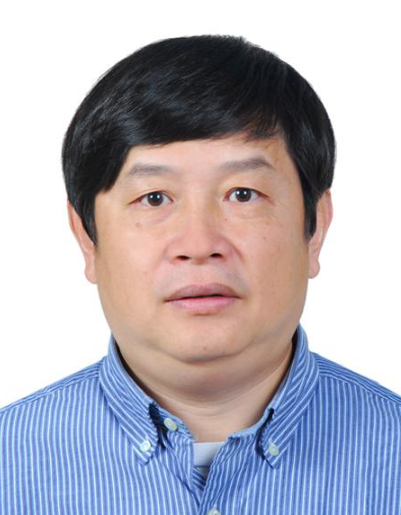 Wendong Wang (王文东)合作论文数School of Computer Science, Beijing University of Posts and Telecommunications2
 Ziye Yan (颜子夜)合作论文数2
 Qirun Huo (霍其润)合作论文数Information Engineering College, Capital Normal University2
 Shungen Xiao (肖顺根)合作论文数2
 Jungang Yang (杨俊刚)合作论文数College of Electronic Science and Technology, National University of Defense Technology2Zelan Zhu合作论文数1Linqing Zhao合作论文数1Guanchun Yin合作论文数1Shuo Yan合作论文数1Shizheng Li合作论文数1Zonglin Tian合作论文数1Xiuyuan Wang合作论文数1Cheng Zhong合作论文数1Yue Yan合作论文数1Qianyu Chen合作论文数1




