The recognition accuracy in radar signal modulation recognition (RSMR) is severely impacted by the lack of training data. Conventional deep learning approaches typically depend on extensive labeled datasets, which are scarce in real-world scenarios. To mitigate this limitation, a convolutional-transformer hybrid network based on self-supervised contrastive learning (CTNet-SSCL) is proposed for RSMR. In self-supervised contrastive pre-training, an amplitude distortion data augmentation technique is proposed, which enables the model to effectively utilize unlabeled data, allowing it to learn meaningful feature representations. Subsequently, the pre-trained multi-scale perceptual transformer (MSPFormer) encoder, combined with a randomly initialized classifier, is fine-tuned using labeled samples. The encoder combines multi-scale feature fusion and time-frequency attention mechanisms to further enhance the robustness and recognition accuracy of the model in complex environments. The excellent performance of the proposed method is verified in experiments on a dataset with 10 different waveforms. The recognition accuracy of the proposed method reaches 99.98% at a signal-to-noise ratio (SNR) of 2 dB.
A variety of widely used Gaussian filters are formulated within the framework of statistical linear regression (SLR), where nonlinear measurement functions are approximated via least-squares linearization. Although effective in numerous applications, conventional SLR neglects the structure of the likelihood function, which can lead to inaccurate Gaussian approximations of the posterior distribution. To overcome this limitation, we propose a likelihood-aware SLR (LA-SLR) method that introduces a linearization criterion explicitly incorporating likelihood structural information. The resulting nonconvex, nonsmooth optimization problem is efficiently solved using a tailored alternating direction method of multipliers, with closed-form solutions derived for its subproblems. Building on LA-SLR, we develop both a posterior approximation algorithm and a nonlinear Kalman filtering algorithm, and evaluate them in several representative scenarios. Simulation results show that the proposed algorithms consistently outperform state-of-the-art Gaussian filters.
In this part of the paper, we consider the invariant framework and the novel constant false alarm rate (CFAR) detector design of Part I in compound Gaussian clutter. Specifically, the focus is on detecting range-spread targets embedded in compound Gaussian clutter that exhibits a Kronecker covariance structure. A suitable transformation group has been identified, ensuring that invariance implies the fully CFAR property, i.e., with respect to both the Kronecker covariance matrix and the texture. A maximal invariant is derived and used to gain insightful re-expressions of some established two-step adaptive CFAR detectors. At the stage of detector design, the pseudo-missing strategy proposed in Part I is adapted to the compound Gaussian case and then integrated into the test architectures to yield modified adaptive detectors. Furthermore, the one-step generalized likelihood ratio test is derived. Both detection strategies result in fully CFAR detectors under some mild technical conditions, as evidenced by their invariance with respect to the identified transformation group. For performance evaluation, their CFAR behavior and detection probability are assessed and analyzed across different experimental setups and signal models, highlighting the superior performance of the newly proposed detectors compared to some conventional counterparts and to those that do not leverage the prior (Kronecker) structure.
This paper proposes a novel active learning (AL)incorporated cross-scene hyperspectral image (HSI) classification method, which combines a graph convolutional network (GCN)based classifier with an adaptive fusion framework for multiple AL selection criteria. Specifically, we extend the existing dynamic multiscale GCN from single-scene to cross-scene classification by introducing a feature alignment module and a cross-scene loss function to enhance domain adaptation. Additionally, our AL module fuses multiple widely used sampling criteria through score-to-probability transformation and categorical distribution fusion, in order to mitigate biases from individual strategies and leverage their complementary strengths. This enables the model to refine its target-scene training set, improving classification performance with minimal labeling effort. Experiments on the Pavia dataset demonstrate that the proposed method outperforms several recent cross-scene HSI classification approaches.
Particle filter (PF) is widely used for dynamic system estimation and tracking applications. However, traditional PF methods often face challenges, including particle degeneracy and insufficient tracking accuracy in complex environments. To address these limitations, this paper introduces a novel fusion method based on the Expectation-Maximization (EM) algorithm. The proposed approach integrates multiple particle filtering techniques to generate several sets of weighted particles at each time step. These sets are then fused into a Gaussian mixture model, providing a more robust and accurate posterior distribution. The fusion process effectively combines the strengths of different particle filters, enhancing tracking performance in dynamic and occlusion-prone video environments. Experimental results demonstrate the superiority of the proposed method in terms of both tracking accuracy and robustness compared to traditional PF-based methods.
This two-part paper addresses maximally invariant detection of range-spread targets embedded in disturbance characterized by an unknown Kronecker product-structured covariance matrix. Part I focuses on Gaussian interference, whereas Part II extends the study to compound-Gaussian, clutter-dominated environments. Leveraging the principle of invariance, this part identifies a suitable transformation group that effectively compresses the nuisance parameter space, ensuring the constant false alarm rate (CFAR) property (with respect to the Kronecker-structured covariance matrix) for all invariant detectors. A maximal invariant and an induced maximal invariant are subsequently derived, serving as powerful tools to guide the design of CFAR detectors. Some existing two-step CFAR detectors for this structured situation are expressed as functions of the derived maximal invariant. Furthermore, two novel detectors (whose CFARity holds true under some mild technical conditions) are devised: the former employs a pseudo-missing strategy by treating elements possibly contaminated by target signals as missing and utilizes an Expectation-Maximization algorithm to perform the covariance matrix estimation; the latter is based on the one-step generalized likelihood ratio test criterion and is implemented via an alternate optimization algorithm. Finally, their CFAR behavior and detection performance are assessed through numerical examples, demonstrating their superiority with respect to some conventional decision rules.
This paper studies the adaptive detection of rangespread targets in a Gaussian environment, assuming a Kronecker-product structure for the disturbance covariance matrix. Invoking the principle of invariance, we identify a transformation group that significantly reduces the dimensionality of nuisance parameters, ensuring the constant false alarm rate (CFAR) property for all invariant statistics. A maximal invariant (MI) is derived, providing the foundation for new CFAR detectors that are invariant tests functionally depending on the MI. At the stage of detector design, two adaptive detectors are devised: the former employs the two-step strategy and incorporates the Kronecker maximum likelihood estimate based on secondary data, while the latter is the one-step generalized likelihood ratio test realized via an alternating-optimization algorithm. Both are invariant tests, and thus their CFAR properties with respect to the Kronecker covariance matrix are naturally guaranteed. Numerical results demonstrate the superior detection performance and robust CFAR behavior of both the detectors compared to conventional methods designed for the unstructured case.
This paper addresses adaptive subspace detection of range-distributed targets in compound Gaussian clutter with Generalized Inverse Gaussian (GIG) texture. Novel adaptive subspace detectors are developed based on the generalized likelihood ratio, Rao, and Wald test criteria, employing two-step design strategies that incorporate the persymmetric covariance structure and the GIG texture distribution to enhance detection performance. Furthermore, to achieve full adaptivity, a novel method is proposed for adaptively estimating the clutter texture parameters. The effectiveness of the proposed adaptive detectors, combined with this new texture parameter estimation method, is validated via numerical examples in various non-Gaussian clutter environments, demonstrating superior detection performance compared to several existing methods.
This paper introduces a decision fusion strategy for automatic target recognition in multi-view synthetic aperture radar (SAR) images. Our proposed architecture integrates decisions derived from adaptive dictionary learning and Convolutional Neural Network (CNN) methods. Specifically, we employ two adaptive dictionary learning methods with distinct dictionary constructions to extract features from SAR images at each viewpoint, leading to intermediate decisions. Simultaneously, the CNN branch utilizes a multi-input single-output fully CNN to extract features from multiple viewpoints and make an intermediate decision. Subsequently, considering the multi-view images and leveraging the strengths of different methods, the classification results produced by these models are aggregated through voting to yield the final classification labels. Experimental results on the MSTAR dataset demonstrate the effectiveness of our proposed method, achieving an outstanding accuracy of 99.958% in a ten-class classification task.
This paper addresses adaptive radar detection in scenarios with incomplete observations due to measurement errors, sensor failures, or outliers, where the target is embedded in compound Gaussian clutter with unknown covariance matrix. The detection problem is formulated as a binary hypothesis test, with a set of selection matrices introduced to represent the observations at each snapshot. At the stage of detector design, a two-step design strategy is employed: first, the Generalized Likelihood Ratio Test (GLRT) is derived assuming known covariance structure; then, the actual covariance matrix in the GLRT is replaced with its maximum likelihood estimate, which is calculated based on the non-missing components of the secondary data using an expectation-maximization (EM) algorithm developed in this paper. Numerical examples demonstrate the effectiveness of these detectors in compound Gaussian clutter environments, showing superior performance compared to the existing detector designed for scenarios with Gaussian interference and missing data, as well as the classical linear imputation method.
This letter considers detecting a multichannel Gaussian signal hidden in a small fraction of multivariate observations. We start by formulating the problem under a multivariate sparse mixture model, where the rarely occurring signal is manifested as a shift in the observation covariance matrix. A novel signal detection method is proposed by applying the higher criticism to energy statistics for each multivariate observation. Moreover, the proposed detector is shown to possess an asymptotic optimality in the sense that its false alarm rate and false detection rate vanish as the number of samples increases to infinity. Finally, numerical examples confirm superior performance of the proposed detector to some conventional ones.
This paper addresses adaptive detection of range spread targets in the presence of thermal noise, jammer, and clutter. After motivating the study, a set of clutter-free training (CFT) data is considered to assist radar detection in absence of conventional secondary data sharing the same spectral properties as the interference of the cells under test. To this end, a maximum likelihood (ML) estimate of the unknown parameters is derived under the alternative hypothesis by leveraging the primary data and the CFT data simultaneously. Subsequently, the ML estimate is used to design decision rules based on generalized likelihood ratio, complex parameter Wald, and complex parameter Gradient test criteria. Furthermore, conditions guaranteeing the constant false alarm rate (CFAR) property of the proposed detectors are discussed. At the analysis stage, numerical examples are presented to evaluate the effectiveness of the proposed detectors in comparison with other detection schemes available in the literature.
This paper studies adaptive target detection in compound-Gaussian clutter for a colocated multi-input multi-output (MIMO) radar. A new one-step generalized likelihood ratio test (GLRT) is devised with all the involved unknown parameters estimated iteratively. Besides, a minor revision is made to the already existing two-step GLRT for this problem. Numerical examples show that both the two detectors are effective. For the considered simulation setup, the newly proposed detector can achieve higher detection rates than the revised one and competitors designed in Gaussian clutter scenarios.
This paper investigates the problem of simultaneous input and state estimation (SISE) for nonlinear dynamic systems. By the augmented state approach, we convert this problem into a standard filtering problem. Then, the split-and-merge technique is utilized for the augmented state estimation. Based on this, a novel split-and-merge based simultaneous input and state filter is developed in order to enhance the ability of dealing with highly nonlinear systems. Simulations demonstrate the effectiveness and efficiency of the proposed filter.
This paper focuses on estimating the number of source signals embedded in Gaussian white noise. We address this problem via a sequence of nested hypothesis tests, and construct variance statistics based on eigenvalues of the sample covariance for each candidate hypothesis. Then, a detailed statistical analysis of these statistics is carried out in both the large-sample and high-dimensional regimes. According to this analysis, we propose a new scheme for determining the number of source signals in both the sample-rich and sample-starved cases. Finally, numerical examples are presented to show its superiority compared to some existing estimation methods.
This paper deals with the adaptive classification problem of heavy-tailed data drawn from a multivariate distribution of the complex elliptically symmetric family. The authors assume that the collected data is either homogeneous or partially homogeneous. Based on the GLRT criterion, two adaptive classifiers are devised for the scenarios of Hermitian and persymmetric scatter matrices, respectively. To estimate the unknown parameters, iterative algorithms with convergence property are introduced to solve the developed non-convex maximum likelihood optimization problems. The simulation results show that, compared with the Hermitian scenario, the exploitation of persymmetric structure information can lead to an obvious performance improvement.
A popular method for fusing a set of covariance matrix estimates (with unavailable correlation) is to solve their geometrical mean or median, which is defined by a Riemannian geometry of Hermitian positive-definite (HPD) matrices. The most well-known such geometry is identical to the Fisher information geometry of multivariate Gaussian distributions with a fixed mean. This paper identifies the space of HPD matrices with the manifold of centered (i.e., zero-mean) complex elliptically symmetric (CES) distributions. First, the Fisher information matrix for the CES distributions defines a different Riemannian metric on HPD matrices, and the induced Riemannian geometry is studied. Then, the Riemannian Lp mean of some HPD matrices is calculated to produce a final estimation for the scatter matrix (proportional to the covariance matrix) of a CES distribution. While the corresponding objective function is proven to be gconvex, a Riemannian gradient descent algorithm is given to compute the solution. Finally, numerical examples are provided to illustrate the derived geometrical structure and its application to target detection.
 Mengjiao Tang合作论文数Yunnan Key Laboratory of Statistical Modeling and Data Analysis, Yunnan University28
 Antonio De Maio合作论文数Dipartimento di Ingegneria Elettrica e delle Tecnologie dell’Informazione, Università degli Studi di Napoli Federico II7
 Augusto Aubry合作论文数Dipartimento di Ingegneria Elettrica e delle Tecnologie dell’Informazione, Università degli Studi di Napoli Federico II6
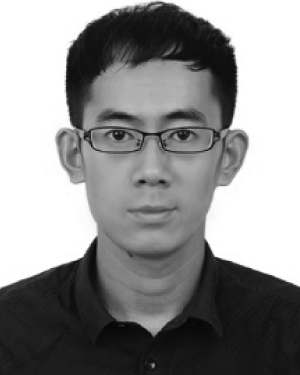 Xiaolin Du合作论文数5
 Xiao-Rong Li合作论文数Information Systems Lab, Department of Electrical and Computer Engineering, University of New Orleans4
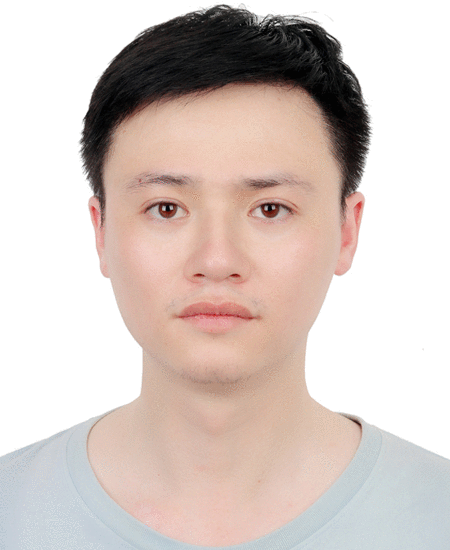 Sanfeng Hu合作论文数3
 Jie Zhou (周杰)合作论文数College of Mathematics, Sichuan University2
 Guolong Cui (崔国龙)合作论文数School of Information and Communication Engineering, University of Electronic Science and Technology of China2
 Liu Yang合作论文数1
 Liping Guo合作论文数1
 Fan Li合作论文数1Zhi-fang LIANG (梁志芳)合作论文数1
 Jibin Zheng (郑纪彬)合作论文数National Key Laboratory of Radar Signal Processing, Xidian University;Department of Electronic Engineering, School of Electronic Engineering, Xidian University1
 Xiaolong Chen (陈小龙)合作论文数Naval Aviation University1




