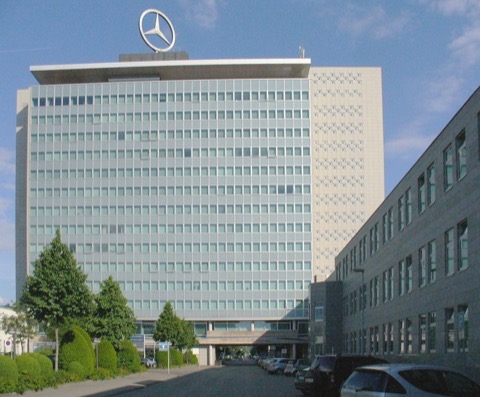
Daimler AG戴姆勒股份公司成立于1998年,是由原德国戴姆勒-奔驰汽车公司与美国克莱斯勒汽车公司合并而成。 总部位于德国斯图加特,是全球最大的商用车制造商,全球第二大豪华车生产商、第二大卡车生产商。公司旗下包括梅赛德斯-奔驰汽车、梅赛德斯-奔驰轻型商用车、戴姆勒载重车和戴姆勒金融服务等四大业务单元。2015年12月4日,诺基亚宣布,由德国汽车制造商奥迪、宝马和戴姆勒公司组成的财团以31亿美元收购其地图部门Here,已经获得全球所有监管机构的批准。

Performance in automated driving tasks improves significantly with the incorporation of location-specific prior knowledge. This is because agent behavior usually strongly correlates with location features. A common example is the strong tendency of vehicles to follow their lane, but less obvious interactions exist as well. To this end, high definition (HD) map information is typically collected and made available during both training and inference to act as a location prior. In this paper, we propose to aggregate location-specific information in a data-driven way. Specifically, we learn a global latent grid that acts as a behavior prior to a learned occupancy prediction model. Since the prediction loss function is directly backpropagated into the latent grid, no additional labels are required beyond the already available future agent locations. We use the large real-world Lyft Level 5 motion prediction dataset to empirically demonstrate the merit of our learned location-specific latent behavior prior. Applied to two different prediction models, our approach achieves performance comparable to or exceeding baseline models that rely on HD maps, without requiring an HD map. Additional experiments reveal that the latent behavior prior is able to distill geometric and semantic information purely from agent behavior. These results indicate that directly learning location-specific priors is a promising direction towards automated driving without costly HD maps.
The Endeavour segment of the Juan de Fuca ridge oceanic spreading center has been intermittently monitored by ocean-bottom seismometer (OBS) networks for three decades. The available long-term earthquake record is influenced by magmatic, tectonic, and hydrothermal processes surrounding a sequence of dike emplacements from 1999 to 2005. Background seismicity decreased at the end of this sequence and was low a decade later in 2016 when multistation monitoring began with the Ocean Networks Canada NEPTUNE cabled observatory. Because of a gap in the catalog, it is unknown whether the rates were consistently low from 2006 to 2016. We expand the catalog to include 2011–2016 using a single OBS on the NEPTUNE cabled observatory. We perform single-station earthquake detection and explore earthquake localization using P-wave polarization and P- and S-wave differential arrival times. We assess the accuracy of these techniques by comparison to traditional network methods in 2016–2017. We find that distances between the earthquake and station are estimated well using a single station, but for most stations, P waves display a strongly preferred polarization direction that is independent of earthquake source azimuth. This is only observed for stations within the highly fractured axial graben. We propose that this effect is intrinsic to the midocean ridge environment and is a result of shallow fracture-induced scattering very near the OBS. Although this prevents us from calculating earthquake hypocenters, we present earthquake counts, ranges, and moments for 2011–2016 in comparison to the multistation catalog that begins in 2016. We show that seismicity rates remain consistently low both in the segment center and segment ends for 2011–2016. Our results provide further evidence that the 1999–2005 dike emplacements relieved most of the extensional strain on the segment.
Alternative Powertrains and Supplements to the Conventional Powertrain introduces alternatives to conventional powertrain of the commercial vehicle





