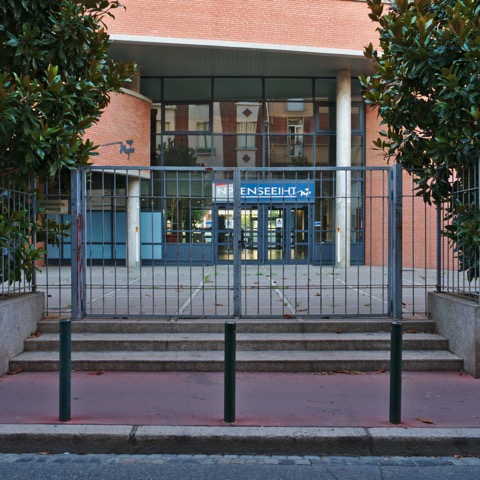
ENSEEIHT是一所位于法国图卢兹的公立的3年制工程师学校,隶属于法国教育部。它亦是是组成图卢兹国立综合理工学院的7所学校之一。
Diabetic retinopathy is one of the leading causes of visual impairment and blindness among individuals with diabetes. This em- phasizes the need for accurate and early classification to enable timely intervention. This study proposes a novel deep learning framework based on VGG16 for classifying DR into five severity levels. In contrast to con- ventional approaches that rely exclusively on final-layer outputs, the pro- posed model leverages features extracted from all convolutional layers, thus capturing both low- and high-level visual representations. These multi-scale features are processed through fully connected layers to esti- mate layer-wise probability distributions, which are then aggregated us- ing a weighted network to perform the final classification. To enhance fea- ture refinement and discriminative capability, a Fusion Refinement Block (FRB) is incorporated to improve multi-scale feature fusion, while a Spa- tial Attention (SA) mechanism is employed to focus on the most relevant retinal regions. Furthermore, oversampling is used to address class imbal- ance, and contrast-limited adaptive histogram equalization (CLAHE) is applied to improve the visibility of blood vessels in fundus images. The proposed model is evaluated on multiple benchmark datasets (IDRiD, APTOS, DDR, and EyePACS), achieving classification precision ranging from 0.8397% to 0.9372% and quadratic weighted kappa scores ranging from 0.8218% to 0.9623% with the three datasets, thus demonstrating its effectiveness and robustness in DR classification tasks. This project code is available at https://github.com/saifalkhaldiurv/CDR-LWP.git.
The purpose of this study is to simulate, with a low computational cost, the turbulent wake of homogeneous and non-homogeneous porous disks. A methodology based on the actuator disk theory and RANS model [1] showed good agreement with experiments for homogeneous porous disks. The first objective was to reproduce the results for homogeneous disks using this methodology and adapt the methodology for non-homogeneous porous disks. This type of modeling could be a useful solution for performing parametric studies of wind turbine distribution on farms. The results of the simulations showed good agreement with the experiment on the mean velocity wake; however, under particular inlet turbulence conditions, the simulation deviated from the experiment on the turbulence intensity of the wake. This deviation appears to be correlated with recent experimental results [2, 3] regarding the presence of an intermittency ring in the turbulent wake of a porous disk. Finally, a benchmark that compares the results of different RANS models with the adapted methodology is provided.
Recent advances in computer vision and human pose estimation, together with the increasing accessibility of drone technology, have opened new opportunities for datadriven vision-based performance analysis in sports. However, their applications remain underexplored in cross-country (XC) skiing, where research has predominantly relied on wearable sensors in controlled environments. These approaches are difficult to generalize to field environments and mostly inaccessible to the general public, while video analysis models and unmanned aerial vehicles are rapidly improving. Hence, publicly available XC skiing datasets can enable novel and accessible technique feedback and insights for both professional and recreational athletes. In this work, we introduce the Nordic Skiing Dataset (NSD)1https://www.nordicskiingdataset.se/, a publicly available drone-based video data set designed to support pose estimation, gear classification, and feedback generation for skating-style cross-country skiing. The dataset features 149 annotated videos of 12 skiers across different skill levels, from beginners to elite national athletes. The dataset captures various real-world skiing conditions and includes annotated segments for gear classification and technique evaluation. Pose annotations were generated using AlphaPose with the Halpe26 keypoint format and refined. Developed in close collaboration with domain experts from the Swedish national skiing team, NSD was carefully designed to support robust and generalizable machine learning research. Although we present initial benchmark results for gear classification, our primary contribution is the dataset itself, an open resource designed to foster further research in athlete modeling, transfer learning, performance feedback, and sports biomechanics.
We report on the vertical distribution of swimming particles in three-dimensional shallow flows obtained by numerical simulations. This study examines shallow flows generated by horizontally forcing a thin fluid layer. These flows are characterized by a Reynolds number related to the forcing (ReF) and the aspect ratio (δ) of the vertical to horizontal length scales. With increasing ReFδ2, the flow transitions from a steady, organized array of vortices to an unsteady disordered flow. For steady and unsteady flows, regions with upwellings and downwellings emerge. The particles swim only vertically with the aim of reaching a target depth, with their speed only depending on the distance from the target depth. Two target depths are considered: one close to the surface and the other near the bottom. Whether in steady or unsteady flow, particles swimming toward the upper target depth accumulate in downdrafts, while those moving toward the lower target depth accumulate in updrafts. In steady flows, this organization does not significantly affect how swimmers are vertically distributed. Many of them remain trapped in stable flow patterns and do not reach the target depth. In unsteady flow, the distributions of swimmers differ significantly. Particles are quickly displaced from the target depth after arrival, either being lifted by updrafts in vorticity-dominated regions or pushed down by downdrafts in strain-dominated regions. These observations are further confirmed using a kinematic flow model which indeed attributes the distribution of swimmers in the fluid layer to both flow unsteadiness and updrafts and downdrafts.
Software Defined Wide Area Networks (SD-WANs) build overlay Wide Area Networks (WANs) over multiple underlay technologies to interconnect headquarters to the enterprise branches. Outgoing packets are routed to an underlay according to user-defined policies. Current solutions rely on static Traffic Engineering policies, yet the design of more sophisticated mechanisms that balance traffic across multiple underlays is an open challenge. Effective policies must account for the dynamic characteristics of the system, including variable network resources due to transient link congestion, and heterogeneous traffic composed of both short-lived and persistent UDP and TCP flows. In this work, we address the challenge of designing adaptive SD-WAN load-balancing policies that exhibit robust performance under such dynamic and unpredictable network conditions. We propose a Deep Reinforcement Learning framework for learning load balancing policies that adapt to realistic network dynamics. The resulting adaptive load balancing strategies are evaluated against state-of-the-art static policies, demonstrating superior performance in handling bursty traffic and good generalization to conditions they have not been trained on. Numerical simulations show that our policies achieve a 48.94% performance improvement over a baseline policy relying solely on instantaneous traffic status in a bandwidth-asymmetric environment. These results highlight the framework’s ability to effectively learn and adapt to the complex, dynamic behavior of IP traffic.




