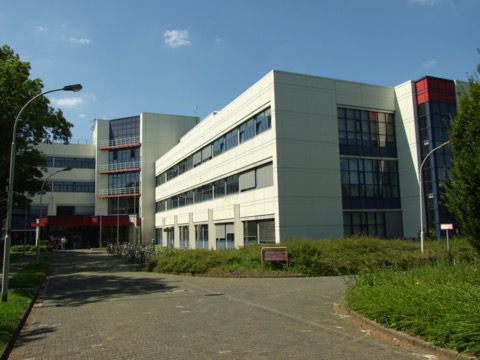
The FH Aachen – Aachen University of Applied Sciences is one of the biggest Fachhochschulen in Germany with roughly 15,000 students, 250 professors, 470 contract lecturers, and 340 assistants. It is specialized in certain topical areas (e.g. technology, engineering, business, design).The FH Aachen ranks as the first best among the Universities of Applied Sciences in Germany in the fields of Electrical, Mechanical engineering and Informatics. Ten Faculties offer 53 Bachelor's, 22 Master's and three cooperative degree programmes.The FH Aachen is situated in Aachen and in Jülich.

Whether parameterized quantum circuits (PQCs) can be systematically constructed to be both trainable and expressive remains an open question. Highly expressive PQCs often exhibit barren plateaus, while several trainable alternatives admit efficient classical simulation. We address this question by deriving a finite-sample, dimension-independent concentration bound for estimating the variance of a PQC cost function, yielding explicit trainability guarantees. Across commonly used ansätze, we observe an anticorrelation between trainability and expressibility, consistent with theoretical insights. Building on this observation, we propose a property-based ansatz-search framework for identifying circuits that combine trainability and expressibility. We demonstrate its practical viability on a real quantum computer and apply it to variational quantum algorithms. We identify quantum neural network ansätze with improved effective dimension using over 6 × fewer parameters, and for VQE on H_2 we achieve UCCSD-like accuracy at substantially reduced circuit complexity.
We consider an inverse shape problem for recovering an unknown simply supported obstacle in two dimensions from near–field point–source measurements for the biharmonic Helmholtz equation. The measured data consist of the scattered field and its Laplacian on a closed measurement curve surrounding the obstacle. By exploiting an operator splitting of the biharmonic operator, we decouple the scattered field into propagating and evanescent components. This decoupling allows us to reformulate the measured data in terms of an acoustic near–field operator for a sound–soft scatterer. Since the acoustic near–field operator does not directly admit the symmetric factorization required by the factorization method, we introduce a far–field transformation (defined independently of the obstacle) that augments the near–field operator into a far–field operator with a symmetric factorization. This yields a rigorous factorization method characterization of the obstacle and leads to a practical reconstruction algorithm based on spectral data of the transformed operator. Finally, we present numerical experiments with synthetic data that demonstrate stable reconstructions under noise and illustrate the role of regularization, including a variant that uses only the scattered field data.
Surface-imprinted polymer (SIP)-based biomimetic sensors are promising for direct whole-bacteria detection; however, the commonly used fabrication approach (micro-contact imprinting) often suffers from limited imprint density, heterogeneous template distribution, and poor reproducibility. Here, we introduce a photolithography-defined master stamp featuring E. coli mimics, enabling high-density, well-oriented cavity arrays (3 × 10⁷ imprints/cm2). Crucially, the cavity arrangement is engineered such that the SIP layer functions simultaneously as the bioreceptor and as a diffraction grating, enabling label-free optical quantification by reflectance changes without additional transduction layers. Finite-difference time-domain (FDTD) simulations are used to model and visualize the optical response upon bacterial binding. Proof-of-concept experiments using a differential two-well configuration confirm concentration-dependent detection of E. coli in PBS, demonstrating a sensitive, low-cost, and scalable sensing concept that can be readily extended to other bacterial targets by redesigning the photolithographic master.
Assistive robots can support collaborative manipulation tasks such as carrying heavy or extended objects. As the human-human interaction is the basis for human-robot interaction, it is important to understand and quantify primarily haptic interaction. The subjects' movements were recorded with a 3D motion capture system to determine spatio-temporal and upper and lower body kinematic parameters. The human-human interaction provided foundational data on human movement in collaborative manipulation tasks. The task with the robot revealed almost no changes in upper body kinematics, however, it was slower and showed adaptations of the human movement in the center of mass motion and in spatio-temporal parameters and lower body kinematics. This shows, that analyzing the interaction between humans and assistive robots focusing on human movement is essential for further developing assistive robots.





