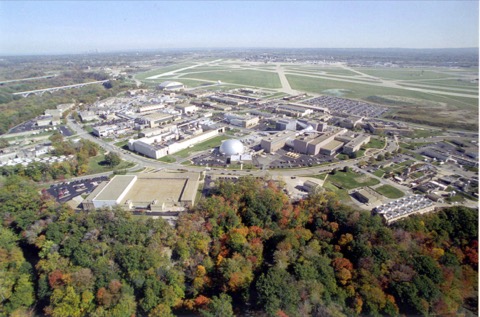
NASA John H. Glenn Research Center at Lewis Field is a NASA center within the cities of Brook Park and Cleveland between Cleveland Hopkins International Airport and the Rocky River Reservation of Cleveland Metroparks, with a subsidiary facility in Sandusky, Ohio. Its director is Marla E. Pérez-Davis. Glenn Research Center is one of ten major NASA facilities, whose primary mission is to develop science and technology for use in aeronautics and space. As of May 2012[update], it employed about 1,650 civil servants and 1,850 support contractors on or near its site.In 2010, the formerly on-site NASA Visitors Center moved to the Great Lakes Science Center in the North Coast Harbor area of downtown Cleveland..

Flame spread over solid fuels is a key determinant of material flammability and fire growth. The primary motivation of this work is to provide information about flame propagation over solid fuels in atmospheres expected in futures spacecraft. Experiments with cylindrical black Polymethyl methacrylate (PMMA) are conducted at sub-atmospheric pressures (40 - 100 kPa) in a sealed combustion chamber on the Combustion Integrated Rack (CIR) of the International Space Station (ISS), and in a similar chamber in normal gravity. The oxygen concentration in the chamber is left to decrease naturally at constant pressure as the PMMA burns. It is found that there is a LOC at which the flame stops spreading, referred here as the limiting oxygen concentration for flame spread (LOC-FS), and another at lower oxygen concentration at which the regressing flame extinguishes (LOCFR). It is also found that both LOCs decreases with ambient pressure and are significantly lower in microgravity than at Earth. Results show that, at a given oxygen level, spread rates are lower in 1-g than in microgravity, and in microgravity the flame propagates to lower oxygen levels before extinguishing. Analysis of flame spread vs oxygen reveals a quadratic decay as oxygen is depleted consistent across conditions.
The tensile strength properties of an insulating paper are provided for room (21°C) to elevated temperature (295°C) in laboratory air.
This paper describes the analysis and evaluation of the Transmission Control Protocol (TCP) performance over cislunar networks which are characterized by large bandwidth-delay-product (BDP). There has been a strong interest in utilizing the Internet Protocol (IP) and protocol suites (e.g. TCP/IP) for space communication networks. TCP is widely deployed and extensively used in terrestrial networks for many applications. The original TCP flow control and congestion control algorithms were designed to be robust and adaptive to different network conditions. However, many terrestrially configured TCP will experience performance degradation due to the very high BDP of space communication networks. Flow control algorithms have evolved in the past decades, including new TCP congestion control algorithm variants. These variants do not change the TCP protocol structure and are interoperable with each other. In this paper, three TCP variants are examined and selected for analysis: TCP NewReno, TCP LinuxReno and H-TCP, which are mostly suitable for cislunar networks. In addition, tuning of some TCP configuration parameters are explored and several beneficial TCP options and extensions are discussed. The performance analysis and evaluation are based on network simulation using the well-known NS3 simulation tool to generate quantitative results. The NS3 TCP module implementation was modified for evaluating different congestion control algorithms and TCP options. The detailed simulation results provide insights on parameter configurations and algorithm selection such that TCP can perform well over cislunar networks.
Laser powder bed fusion (LPBF) has shown significant promise for the manufacturing of high performing wicking structures for advanced thermal management solutions that use geometries with embedded heat pipes. Examples of integrated thermal management solutions using heat pipes include radiator panels, mechanical structures with thermally optimized cooling, or integrated heat sinks. The complexity of these designs necessitates the fabrication of heat pipes at different print orientations to maximize thermal efficiency. Several design approaches for heat pipe structure are possible, such as serpentine, concentric, and branched. However, there is little understanding of how or why print orientation influences wick performance, which is the first aim of this work. The second aim is to examine the effects of oxidation on wick performance to test the hypothesis that oxidizing wicks improve capillary action. Using LPBF and Inconel 718 as the material of choice, representative half-cylinder specimens were fabricated with interconnected porosity using rastered and sintered strategies developed in prior work. These wicks were manufactured in five different orientations, including two down-facing ones, and evaluated in as-printed and post-oxidation conditions. The findings of this work reveal that print orientation does impact wick manufacturability, with thicker, sintered wicks showing the lowest sensitivity to defect formation as a function of orientation. Print orientation also impacts wick performance significantly, but this impact varies by print strategy, with the rastered wicks showing optimum performance when fabricated in the vertical orientation and sintered wicks in the horizontal orientation. The studies show that wick performance can be significantly improved with oxidation when water is the working fluid of choice, but these gains were not observed for ethanol. Taken together, these findings suggest new approaches to wick manufacturing with LPBF that take into consideration effects of print orientation and post-print oxidation on wick performance.
Ceramic matrix composites (CMCs) have emerged as a transformative material class for gas turbine engines, offering significant advantages over nickel-based superalloys due to their reduced weight and higher temperature capabilities. However, their long-term durability in harsh operating environments depends on the development of Environmental Barrier Coatings (EBCs) to protect against oxidation and volatilization caused by water vapor. This article reviews the evolution of EBC technology, from early architectures consisting of silicon bond coats and rare-earth silicate topcoats to advanced multilayer systems with enhanced durability. Key challenges addressed include thermal expansion matching, chemical compatibility, and resistance to degradation mechanisms such as particulate corrosion, thermomechanical stresses, and impact damage. Recent breakthroughs, including alumina-modified EBCs with dramatically improved lifetimes, highlight the progress made in extending component viability. Looking forward, future research aims to expand EBC/CMC applications to rotating components, increase upper temperature limits through novel bond coats, and incorporate mechanics-based design strategies alongside thermochemistry. Collectively, these advances demonstrate that EBCs are critical enablers for realizing the efficiency, performance, and emissions benefits of CMCs in next-generation aviation propulsion.





