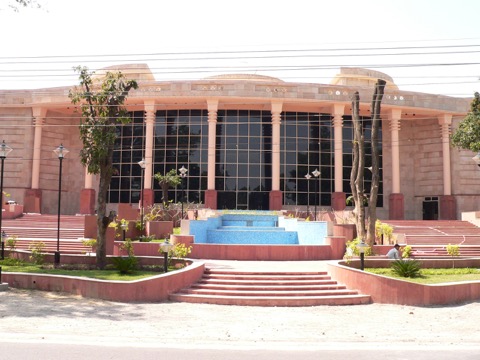
印度理工学院(Indian Institute of Technology),简称IIT,是由印度政府所建设和组成的七间自治工程与技术学院。在学术界具有世界声誉,被称为印度“科学皇冠上的瑰宝”,是印度最顶尖的工程教育与研究机构。 印度理工学院培养的IT人才遍及世界各地,美国硅谷更是这些IT人才的聚集地。印度理工学院为印度软件业在世界范围内的成功做出了不可磨灭的贡献。 印度理工学院创建于1951年,在全国共设有7所校区,分别是:德里理工学院、坎普尔理工学院、卡哈拉格普尔理工学院、马德拉斯理工学院、孟买理工学院、瓜哈提理工学院和卢克里理工学院。 1963年,根据印度国家技术院校法案,印度理工学院被列为国家重点院校,并赋予独立的学术政策、独立的招生及学位授予权。印度理工学院在全国的7所院校均为政府大学,在教学和经济管理上由直属中央政府的印度理工学院委员会管辖。印度人力资源开发部是该委员会的主席,每个分院各设董事会负责全权管理。董事会负责各院校的学术政策的制定,教学大纲的审核及成绩考核。
Abstract Evaporation of water from compacted expansive soils results in significant volumetric shrinkage due to the presence of montmorillonite clay mineral. The nonuniform shrinkage of these soils often results in the formation of desiccation cracks. The present study aims to investigate the role of lateral and basal boundary conditions in the initiation and propagation of desiccation-induced cracking and strain localization in compacted expansive soil. A laboratory-scale desiccation simulation chamber equipped with an automatic image acquisition system was employed to conduct desiccation cracking tests on compacted specimens under different external boundary conditions. Quantification of various geometrical and morphological parameters of desiccation cracking was done using the digital image analysis (DIA) technique. The dynamic evolution of two-dimensional localized displacement and strain fields over the specimen surface was investigated using the digital image correlation (DIC) technique. The results from this study reveal that a soil mass under a similar compaction state and desiccation environment can exhibit significantly different cracking morphologies and strain localization patterns due to slight changes in the basal and lateral boundary conditions around the specimen. The maximum crack intensity factor (CIF) increased from 3.9% under the smooth boundary condition to 10.5% under the highly laterally restrained condition, representing nearly a threefold increase. Similarly, the average crack width ranged between 0.4 and 0.6 mm for specimens with basal restraints but increased to 1.3–1.7 mm for laterally restrained specimens. This study also highlights the possible chances of underestimating the desiccation cracking potential of compacted soils owing to different boundary conditions used during laboratory experiments.
Crater wear is one of the dominant failure mechanisms limiting the performance of ceramic cutting tools during high-speed dry machining. In this study, the effect of vanadium incorporation into TiAlSiN coatings on the evolution of crater wear during dry turning of 42CrMo4 steel was investigated. TiAlSiN, TiAlSiV4N and TiAlSiV11N coatings were deposited on Al2O3/SiC whisker-reinforced ceramic inserts by reactive DC magnetron sputtering and evaluated under different cutting speeds and feed rates. Crater wear was characterized using three-dimensional optical profilometry, while infrared thermography, Raman spectroscopy and energydispersive X-ray spectroscopy were used to investigate the thermal and tribochemical response of the rakeface contact. TiAlSiV11N exhibited the best overall machining performance, reducing the principal craterwear parameters by approximately 30-50% compared with the uncoated tool while lowering the measured cutting temperature by approximately 8-12%. Cutting-length-dependent measurements further showed a slower progression of crater volume for the V-containing coatings. Raman spectroscopy confirmed the formation of V2O5 together with Fe2O3, Cr2O3, TiO2, Al2O3 and SiO2. Fe and O concentrations showed a strong dependence on cutting temperature, with comparable values at similar temperatures irrespective of coating composition, indicating that thermal loading is the dominant factor governing material transfer and oxidation. The superior performance of TiAlSiV11N is therefore attributed to the combined influence of improved coating adhesion, modified mechanical and oxidation behaviour, reduced thermal loading and V-induced tribochemical reactions. These results provide experimental support for a coupled thermo-tribochemical interpretation of wear suppression in TiAlSiVxN-coated ceramic tools.
Abstract Double-skin tubular columns (DSTCs), composed of two concentrically placed hollow steel tubes with sandwiched concrete infill, are efficient composite sections for resisting high axial loads. However, localized buckling failure of the steel tube restricts its structural efficiency. Multicell DSTCs (MCDCs), incorporating stiffeners between the tubes, improve confinement and ductility, but existing confinement models fail to accurately capture stiffener-induced effects and are constrained by limited experimental evidence. This study introduces a modified confinement model that explicitly accounts for the enhanced confinement provided by the stiffeners, representing a significant advancement over previous models. The model is validated through nonlinear finite-element analysis and experimental comparisons, demonstrating an excellent accuracy ( R 2 = 0.99 and average error < 5 % ). A comprehensive parametric study is also conducted, covering the stiffener number, distribution, and hollowness ratio across a wide range. The findings reveal the governing parameters controlling the axial strength and failure modes and highlight the limitations of existing axial strength prediction models. By addressing gaps in the past research and providing a more comprehensive design methodology, this work provides new insights and an analytical framework for optimizing the structural performance of MCDCs in structural engineering applications.
Y1−xCexMnO3 (x = 0.0, 0.05, 0.10) manganites, were investigated to correlate structural distortion, defect chemistry, and multifunctional properties. Rietveld-refinement confirms the retention of the hexagonal P63cm structure upon Ce doping, accompanied by anisotropic lattice distortion, increased crystallite size, and microstrain. XPS indicates the coexistence of Ce3+/Ce4+ and Mn3+/Mn4+ mixed-valence states along with oxygen vacancies. Optical band gap reduced from 1.42 to 1.36 eV with increasing Ce content, suggesting defect-induced band tailing. Magnetic measurements reveal a suppression of the Néel temperature from ∼72 K to 56 K, which indicates short-range ferromagnetic correlations. Curie-Weiss analysis demonstrates a reduction in antiferromagnetic interaction and magnetic frustration, confirming a transition toward a magnetically inhomogeneous state. Isothermal magnetization supports the coexistence of competing antiferromagnetic superexchange and ferromagnetic double-exchange interactions. Bound magnetic polaron analysis suggests defect-mediated magnetic clustering upon Ce substitution. Moreover, 10% Ce doped YMnO3, achieving ∼79% methylene blue degradation within 180 min compared to ∼45% for YMnO3. These results provide important insights into the development of advanced oxide materials for optoelectronic and water remediation applications.
Selectively gated state-space models (SSMs), notably Mamba, are increasingly used for financial time series, yet how they internally represent market regimes (bull, bear, sideways) remains opaque. This paper applies Mechanistic Interpretability (MI) to a six-layer Mamba trained on approximately twenty-one years of daily data for a point-in-time set of S&P 500 constituents plus macroeconomic and Fama-French factors, decomposing per-layer hidden states with Top-K Sparse Autoencoders (SAEs). Our central contribution is methodological and cautionary. A prior, uncontrolled configuration recovered market regimes from SAE features at F1 = 1.00. Under a controlled protocol that (i) removes the three input features that overlap the HMM label definition, (ii) disables the auxiliary regime-classification head, (iii) uses a point-in-time constituent universe, and (iv) evaluates against labels disjoint from the inputs, the same regime label is recovered at only F1 = 0.398, indistinguishable from a logistic baseline on raw inputs (0.435) and from an SAE trained on a randomly initialized, untrained Mamba (0.364). A 2 & times; 2 attribution grid shows the near-perfect result is an interaction of auxiliary supervision and label-defining inputs: neither factor alone exceeds F1 similar to 0.40. Effect sizes with block-bootstrap inference show the residual selective-gate (Delta t) regime effect is statistically detectable but economically negligible and uniform across layers rather than layer-specialized; the apparent polysemanticity gradient disappears under continuous, theory-grounded measures. We contribute a reproducible leakage-control protocol for interpretability evaluation of financial SSMs, a quantified demonstration that previously reported regime structure is a label-contamination artifact, and a modest economically grounded feature subset that genuinely survives the controls.




