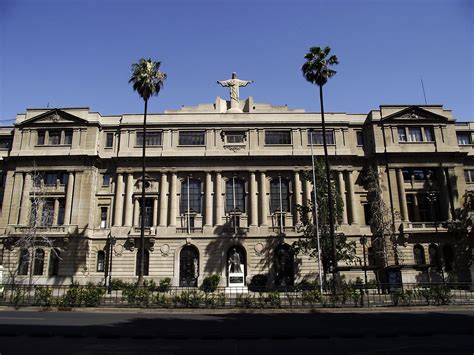
The Pontifical Catholic University of Valparaiso (Spanish: Pontificia Universidad Católica de Valparaíso) (PUCV), also known as Universidad Católica de Valparaíso (UCV), is one of six Catholic universities in Chile and one of the two pontifical universities in the country, along with the Pontifical Catholic University of Chile. It is located in Valparaíso, Chile and has approximately 14,000 students. PUCV attracts students from different areas of Chile, as well as hundreds of exchange students from Europe, North America and several countries from South America, due to its convenient student exchange programs. It is recognized as a traditional institution with high academic prestige and as a complex university due to its important research and educational development in the fields of science, engineering, humanities and arts. As a Catholic university, it answers directly to the Holy See and the Bishopric of Valparaíso. It is a private university with state support. PUCV is an urban university. It has a central campus known as Casa Central (Central House) located in downtown Valparaíso, only a few blocks away from the Chilean Congress, the Metro, and the Pacific Ocean. One of the drawbacks of being an urban university is the difficulty of growing at the original site of its foundation. Several PUCV buildings are on the historic palm-tree-lined Avenida Brasil, but most of its schools are dispersed in throughout Valparaíso, Viña del Mar, Quilpué and Quillota. It was positioned 29th at the QS Latin America University Ranking 2014 (5th nationwide). At the 2014 edition of the América Economía magazine university ranking, it was positioned 5th nationwide and first in the Region of Valparaiso.

La modernidad líquida –como categoría sociológica– es una figura del cambio y de la transitoriedad, de la desregulación y liberalización de los mercados. La metáfora de la liquidez –propuesta por Bauman– intenta también dar cuenta de la precariedad de los vínculos humanos en una sociedad individualista y privatizada, marcada por el carácter transitorio y volátil de sus relaciones. El amor se hace flotante, sin responsabilidad hacia el otro, se reduce al vínculo sin rostro que ofrece la Web. Surfeamos en las olas de una sociedad líquida siempre cambiante – incierta– y cada vez más imprevisible, es la decadencia del Estado del bienestar. La modernidad líquida es un tiempo sin certezas, donde los hombres que lucharon durante la Ilustración por poder obtener libertades civiles y deshacerse de la tradición, se encuentran ahora con la obligación de ser libres asumiendo los miedos y angustias existenciales que tal libertad comporta; la cultura laboral de la flexibilidad arruina la previsión de futuro.
Aortic hemodynamic parameters estimated from 4D Flow Magnetic Resonance (MR) velocity measurements are often estimated using a constant Newtonian viscosity, neglecting blood's shear-thinning behavior. The aim of this work is to estimate and assess whether Newtonian viscosity is sufficient to quantify these parameters, given the non-Newtonian nature of blood. Additionally, we demonstrate that shear-thinning effects remain observable in large vessels despite artifacts commonly present in 4D Flow MR images.. To address this, we quantified the impact of blood rheology and hematocrit (Hct) on Wall Shear Stress (WSS), the rate of viscous Energy Loss (EL), and the Oscillatory Shear Index (OSI) based on velocity data obtained from 4D Flow MR images. Using a Hct-dependent power-law non-Newtonian model with experimentally derived rheological parameters, we analyzed these metrics across a broad range of Hct values at physiological temperatures in both in-silico and in-vivo MR datasets. The results reveal significant differences between Newtonian and non-Newtonian models. In in-silico experiments, WSS and EL differed by up to +189% and +112% at systole, with reductions of-74% and-80% at diastole, respectively, while OSI differences ranged from-23% to-30%. For in-vivo data, WSS and EL deviations reached-44% and-60% at systole, ranging from-69% to +73% at diastole, with OSI differences averaging-21%. These findings highlights the importance of accounting for non-Newtonian blood rheology when estimating hemodynamic parameters from 4D Flow MR images in large vessels, enhancing the accuracy of cardiovascular disease assessments using in-vivo aortic data.
Dryland rivers, historically central to human development in water-scarce regions, now face compounding threats from pollution and climate change that jeopardize both ecosystems and socio-economic stability. This study provides the first global systematic synthesis, based exclusively on previously published secondary data, integrating chemical, hydrological, and socio-economic data across nine major dryland rivers spanning four continents: Limpopo and Nile (Africa), Amu Darya and Shule (Asia), Darling (Oceania), and Colorado, Conchos, Grande/Bravo, and Loa (Americas). A cross-matrix analysis of water, sediment, and biota revealed that over 70% of sites reported contaminant concentrations exceeding international safety thresholds. Legacy pollutants—particularly metalloids (As, Hg, Cd, Pb) and persistent organic compounds (PCBs, PAHs, DDT)—were detected in more than 80% of the studied rivers, often accumulating in sediments and aquatic organisms. These pollutants, coupled with declining discharge and rising aridity, intensify ecological stress and reduce ecosystem resilience. Socio-economic assessment indicates that communities in more than half of the basins experience medium to high levels of economic loss, health impacts, or conflict, reflecting the intersection of environmental degradation and human vulnerability. By linking quantitative pollutant data with hydrological and socio-environmental indicators, this study provides the first global evidence that pollution and water scarcity jointly amplify ecosystem and human vulnerabilities in dryland rivers, underscoring the urgent need for standardized transboundary monitoring, integration of socio-economic metrics in water governance, and adaptive management strategies to enhance resilience in dryland regions globally.
Metals phytotoxicity assessment in soils is predominantly based on laboratory testing. In this paper, we evaluated the effect of the duration of laboratory testing on copper toxicity levels, in ryegrass (Lolium perenne L.) grown in soils polluted by copper mining. Laboratory testing was carried out according to the protocols of ISO 11269-2, 2012 (for 21 days) and ISO 22 030, 2005 (for 60 days). When tested for 21 days, the soil copper content had no statistically significant effect on plant growth or on the ryegrass shoot copper content. Conversely, when tested for 60 days, plant growth was inversely proportional to the total soil copper content and to the soil exchangeable copper concentration. Therefore, short-term testing underestimated copper phytotoxicity. The results of this study demonstrate that long-term laboratory testing is required to realistically predict metal toxicity in plants grown under the real conditions of natural and agricultural ecosystems.
This study employs physics-informed neural networks (PINNs) to model avocado firmness during ripening, based on a physiological framework where firmness loss is governed by enzymatic cell wall degradation, with kinetics modulated by the metabolic rate. PINNs are trained on literature datasets from diverse cultivars and countries under constant storage conditions, revealing comparable climacteric ripening kinetics. The approach is extended to dynamic storage scenarios using a time/temperature/gas-conditions superposition principle. Variations due to orchard origin, climate, and harvest time are captured through differences in the initial pre-climacteric state, which cannot be described by a single state variable.





