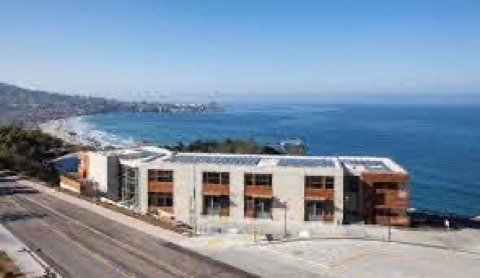
The Scripps Institution of Oceanography (sometimes referred to as SIO, Scripps Oceanography, or Scripps) in San Diego, California, founded in 1903, is one of the oldest and largest centers for ocean and Earth science research, public service, undergraduate and graduate training in the world. Hundreds of ocean and Earth scientists conduct research with the aid of oceanographic research vessels and shorebased laboratories. Its Old Scripps Building is a U.S. National Historic Landmark. SIO is a division of the University of California San Diego (UCSD). The public explorations center of the institution is the Birch Aquarium at Scripps. Since becoming part of the University of California in 1912, the institution has expanded its scope to include studies of the physics, chemistry, geology, biology, and climate of Earth.Dr. Margaret Leinen took office as Vice Chancellor for Marine Sciences, Director of Scripps Institution of Oceanography, and Dean of the Graduate School of Marine Sciences on October 1, 2013.Scripps publishes explorations now, an e-magazine of ocean and earth science.

The recent surge in machine learning (ML) methods for geophysical modeling has raised the question of how these methods might be applied to data assimilation (DA). We focus on diffusion modeling (a form of generative artificial intelligence) for systems that can perform the entire DA process, rather than on ML-based tools used within a conventional DA system. We identify at least three distinct types of diffusion-based DA systems and show that they differ in the posterior distribution they target for sampling. These posterior distributions correspond to different priors and/or likelihoods, which in turn result in unique training datasets, computational requirements, and state estimate qualities. Our analysis further shows that a diffusion DA system designed to target the same posterior distribution as current ensemble DA algorithms requires retraining at each DA cycle. We discuss the implications of these findings for the use of diffusion modeling in DA.
As part of a National Oceanographic Partnership Program (NOPP) project, seven teams-comprising investigators from universities, federal laboratories, and industry-are collaboratively investigating the generation, propagation, and dissipation of internal waves in the global ocean using complementary, state-of-the-art observations and model simulations. Internal waves, generated by the interaction of tides, winds, and mean flows, permeate the ocean and influence its physical state. Internal waves transport scalar and vector properties-both geographically and across scales-and contribute to irreversible mixing, modulate acoustic propagation, and complicate the identification of subinertial (e.g., geostrophic) flows in observations. For these reasons, accurately representing internal waves in global ocean forecast models is a high priority. The collaborations reported here are improving the understanding of the internal wave life cycle and enhancing model skill in simulating it. Three observational teams are collecting in situ data using 1) redeployable moored arrays that resolve internal waves from multiple directions, 2) global deployments of profiling floats that measure internal wave energy fluxes, shear, and mixing, and 3) high-resolution arrays that focus on bottom boundary layer processes. Four modeling teams are guiding the design and placement of these observation platforms and are using the collected observations to 1) improve internal wave representation and dissipation in ocean models, 2) conduct high-resolution process studies, and 3) implement data assimilation in idealized, regional, and global simulations. These efforts are further supported by high-resolution sea surface height measurements from the new Surface Water and Ocean Topography (SWOT) satellite, which provide context for in situ observations and improve ocean forecasting systems. SIGNIFICANCE STATEMENT: A collaboration among scientists from U.S. universities, national laboratories, and industry is advancing our understanding and prediction of internal waves in the global ocean. These waves-characterized by vertical scales of tens to hundreds of meters and horizontal scales of tens to hundreds of kilometers-play a critical role in maritime commerce, naval operations, and ocean circulation. The team integrates novel observational approaches, including internal wave-resolving moored arrays, ship-of-opportunity float deployments, bottom boundary layer-distributed sensor networks, and satellite wide-swath altimetry, with cutting-edge global, regional, and process-model simulations. Together, these efforts are improving the repre-sentation of internal wave processes in ocean models and enhancing their predictive capabilities for operational forecasts.
Diurnal cycles of sea surface temperature (SST) are important for ocean-atmosphere coupling. However, observations of their lateral variability, especially in freshwater-dominated regions and in presence of diurnal warm layers (DWLs), remain limited. This study investigates the spatial differences in the diurnal SST amplitude (during DWL and non-DWL days) and subsurface DWL evolution in the Bay of Bengal using remote sensing, in situ observations, and 1D modeling. While satellite data reveal O(1)degrees C differences in diurnal SST amplitude over 100 km, in situ observations uncover finer-scale and more extreme variability, especially during DWL events. We observe that differences in diurnal SST amplitude over mesoscale and smaller lengths (,100 km) are larger during DWL days (median: 0.2 degrees C, extreme: 1.4 degrees C) when compared to non-DWL days (median: 0.1 degrees C, extreme: 0.2 degrees C). Observations from drifters and complementary 1D model simulations reveal that lateral differences in salinity-driven stratification leads to diurnal SST amplitude differences of about 0.2 degrees C for shallow mixed layer scenarios (,8 m). While stratification differences explain the median variability in diurnal SST amplitude, extreme differences in diurnal SST require additional contributions from spatial variations in surface forcing and optical properties. Observations also reveal that lateral differences in salinity stratification modify the DWL response, leading to O(10) m differences in DWL depth, making it the same order as typical mixed layer depth (MLD) scales in the Bay. These results highlight the critical role of small-scale differences in salinity-driven stratification (set by rainfall and mesoscale flow fields in the Bay) in causing diurnal SST and DWL response differences. SIGNIFICANCE STATEMENT: The daily cycle of sea surface temperature (SST) plays a key role in ocean-atmosphere heat and moisture exchange. This effect is particularly enhanced during the presence of diurnal warm layers, which are anomalously warm upper-ocean layers formed during low wind speeds. This study explores how daily SST warming varies over distances less than 100 km. Using satellite and in situ data from the Bay of Bengal, we find that warming can differ by up to 1 degrees C across around 100 km. These differences arise partly from salinity-driven stratifica-tion, but variations in surface forcing and water optics also play a role. Understanding these patterns is important because they affect the ocean and atmosphere interaction, influencing atmospheric convection and weather.
Observations, models and theory have suggested that ocean fronts are ecological hotspots, generally associated with higher diversity and biomass across many trophic levels. Nutrient injections are often associated with higher chlorophyll concentrations at fronts, but the response of the zooplankton community is still insufficiently understood. The present study investigates mesozooplankton stocks and composition during late spring, northeast of Menorca, along two north-south transects that crossed the North Balearic Front separating central waters of the Northwestern Mediterranean Sea gyre from peripheral waters originating from the Algerian basin. During the BioSWOT-Med campaign, vertical triple-net tows with 200 and 500 µm meshes were carried out at three depths (100, 200, and 400 m), and the samples were processed with ZooScan to classify organisms into eight taxonomic groups. Zooplankton distributions were analyzed for the surface layer (0–100 m), a mid-depth layer (100–200 m), and a deeper layer (200–400 m). The results did not show a significant increase in biomass in the front in any layers. The NBF appears to act as a boundary between communities rather than a pronounced area of active or passive zooplankton accumulation. Analyses of stratified vertical distributions of zooplankton highlighted distinct taxonomic compositions in the three layers, and a progressive homogenization of community structure with depth, reflecting a weaker impact of hydrological processes on deeper communities. The clearest impact of the front was within the upper 100 m, where the mesozooplanktonic taxonomic composition differed between the front and adjacent water masses, with a decrease in all taxonomic groups except Cnidaria, which increased dramatically. In the two deeper layers, the front also influenced community composition, although to a lesser extent, with marked increases in Foraminifera and Cnidaria. Moreover, the northern water mass and the front were dominated by large copepods, while the southern water mass exhibited higher zooplankton diversity and smaller-sized copepods. The results of this study highlight the complexity of processes shaping planktonic communities over time and space in the NBF zone and its adjacent waters. These processes include zooplankton stock reduction in the transitional post-bloom period, marked effect of diel variation linked to vertical migrations, and potentially the impact of storm-related mixing in the surface layer that can disrupt established ecological patterns.
Kappa opioid receptor agonists are clinically used to treat pruritus and have therapeutic potential for the treatment of pain and neuropsychiatric disorders. We have previously shown that triazole 1.1 is a G protein signaling-biased KOR agonist, that can suppress itch without producing signs of sedation in mice. This profile was recapitulated in rats and non-human primates; however, triazole 1.1 had limited potency as an antipruritic. Here we describe a more potent, G protein signaling-biased agonist, triazole 187. Triazole 187 is a potent antipruritic agent and does not decrease spontaneous locomotor activity; interestingly, it produces anxiolytic-like behaviors in mice, an effect not observed for triazole 1.1. In addition to curbing sedation, triazole 187 produces only mild diuresis, resulting in 30% of urine output induced by U50,488H at a dose that is more than 100-fold the antipruritic potency dose. Compounds like triazole 187 may present a means to treat anxiety that is independent of or accompanied by persistent chronic itch while avoiding sedation and diuresis accompanied by typical KOR agonists.





