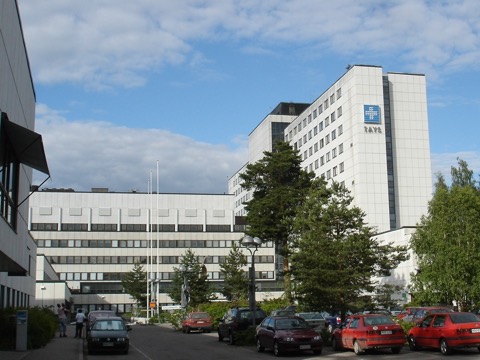
Tampere University Hospital (Finnish: Tampereen yliopistollinen sairaala, TAYS, Swedish: Tammerfors universitetssjukhus) is a teaching hospital of Tampere University along Teiskontie at the Kauppi district in Tampere, Finland. It serves as one of the main hospitals in the country and operates in the facilities of Central Hospital (Keskussairaala) and Heart Hospital (Sydänsairaala) in Tampere, Pitkäniemi Hospital in Nokia, Valkeakoski Hospital in Valkeakoski and Sastamala Hospital in Sastamala.34 medical specialties are represented at Tampere University Hospital. Most of the specialty activities take place at the Central Hospital, with more than a thousand beds and over 3,000 employees. The hospital provides services to more than 1 million Finns.The hospital belongs to Pirkanmaa Hospital District, of which it covers 80%. The 24h emergency center of Tampere University Hospital treats patients from Tampere, Hämeenkyrö, Ikaalinen, Nokia, Orivesi, Pirkkala, Ruovesi, Sastamala, Virrat and Ylöjärvi.Tampere University Hospital campus will be the Eastern terminus of Tampere light rail. The line will connect Tampere University Hospital to the city center. Media related to Tampere University Hospital at Wikimedia Commons.

Purpose Dupuytren contracture (DC) is a common benign fibroproliferative hand disorder, causing progressive flexion contractures of the finger joints. DC is a chronic condition with no definitive cure, and treatment is primarily surgical, although percutaneous options also exist. We assessed the safety of DC treatments by analyzing national compensation claims. Methods This retrospective registry study included all compensation claims related to the treatment of DC submitted to the Finnish Patient Insurance Center between 2010 and 2023. The number of filed and compensated claims, the types of treatment injuries claimed, and the proportion of avoidable injuries were analyzed. The national incidence of claimed treatment injuries was calculated using annual procedure volumes. Injury avoidability was assessed retrospectively by expert review. Results During the 14-year study period, 54 compensation claims were filed following treatment for DC, corresponding to an incidence of 4.0 claimed injuries per 1,000 operations. The most frequently reported injuries were nerve injuries, tendon injuries, infections, and recurrent contractures. Of the 54 claims, 20 resulted in compensation, most commonly for nerve injuries, tendon injuries, amputations, and infections. Based on the retrospective assessment, 29.6% of the cases were considered avoidable. Conclusions The number of claims and compensated treatment injuries was low in relation to the total number of procedures performed. Type of study/level of evidence Therapeutic IV.
This international, multidisciplinary consensus report represents the first effort to systematically define and characterize fatty pancreas. A key outcome of this endeavor was the recommendation to adopt "fatty pancreas" as the standardized and inclusive term to describe all forms of fat accumulation in the pancreas. This terminological consensus provides a critical foundation for unified reporting and clinical communication. Another major contribution of the report is the consensus on diagnostic imaging findings, which was based on radiological and endoscopic modalities. The proposed criteria aim to enhance consistency in clinical assessment and support the development of standardized research protocols. In addition to establishing terminology and diagnostic frameworks, the report also synthesizes current knowledge across a wide range of relevant domains. These include the etiology and epidemiology of fatty pancreas, as well as its associations with alcohol consumption, smoking, acute and chronic pancreatitis, pancreatic exocrine insufficiency, type 2 diabetes mellitus, and surgical outcomes. The potential links between fatty pancreas and neoplastic conditions such as intraductal papillary mucinous neoplasms and pancreatic cancer are also addressed, alongside the current understanding of its metabolic implications (beta-cell function and glucose homeostasis) and treatment strategies. Throughout the consensus process, a consistent theme emerged: the limited availability of high-quality, prospective clinical data. Therefore, many of the recommendations in this report are based on expert consensus rather than strong empirical evidence. As such, the statements require rigorous prospective validation before they can be adopted into routine clinical practice. This underscores a critical need for further research, particularly studies aimed at clarifying causal relationships, validating diagnostic tools, and determining the clinical relevance of fatty pancreas across diverse patient populations. This report serves as both a summary of our current understanding and a roadmap for future investigations, aiming to close existing knowledge gaps and guide evidence-based clinical practice in this emerging field.
The Injury Severity Score (ISS) and New Injury Severity Score (NISS) are widely used in evaluation of injury severity in trauma patients. The aim of this study is to assess the predictive accuracy of these scoring systems on clinical outcomes. We conducted a retrospective registry study of 1,112 severely injured trauma patients (NISS ≥ 16) treated at Tampere University Hospital (TAUH) between 2015 and 2024. Outcomes included in-hospital mortality, prolonged hospital and ICU stay (≥ 75th percentile), in-hospital intubation, and blood transfusions. Predictive performance was assessed using the area under the receiver operating characteristic curve (AUC) and the Hosmer-Lemeshow (H-L) test for calibration. Subgroup analyses were performed for patients with significant (AIS ≥ 3) head, thorax, and extremity injuries. A total of 848 (76
Cardiovascular Risk in Young Finns Study (YFS) is a prospective cohort of 3596 males and females (baseline age 3-18 years) that was established in 1980 to study cardiovascular risk factors in children and adolescents. The YFS has been instrumental in demonstrating the links between childhood risk factors and adult cardiovascular outcomes with implications on paediatric cardiovascular preventive practise. In the latest follow-up in 2018-2020, the study was expanded into a three-generation cohort, including the original cohort members, as well as their parents and offspring. Altogether 7341 individuals aged 3-92 years participated; 2127 original cohort members (now aged 40-58 years), 2452 parents (aged 58-92 years) and 2762 offspring (aged 3-37 years) of the original cohort members. The main aim was to establish a multigenerational population data base, sample biobank and links to national health registries that would offer a unique platform to study familial transmission of health-related traits. The field studies and data collections were conducted as part of the ERC funded MULTIEPIGEN project designed testing a specific hypothesis that epigenetic markers in the semen play a role in the transmission of intergenerational information in the paternal lineage. It is a first a priori designed epidemiologic study assessing the role of paternal life exposures, including chemical and psychosocial stress, in the development of cardio-metabolic, cognitive and psychosocial outcomes in their offspring. ### Competing Interest Statement The authors have declared no competing interest. ### Funding Statement The Young Finns Study has been financially supported by the Academy of Finland: grants 356405, 322098, 286284, 134309 (Eye), 126925, 121584, 124282, 129378 (Salve), 117797 (Gendi), and 141071 (Skidi); the Social Insurance Institution of Finland; Competitive State Research Financing of the Expert Responsibility area of Kuopio, Tampere and Turku University Hospitals (grant X51001); Juho Vainio Foundation; Paavo Nurmi Foundation; Finnish Foundation for Cardiovascular Research; Finnish Cultural Foundation; The Sigrid Juselius Foundation; Tampere Tuberculosis Foundation; Emil Aaltonen Foundation; Yrjo Jahnsson Foundation; Signe and Ane Gyllenberg Foundation; Diabetes Research Foundation of Finnish Diabetes Association; EU Horizon 2020 (grant 755320 for TAXINOMISIS and grant 848146 for To Aition); European Research Council (grant 742927 for MULTIEPIGEN project); Tampere University Hospital Supporting Foundation; Finnish Society of Clinical Chemistry; the Cancer Foundation Finland; pBETTER4U_EU (Preventing obesity through Biologically and bEhaviorally Tailored inTERventions for you; project number: 101080117); CVDLink (EU grant nro. 101137278) and the Jane and Aatos Erkko Foundation; Research Committee of the Kuopio University Hospital Catchment Area (State Research Funding, 5031364); Research Council of Finland Flagship InFLAMES (funding decision numbers 337530 and 357910). Pashupati P. Mishra was supported by the Academy of Finland (Grant number: 349708) and Emma Raitoharju (grants: 330809, 338395). ### Author Declarations I confirm all relevant ethical guidelines have been followed, and any necessary IRB and/or ethics committee approvals have been obtained. Yes The details of the IRB/oversight body that provided approval or exemption for the research described are given below: Ethical committees of the Hospital District of Southwest Finland and the European Research Council have approved the study. All individuals and/or legal guardians have signed a written informed consent to take part in the study. They had the right to refuse any part of the study protocol or discontinue at any time without the need to give any explanation. I confirm that all necessary patient/participant consent has been obtained and the appropriate institutional forms have been archived, and that any patient/participant/sample identifiers included were not known to anyone (e.g., hospital staff, patients or participants themselves) outside the research group so cannot be used to identify individuals. Yes I understand that all clinical trials and any other prospective interventional studies must be registered with an ICMJE-approved registry, such as ClinicalTrials.gov. I confirm that any such study reported in the manuscript has been registered and the trial registration ID is provided (note: if posting a prospective study registered retrospectively, please provide a statement in the trial ID field explaining why the study was not registered in advance). Yes I have followed all appropriate research reporting guidelines, such as any relevant EQUATOR Network research reporting checklist(s) and other pertinent material, if applicable. Yes Due to the local legal restrictions concerning the distribution of all personal information, allowance of open access to the YFS data is not possible. Therefore, data sharing outside the study group requires a data-sharing agreement. Investigators can submit an expression of interest to the YFS Steering Group / Data Sharing Committee (PI of the YFS, Prof. Olli Raitakari, olli.raitakari@utu.fi).





