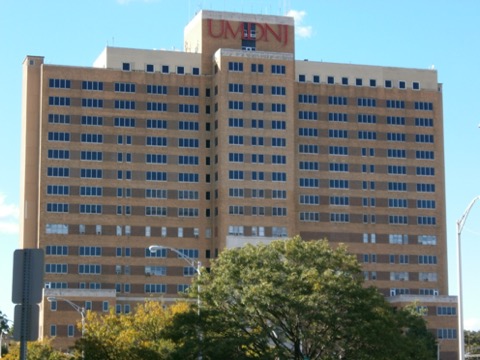
The University of Medicine and Dentistry of New Jersey (UMDNJ) was a state-run health sciences institution of New Jersey, United States.It was founded as the Seton Hall College of Medicine and Dentistry in 1954, and by the 1980s was both a major school of health sciences, and a major research university. On July 1, 2013 it was dissolved, with most of its schools merging with Rutgers University to form a new Rutgers School of Biomedical and Health Sciences, while the School of Osteopathic Medicine, including its Graduate School of Biomedical Sciences, became part of Rowan University and was renamed the Rowan University School of Osteopathic Medicine.

Small-cell lung cancer (SCLC) is the most lethal type of lung cancer. Paradoxically, this tumor displays a high mutation burden; however, a modest response to immunotherapy. Improving Immunotherapy response in SCLC patients remains an unmet need. Here, we report that across 24 tumor types, including over 179,000 real-world patient tumors, SCLC has the highest expression of nonhomologous end joining (NHEJ) DNA repair regulator PRKDC (DNAPKcs). High PRKDC expression predicts poor response to immunotherapy in SCLC. DNAPKcs depletion causes activation of cGAS/STING pathway due to cytoplasmic accumulation of double-stranded DNA, inducing immunogenicity and enhancing sensitivity of SCLC models to immunotherapy. Analyses in SCLC cell lines and mouse models shows that depletion of DNAPKcs leads to proteasomal degradation of MYC via GSK3β pathway. We show that DNAPKcs upregulation contributes to immunotherapy resistance and DNAPKcs inhibition represents a promising therapeutic strategy to induce antitumor immunity and potentiate immunotherapy efficacy in immunologically suppressed SCLC.
Pneumonic plague remains a high-consequence respiratory disease, highlighting the need for vaccines that induce durable lung-localized immunity. We show that intramuscular prime-boost vaccination with Alum-absorbed OMV46-LcrV (OMV46-LcrV/Alum) is safe but provides limited long-term protection against respiratory Yersinia pestis challenge in mice. To enhance lung immunity, we deliver an adjuvant-free intranasal LcrV "spike" following IM OMV46-LcrV/Alum priming. This "prime-spike" regimen is well tolerated and confers complete short- and long-term protection against high-dose pulmonary Y. pestis challenge. The approach increases lung resident memory B cells, including antibody-secreting cells, and resident memory T cells with elevated Interferon-γ, Interleukin-17A, and Interleukin-4 production. These localized memory responses contribute to improved protection, demonstrating the promising potential of prime-spike immunization for combating pneumonic plague.
The recently published EUFOREA pocket guide "Biologics in Upper and Lower Airway Diseases" summarises recommendations on the use of biologics in chronic rhinosinusitis with nasal polyps (CRSwNP) and asthma and offers advice on biologic choice for practicing clinicians. The creation of this pocket guide, in the absence of any head-to-head studies at that time, drew on expert opinions and published indirect treatment comparison (ITC) approaches. It makes a single recommendation for a preferred biologic, in patients affected by CRSwNP, without concomitant asthma (apart from specific cases such as pregnancy), whilst offering different options in asthma endotypes and phenotypes. We wish to draw the attention of the readership to some additional considerations relating to biologic choice for these diseases and how they are classified.
Countervailing powers have enjoyed ever‐increasing use and development in insightful ways by researchers and scholars who find the concept useful for analyzing dynamic, ongoing processes between stakeholders. This revised overview features key ideas and recent developments based on both micro and macro studies.
At the maternal-fetal interface, tightly regulated levels of retinoic acid (RA), the physiologically active metabolite of vitamin A, are required for embryo implantation and pregnancy success. Herein, we utilize mouse models, primary human cells, and pharmacological tools to demonstrate how depletion of RA signaling via RA receptor (RAR) disrupts implantation and progression of early pregnancy. To inhibit RAR signaling during early pregnancy, BMS493, an inverse pan-RAR agonist that prevents RA-induced differentiation, was administered to pregnant mice during the peri-implantation period. Attenuation of RA/RAR signaling prior to embryo implantation results in implantation failure, whereas attenuation of RA/RAR signaling after embryo implantation disrupts the post-implantation decidual vasculature and results in pregnancy failure by mid-gestation. To inhibit RAR signaling during human endometrial stromal cell (HESC) decidualization, primary HESCs and decidualized primary HESCs were transfected with silencing RNA specific for human RARA. Inhibition of RA/RARA signaling prevents initiation of HESC decidualization, but not maintenance of the decidualized HESC phenotype. These data show that RA/RAR signaling is required for maintenance of the decidual vasculature that supports early pregnancy in mice, and distinct RAR signaling is required for initiation, but not maintenance of primary HESC decidualization in vitro.





