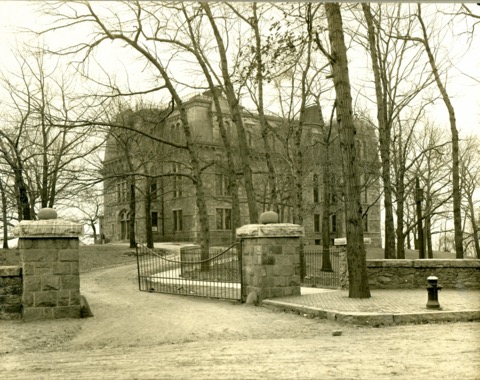
Worcester State University (WSU) is a public university in Worcester, Massachusetts. It was founded in 1874 and enrolls nearly 5,500 undergraduates and over 900 graduate students.
Urbanization of watersheds, including increased impervious surfaces, altered land use, and the introduction of anthropogenic pollutants, alters watershed hydrology and water quality. While the connection between land use and water quality is well established at regional scales, the inconsistent gains in water quality despite management efforts underscores the need to better understand how water quality in individual small watersheds responds to overlapping modern stressors and legacy effects. This study examines the influence of urbanization on the chemical characteristics of a small watershed in central Massachusetts. We used field measurements and laboratory analyses to assess how conductivity, nutrients (nitrate, ammonia, total phosphorus), and trace metals (Cu, Pb, Zn) varied across 13 stream, lake, and tributary sites during the 2022 field season. Land cover analysis of subwatersheds for each site revealed a gradient of urbanization from predominantly forested headwaters to densely developed downstream sites. Specific conductance was positively correlated with impervious surface area and road density; the highest values were observed downstream and during the winter and early spring, suggesting road salt as a key driver of stream salinization. Nitrates showed a strong correlation with impervious surface cover and lawn area, while phosphorus concentrations were more weakly correlated with urbanization metrics and may be more influenced by legacy (historical) sources. Following the single large precipitation event, phosphorus concentrations increased, consistent with a source of sediment-bound legacy phosphorus. Streambed metal concentrations showed no significant correlation with urbanization metrics across sites, but were markedly elevated at the most downstream main stem stream site, possibly indicating a localized point source from historical industrial activity. These findings underscore the complex and spatially variable impacts of urbanization on watershed health and emphasize the need for high-resolution, local monitoring to inform effective management and restoration strategies.
Polarization observations of the Milky Way and many other spiral galaxies have found a close correspondence between the orientation of spiral arms and magnetic field lines on scales of hundreds of parsecs. This paper presents polarization measurements at 214 μ m toward 10 filamentary candidate “bones” in the Milky Way using the High-resolution Airborne Wide-band Camera on the Stratospheric Observatory for Infrared Astronomy. These data were taken as part of the Filaments Extremely Long and Dark: A Magnetic Polarization Survey and represent the first study to resolve the magnetic field in spiral arms at parsec scales. We describe the complex yet well-defined polarization structure of all 10 candidate bones, and we find a mean difference and standard deviation of −74° ± 32° between their filament axis and the plane-of-sky magnetic field, closer to a field perpendicular to their length rather than parallel. By contrast, the 850 μ m polarization data from Planck on scales greater than 10 pc show a nearly parallel mean difference of 3° ± 21°. These findings provide further evidence that magnetic fields can change orientation at the scale of dense molecular clouds, even along spiral arms. Finally, we use a power law to fit the dust polarization fraction as a function of total intensity on a cloud-by-cloud basis and find indices between −0.6 and −0.9, with a mean and standard deviation of −0.7 ± 0.1. The polarization, dust temperature, and column density data presented in this work are publicly available online.
An analysis of the Millimetre Astronomy Legacy Team 90 GHz survey has produced a sample of 27 candidate dense molecular clumps with large collapse motions, as revealed by large "blue" asymmetrical line profiles of the optically thick HCO+ (1-0) line. New, more sensitive molecular line observations of this sample, conducted with the Mopra 22 m telescope, confirm the blue asymmetries in the HCO+ (1-0) line profiles, with large, positive values of the asymmetry parameter A ( AHCO+=0.69 +/- 0.01 ), and positive, but smaller asymmetries in the HCN (1-0) and HNC (1-0) lines ( AHCN=0.35 +/- 0.01 and AHNC=0.28 +/- 0.01 ), as expected for a less optically thick tracer in collapsing clumps. The small, positive mean asymmetry parameters for C2H (N = 1-0; J = 3/2-1/2; F = 2-1) and H13CO+ (1-0), AC2H=0.15 +/- 0.02 and AH13CO+=0.18 +/- 0.03 , likely indicate slightly optically thick emission for at least some clumps. The hyperfine ratios for N2H+ (1-0) are in their optically thin, LTE, values, but for HCN (1-0) they are not; the F = 1 -> 1 hyperfine line shows abnormally weak intensities. A simple two-component model shows that self-absorption of the background F = 1 -> 1 hyperfine line by the main F = 2 -> 1 hyperfine line of a cold, foreground, redshifted cloud can reproduce the observed HCN (1-0) hyperfine intensities and match the HCN (1-0) and HCO+ (1-0) line profiles. All of these results are consistent with self-absorption of the optically thick lines on the red side of the profile, as expected for collapsing clumps. The simple two-cloud model suggests that this sample represents dense clumps with extreme collapse velocities, Vinf similar to 2.4 km s-1.
PURPOSE:This clinical focus article explores the role of interdisciplinary collaboration between audiologists and psychologists in managing hearing loss and cognitive decline as interconnected conditions. By employing the International Classification of Functioning, Disability and Health (ICF) framework, the article systematically maps the roles and responsibilities of audiologists and psychologists to optimize patient outcomes. METHOD:A structured methodology was used to align the ICF core set for hearing loss with interdisciplinary interventions, highlighting areas of individual and shared responsibility. RESULTS:Findings underscore the importance of an integrated care model, where audiologists focus on auditory rehabilitation and cognitive load reduction, while psychologists address the psychosocial and cognitive aspects of hearing loss. CONCLUSION:A multidisciplinary approach that extends beyond audiology and psychology to include neurologists, occupational therapists, and general practitioners ensures comprehensive patient-centered care.
Controlling nanoparticle assembly in soft matter is an important objective in materials science and technology. Cholesteric liquid crystals (CLCs) constitute an exceptional template for this purpose, guiding nanoparticles into complex, organized superstructures. However, achieving large‐scale superstructures and understanding the interplay of the governing forces remain a challenge. Here, we demonstrate the precise localization of gold nanoparticle (AuNP) monolayers within the modulated texture of a polymer‐stabilized CLC. Using optical, electron, and atomic force microscopy combined with Landau‐de Gennes energy simulations, we show and explain how AuNPs self‐assemble into large‐scale arch textures that replicate the underlying CLC undulations. The organization is dictated by a balance between the mitigation of elastic distortions in the CLC and the anchoring conditions imposed by the AuNP monolayer. This balance positions the nanoparticles in valleys, slightly displaced from the most elastically distorted regions, just below the air interface. This specific localization appears to be associated with a less tilted easy axis at the CLC‐AuNP interface compared to nematic films, resulting in reduced local hexagonal ordering within the AuNP monolayers. Our work provides design principles for controlling nanoparticle assemblies across multiple length scales, from macroscopic architectures to nanoscale order, by exploiting the coupling between liquid crystal elasticity and surface anchoring.




