Gradient signals in LLM training are highly anisotropic: recurrent linguistic structure concentrates energy into a small set of dominant spectral directions, while context specific information resides in a long tail. We show that this spike tail separation persists throughout training, with the spike occupying only about 1.5
Mixture-of-Experts (MoE) architectures are often considered a natural fit for continual learning because sparse routing should localize updates and reduce interference, yet MoE Transformers still forget substantially even with sparse, well-balanced expert utilization. We attribute this gap to a pre-routing bottleneck: multi-head attention concatenates head-specific signals into a single post-attention router input, forcing routing to act on co-occurring feature compositions rather than separable head channels. We show that this router input simultaneously encodes multiple separately decodable semantic and structural factors with uneven head support, and that different feature compositions induce weakly aligned parameter-gradient directions; as a result, routing maps many distinct compositions to the same route. We quantify this collision effect via a route-wise effective composition number N_eff and find that higher N_eff is associated with larger old-task loss increases after continual training. Motivated by these findings, we propose MH-MoE, which performs head-wise routing over sub-representations to increase routing granularity and reduce composition collisions. On TRACE with Qwen3-0.6B/8B, MH-MoE effectively mitigates forgetting, reducing BWT on Qwen3-0.6B from 11.2
Mixture-of-Experts (MoE) architectures scale Large Language Models via expert specialization induced by conditional computation. In practice, however, expert specialization often fails: some experts become functionally similar, while others functioning as de facto shared experts, limiting the effective capacity and model performance. In this work, we analysis from a spectral perspective on parameter and gradient spaces, uncover that (1) experts share highly overlapping dominant spectral components in their parameters, (2) dominant gradient subspaces are strongly aligned across experts, driven by ubiquitous low-rank structure in human corpus, and (3) gating mechanisms preferentially route inputs along these dominant directions, further limiting specialization. To address this, we propose Spectral-Decoupled MoE (SD-MoE), which decomposes both parameter and gradient in the spectral space. SD-MoE improves performance across downstream tasks, enables effective expert specialization, incurring minimal additional computation, and can be seamlessly integrated into a wide range of existing MoE architectures, including Qwen and DeepSeek.
This report summarizes the discussions and recommendations from the NSF Workshop on Algorithm-Hardware Co-design for Medical Applications, held on September 26-27, 2024, in Pittsburgh, PA. The workshop assembled an interdisciplinary cohort of researchers, clinicians, and industry leaders to examine foundational challenges and develop a strategic roadmap for algorithm-hardware co-design in medical computing. The workshop focuses on four thematic areas: (1) teleoperations, telehealth, and surgical operations; (2) wearable and implantable medicine, including implantable living pharmacies; (3) home ICU, hospital systems, and elderly care; and (4) medical sensing, imaging, and reconstruction. This report calls for a fundamental shift in how next-generation medical technologies are conceived, designed, validated, and translated into practice. The report recommends that NSF sustain investment in shared standardized data infrastructures and compute infrastructures, develop clinic workflow-aware systems and human-AI collaboration frameworks, promote scalable validation ecosystems grounded in objective, continuous measures, and physics-informed, and enable safe, accountable, and resilient platforms, including virtual-physical healthcare ecosystems, to de-risk translational pathways. The workshop information can be found on the website: https://sites.google.com/view/nsfworkshop.
Denoising-based diffusion models have attained impressive image synthesis; however, their applications on videos can lead to unaffordable computational costs due to the per-frame denoising operations. In pursuit of efficient video generation, we present a Diffusion Reuse MOtion (Dr. Mo) network to accelerate the video-based denoising process. Our crucial observation is that the latent representations in early denoising steps between adjacent video frames exhibit high consistencies with motion clues. Inspired by the discovery, we propose to accelerate the video denoising process by incorporating lightweight, learnable motion features. Specifically, Dr. Mo will only compute all denoising steps for base frames. For a non-based frame, Dr. Mo will propagate the pre-computed based latents of a particular step with inter-frame motions to obtain a fast estimation of its coarse-grained latent representation, from which the denoising will continue to obtain more sensitive and fine-grained representations. On top of this, Dr. Mo employs a meta-network named Denoising Step Selector (DSS) to dynamically determine the step to perform motion-based propagations for each frame, ensuring the correct transformation of multi-granularity visual features. Extensive evaluations on video generation and editing tasks indicate that Dr. Mo delivers widely applicable acceleration for diffusion-based video generations while effectively retaining the visual quality and style. Video generation and visualization results can be found at https://drmo-denoising-reuse.github.io.
Increase in data, size, or compute can lead to sudden learning of specific capabilities by a neural network---a phenomenon often called "emergence". Beyond scientific understanding, establishing the causal factors underlying such emergent capabilities is crucial to enable risk regulation frameworks for AI. In this work, we seek inspiration from study of emergent properties in other fields and propose a phenomenological definition for the concept in the context of neural networks. Our definition implicates the acquisition of general regularities underlying the data-generating process as a cause of sudden performance growth for specific, narrower tasks. We empirically investigate this definition by proposing an experimental system grounded in a context-sensitive formal language, and find that Transformers trained to perform tasks on top of strings from this language indeed exhibit emergent capabilities. Specifically, we show that once the language's underlying grammar and context-sensitivity inducing regularities are learned by the model, performance on narrower tasks suddenly begins to improve. We then analogize our network's learning dynamics with the process of percolation on a bipartite graph, establishing a formal phase transition model that predicts the shift in the point of emergence observed in our experiments when intervening on the data regularities. Overall, our experimental and theoretical frameworks yield a step towards better defining, characterizing, and predicting emergence in neural networks.
Camera-based inference techniques can be used to estimate PM(2.5)concentrations in air based on the aggregate effects of particles on light scattering and absorption. These techniques can be spatially fine-grained, operate in real time, and substantially improve accuracy compared with particle counting sensors. However, existing camera-based techniques fail at night, when pollution exposure and production remain important. We describe the first vision-based technique for nighttime PM2.5 concentration estimation. The design approach differs substantially from that of daytime systems because the primary source of daytime information, the progression of color toward "airlight" color with increasing depth, is much less useful at night and the primary source of nighttime information, the glowing halation regions around artificial light sources, is insignificant during the day. We describe a nighttime pollution estimation technique that builds upon novel "illumination map (IM)" feature. We describe an IM-based dual-channel squeeze-and-excitation convolutional neural network (DSECNet) is to estimate PM(2.5 )concentrations. This method is evaluated on real-world data and images and outperforms the most advanced related existing (daytime) haze estimation methods, achieving a mean absolute error (MAE) of 8.65 mu g/m(3) , which is 16.99% lower than the state-of-the-art baseline method. To the best of the authors' knowledge, this is the first vision-based nighttime nighttime PM(2.5)estimation method.
Developing chatbots as personal companions has long been a goal of artificial intelligence researchers. Recent advances in Large Language Models (LLMs) have delivered a practical solution for endowing chatbots with anthropomorphic language capabilities. However, it takes more than LLMs to enable chatbots that can act as companions. Humans use their understanding of individual personalities to drive conversations. Chatbots also require this capability to enable human-like companionship. They should act based on personalized, real-time, and time-evolving knowledge of their owner. We define such essential knowledge as the \textit{common ground} between chatbots and their owners, and we propose to build a common-ground-aware dialogue system from an LLM-based module, named \textit{OS-1}, to enable chatbot companionship. Hosted by eyewear, OS-1 can sense the visual and audio signals the user receives and extract real-time contextual semantics. Those semantics are categorized and recorded to formulate historical contexts from which the user's profile is distilled and evolves over time, i.e., OS-1 gradually learns about its user. OS-1 combines knowledge from real-time semantics, historical contexts, and user-specific profiles to produce a common-ground-aware prompt input into the LLM module. The LLM's output is converted to audio, spoken to the wearer when appropriate.We conduct laboratory and in-field studies to assess OS-1's ability to build common ground between the chatbot and its user. The technical feasibility and capabilities of the system are also evaluated. OS-1, with its common-ground awareness, can significantly improve user satisfaction and potentially lead to downstream tasks such as personal emotional support and assistance.
Transformers trained on huge text corpora exhibit a remarkable set of capabilities, e.g., performing basic arithmetic. Given the inherent compositional nature of language, one can expect the model to learn to compose these capabilities, potentially yielding a combinatorial explosion of what operations it can perform on an input. Motivated by the above, we train autoregressive Transformer models on a synthetic data-generating process that involves compositions of a set of well-defined monolithic capabilities. Through a series of extensive and systematic experiments on this data-generating process, we show that: (1) autoregressive Transformers can learn compositional structures from small amounts of training data and generalize to exponentially or even combinatorially many functions; (2) generating intermediate outputs when composing functions is more effective for generalizing to new, unseen compositions than not generating any intermediate outputs (3) biases in the order of the compositions in the training data result in Transformers that fail to compose some combinations of functions; and (4) the attention layers select which capability to apply while the feed-forward layers execute the selected capability.
Transformers trained on huge text corpora exhibit a remarkable set of capabilities, e.g., performing simple logical operations. Given the inherent compositional nature of language, one can expect the model to learn to compose these capabilities, potentially yielding a combinatorial explosion of what operations it can perform on an input. Motivated by the above, we aim to assess in this paper “how capable can a transformer become?”. Specifically, we train Transformer models on a data-generating process that involves compositions of a set of well-defined monolithic capabilities. Through a series of extensive and systematic experiments on this data-generating process, we show that: (1) Transformers can learn compositional structures from the training data and generalize to exponentially or even combinatorially many functions; (2) Composing functions by generating intermediate outputs is more effective at generalizing to unseen compositions, compared to generating no intermediate outputs; (3) The training data has a significant impact on the model’s ability to compose unseen combinations of functions; (4) The attention layers in the latter half of the Transformer seem critical to compositionality.
Developing chatbots as personal companions has long been a goal of artificial intelligence researchers. Recent advances in Large Language Models (LLMs) have delivered a practical solution for endowing chatbots with anthropomorphic language capabilities. However, it takes more than LLMs to enable chatbots that can act as companions. Humans use their understanding of individual personalities to drive conversations. Chatbots also require this capability to enable human-like companionship. They should act based on personalized, real-time, and time-evolving knowledge of their users. We define such essential knowledge as the common ground between chatbots and their users, and we propose to build a common-ground-aware dialogue system from an LLM-based module, named OS-1, to enable chatbot companionship. Hosted by eyewear, OS-1 can sense the visual and audio signals the user receives and extract real-time contextual semantics. Those semantics are categorized and recorded to formulate historical contexts from which the user's profile is distilled and evolves over time, i.e., OS-1 gradually learns about its user. OS-1 combines knowledge from real-time semantics, historical contexts, and user-specific profiles to produce a common-ground-aware prompt input into the LLM module. The LLM's output is converted to audio, spoken to the wearer when appropriate. We conduct laboratory and in-field studies to assess OS-1's ability to build common ground between the chatbot and its user. The technical feasibility and capabilities of the system are also evaluated. Our results show that by utilizing personal context, OS-1 progressively develops a better understanding of its users. This enhances user satisfaction and potentially leads to various personal service scenarios, such as emotional support and assistance.
Existing image-based fire segmentation techniques use convolutional neural networks to handle complicated scenes. Such approaches perform poorly when flame sizes vary greatly and when backgrounds are complex. In this paper, we describe a novel Context-Oriented Multi-Scale Network for fire segmentation. We construct a multi-scale aggregation module that combines semantic information at different levels in the neural network in order to recognize fires with different shapes and sizes. We also describe a Context-Oriented Module, which increases the receptive field of the network by utilizing relationships of all pixels in the feature map in order to obtain features that more effectively discriminate between fire and non-fire pixels. Experimental results demonstrate that our proposed model has a 2.7% higher mean Intersection over Union (mIoU) accuracy than previous fire detection methods.
Fine-tuning large pre-trained models has become the de facto strategy for developing both task-specific and general-purpose machine learning systems, including developing models that are safe to deploy. Despite its clear importance, there has been minimal work that explains how fine-tuning alters the underlying capabilities learned by a model during pretraining: does fine-tuning yield entirely novel capabilities or does it just modulate existing ones? We address this question empirically in synthetic, controlled settings where we can use mechanistic interpretability tools (e.g., network pruning and probing) to understand how the model's underlying capabilities are changing. We perform an extensive analysis of the effects of fine-tuning in these settings, and show that: (i) fine-tuning rarely alters the underlying model capabilities; (ii) a minimal transformation, which we call a 'wrapper', is typically learned on top of the underlying model capabilities, creating the illusion that they have been modified; and (iii) further fine-tuning on a task where such hidden capabilities are relevant leads to sample-efficient 'revival' of the capability, i.e., the model begins reusing these capability after only a few gradient steps. This indicates that practitioners can unintentionally remove a model's safety wrapper merely by fine-tuning it on a, e.g., superficially unrelated, downstream task. We additionally perform analysis on language models trained on the TinyStories dataset to support our claims in a more realistic setup.
Language models (LMs) only pretrained on a general and massive corpus usually cannot attain satisfying performance on domain-specific downstream tasks, and hence, applying domain-specific pretraining to LMs is a common and indispensable practice. However, domain-specific pretraining can be costly and time-consuming, hindering LMs' deployment in real-world applications. In this work, we consider the incapability to memorize domain-specific knowledge embedded in the general corpus with rare occurrences and long-tail distributions as the leading cause for pretrained LMs' inferior downstream performance. Analysis of Neural Tangent Kernels (NTKs) reveals that those long-tail data are commonly overlooked in the model's gradient updates and, consequently, are not effectively memorized, leading to poor domain-specific downstream performance. Based on the intuition that data with similar semantic meaning are closer in the embedding space, we devise a Cluster-guided Sparse Expert (CSE) layer to actively learn long-tail domain knowledge typically neglected in previous pretrained LMs. During pretraining, a CSE layer efficiently clusters domain knowledge together and assigns long-tail knowledge to designate extra experts. CSE is also a lightweight structure that only needs to be incorporated in several deep layers. With our training strategy, we found that during pretraining, data of long-tail knowledge gradually formulate isolated, outlier clusters in an LM's representation spaces, especially in deeper layers. Our experimental results show that only pretraining CSE-based LMs is enough to achieve superior performance than regularly pretrained-finetuned LMs on various downstream tasks, implying the prospects of domain-specific-pretraining-free language models.
Large language models (LLMs) trained on huge corpora of text datasets demonstrate intriguing capabilities, achieving state-of-the-art performance on tasks they were not explicitly trained for. The precise nature of LLM capabilities is often mysterious, and different prompts can elicit different capabilities through in-context learning. We propose a framework that enables us to analyze in-context learning dynamics to understand latent concepts underlying LLMs' behavioral patterns. This provides a more nuanced understanding than success-or-failure evaluation benchmarks, but does not require observing internal activations as a mechanistic interpretation of circuits would. Inspired by the cognitive science of human randomness perception, we use random binary sequences as context and study dynamics of in-context learning by manipulating properties of context data, such as sequence length. In the latest GPT-3.5+ models, we find emergent abilities to generate seemingly random numbers and learn basic formal languages, with striking in-context learning dynamics where model outputs transition sharply from seemingly random behaviors to deterministic repetition.
Stepwise inference protocols, such as scratchpads and chain-of-thought, help language models solve complex problems by decomposing them into a sequence of simpler subproblems. Despite the significant gain in performance achieved via these protocols, the underlying mechanisms of stepwise inference have remained elusive. To address this, we propose to study autoregressive Transformer models on a synthetic task that embodies the multi-step nature of problems where stepwise inference is generally most useful. Specifically, we define a graph navigation problem wherein a model is tasked with traversing a path from a start to a goal node on the graph. Despite is simplicity, we find we can empirically reproduce and analyze several phenomena observed at scale: (i) the stepwise inference reasoning gap, the cause of which we find in the structure of the training data; (ii) a diversity-accuracy tradeoff in model generations as sampling temperature varies; (iii) a simplicity bias in the model's output; and (iv) compositional generalization and a primacy bias with in-context exemplars. Overall, our work introduces a grounded, synthetic framework for studying stepwise inference and offers mechanistic hypotheses that can lay the foundation for a deeper understanding of this phenomenon.
Fully automated retail vehicles will have stringent, real-time operational safety, sensing, communication, inference, planning, and control requirements. Meeting them with existing technologies will impose prohibitive energy-provisioning and thermal management requirements. This article summarizes the research challenges facing the designers of computationally energy-efficient, economical, safe, and reliable automated retail vehicles.
The process of reading has attracted decades of scientific research. Work in this field primarily focuses on using eye gaze patterns to reveal cognitive processes while reading. However, eye gaze patterns suffer from limited resolution, jitter noise, and cognitive biases, resulting in limited accuracy in tracking cognitive reading states. Moreover, using sequential eye gaze data alone neglects the linguistic structure of text, undermining attempts to provide semantic explanations for cognitive states during reading. Motivated by the impact of the semantic context of text on the human cognitive reading process, this work uses both the semantic context of text and visual attention during reading to more accurately predict the temporal sequence of cognitive states. To this end, we present a Cognition-Aware Smart Eyewear System (CASES), which fuses semantic context and visual attention patterns during reading. The two feature modalities are time-aligned and fed to a temporal convolutional network based multi-task classification deep model to automatically estimate and further semantically explain the reading state timeseries. CASES is implemented in eyewear and its use does not interrupt the reading process, thus reducing subjective bias. Furthermore, the real-time association between visual and semantic information enables the interactions between visual attention and semantic context to be better interpreted and explained. Ablation studies with 25 subjects demonstrate that CASES improves multi-label reading state estimation accuracy by 20.90% for sentence compared to eye tracking alone. Using CASES, we develop an interactive reading assistance system. Three and a half months of deployment with 13 in-field studies enables several observations relevant to the study of reading. In particular, observed how individual visual history interacts with the semantic context at different text granularities. Furthermore, CASES enables just-in-time intervention when readers encounter processing difficulties, thus promoting self-awareness of the cognitive process involved in reading and helping to develop more effective reading habits.
We study neural network loss landscapes through the lens of mode connectivity, the observation that minimizers of neural networks retrieved via training on a dataset are connected via simple paths of low loss. Specifically, we ask the following question: are minimizers that rely on different mechanisms for making their predictions connected via simple paths of low loss? We provide a definition of mechanistic similarity as shared invariances to input transformations and demonstrate that lack of linear connectivity between two models implies they use dissimilar mechanisms for making their predictions. Relevant to practice, this result helps us demonstrate that naive fine-tuning on a downstream dataset can fail to alter a model's mechanisms, e.g., fine-tuning can fail to eliminate a model's reliance on spurious attributes. Our analysis also motivates a method for targeted alteration of a model's mechanisms, named connectivity-based fine-tuning (CBFT), which we analyze using several synthetic datasets for the task of reducing a model's reliance on spurious attributes.
Our goals are to better understand dog cognition, and to support others who share this interest. Existing investigation methods predominantly rely on human-manipulated experiments to examine dogs' behavioral responses to visual stimuli such as human gestures. As a result, existing experimental paradigms are usually constrained to in-lab environments and may not reveal the dog's responses to real-world visual scenes. Moreover, visual signals pertaining to dog behavioral responses are empirically derived from observational evidence, which can be prone to subjective bias and may lead to controversies. We aim to overcome or reduce the existing limitations of dog cognition studies by investigating a challenging issue: identifying the visual signal(s) from dog eye motion that can be utilized to infer causal explanations of its behaviors, namely estimating causal attention. To this end, we design a deep learning framework named Causal AtteNtIon NEtwork (CANINE) to unveil the dogs' causal attention mechanism, inspired by the recent advance in causality analysis with deep learning. Equipped with CANINE, we developed the first eyewear device to enable inference on the vision-related behavioral causality of canine wearers. We demonstrate the technical feasibility of the proposed CANINE glasses through their application in multiple representative experimental scenarios of dog cognitive study. Various in-field trials are also performed to demonstrate the generality of the CANINE eyewear in real-world scenarios. With the proposed CANINE glasses, we collect the first large-scale dataset, named DogsView, which consists of automatically generated annotations on the canine wearer's causal attention across a wide range of representative scenarios. The DogsView dataset is available online to facilitate research.
 Li Shang (尚笠)合作论文数School of Computer Science, Fudan University40
 Peter A. Dinda合作论文数Department of Computer Science, McCormick School of Engineering and Applied Science, Northwestern University;Department of Electrical and Computer Engineering, McCormick School of Engineering and Applied Science, Northwestern University22
 Qin (Christine) Lv合作论文数Department of Computer Science, University of Colorado Boulder22
 Ekdeep Singh Lubana合作论文数Harvard University;Krueger AI Safety Lab17
 Wang Yujiang合作论文数Institute of Biomedical Engineering, Department of Engineering Science, University of Oxford;Computational Health Informatics Lab, Department of Engineering Science, University of Oxford;Machine Learning Lab, Oxford Suzhou Centre for Advanced Research15
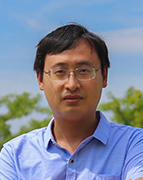 Fan Yang (杨帆)合作论文数School of Microelectronics, Fudan University;State Key Lab of Integrated Circuits and Systems, Fudan University14
 Tun Lu (卢暾)合作论文数School of Computer Science, Fudan University14
 Dongming Zhi (支东明)合作论文数China National Petroleum Corporation;Huairou Laboratory12
 Thidapat Chantem合作论文数University of Notre Dame12
 Yingying Zhao合作论文数Key Laboratory for Mechanical Behavior of Materials School of Materials Science and Engineering, Xi an Jiaotong University11
 Ning Gu (顾宁)合作论文数School of Computer Science, Fudan University11
 Lei Yang合作论文数Google Inc.10
 Arindam Mallik合作论文数Northwestern University;Electrical Engineering and Computer Sc. Department10
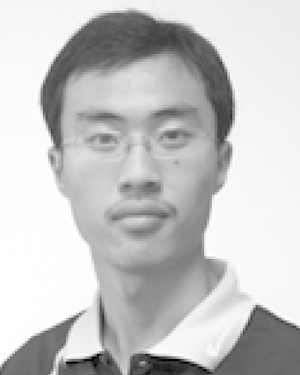 Xi Chen合作论文数9
 David R. Bild合作论文数University of Michigan9
 Hidenori Tanaka (田中秀宣)合作论文数Center for Brain Science, Harvard University;NTT Physics & Informatics Laboratories9
 Sharon Hu合作论文数Department of Computer Science and Engineering, College of Engineering, University of Notre Dame9
 George J. Brewer合作论文数Department of Human Genetics, Medical School, University of Michigan;Department of Internal Medicine, Medical School, University of Michigan8
 Yun Xiang合作论文数University of Michigan8
 Gokhan Memik合作论文数Department of Electrical and Computer Engineering, Mccormick School of Engineering, Northwestern University8
 Lan Bai合作论文数8
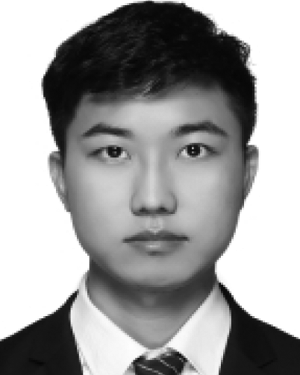 Yue Ma合作论文数7
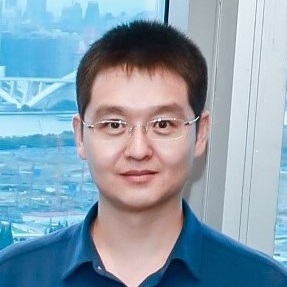 Dongsheng Li (李东胜)合作论文数Microsoft Research Asia;School of Computer Science, Fudan University7
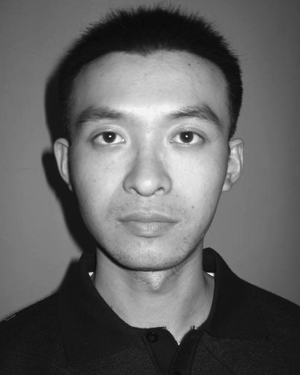 Changyun Zhu合作论文数Queen's University7
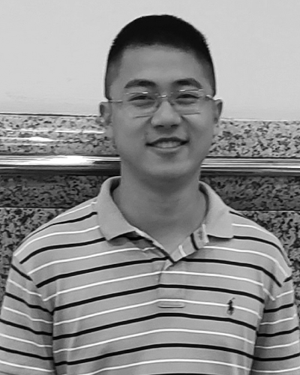 Tony Zhang合作论文数6
 Yuhu Chang合作论文数School of Computer Science, Fudan University, Shanghai, China, Shanghai Key Laboratory of Data Science, Fudan University, Shanghai, China6
 Z. Morley Mao (茅斫青)合作论文数Department of Electrical Engineering and Computer Science, College of Engineering, University of Michigan;Michigan Institute for Data Science, University of Michigan6
 Hai Zhou合作论文数Department of Electrical and Computer Engineering, McCormick School of Engineering, Northwestern University6
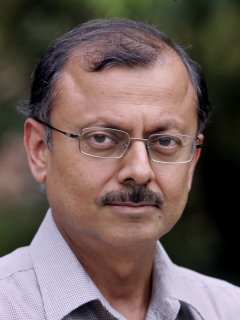 Niraj K. Jha合作论文数Department of Electrical and Computer Engineering, School of Engineering and Applied Science, Princeton University6Peter Gu合作论文数Northwestern University, Evanston, IL6Yonghong Yang合作论文数5Hou Guoqing合作论文数Department of Pediatrics.5
 Haris Lekatsas合作论文数5
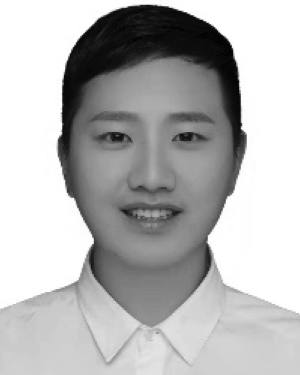 Kun Li合作论文数5
 Michael Hannigan合作论文数College of Engineering & Applied Science, University of Colorado5Ricardo Piedrahita合作论文数5Yubin Shi (施渝斌)合作论文数4
 Xiaochen Yang合作论文数Department of Statistical Science, University College London, London WC1E 6BT, U.K.4
 Rui Zhu合作论文数4
 Huazhong Yang (杨华中)合作论文数Department of Electronic Engineering, Tsinghua University4
 Dan Wallach合作论文数Department of Computer Science, Rice University;Defense Advanced Research Projects Agency4
 Yue Liu合作论文数University of Michigan4
 Alok Choudhary合作论文数McCormick School of Engineering and Applied Science, Northwestern University;Center for Ultra-Scale Computing and Information Security, Northwestern University4
 Alex Shye合作论文数Pace4
 Yongpan Liu (刘勇攀)合作论文数Department of Electronic Engineering, Tsinghua University4Sausan Yazji合作论文数4
 Stephen P. Tarzia合作论文数Northwestern University4
 Russ Joseph合作论文数Department of Electrical and Computer Engineering, Robert R. McCormick School of Engineering and Applied Science, Northwestern University;Department of Computer Science, Robert R. McCormick School of Engineering and Applied Science, Northwestern University4




