Fire disturbance is one of the key processes affecting forest succession in boreal forest ecosystems.Variations in disturbance characteristics have an important effect on ecosystem properties and processes.Due to the diversity of topography,fuel heterogeneity and micro-climatic conditions during a fire,the intensity of fires is quite variable,producing landscapes in different mosaic patterns.Although the resulting heterogeneity of fire characteristics(e.g.,burn severity) has been widely recognized as an important driver of boreal forest regeneration,its effects on early post-fire tree recruitment has not been thoroughly studied in boreal forests of the Great Xing′an Mountains.Early post-fire tree recruitment can reflect future forest structures and succession pathways.A clear understanding of the controls and mechanisms of post-fire tree recruitment is therefore necessary for us to predict future forest dynamics,devise reasonable forest management practices,and properly maintain natural landscape structures. In addition to fire characteristics,environmental conditions and pre-fire vegetation can also have important effects on post-fire tree recruitment.Environmental conditions such as elevation,slope,aspect,soil can affect post-fire seed germination.Pre-fire vegetation can affect seed banks and the distribution of post-fire seed sources.Post-fire tree recruitment in boreal forest ecosystems,as a whole,is influenced by multiple factors,including elevation,slope,aspect,soil depth,pre-fire forest type,pre-fire stand age,burn severity,and burned patch size.The objective of this study is to discover which factors are the most important controls on post-fire conifer and broadleaf tree recruitment and to predict what succession pathways will take place. We selected Huzhong and Xinlin Forestry Bureaus as study area to carry out field survey.The forest type of the study area is typical in Great Xing′an Mountains with major tree species being white birch(Betula platyghylla) and Dahuirian larch(Larix gmelini).Post-fire forest succession in this study area can be divided into two pathways,which are self-replacement(i.e.,the composition of immediately re-established post-fire tree species is the same as pre-fire canopy dominated ones,and continues as canopy dominant) and relay succession(i.e.,different tree species successively assume post-fire canopy dominance,which is firstly dominated with early-successional tree species and gradually by late successional ones).This study analyzed relative influences of various controls(environmental conditions,pre-fire vegetation,and fire disturbance characteristics) on post-fire tree recruitment and their marginal effects using a boosted regression tree method and data collected from 55 recently burned sites.Our results showed that 1) elevation was the most important factor for conifer tree recruitment;2) slope was the most important factor for broadleaf tree recruitment;3) time-since-last-fire was the most important control of the post-fire conifer seedling proportion,and forest type was the second;4) Post-fire conifer seedling proportion was higher in plots with conifer forest as pre-fire forest type than that with mixed or broadleaf forest;5) conifer tree regeneration after intermediate-severity fires was better than that after low-and high-severity fires.Our study suggested that self-replacement often occurred in the sites with single-species forest as the pre-fire forest type;while relay succession often occurred in the sites with mixed forest.
An investigation was made on the coarse woody debris (CWD) in burned forestlands in Huzhong area of Great Xing' an Mountains. The loading capacity of CWD in the burned forestlands was 24.9-181.0 m3 x hm(-2), among which, snag and log occupied 24.3%-85.9% and 14.0%-75.7%, being 6.0-93.9 m3 x hm(-2) and 15.3-138.4 m3 x hm(-2), respectively. Significant differences were observed among burned forestlands and among years. The predominant DBH class of snag and log was 2.5-20 cm and 1.5-15 m, and the height of most snags and logs was 2.5-15 m and 5-20 cm, respectively. The loading capacity of CWD had no obvious change with the recovery of forest vegetation. The characteristics of CWD had a close relationship with pre-fire forest stand conditions and burn intensity.
Ground surface dead fuel moisture content in forests is closely related to forest fires.To understand this moisture content and its relationship with environmental factors is of great significance in wildfire management.In this paper,the ground surface dead fuel moisture content in different forest types in Huzhong area of Great Xing'an Mountains was investigated,according to the classification standard of 1,10,and 100 h.The results showed that Betala platyphlla-Populus davidiana forest and Chosenia arbutifolia forest had higher dead fuel moisture contents than the other forest types,but no distinct difference was observed in the other forest types.Among different Larix gmelinii forest types,Vaccinium vitis-idaea-Larix gmelinii forest had a higher dead fuel moisture content than the rest Larix gmelinii forest types,but there was no obvious difference as well.The detrended canonical correspondence analysis(DCCA)on the environmental gradient of ground surface dead fuel moisture content indicated that the first axis reflected the spatial gradients of altitude and topographic position,i.e.,temperature condition,while the second axis reflected the gradients of aspect and stand density,i.e.,humidity condition.Generally,the main factors affecting the spatial pattern of ground surface dead fuel moisture content in forests were altitude and topographic position.The two-dimensional plots of axis 1 and axis 2 could clearly express the spatial gradient of ground surface dead fuel moisture content in Huzhong forest area of Great Xing'an Mountains.
Aims Coarse woody debris (CWD) plays an important role in maintaining biodiversity, providing critical habitat for organisms and cycling of carbon and nitrogen in forest systems. Our objective was to understand the effects of anthropogenic disturbance on CWD in Da Hinggan Mountains as the key to forest health and sustainable forest management. Methods We compared CWD storage using a line-intercept method in Huzhong Forest Bureau, which represented forest affected by anthropogenic disturbance, with Huzhong Natural Reserve, which represented primary forest unaffected by anthropogenic disturbance, of Da Hinggan Mountains. Important findings Storage of CWD varied between 5.92–43.53 m·hm in Huzhong Natural Reserve and 12.70–47.59 m·hm in Huzhong Forest Bureau. Anthropogenic disturbance had greater effects on mixed and coniferous forest than broadleaf forest. More CWD occurred in mixed forest and less CWD in coniferous forest, and the proportion of the advanced decay class CWD increased and snags decreased with anthropogenic disturbance. The storage of CWD in managed forest (8.20–25.60 m·hm) is less than that in virgin forest (18.70–36.99 m·hm). Residue from harvesting should be maintained to retain the natural forest characteristics of CWD.
The coarse woody debris (CWD) loading capacity of main forest types and of different larch forest communities in Huzhong area of Great Xing'an Mountains was investigated, with its environmental gradient analyzed by Detrended Canonical Correspondence Analysis (DCCA). The CWD loading capacity varied significantly with forest type, being the highest (0.20 m3 x hm(-2)) in spruce forest (Picea koraiensis). Different larch forest (Larix gmelinii) communities had a CWD loading capacity from 0 to 0.28 m3 x hm(-2), with the highest in Pinus pumila-Larix gmelinii (0.28 m3 x hm(-2)) and the lowest in Sphagnum magellanicum-Ledum palustre-Larix gmelinii (0), but the differences were not significant. The CWD loading capacity across the study area was complicated, which might result from the complex interplay of affecting factors. The main factors affecting the spatial pattern of the CWD loading capacity were topographic factors (elevation and slope position) and stand structure (age, canopy cover, and others), and the interaction between topographic factors and stand structure expressed the spatial gradient of CWD loading capacity in Huzhong area of Great Xing' an Mountains.
By using geo-statistics and based on time-lag classification standard, a comparative study was made on the land surface dead combustible fuels in Huzhong forest area in Great Xing'an Mountains. The results indicated that the first level land surface dead combustible fuel, i. e., 1 h time-lag dead fuel, presented stronger spatial auto-correlation, with an average of 762.35 g x m(-2) and contributing to 55.54% of the total load. Its determining factors were species composition and stand age. The second and third levels land surface dead combustible fuel, i. e., 10 h and 100 h time-lag dead fuels, had a sum of 610.26 g x m(-2), and presented weaker spatial auto-correlation than 1 h time-lag dead fuel. Their determining factor was the disturbance history of forest stand. The complexity and heterogeneity of the factors determining the quality and quantity of forest land surface dead combustible fuels were the main reasons for the relatively inaccurate interpolation. However, the utilization of field survey data coupled with geo-statistics could easily and accurately interpolate the spatial pattern of forest land surface dead combustible fuel loads, and indirectly provide a practical basis for forest management.
 ZhiHua Liu (刘志华)合作论文数Key Laboratory of Terrestrial Ecosystem Carbon Neutrality, Liaoning Province, Institute of Applied Ecology, Chinese Academy of Sciences6
 HongXin Zhang (张红新)合作论文数5
 Yu Chang (常禹)合作论文数中国科学院沈阳应用生态研究所5Chang-Meng Zhang (张长蒙)合作论文数4Hongwei Chen (陈宏伟)合作论文数华侨大学材料科学与工程学院4
 Wenjuan Wang (王文娟)合作论文数中国科学院东北地理与农业生态研究所3Jinhai Wang (王金海)合作论文数2
 Yuanman Hu (胡远满)合作论文数Institute of Applied Ecology, Chinese Academy of Sciences2Shengji Liu (柳生吉)合作论文数1Wenhua Cai合作论文数1周睿合作论文数中科院物理所1Zengfu Zhao (赵增福)合作论文数1
 Yuehui Li (李月辉)合作论文数Institute of Applied Ecology, Chinese Academy of Sciences;University of Chinese Academy of Sciences1
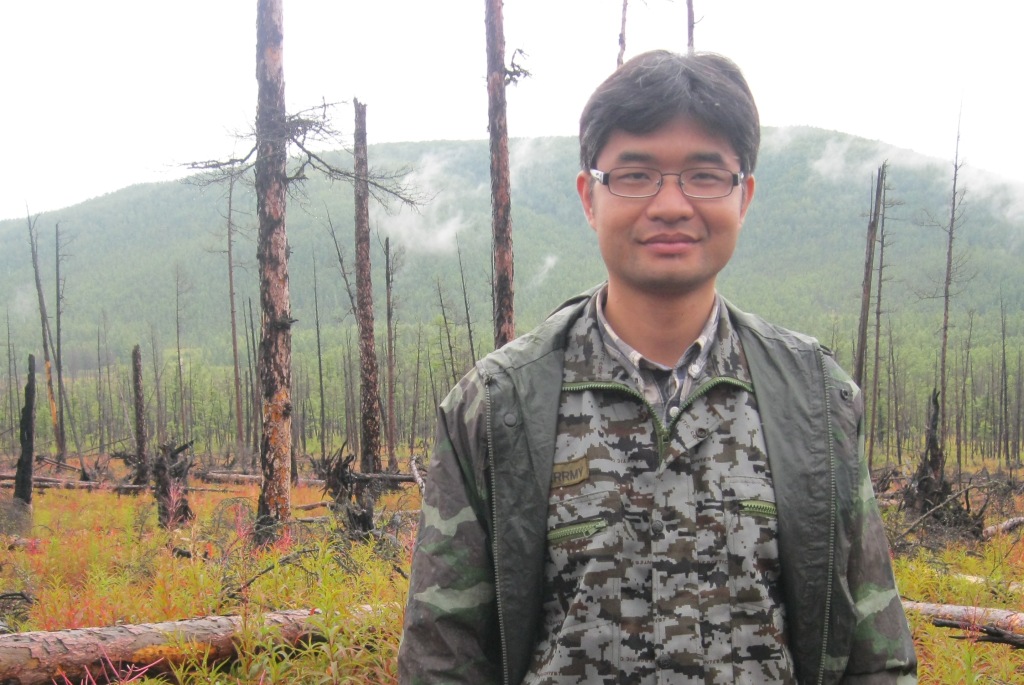 Jian Yang (杨健)合作论文数Institute of Applied Ecology,Chinese Academy of Sciences1




