We report the development and validation of a new neutron detector, the spherical moderator counter (SMC), which represents the next generation of long counter technology. Unlike conventional cylindrical designs, the SMC employs a spherical moderator geometry, optimized by Monte Carlo transport simulations to achieve a near isotropic angular response and a broad, flat energy sensitivity. The prototype detector has been extensively tested with a wide range of neutron energies, i.e., neutrons coming from d-D and d-T accelerators, Cf-252 spontaneous fission, Am-Be (alpha and n) reactions, fission reactors, and spallation sources, covering the entire energy range from thermal to several tens of MeV. The experimental results demonstrate that SMC achieves a uniform response over 4 pi steradians, with an angular deviation of less than 6% for fast neutrons, and maintains adequate sensitivity from 0.01 eV to 20 MeV. These findings confirm that SMC not only addresses the inherent limitations of traditional cylindrical long counters but also establishes a versatile and reliable platform for neutron metrology, with significant potential for applications in next-generation fusion and advanced nuclear technologies.
In clinical diagnosis, conventional X-ray absorption-contrast computed tomography (XACT) technology cannot effectively differentiate diseased tissues from the healthy ones. X-ray phase-contrast CT (XPCT) and dual-energy CT (DECT), emerging X-ray imaging technologies with superior diagnostic capabilities, address this issue through different principles. While both XPCT and DECT have advantages and disadvantages in medical applications, their systematic comparison is lacking. Using GEANT4 and MATLAB, in this study, we established an X-ray phase-contrast imaging (XPCI) model based on single-mask and single-shot edge illumination for fast XPCT imaging, comparing it with DECT on soft-tissue phantom. XACT served as a reference for comparison. The study introduces an evaluation system using statistical measures including absolute error, mean absolute error, structure similarity index measure, peak signal-to-noise ratio, and contrast-to-noise ratio. Results show XPCT images are superior to DECT. The XPCI model can be improved on existing medical CT for widespread medical application.
This paper presents the development and validation of China's first benchmark measurement system for neutron leakage time-of-flight (TOF) spectra using a Cf-252 spontaneous fission source and spherical polyethylene sample. EJ-309 and CLYC scintillation detectors were used for neutron detection, and a shadow cone was employed for background suppression. Notably, the SiC detector was, for the first time on this platform, applied as the start-time signal generator in TOF spectrum measurement. The TOF spectrum covering the energy range of 0.15-8.00 MeV was measured, and the results were systematically compared with evaluated data from four major nuclear libraries: ENDF/B-VIII.1, JEFF-3.3, JENDL-5, and CENDL-3.2. The comparison revealed strong agreement across the full spectrum, with calculated to experimental (C/E) deviations remaining within 5% in the high-energy region and within 13% at low energies. These results verify the system's stability and suitability for integral experiments. The established benchmark platform provides a strong technical foundation for future neutron nuclear data validation, particularly in shielding applications and the improvement of fission-spectrum nuclear databases.
Abstract The data on fission by neutrons is widely applied in reactor burnup, neutron fuel verification, and the identification of nuclear fuels. Due to the abundance of 238U, which is the most common isotope of uranium, cumulative data of 238U fission yield in the D-D neutron energy range is significant in fission research in Generation-IV (Gen-IV) reactors. In this article, measurements of the fission yield of the 238U(n,f) reaction at a neutron energy of 2.9 ± 0.3 MeV have been carried out by the activation technique based on off-line γ-ray spectrometry. The neutron irradiation experiment was conducted in the CPNG-600 neutron generator installed in the China Institute of Atomic Energy (CIAE). A quasi-monoenergetic beam of neutrons was made using the D(d,n)3He reaction. The γ-rays of the activation products were characteristically measured with the help of a low-background HPGe spectrometry system, and fluctuations of neutron flux were measured with the aid of an Au-Si surface barrier detector. Once the correction factor needed was applied, highly accurate cumulative yields of seven fission products were derived. The obtained measurements were related to the existing experimental values and data on estimating yield provided by the ENDF/B-VIII.0 library. Fission yields of a 238U(n,f) reaction were also determined with the help of the TALYS-1.96 code. The current outcomes have dependable information to confirm the behavior of energy-dependent fission yield and a supplementary nuclear reaction database as applied in reactor design and operation.
Edge illumination (EI), as an X-ray phase contrast imaging (XPCI) technique, is one of the most promising technologies for large-scale application of XPCI due to its tolerance for equipment. Conventional EI methods such as double-mask EI, single-mask (SM) based on small detection pixels, and single-mask based on high system magnification obtain these absorption, phase and Dark-field (DF) by fitting illumination curves (ICs) without and with objects. However, two masks are not practical for actual operation, too small pixels and too large magnification limits the size of object, therefore, these settings reduce the practicality and applicability of EI in large-size multi-contrast imaging scenarios. Conventional SM EI setup is expected to solve this problem, but it is unable to extract DF signal. This study introduces an innovative imaging technology for SM IC analysis that significantly relaxes traditional limitations imposed by system complexity, pixel size, and magnification requirements while enabling large-size imaging capabilities. Through comparative analysis of object and flat-field SM ICs, the method achieves simultaneous quantitative extraction and imaging of absorption, phase, and DF signals. A comprehensive evaluation framework incorporating mutual information (MI), fast Fourier transform spectral similarity (S-FFT), and the Natural Image Quality Evaluator (NIQE) was implemented to assess the three distinct contrast images, conclusively demonstrating, the method's efficacy. Moreover, the detection unit in our SM EI setup is a single pixel rather than two pixels, which improves the imaging resolution. In addition, in this method, only three exposures of the object are required to complete the information extraction, thereby reducing the acquisition time.
The cross-sections of K-39(n, p)Ar-39 at an energy of 2-3 MeV play an important role in nuclear structure research and Ar-40/Ar-39 geochronology application. Due to the limitations of n-He-3 coincidence technology and counting instruments, the data in literature are from before 1967, and existing data are scarce and significantly diverge. Meanwhile, there are large discrepancies between the measured and evaluation results. By taking advantage of the high sensitivity and resolution of the noble gas mass spectrometer at the Institute of Geology and Geophysics, Chinese Academy of Sciences (IGGCAS), the cross-sections of K-39(n, p)Ar-39 were measured by combining neutron activity analysis and noble gas mass spectrometry, and the uncertainties are discussed in detail. The cross-sections of K-39(n, p)Ar-39 were measured as 103.84 +/- 16.33, 109.76 +/- 15.88, and 150.27 +/- 24.19 mb at 2.56 +/- 0.08, 2.69 +/- 0.08, and 2.96 +/- 0.12 MeV energies, respectively. The measured data filled the data gaps and provided more accurate data support for Ar-40/Ar-39 dating. Furthermore, the theoretical excitation function of K-39(n, p)Ar-39 was calculated using TALYS-1.97 computer codes. Then, the experimentally determined cross-sections were analyzed by comparing them with the data from the EXFOR database and evaluated nuclear data in ENDF/B-VIII.0, JEFF-3.2, TENDL-2021, BROND-3.1, and JENDL-5 databases. According to the comparative results, the measured cross-sections of K-39(n, p)Ar-39 exhibit a rapid energy-dependent increase between 2-3 MeV, aligning with higher literature values and resolving previous discrepancies. Compared with the previously reported data, the precision of the determined cross-sections in this study showed considerable improvement. The comparison of measured data indicates that the combined detection method of neutron activity analysis and noble gas mass spectrometry techniques is suitable for measuring the cross-sections of nuclear reactions with long-lived product nuclei and the application of Ar-40/Ar-39 geochronology with a D-D neutron source.
Internal cracks significantly influence the performance and reliability of polymer-bonded explosive (PBX). Recently, crack segmentation methods based on deep learning have achieved remarkable success. However, accurately segmenting internal cracks in PBX remains challenging due to low contrast between cracks and the background, complex morphology, and scarce real data. To enhance the segmentation and quantification capabilities of PBX cracks, we optimised the concatenation connections in the U-Net and introduced a feature fusion block, leading to the development of the CSNet_PBX network. To address the issue of limited PBX crack datasets, we propose a synthetic data augmentation method that combines skeleton generation and image fusion techniques to synthesise realistic PBX crack images, thereby expanding the dataset. Experimental results show that the proposed data augmentation method effectively expands the PBX crack dataset, thereby improving the crack segmentation performance of CSNet_PBX. The Crack Intersection over Union (IoU) reaches 0.741, and the Relative Crack Area (RCA) reaches 0.956, showing improvements of 27.78 % and 15.84 % in Crack IoU and RCA, respectively, compared to training with a dataset without data augmentation. Furthermore, CSNet_PBX has fewer parameters and outperforms current representative networks, generating more realistic results.
To achieve high-accuracy in-situ calibration of the neutron flux monitor on the Experimental Advanced Superconducting Tokamak (EAST), a systematic comparison of continuous and multi-point calibration approaches is conducted using a full three-dimensional (3D) engineering model. 3D neutron transport simulations for 2.45 MeV neutrons in the complex structural environment of EAST are carried out using MCNP and PHITS. Calibration calculations are conducted for three different source configurations: a toroidal ring line source, 32 coplanar point sources, and a D-shaped volume source representing realistic plasma conditions. Neutron flux responses and energy spectrum at the spherical long counter (SLC) location are quantitatively analyzed. The results show that the differences in neutron flux between the ring source and point source calibration approaches remain within 2.2%. An operational calibration strategy for an upcoming in-situ experiment on EAST using a 1 × 10⁹ n/s D-D accelerator neutron source is proposed. This work establishes quantitative criteria for relating volumetric and point-source models and provides a transferable framework for neutron calibration in EAST.
X-ray multimodal imaging, which extracts absorption, refraction, and scattering signals simultaneously, holds significant potential in biomedical and materials science applications. However, laboratory-based X-ray multimodal imaging remains underdeveloped, with existing techniques constrained by system magnification and detector pixel size. This study employs a single-mask edge illumination (SM EI) configuration and establishes the corresponding single-mask illumination curve (SM IC). Using Geant4 simulations, we validate the feasibility of retrieving all three signals under conventional magnification and large-pixel detectors. Results show accurate extraction of both refraction and scattering signals, with model fitting close to unity. We further explore the impact of key system parameters, including focal spot size, tube voltage, mask thickness, duty cycle, pixel count, and detector operation mode on imaging performance. The simulations reveal that small focal spots and low-energy X-rays enhance contrast, thick masks maintain signal quality at high energy, and low duty cycles and high photon counts improve the contrast-to-noise ratio (CNR). Additionally, the charge summing mode increases refraction CNR by approximately three times compared to standard modes. These findings demonstrate the effectiveness of the SM EI method, enhancing spatial resolution and providing optimization insights for designing laboratory-based X-ray multimodal imaging systems.
A high-performance neutron and gamma-ray collimator was developed to address the challenges of high-precision multi-particle diagnostics, such as deuterium-deuterium (D-D) neutron, deuterium-tritium (D-T) neutron, and gamma-ray, in the extreme radiation environment of fusion devices. The design integrates geometric shielding, material attenuation, and energy-selection optimization. Full-scale three-dimensional Monte Carlo radiation transport simulations were conducted to evaluate the collimator performance in a complex structural environment on the EAST device. After collimation, the peak contributions of 2.5 MeV and 14 MeV neutrons reach 57.47 % and 21.31 % of the total energy spectrum, respectively, demonstrating effective energy discrimination. Predicted neutron spectra under d-T operation in EAST show that the collimator significantly suppresses environmental scattering and enhances directional sensitivity. The results indicate strong potential for dual-mode neutron-gamma-ray diagnostics in future d-T fusion reactors and high applicability to ongoing d-D experiments such as EAST. The collimator has been fabricated and installed on EAST and will be deployed in the upcoming d-T experimental campaigns.
To provide complementary benchmark data for validating evaluated neutron nuclear data with time-of-flight techniques, a neutron leakage experiment for spherical natural-iron samples was conducted on a 252Cf spontaneous-fission-source-based integral experiment platform established at Lanzhou University. Neutron leakage spectra from spherical natural-iron samples with diameters of 12, 24, and 36 cm were measured over the energy range of 0.15–8.00 MeV. The 0.15–0.80 MeV region was measured using a CLYC detector, while the 0.80–8.00 MeV region was measured using an EJ-309 liquid scintillation detector.Monte Carlo simulations were performed using the MCNP code with four evaluated nuclear data libraries: ENDF/B-VIII.1, CENDL-3.2, JEFF-3.3, and JENDL-5. The calculated leakage spectra were compared with the experimental results. The calculated-to-experimental (C/E) ratios indicate that JENDL-5 and ENDF/B-VIII.1 show comparatively good agreement with the measurements, whereas CENDL-3.2 and JEFF-3.3 exhibit larger deviations, particularly in the 0.80–8.00 MeV region.The NDPlot-based diagnostic analysis of 252Cf-spectrum-weighted secondary-neutron emission spectra suggests that these deviations may be related to differences in the treatment and representation of elastic and discrete-level inelastic scattering processes in the evaluated nuclear data libraries and the numerical reconstruction procedure. However, since the measured leakage spectra represent integral responses involving multiple scattering and coupled reaction channels, further sensitivity and uncertainty analyses are required to identify the dominant contributors quantitatively.This work provides complementary modern TOF-based benchmark data for natural-iron shielding calculations using a 252Cf-driven integral experiment platform. The measured leakage spectra provide additional experimental information for validating recently updated evaluated nuclear data libraries and may support future sensitivity, uncertainty quantification, and nuclear-data improvement for shielding applications in advanced nuclear energy systems.
BackgroundSparse-view CT shortens scan time and reduces radiation dose but results in severe streak artifacts due to insufficient sampling data. Deep learning methods can now suppress these artifacts and improve image quality in sparse-view CT reconstruction.PurposeThe quality of sparse-view CT reconstructed images can still be improved. Additionally, the interpretability of deep learning-based optimization methods for these reconstruction images is lacking, and the role of different network layers in artifact removal requires further study. Moreover, the optimization capability of these methods for reconstruction images from various sparse views needs enhancement. This study aims to improve the network's optimization ability for sparse-view reconstructed images, enhance interpretability, and boost generalization by establishing multiple network structures and datasets.MethodsIn this paper, we developed a sparse-view CT reconstruction images improvement network (SRII-Net) based on U-Net. We added a copy pathway in the network and designed a residual image output block to boost the network's performance. Multiple networks with different connectivity structures were established using SRII-Net to analyze the contribution of each layer to artifact removal, improving the network's interpretability. Additionally, we created multiple datasets with reconstructed images of various sampling views to train and test the proposed network, investigating how these datasets from different sampling views affect the network's generalization ability.ResultsThe results show that the proposed method outperforms current networks, with significant improvements in metrics like PSNR and SSIM. Image optimization time is at the millisecond level. By comparing the performance of different network structures, we've identified the impact of various hierarchical structures. The image detail information learned by shallow layers and the high-level abstract feature information learned by deep layers play a crucial role in optimizing sparse-view CT reconstruction images. Training the network with multiple mixed datasets revealed that, under a certain amount of data, selecting the appropriate categories of sampling views and their corresponding samples can effectively enhance the network's optimization ability for reconstructing images with different sampling views.ConclusionsThe network in this paper effectively suppresses artifacts in reconstructed images with different sparse views, improving generalization. We have also created diverse network structures and datasets to deepen the understanding of artifact removal in deep learning networks, offering insights for noise reduction and image enhancement in other imaging methods.
离子束放射治疗(放疗)越来越广泛地被运用于肿瘤治疗。目前使用传统X射线计算机断层扫描(CT)来制定离子放疗治疗计划时存在相对阻止本领(RSP)具有较大误差的问题,理想的方式是直接使用高能离子束对患者成像,生成离子放疗治疗计划设计时所需的医学图像,避免RSP转换从而减小RSP的误差。本研究使用蒙特卡罗程序Geant4/Gate搭建了离子CT模拟平台,设计了理想与现实两种离子CT成像系统探测器,利用最大似然法和ASD-POCS算法实现了图像重建,研究了理想与现实两种设置、多种能量以及不同离子种类对模体内硫、磷、碳和钙四种材料插件重建RSP误差的影响。结果表明,330 MeV质子在理想与现实设置两种情况下的RSP相对误差都小于1.547%,理想设置下的RSP相对误差远小于现实设置,现实设置下各材料的RSP重建误差接近理想设置下的3倍;质子的RSP相对误差随着能量的增加而减小,在230 MeV时的RSP相对误差最大,在硫、磷、碳、钙四种材料中分别为2.855%、2.468%、1.653%、2.553%。在330 MeV时的RSP相对误差达到最小,在硫、磷、碳、钙四种材料中分别为0.181%、0.351%、0.250%、0.245%;在能量330 MeV/u下,碳离子在硫、磷、碳、钙四种材料中的RSP相对误差分别为0.060%、0.281%、0.150%、0.082%,误差均在0.281%以内,RSP相对误差小于330 MeV的质子。因此,与质子CT相比,碳离子CT应能为离子放疗治疗计划设计提供更为精确的RSP数据。
Innovation in neutron detection has supported basic science, the development of large-scale scientific facilities, and the development of clean nuclear energy. However, due to the uncharged nature of neutrons, accurately measuring neutron flux and spectrum simultaneously over a wide range of energies has always been challenging. A new type of neutron detector is designed based on PHITS-334, which utilizes a hydrogen-3He gas combination, combined with the nuclear recoil method and nuclear reaction method, to simultaneously measure neutron flux and spectrum in a broad energy region. Based on the isotope neutron sources of Am-B, Am-Be, Cf-252, and C-252 f -D2O given by ISO8529-1, the DD fusion neutron source of Experimental Advanced Superconducting Tokamak (EAST), and the theoretical fusion DT neutron source of International Thermonuclear Experimental Reactor (ITER), the energy spectrum measurement capability of the detector is evaluated. It has been demonstrated that the new detector can measure neutron flux over the entire energy range. The low limit of the conventional energy spectrum measurement is extended from 0.1 to 0.001 MeV through neutron spectrum analysis. The proposed method provides a new reference for developing neutron detectors. It should be noted that the new neutron detector can simultaneously measure neutron flux and spectrum information in a broad energy area, which will be the basis for integrating and miniaturizing neutron detection systems, such as fusion reactors.
Polymer bonded explosive (PBX) is a composite explosive mainly made up of explosive crystals and binders. The presence of cracks and impurities within PBX impacts its mechanical properties and detonation performance. The highly filled granular nature and heterogeneous characteristics of PBX's internal structure, combined with the low contrast and small proportion of defects in PBX, present significant challenges for the precise segmentation and quantification of internal defects in PBX. In this paper, we proposed PBX_SegNet for PBX defect segmentation based on convolutional neural network. The PBX_SegNet is built on the encoder–decoder architecture of U-Net. We optimize the structure of skip connection in PBX_SegNet and introduce a concurrent spatial and channel squeeze and excitation (SCSE) module on each stage in the encoder network and in the decoder network. We train and evaluate PBX_SegNet on PBX defect dataset which consists of images acquired by micro computed tomography (μCT). Using the same test dataset, the proposed method was compared and evaluated against four mainstream segmentation methods based on deep learning. The results demonstrate that PBX_SegNet realizes the simultaneous segmentation of PBX cracks and impurities, and further completes the quantitative characterization of PBX cracks and impurities by processing the segmentation results using image processing methods. PBX_SegNet achieves Dice score (DICE) of 0.9965, crack relative area (RAC) of 0.9033 and impurity relative area (RAI) of 0.9511 on the three PBX defect datasets in average, which outperforms the current four state-of-the-art methods and improves the low contrast and small proportion of defect segmentation and quantification characterization capabilities. The proposed method shows promise for segmenting subtle, low-contrast defects in images from various domains or imaging techniques.
目前厚度测量精度不高或者测量方式复杂,为设计一套操作简单、高效、无损、适用范围广的高精度厚度测量装置,本研究利用241Am放射源和碲锌镉(CZT)探测器,开发一套高精度厚度测量系统,同时提出采用测量条件补偿法实现样品无损、高精度在线测量.利用Geant4程序对厚度测量系统进行模拟设计,确定准直孔尺寸、源与探测器相对位置和屏蔽层厚度等关键参数.利用搭建的厚度测量系统测量纸张、圆台型样品、陶瓷和高速钢等样品.结果表明,该系统对厚度精度在百微米量级时,可以实现高效、实时在线厚度测量;当对测量精度要求提高时,通过延长测量时间、采用测量条件补偿法等,可实现高精度测量.对于1mm厚的物质,测量精度可达1μm;该系统长时间工作稳定,24h内相对标准偏差约为0.057%.
Neutron detection using a long counter is the most commonly used method for accurate neutron flux measurement. It is desirable to design a long counter with a flat energy response and a consistent angular response. This requires counters to have neutron-energy-independent efficiency over a wide range of energies and a very slight dependence on the direction of neutron incidence in the 4π space. In this work, we designed a spherical neutron long counter using the Monte Carlo method, with a model consisting of a polyethylene ball, built-in air rings, and boron carbide material. The internal air rings enhance the energy response of thermal neutrons, spherical polyethylene improves the energy response of fast neutrons, and boron carbide material solves the problem of high local neutron energy response. We analyzed the energy response, angular response, and detection efficiency of long counters using neutron sources such as Pu–Be and Am–Be. The results show that the neutron energy response is relatively flat in the energy region of 0.01 eV to 20 MeV, the angular response is consistent in 2π space, and the maximum relative angular response deviation in 4π space is no more than 16.5%. We focus on the applicability of long counters in complex neutron fields, such as scattered neutron fields, and provide a reference for their use of long counters in neutron detection.
A three-wave based laser polarimeter/interferometer and a CO 2 laser dispersion interferometer are used to determine the electron and current density profiles on a Chinese fusion engineering test reactor(CFETR). Radiation shielding is designed for the combination of polarimeter/interferometer and CO 2 dispersion interferometer. Furthermore, neutronics models of the two systems are developed based on the engineering-integrated design of CFETR polarimeter/interferometer and CO 2 dispersion interferometer and the major material components of CFETR.The polarimeter/interferometer and CO 2 dispersion interferometer’s neutron and photon transport simulations were performed using the Monte Carlo neutral transport code to determine the energy deposition and neutron energy spectrum of the optical mirrors. The energy depositions of the first mirrors on the polarimeter/interferometer are reduced by three orders with the whole shielding. Since the mirrors of CO 2 dispersion interferometer are very close to the diagnostic first wall, shielding space is limited and the CO 2 dispersion interferometer energy deposition is higher than that of the polarimeter/interferometer. The dose rate after shutdown106s in the back-drawer structure has been estimated to be 83 μSv h -1 when the radiation shield is filled in the diagnostic shielding modules, which is below the design threshold of 100 μSv h -1 .Radiation shielding design plays a key role in successfully applying polarimeter/interferometer and CO 2 dispersive interferometer in CFETR.
The half-life of 95m Tc and the cross-sections of the 96 Ru ( n, x ) 95m Tc reaction induced by D–T neutrons were measured through the neutron activation technique in combination with off-line γ-ray spectrometry. The neutron beam was generated from the T ( d, n ) 4 He reaction using the K-400 neutron generator at the Chinese Academy of Engineering Physics (CAEP). Through exponential function fitting and a detailed discussion of the uncertainty evaluation, the measured half-life of 95m Tc was 61.88 ± 0.22 days, which uncertainty is reduced greatly compared with the currently recommended value. Based on the determination of the 95m Tc half-life, the cross-sections of 96 Ru ( n, x ) 95m Tc reaction at the 13.85 ± 0.2, 14.30 ± 0.2 and 14.72 ± 0.2 MeV neutron energies were measured relative to the 93 Nb ( n, 2n ) 92m Nb monitor reaction. Considering the correlations between different attributes, detailed uncertainty propagation was performed by the covariance analysis and the cross-sections were reported with their uncertainties and correlation matrix. Then, experimentally determined cross-sections were analyzed by comparing with the literature data available in the EXFOR database and theoretically calculated values using the TALYS-1.95 and EMPIRE-3.2.3 codes. The accuracy of current experimental results with the thorough uncertainties and covariance information is greatly improved, which is critical for verifying the reliability of the theoretical model and improving the quality of the nuclear database.
 Gongping Li (李公平)合作论文数School of Nuclear Science and Technology, Lanzhou University47
 HongJie Shang (商宏杰)合作论文数15
 Changlin Lan (兰长林)合作论文数School of Nuclear Science and Technology, Lanzhou University14
 Cui Zhang合作论文数Department of Chemistry, University of California, Davis13Gong Jiang合作论文数6
 Haiqing Liu (刘海庆)合作论文数Division of Plasma Diagnostics, Chinese Academy of Sciences6Yangbo Nie (聂阳波)合作论文数5Qiaolu Lin合作论文数5Yihai ZHANG (张益海)合作论文数5Kuozhi Xu (徐阔之)合作论文数4Bo Hong合作论文数4Xubo WEI (魏绪波)合作论文数4Deng-fu FANG (方登富)合作论文数4Yan-hong LUO (骆岩红)合作论文数4Jingjie Ding (丁晶洁)合作论文数兰州大学核科学与技术学院4Ruijie Zhou合作论文数4LIU Shi-long合作论文数3Wang Yun-Bo合作论文数3
 Sihan Ma合作论文数3Zhanggu CHEN (陈章谷)合作论文数3Yongfan PU (蒲永凡)合作论文数3Dong WANG (王东)合作论文数3
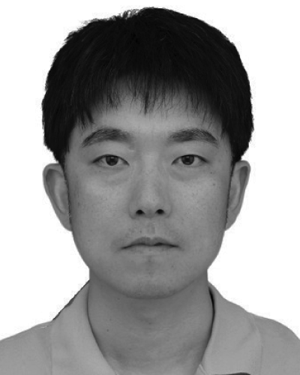
 Xichao Ruan (阮锡超)合作论文数中国原子能科学研究院3
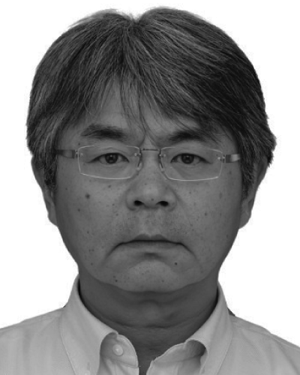
 Kunihiro Ogawa合作论文数3Nannan Xu (许楠楠)合作论文数3Jianhui Wu (伍建辉)合作论文数3
 Mitsutaka Isobe (磯部光孝)合作论文数National Institute for Fusion Science3
 Shixu Zhang (张世旭)合作论文数School of Nuclear Science and Technology, Lanzhou University3Lv Liang-Liang合作论文数2Yuting Wei合作论文数2Yujie Ge合作论文数2zhigang gai合作论文数2SUN Shuyi (孙淑义)合作论文数2Jiahao Wang合作论文数2HONG Bo (洪博)合作论文数2Xianlin Yang合作论文数2Yanyan Ding合作论文数2Qi Wu (武启)合作论文数2Wei Wang (王玮)合作论文数2
 Deyang Yu (于得洋)合作论文数University of Chinese Academy of Sciences;Institute of Modern Physics, Chinese Academy of Sciences2
 Xuejian Wang合作论文数Nantong University, Nantong University2
 Caojie Shao (邵曹杰)合作论文数Institute of Modern Physics, Chinese Academy of Science;University of Chinese Academy of Sciences2Ni Zhao (赵妮)合作论文数2Xuemin Liu (柳学敏)合作论文数2
 Jingsheng Chen合作论文数Department of Materials Science and Engineering, College of Design and Engineering, National University of Singapore2
 Yunbo Wang (王耘波)合作论文数School of Optical and Electronic Information, Huazhong University of Science and Technology;School of Microelectronics, Huazhong University of Science and Technology2Zhenxing Tang (汤振兴)合作论文数2Liangman Bao合作论文数2
 Yu Zhang (张宇)合作论文数School of Nuclear Science and Technology, Lanzhou University2




