Traumatic brain injury (TBI) is a significant contributor to global mortality and morbidity, with emerging evidence indicating a heightened risk of developing Alzheimer’s disease (AD) following TBI. This study aimed to explore the molecular intersections between TBI and AD, focusing on the role of adipose mesenchymal stem cell (ADMSC)-derived exosomes and hub genes involved in microglial polarization. Transcriptome profiles from TBI (GSE58485) and AD (GSE74614) datasets were analyzed to identify differentially expressed genes (DEGs). The hub genes were validated in independent datasets (GSE180811 for TBI and GSE135999 for AD) and localized to specific cell types using single-cell RNA (scRNA) sequencing data (GSE160763 for TBI and GSE224398 for AD). Experimental validation was conducted to investigate the role of these genes in microglial polarization using cell culture and ADMSC-derived exosomes interventions. Our results identified three hub genes—Bst2, B2m, and Lgals3bp—that were upregulated in both TBI and AD, with strong associations to inflammation, neuronal apoptosis, and tissue repair processes. scRNA sequencing revealed that these genes are predominantly expressed in microglia, with increased expression during M1 polarization. Knockdown of these genes reduced M1 polarization and promoted M2 phenotype in microglia. Additionally, ADMSC-derived exosomes attenuated M1 polarization and downregulated the expression of hub genes. This study provides novel insights into the shared molecular pathways between TBI and AD, highlighting potential therapeutic targets for mitigating neuroinflammation and promoting recovery in both conditions.
The Grushin spaces, as one of the most important models in the Carnot-Carathéodory space, are a class of locally compact and geodesic metric spaces which admit a dilation. Function spaces on Grushin spaces and some related geometric problems are always the research hotspots in this field. Firstly, we investigate two classes of Besov type spaces based on the Grushin semigroup and the fractional Grushin semigroup, respectively, and prove some important properties of these two Besov type spaces. Moreover, we also reveal the relationship between them. Secondly, we establish the isoperimetric inequality for the fractional perimeter, which is defined by the Grushin-Laplace operator on Grushin spaces. Finally, we combine the semigroup theory with a nonlocal calculus for the Grushin-Laplace operator to obtain the Sobolev type inequality. As an application, we also obtain the embedding theorem for Besov type spaces.
Let L=-1/ωdiv(A(x)·∇ )+V be a degenerate Schrödinger operator in ℝ^n , where ω is a weight of the Muckenhoupt class A_2 , A(x) is a real and symmetric matrix depending on x and satisfies C^-1ω (x)|ξ |^2≤ A(x)ξ _iξ _j≤ Cω (x)|ξ |^2 for some positive constant C and all x, ξ in ℝ^n , and V is a nonnegative potential belonging to a certain reverse Hölder class with respect to the measure ω (x)dx . By the subordinative formula, various regularity estimates about the fractional heat semigroup {e^-tL^α}_t>0 are investigated, where L^α denotes the fractional powers of L for α∈ (0,1) . As an application, we obtain the boundedness on the weighted Morrey spaces and BMO type spaces for some operator related to L^α .
In this paper, we use the s-harmonic functions which are the solutions to the following equations{div(t1−s∇u)=0,(x,t)∈R+n+1;u(x,0)=f(x),x∈Rn to characterize a new class of Q-type spaces QK,λp(Rn) which are related to weight functions K. By the aid of the fractional Poisson kernel pts(⋅), s∈(0,2), we establish a Carleson type extension of QK,λp(Rn) to the space HKp,λ(R+n+1). As applications, the extension results can be applied to the Q type spaces related with logarithmic functions. Moreover, the boundedness of convolution singular integrals on QK,λp(Rn) and the s-harmonic extensions of Campanato-Sobolev classes are also considered, respectively.
Let T be a bounded operator on L-p( R-n). Under the assumption that the kernel of T satisfies some Hormander-type estimates, we obtain a boundedness criterion for the multilinear commutators T-(b) over right arrow on the weighted Lebesgue spaces L-p(omega) with (b) over right arrow is an element of BMO(R-n) and omega belonging to the Muckenhoupt weight class A(p/ m'). Further, for (b) over right arrow is an element of CMO(R-n), the vanishing mean oscillation space, a criterion of L-p-weighted compactness of T-(b) over right arrow is established. As applications, the weighted L-p-boundedness and L-p-compactness criteria can be applied to the theta-type Calderon-Zygmund operator and its commutators.
In this paper, in the setting of Heisenberg groups , we introduce two classes of ‐type spaces related with weight functions denoted by . We investigate several basic properties of , including the average oscillation property, the John–Nirenberg‐type inequality and the relations with classical function spaces. By the family of convolution operators , we extend , to the function spaces on the Siegel upper half space . The wavelet characterizations of are also obtained.
Let $${\mathcal {L}}=-\Delta _{{\mathbb {H}}^{n}}+V$$ be the Schrödinger operator on the Heisenberg group $${\mathbb {H}}^{n}$$ , where $$\Delta _{{\mathbb {H}}^{n}}$$ is the sub-Laplacian and the nonnegative potential V belongs to the reverse Hölder class $$B_{q}$$ for $$q\ge Q/2$$ . Suppose that $$b\in BMO_{\rho }^{\theta }({\mathbb {H}}^{n})$$ , which is larger than $$BMO({\mathbb {H}}^{n})$$ . We prove that the operator $$T_{\beta _{1},\beta _{2}}=(-\Delta _{{\mathbb {H}}^{n}}+V)^{-\beta _{1}}V^{\beta _{2}}$$ is bounded from the Herz space $${\dot{K}}_{p_{1}}^{\alpha ,p}({\mathbb {H}}^{n})$$ into $${\dot{K}}_{p_{2}}^{\alpha ,p}({\mathbb {H}}^{n})$$ . By a maximal estimate, we obtain the boundedness of the commutators $$[b,T_{\beta _{1},\beta _{2}}]$$ and $$[b,T_{\beta }]$$ from $${\dot{K}}_{p_{1}}^{\alpha ,p}({\mathbb {H}}^{n})$$ into $${\dot{K}}_{p_{2}}^{\alpha ,p}({\mathbb {H}}^{n})$$ , where $$T_{\beta }=(-\Delta _{{\mathbb {H}}^{n}}+V)^{-\beta }$$ .
Let L=-Δ +V be a Schrödinger operator with the potential V belonging to the reverse Hölder class B_q, q>n/2 . Denote by CMO_θ(ρ ) the vanishing mean oscillation type space associated with L . By the aid of the regularity estimates of the fractional heat kernel related with L , we investigate the weighted boundedness and compactness of the commutators of operators generated by fractional heat semigroups related to L and functions belonging to CMO_θ(ρ ) .
. Let G be a stratified Lie group and let { X 1 , · · · , X n 1 } be a basis of the first layer of the Lie algebra of G . The sub-Laplacian ∆ G is defined by ∆ G = − n 1 ∑ j = 1 X 2 j . The operator defined by ∆ G − n 1 ∑ j = 1 X j p p X j is called the Ornstein-Uhlenbeck operator on G , where p is a heat kernel at time 1 on G . In this paper, we investigate Gaussian BV functions and Gaussian BV capacities associated with the Ornstein-Uhlenbeck operator on the stratified Lie group
Let be a Schrödinger operator on stratified Lie groups, where is the sub‐Laplacian on and V belongs to the reverse Hölder class. In this paper, we introduce a new Campanato‐type space of vanishing mean oscillation associated with L. By Carleson measures related to fractional heat semigroups, we establish an equivalent characterization of . As an application, we prove that the dual of is , where is the completeness of .
Let L = -Delta + V be a Schrodinger operator, where the potential V satisfies the reverse Holder condition. In this paper, via the heat semigroup e(-tL) and the Poisson semigroup e(-t root L), we introduce several classes of fractional square functions associated with L including the Litttlewood-Paley g-function, the area integral and the g(lambda)*-function, respectively. By the regularities of semigroup, we establish several square function characterizations of the Hardy space and the Hardy-Sobolev space related to the Schrodinger operator.
Let Lf(x) = -1/omega(x) Sigma(i,j )partial derivative(i)(alpha(ij)(.)partial derivative(j)f)(x)+ V(x)f(x) be the degenerate Schrodinger operator, where omega is a weight from the Muckenhoupt class A2, V is a nonnegative potential that belongs to a certain reverse Holder class with respect to the measure omega(x)dx. For such an operator we define the area integral S-h(L) associated with the heat semigroup and obtain the area integral characterization of H-L(1) which is the Hardy space associated with L.
In this paper, we use regular wavelets to investigate the harmonic extension of a class of -type spaces . For a locally integrable function f, we apply regular wavelets to decompose and estimate the Poisson integral of f. Then, by the aid of a reproducing formula, we characterize the harmonic extension of Q(k,y)(R).
In this paper, we use regular wavelets to study the Poisson extension of the fractional mean oscillation spaces . Via a distributional trace operator πφ, we establish a relation between and a class of harmonic function spaces .
Let L = -Delta + mu be the generalized Schrodinger operator on R-n,n >= 3, where Delta is the Laplacian and mu not equivalent to 0 is a nonnegative Radon measure on R-n. In this article, we introduce two families of Carleson measures {d nu(h,k)} and {d nu p,k } generated by the heat semigroup {e(-tL)} and the Poisson semigroup {e(-t root L)}, respectively. By the regularities of semigroups, we establish the Carleson measure characterizations of BMO-type spaces BMOL(R-n) associated with the generalized Schrodinger operators.
Background Cancer pain is a well-known serious complication in metastatic or terminal cancer patients. Current pain management remains unsatisfactory. The activation of spinal and supraspinal P2X 7 receptors plays a crucial role in the induction and maintenance mechanisms of various kinds of acute or chronic pain. The midbrain periaqueductal gray is a vital supraspinal site of the endogenous descending pain-modulating system. Tramadol is a synthetic, centrally acting analgesic agent that exhibits considerable efficacy in clinically relieving pain. The purpose of this study was to determine whether the activation of P2X 7 receptor in the ventrolateral region of the periaqueductal gray (vlPAG) participates in the analgesic mechanisms of tramadol on bone cancer pain in rats. The bone cancer pain rat model was established by intratibial cell inoculation of SHZ-88 mammary gland carcinoma cells. The analgesic effects of different doses of tramadol (10, 20, and 40 mg/kg) were assessed by measuring the mechanical withdrawal threshold and thermal withdrawal latency values in rats by using an electronic von Frey anesthesiometer and radiant heat stimulation, respectively. Alterations in the number of P2X 7 receptor-positive cells and P2X 7 protein levels in vlPAG were separately detected by using immunohistochemistry and Western blot assay. The effect of intra-vlPAG injection of A-740003 (100 nmol), a selective competitive P2X 7 receptor antagonist, on the analgesic effect of tramadol was also observed. Results The expression of P2X 7 receptor in the vlPAG on bone cancer pain rats was mildly elevated, and the tramadol (10, 20, and 40 mg/kg) dose dependently relieved pain-related behaviors in bone cancer pain rats and further upregulated the expression of P2X 7 receptor in the vlPAG. The intra-vlPAG injection of A-740003 pretreatment partly but significantly antagonized the analgesic effect of tramadol on bone cancer pain rats. Conclusions The injection of tramadol can dose dependently elicit analgesic effect on bone cancer pain rats by promoting the expression of the P2X 7 receptor in vlPAG.
Background Cancer pain is a well-known serious complication in metastatic or terminal cancer patients. Current pain management remains unsatisfactory. The activation of spinal and supraspinal P2X 7 receptors plays a crucial role in the induction and maintenance mechanisms of various kinds of acute or chronic pain. The midbrain periaqueductal gray is a vital supraspinal site of the endogenous descending pain-modulating system. Tramadol is a synthetic, centrally acting analgesic agent that exhibits considerable efficacy in clinically relieving pain. The purpose of this study was to determine whether the activation of P2X 7 receptor in the ventrolateral region of the periaqueductal gray (vlPAG) participates in the analgesic mechanisms of tramadol on bone cancer pain in rats. The bone cancer pain rat model was established by intratibial cell inoculation of SHZ-88 mammary gland carcinoma cells. The analgesic effects of different doses of tramadol (10, 20, and 40 mg/kg) were assessed by measuring the mechanical withdrawal threshold and thermal withdrawal latency values in rats by using an electronic von Frey anesthesiometer and radiant heat stimulation, respectively. Alterations in the number of P2X 7 receptor-positive cells and P2X 7 protein levels in vlPAG were separately detected by using immunohistochemistry and Western blot assay. The effect of intra-vlPAG injection of A-740003 (100 nmol), a selective competitive P2X 7 receptor antagonist, on the analgesic effect of tramadol was also observed. Results The expression of P2X 7 receptor in the vlPAG on bone cancer pain rats was mildly elevated, and the tramadol (10, 20, and 40 mg/kg) dose dependently relieved pain-related behaviors in bone cancer pain rats and further upregulated the expression of P2X 7 receptor in the vlPAG. The intra-vlPAG injection of A-740003 pretreatment partly but significantly antagonized the analgesic effect of tramadol on bone cancer pain rats. Conclusions The injection of tramadol can dose dependently elicit analgesic effect on bone cancer pain rats by promoting the expression of the P2X 7 receptor in vlPAG. Keywords Bone cancer pain , tramadol , midbrain periaqueductal gray , P2X , receptor , analgesic effect
In this paper, we apply wavelets to study the Triebel‐Lizorkin type oscillation spaces and identify them with the well‐known Triebel‐Lizorkin‐Morrey spaces. Further, we prove that Calderón‐Zygmund operators are bounded on .
 Yanshu Pan (潘彦舒)合作论文数School of Traditional Chinese Medicine, Beijing University of Chinese Medicine32
 Weihong Li (李卫红)合作论文数School of Traditional Chinese Medicine, Beijing University of Chinese Medicine26
 Qian Hua (华茜)合作论文数School of Acupuncture-Moxibustion and Tuina, Beijing University of Chinese Medicine23
 Huiling Tang合作论文数21
 Ya Xu (徐雅)合作论文数School of Traditional Chinese Medicine, Beijing University of Chinese Medicine20Jincai Hou合作论文数17
 Xiaolei Zhu (朱晓磊)合作论文数Department of Psychiatry and Behavioral Sciences, Johns Hopkins University School of Medicine14
 Yongyan Wang (王永炎)合作论文数Institute of Basic Research in Clinical Medicine, China Academy of Chinese Medical Sciences;China Central Institute for Culture and History14Huan Du (杜欢)合作论文数12yixia yuan合作论文数11jiashun song合作论文数11
 Xinyue Wang (王新月)合作论文数Third Affiliated Hospital, Beijing University of Chinese Medicine11
 Qing Wang (王青)合作论文数Department of Computer and Information Sciences, Mathematics, and Engineering, Shepherd University11
 QingHong Du (杜庆红)合作论文数School of Traditional Chinese Medicine, Beijing University of Chinese Medicine11xunchang zhan合作论文数10chunyou lin合作论文数10
 Zhanjun Zhang (张占军)合作论文数State Key Laboratory of Cognitive Neuroscience and Learning, Beijing Normal University10haoran guo合作论文数9JunJie Jiang (姜俊杰)合作论文数9
 Lin Han (韩琳)合作论文数School of Traditional Chinese Medicine, Beijing University of Chinese Medicine9
 Qixiang Yang (杨奇祥)合作论文数Department of Pure Mathematics, School of Mathematics and Statistics, Wuhan University9XIAO QUANHAO (肖权浩)合作论文数8Zhenqiang Zhang合作论文数8Xu Jia (贾旭)合作论文数8Bo Di (狄波)合作论文数8Xuemei Qing (青雪梅)合作论文数8
 Ligang Gu (顾立刚)合作论文数Beijing University of Chinese Medicine8Huicong Chen (陈会丛)合作论文数8QiFu Huang (黄启福)合作论文数7
 Dayong Cai (蔡大勇)合作论文数Institute of Medicinal Plant Development, Chinese Academy of Medical Sciences7
 Zhong Wang (王忠)合作论文数Institute of Basic Research in Clinical Medicine, China Academy of Chinese Medical Sciences7
 Jinghong Hu (胡京红)合作论文数School of Traditional Chinese Medicine, Beijing University of Chinese Medicine7
 Delu Tian (田德禄)合作论文数Dongzhimen Hospital, Beijing University of Chinese Medicine7
 Jing Jia (贾静)合作论文数Third Affiliated Hospital, Beijing University of Chinese Medicine7
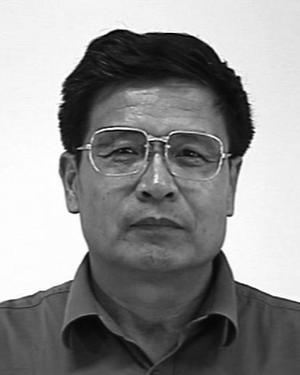 Lizhong Peng (彭立中)合作论文数7
 Shuoren Wang (王硕仁)合作论文数Dongzhimen Hospital, Beijing University of Chinese Medicine7
 Jun Wang (汪军)合作论文数Department of Integrative Medicine and Neurobiology, School of Basic Medical Sciences, Fudan University6JunYing Song (宋军营)合作论文数6YaQuan Jia (贾亚泉)合作论文数6
 Yu Liu (刘宇)合作论文数School of Mathematics and Physics, University of Science and Technology Beijing6
 Lingqun Zhu (朱陵群)合作论文数Dongzhimen Hospital, Beijing University of Chinese Medicine6Yangyang Yan合作论文数5WenYuan Dou (都文渊)合作论文数5FuLing Niu (牛福玲)合作论文数5
 Ying Liu (刘英)合作论文数Peking Union Medical College5Cong Gai (盖聪)合作论文数School of Traditional Chinese Medicine, Beijing University of Chinese Medicine5
 Xianggen Zhong (钟相根)合作论文数School of Traditional Chinese Medicine, Beijing University of Chinese Medicine5
 Shuran Ma (马淑然)合作论文数School of Traditional Chinese Medicine, Beijing University of Chinese Medicine5




