A novel class II 5-enoylpyruvylshikimate-3-phosphate synthase (EPSPS) was identified from Pseudomonas stutzeri A1501 by complementation of an Escherichia coli auxotrophic aroA mutant. The single amino acid substitution of serine (Ser) for asparagine (Asn)-130 of the A1501 EPSPS enhanced resistance to 200 mM glyphosate. The mutated EPSPS had a 2.5-fold increase for IC(50) [glyphosate] value, a 2-fold increase for K (i) [glyphosate] value, but a K (m) [PEP] value similar to that of wild type. The effect of the single residue mutation on glyphosate resistance was also analyzed using a computer-based three-dimensional model.
A mutagenesis library was constructed using GPS-LS system to insert a random 5 aa into the 5-enolpyruvylshikimate-3-phosphate synthase (EPSPS) encoded by aroA gene. Active EPSPS proteins were identified by the ability to rescue growth of aroA-deleted mutant ER2799 on M9 minimal media. 12 unique sites, which can tolerate a 5-aa insertion, were identified. In all of the 12 sites, only F295/T296 site was found to split the G2-EPSPS properly by co-transformation of plasmids into E. coli ER2799. The G2-EPSPS gene was then divided into N-terminal and C-terminal from F295/T296 site which were fused to the N-terminal and C-terminal of Ssp.DnaE intein, respectively, creating two plasmids pMEPSN295IN and pKEPSc296lc. Co-transformation of plasmids, pMEPSN295IN and pKEPSc296lc, rescued growth of ER2799 in M9 minimal media, indicating that the intein splicing domains were bringing the EPSPS fragments together to generate activity. Reconsituted activity of splitted G2-EPSPS enzyme was 4.48 U/mg.
This paper researches the method of constructing 3D surface from planar contours. We base our work on distance field function method and mainly concentrate on how to simply and uniformly solve the problems of isosurface generation caused by non-manifold surface. Our work includes three main steps: grid adjustment analysis, volume construction and surface construction. In the first step, we present a new method to process non-manifold contour by adaptively adjusting grid size. In the volume construction and the surface construction steps, we use classic distance field function and Marching Cube method respectively. The experiment shows that our algorithm has more realistic results in constructing 3D surface from planar contour.
利用错误倾向PCR(error-prone PCR)突变技术,以可变盐单胞菌(Halomonas variabilis)HTG7的5-烯醇丙酮莽草酸-3-磷酸(EPSP)合酶基因为模板进行随机PCR扩增,得到目的基因片段(约1.35kb).将该基因片段与pACYC184载体连接后转化EPSP合酶缺陷型菌株大肠杆菌ER2799.利用功能互补筛选法得到了2株不具有草苷膦抗性的EPSP合酶阳性克隆突变株,记为Pmu1和Pmu2.序列分析表明,突变体Pum1的EPSP合酶编码区与突变前基因相比,核苷酸有2处发生突变,导致氨基酸残基1处发生了改变;突变体Pmu2的EPSP合酶编码区与突变前基因相比,核苷酸有5处发生突变,导致氨基酸残基2处发生了改变.对突变前后EPSP合酶进行比较预测发现,其三级结构及蛋白中心骨架是大致相同的,但突变前后氨基酸位点肽平面和Cα相连的N键之间形成的扭转角度存在一定的差别.这些结果表明,酶的功能主要由蛋白的构象决定,二肽链形成后肽平面和N键之间角度的变化,造成高级结构构象细微的差别,致使草苷膦抗性功能丢失.
为探索利用宏基因组文库筛选草甘膦不敏感的5-烯醇式丙酮莽革酰-3-磷酸合酶(EPSPS)基因,直接从土壤中提取细菌DNA,构建草甘膦污染土壤细菌宏基因组文库,并利用EPSP合酶缺失突变株ER2799筛选到4个能互补EPSP合酶功能的克隆,其中两个克隆的转化子能够在含5mmol/L草甘膦的MOPS培养基上生长。测序结果表明它们均含有完整的EPSP合酶编码基因,GT-1aroA核苷酸长度为1335bp,编码445个氨基酸,GT-4aroA核苷酸长度为1350bp,编码450个氨基酸。利用PCR方法将两个基因克隆到原核表达载体pET28a上后,可以使宿主细胞BL21(DE3)在含100mmol/L草甘膦的MOPS培养基中良好生长。上述结果表明,利用宏基因组文库筛选方法可以得到高抗草甘膦的EPSPS基因。
To explore the feasibility of applying metagenomic libraries to obtain the glyphosate insensitive 5-enolpyruvyl shiki-mate-3-phosphate synthase genes, metagenomic library of soil which was extremely contaminated with glyphosate was constructed by directly isolating DNA, and 4 clones which can complement EPSPS' function were screened by using aroA - mutant E. coli ER2799. Two of them can grow on MOPS media supplied with 5 mmol/L glyphosate, GT-1 aroA has 1335 bp fragment encoding 445 amino acids and GT-4 aroA has 1350bp fragment encoding 450 amino acids. Two aroA genes were cloned into pET28a vector by PCR and transformed into E. coli BL21(DE3), both of transformants showed glyphosate insensitive and grew well on MOPS media supplied with 100 mmol/L glyphosate. The results showed that metagenomic libraries screening method could be applied to obtain the new glyphosate insensitive 5-enolpyruvyl shikimate-3-phosphate synthase genes in future.
Bacterial strain HTG7 was isolated from extremely glyphosate-polluted soil. It was identified as Halomonas varabilis preliminarily . It could tolerate in 500 mmol/L glyphosate concentration. Micrograph of HTG7 demonstrated that almost no cells lived well in the 550 mmol/L glyphosate concentration. General characterization of strain HTG7 showed that the optimal pH was 7.0. It grew well in the NaCl concentration range from 0 to 10%.
Bacterial strain HTG7 is isolated from extremely glyphosate-polluted soil. It is identified as Halomonas Varabilis. It can tolerate in 500 m mol/L glyphosate concentration. Physiological characterization of strain HTG7 shows that the optimum pH and temperature are 7.0 and 30°C, respectively. It grows well in the NaCl concentrations ranging from 0% to 10%. A plasmid pACYC184 carrying a 3.5 kb DNA fragment, which confers increased glyphosate tolerance, is cloned. The DNA fragment is able to complement with an E. coli auxotrophic aro A mutant.
Bcterial strain HTG7 is isolated from extremely glyphosate-polluted soil. It is identified as Halomonas Varabilis. It can tolerate in 500 m mol/L glyphosate concentration. Physiological characterization of strain HTG7 shows that the optimum pH and temperature are 7.0 and 30℃, respectively. It grows well in the NaCl concentrations ranging from 0% to 10%. A plasmid pACYC184 carrying a 3.5 kb DNA fragment, which confers increased glyphosate tolerance, is cloned. The DNA fragment is able to complement with an E.coli auxotrophic aroA mutant.
运用易错PCR介导的随机突变技术使高抗草甘膦的菌株的5-烯醇式丙酮酸-3-磷酸莽草酸合酶 (5-Enolpyruvylshikimate-3-phosphate,EPSPs) 基因发生随机突变,转入EPSPs基因缺陷型的大肠杆菌ER2799中,通过互补试验获得对草甘膦抗性明显降低的突变株AZ100.测序结果发现AZ100的EPSPs基因与未突变基因相比,碱基序列发生了两个位点变化,第792位的碱基由鸟嘌呤(G)突变为胸腺嘧啶(T),第1203位的碱基由胞嘧啶(C)突变为鸟嘌呤(G).氨基酸序列也发生了相应的变化,第264位由甘氨酸(Gly)突变为缬氨酸(Val),第401位由丙氨酸(Ala)突变为甘氨酸(Gly).二级结构预测显示此两个突变的氨基酸的位点恰好位于EPSPs与底物结合的关键部位.这两个氨基酸位点的突变,导致EPSPs在有草甘膦存在的情况下活性降低,从而导致菌株的草甘膦抗性降低.将这两个突变的碱基位点与美国的专利保护位点比较,发现这两个突变位点均不在专利保护范围之内.
 Min Lin (林敏)合作论文数Biotechnology Research Institute, Chinese Academy of Agricultural Sciences11
 Wei Lu (陆伟)合作论文数中国农业科学院生物技术研究所9
 Shuzhen Ping (平淑珍)合作论文数8
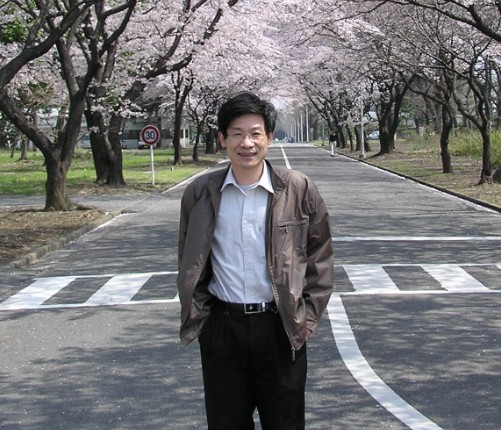 Ming Chen (陈明)合作论文数中国农业科学院生物技术研究所7
 Dan Jin (金丹)合作论文数College of Agronomy and Biotechnology, Southwest University6BaoQing Dun (顿宝庆)合作论文数5
 Wei Zhang (张伟)合作论文数Biotechnology Research Institute, Chinese Academy of Agricultural Sciences5Zhu Liu合作论文数4Xiuping Meng (孟秀萍)合作论文数3
 Jing Wang (王劲)合作论文数Biotechnology Research Institute, Chinese Academy of Agricultural Science3
 Yuquan Xu (徐玉泉)合作论文数Biotechnology Rearch Institute, Chinese Academy of Agricultural Sciences3
 Zhirong Yang (杨志荣)合作论文数Sichuan University3Wenchao Mu合作论文数3
 Xujing Wang (王旭静)合作论文数中国农业科学院生物技术研究所2Xu M Q合作论文数2Song-Na Hou合作论文数2Zhonglin Zhao合作论文数2Chuanpeng Wang合作论文数1ZHANG Huaijiang (张怀江)合作论文数1Zhu LIU (刘柱)合作论文数1GuoXun Li (李国勋)合作论文数1YiDing Wang (王一丁)合作论文数1
 Yongliang Yan (燕永亮)合作论文数中国农业科学院生物技术研究所1
 Xiaohui Liang (梁晓辉)合作论文数State Key Laboratory of Virtual Reality Technology and Systems, School of Computer Science and Engineering, Beihang University1Guangquan Liu (刘光全)合作论文数1Xiumin Liu (刘秀敏)合作论文数1
 Liang Li (李靓)合作论文数School of life Sciences,NanjingUniversity1
 Yu-Quan Xu合作论文数1Xiaoxiao Wu合作论文数1




