Dear Editor, This letter deals with the formation control problem of a multi-agent system that moves along a closed curve and is subject to posi-tion constraints.A distributed formation control law is developed under which the position constraint of each agent can always be satis-fied.Due to the existence of position constraints,prescribed forma-tions generally cannot be achieved by the agents.
In modern networked control systems, various network-induced constraints pose critical challenges to reliable system operation. This paper investigates the robust model predictive control (RMPC) problem for networked linear parameter varying (LPV) systems subject to time delays and dynamic quantization. The dynamic quantizer compresses sensor data for transmission to the controller, inevitably introducing quantization errors. In order to address these constraints, an RMPC framework integrated with the grey wolf-pattern search optimization (GWPS) algorithm is proposed. The GWPS algorithm is utilized to update the weight matrices of RMPC online, thereby improving the system performance under quantization errors and time delays. Moreover, a mixed $H_{2}/H_{\infty }$ performance index is embedded into the controller design to guarantee both robustness and baseline control performance against bounded disturbances and quantization errors. Simulation results on a numerical example and an islanded microgrid system example have demonstrated the effectiveness and feasibility of the proposed method.
Traditional Lyapunov stability theory cannot directly apply to constrained stochastic nonlinear systems when using barrier Lyapunov functions due to their inherent lack of radial unboundedness. This article presents a novel approach to establishing finite-time stability for such systems by employing Lyapunov functions. The proposed stability analysis relies on a time-varying gain function that remains uniformly bounded. This approach ensures that the system achieves finite-time stability with an arbitrarily prescribed upper bound on the settling time, thereby effectively avoiding the unbounded controller gain problem. The resulting stability is further extended to the finite-time state-feedback control for strict-feedback stochastic nonlinear systems with output constraints. Simulation studies validate the effectiveness of the proposed control scheme.
This study establishes a novel memoryless output feedback control framework for the global exponential stabilization in mean square of stochastic time-delay nonlinear systems with a lower triangular structure. A key limitation of prior work is the inability to handle the simultaneous presence of input and state delays under stochastic disturbances. Our unified control framework effectively addresses this challenge. Employing the idea of feedback domination, we develop a memoryless (or delay-independent) output feedback control law. Under constrained input delay (with arbitrary state delays), we demonstrate the stability of the closed-loop system using the Lyapunov-Krasovskii functional method. The feedback control strategy is delay-independent, which simplifies its implementation in practical applications. To show the efficacy of the proposed control scheme, we present an electromechanical system as an example.
The main focus of this paper centers around the asynchronous observer-based control of continuous-time jump systems with perturbation parameters via a hidden Markov model. In view of the difficulty in accurately obtaining the system state and system mode, an asynchronous controller under the framework of a hidden Markov model and observer is designed to stabilize the studied systems. Moreover, a kind of alpha-mode-dependent Lyapunov function that contains several common ones in the published works is constructed to analyze the system stability with the aid of Lyapunov stability theory, stochastic theory, etc. Subsequently, the gains of the observer-based asynchronous controller are obtained by solving matrix convex optimization problem. Finally, one case study is presented to verify the effectiveness and practicability of the established method under two different transition rate matrices of the hidden Markov model.
This article addresses the event-triggered consensus tracking control problem for complex heterogeneous multiagent systems with multiple unknown. The systems under consideration involve fully unknown time-varying control directions (CDs), unknown time-varying input delays (UTVDs) and functions, making the problem particularly challenging. To reduce the effects of UTVDs, an auxiliary system is constructed to produce a compensation signal. Building upon this, a novel adaptive proportional-integral (PI) control approach is developed through the backstepping method and a series of Nussbaum functions. It is demonstrated that the tracking error can meet predefined transient and steady-state performance criteria, ensuring asymptotic tracking and global boundedness of all signals in the closed-loop system. The key advantage of this solution lies in its simplicity of controller design and improved control performance, without requiring prior information about the unknown functions. Finally, a simulation example validates the validity of the proposed approach.
This paper addresses the distributed predefined-time (PT) exact consensus tracking problem for nonlinear second-order multi-agent systems subject to disturbances and deception attacks by developing a three-player mixed zero-sum game-based strategy. Different from conventional distributed control methods that typically require separate design of a leader state observer and controller, the proposed approach directly embeds the consensus tracking error associated with the communication topology into a zero-sum differential game framework, without resorting to explicit observer design. On this basis, a distributed control architecture is established without requiring online global topological information or additional observer construction, thus effectively reducing system implementation complexity. Moreover, an adaptive approximation mechanism based on a critic neural network is introduced to estimate the Nash equilibrium strategy online, yielding a realizable approximate optimal control policy. The proposed method not only guarantees the consensus error converges to zero within a PT but also yields a realizable approximate optimal policy in the presence of attacks and disturbances, while ensuring uniform boundedness of all closed-loop signals. Finally, a numerical simulation is provided to demonstrate the effectiveness of the proposed method.
The constrained output regulation problem for unknown linear discrete-time systems is solved in this work. This is achieved by first deriving sufficient conditions for the existence of regulator equation solution pairs, followed by the creation of a data-driven technique to obtain these solutions. Subsequently, a constrained observer is designed to provide precise state estimation while guaranteeing that the observer error confined within a predefined set. Finally, leveraging linear programming, we develop a data-driven output feedback controller that achieves reference tracking, enforces state and input constraints, and operates without explicit knowledge of the system dynamics.
This article establishes a comprehensive framework of stochastic practical fixed-time input-to-state stability (SPFT-ISS). Its contributions are characterized by two points: 1) we propose the concept of SPFT-ISS and stochastic practical fixed-time stability (SPFTS), and establish the relationship between SPFT-ISS and the SPFT-ISS Lyapunov function; and 2) as the application of this framework, an interesting problem on adaptive practical fixed-time control of stochastic nonlinear systems with unknown parameters, high-order powers, uncertainties of nonlinear functions, and stochastic inverse dynamics is solved thoroughly.
This paper discusses the robust $\mathcal {H}\_{\infty }$ control problem for continuous-time nonlinear hidden Markov jump systems under false-data-injection (FDI) attacks by means of a mode- and rule-dependent extended observer-based method. To capture both nonlinearity and parameter uncertainty, the system is modeled via an interval type-2 Takagi-Sugeno (IT2 T-S) fuzzy framework, where the asynchronous switching between plant and controller is described by a hidden Markov model. During the data transmission, the measurement data may be corrupted by FDI attacks generated by an exogenous system subject to external disturbance. To handle this, a mode- and rule-dependent extended observer that simultaneously detects and estimates the plant states and the injected attack is constructed. Building on these estimates, an asynchronous $\mathcal {H}\_{\infty }$ controller is synthesized within the IT2 T-S fuzzy setting. Moreover, some sufficient conditions, guaranteeing the stability of the resulting systems in a stochastic sense and satisfying the $\mathcal {H}\_{\infty }$ performance, are derived by using tools such as the Lyapunov stability theory. Finally, the effectiveness and superiority of the proposed approach are illustrated via the simulation results.
This article investigates the prescribed-time (PT) optimal formation control issue for second-order MAS. A novel formation scheme that integrates RL with a FLS is presented, incorporating actor, critic, and identifier components to estimate the optimal control, the optimal cost function, and the uncertain system dynamics (including unknown nonlinearities, external disturbances, and leader input), respectively. To achieve PT formation, we introduce a prescribed performance function and a filtered variable, which are then used to develop an error transformation function for the controller design. Unlike existing PT control approaches, this method eliminates initial value limitations, ensuring that both the prescribed performance function’s initial condition and the error transformation parameter are independent of the initial tracking error and system dynamics. We further demonstrate that the developed scheme ensures the prescribed performance of the filtered error, guaranteeing that all formation errors converge to a bounded region within the PT while achieving satisfactory transient performance. Finally, we illustrate the effectiveness of the scheme through two simulated examples.
This article addresses the zonotopic L. dynamic output-feedback control problem for discrete-time switched Takagi-Sugeno (T-S) fuzzy systems. To overcome the conservatism of existing methods, a novel relieved asynchronous average dwell time (ADT) switching scheme is proposed, which successfully eliminates the conventional restrictive requirement that the subsystem dwell time (DT) must strictly exceed the maximum asynchronous duration. First, state and output zonotopes are constructed, facilitating the introduction of multiple radius and center-distance functions. Distinct from Lyapunov-dependent approaches, by leveraging the radius-and center-distance-based analysis technique, sufficient conditions are derived to guarantee the dual convergence and the prescribed L-infinity. performance of the zonotopes. Subsequently, building upon these zonotopic results, the allowable ADT switching signals and switched fuzzy dynamic output-feedback controllers are codesigned to achieve the stability of the closed-loop systems. Finally, the superiority and effectiveness of the proposed zonotopic control scheme are validated through an illustrative switched T-S fuzzy example.
This paper investigates prescribed-time coverage control for bidirectional and unidirectional mobile sensor networks deployed on a closed curve. By using a time-varying scaling function, prescribed-time coverage control laws are developed for the two types of sensor networks and their convergence is established via matrix theory and Lyapunov stability theory. It is shown that the sensors can be guided to the configuration minimizing the coverage cost function at the prescribed convergence time while respecting their control input constraints provided that the sensors' maximum velocities satisfy a given condition. In contrast to previous studies, we further demonstrate that the order of the sensors on the closed curve is strictly maintained at all times. In consequence, only the information of two immediate counterclockwise and clockwise sensors is needed for each sensor to compute its control input and collision among mobile sensors can be avoided. Finally, the effectiveness of the proposed control laws is validated through numerical simulations.
Most existing control strategies for nonlinear systems under denial-of-service (DoS) attacks require prior knowledge of the attack frequency and duration and typically achieve only bounded or asymptotic convergence. In this article, an adaptive predefined-time (PT) event-triggered (ET) security control scheme is developed for a class of nonlinear strict-feedback cyber-physical systems (CPSs) subject to DoS attacks. By designing an adaptive high-gain filter, the discontinuous and unmeasurable states caused by DoS attacks are estimated in a smooth and differentiable manner within a PT. Building on this estimation, the proposed control strategy ensures not only the ultimate boundedness of all closed-loop signals but also guarantees that the tracking error converges to zero within a PT, even when the frequency and duration of DoS attacks are unknown. The key advantages of the proposed approach lie in its broader applicability and improved control performance while concurrently conserving communication resources. Finally, numerical simulations are provided to demonstrate the efficacy of the proposed method.
This paper investigates predefined-time synchronization of stochastic complex networks via a new asynchronous aperiodic intermittent dynamic event-triggered control (AAIDE-TC) scheme. By incorporating a bounded time-varying function into both the controller and the event-triggering mechanism, the proposed approach guarantees that the synchronization error converges to an adjustable neighborhood within the user-specified settling time, while rigorously excluding Zeno behavior. Unlike conventional continuous or sampled-data control strategies, the AAIDE-TC framework allows each subsystem to update its control input asynchronously at irregular event-triggered instants, significantly reducing communication and control effort. Lyapunov-based stochastic analysis establishes the sufficient condition for achieving practical predefined-time synchronization in the mean-square sense. Numerical simulations on the islanded microgrid system validate the effectiveness of the proposed method and illustrate the influence of design parameters on convergence performance.
This paper is concerned with the design of general stealthy attacks on remote state estimation with encryption-decryption schemes. To ensure the stealthiness of general attacks under encryption-decryption schemes, we firstly redefine the stealthiness constraints of attacks from the perspectives of the alarm rate and the detection index's expectation. Then, under the constraint of the detection index's expectation, the analytical expression of the optimal general attack that maximizes estimation error is derived, and the corresponding detection rate is computed to assess the compliance with the alarm rate constraint. If the alarm rate constraint is not satisfied, we further derive an upper bound of the detection rate caused by general attacks, and obtain the analytical expression of a feasible general stealthy attack. Finally, a numerical example is presented to verify the effectiveness of theoretical results.
This article concentrates on the problem of practically time-synchronized tracking control for multi-input multi-output (MIMO) systems with unmatched nonlinearities and input saturations. Different from the existing approaches, a practically time-synchronized command filtered backstepping (CFB) control scheme is proposed. By integrating modified command filters and control signals designed with norm-normalized sign functions, the newly developed framework not only retains the advantages of the CFB control approach but also guarantees the property of time-synchronized convergence. Specifically, the “explosion of complexity” phenomenon and the influence of filtering errors are simultaneously addressed, and all components of the tracking error can achieve practically synchronous convergence to a small neighborhood of the origin in a finite time, despite the presence of unmatched nonlinearities in high-order systems. Furthermore, novel auxiliary systems are recursively embedded into each step of the time-synchronized CFB design to counteract the effect of input saturation. Rigorous theoretical analyses and comparative simulations demonstrate the rationality, effectiveness, and superiority of the proposed control scheme.
This article investigates the distributed online optimization problem in a zero-sum game between two distinct time-varying multiagent networks. At each iteration, the agents not only communicate with their neighbors but also gather information about agents in the opposing network through a time-varying network, assigning weights accordingly. Moreover, we consider quantized communication and bandit feedback mechanisms, with agents transmitting quantized information and adopting one-point estimators. At each iteration, agents make and submit decisions and then receive the cost function values near their decision points rather than the full cost function information. To guarantee the payoff of each network, we design an algorithm named quantized distributed online bandit optimization in two-network (QDOBO-TN). We use dynamic Nash equilibrium regret to measure the positive payoff discrepancy between the decision sequence produced by Algorithm QDOBO-TN and the Nash equilibrium sequence. Furthermore, we propose a multiepoch version of Algorithm QDOBO-TN. The regret bounds for both algorithms are sublinear with respect to the iteration count T. Finally, we conduct a series of simulation experiments that further validate the effectiveness of the algorithms.
This article focuses on stabilizing uncertain nonlinear systems with limited communication resources. Traditional approaches relying on static quantizers or fixed-gain observers face significant limitations. To solve this, an adaptive observer-based quantized output feedback control framework is proposed. A dynamic-gain state observer is developed, with observer gains adjusted by a differential equation to handle nonlinearities and quantization effects. A criterion for choosing quantization parameters is established, linking them to control gains, observer dynamics, and bounded uncertainties. This confines quantization errors and ensures global asymptotic stability of the closed-loop system. Simulations on a robotic manipulator system validate the superiority of the proposed method. The work integrates dynamic observer adaptation and quantizer design, promoting resource-efficient control in bandwidth and resource-constrained applications.
This article considers the observer-based multiobjective control problem of switched networked control systems (SNCSs) subjected to multipath packet dropouts and switching rule loss. Three mutually independent Bernoulli distribution random sequences are adopted to model the packet dropouts existing in the control input, the measurable output, and the switching rule, which have been rarely studied in existing works. To solve the problems caused by the multipath packet dropouts and switching rule loss, multiple hybrid strategies are adopted to design the observer-based controllers of SNCSs. First, a novel hybrid observer design scheme is used to design the dynamical equation of observers. Second, the mode-dependent and mode-independent hybrid observer-based controllers are designed. Then, based on the multiple Lyapunov functionals (MLFs) and average dwell time (ADT) technology, the multiobjective control problem of SNCSs is formulated as a problem to minimize the $H_{\infty } $ disturbance attenuation level for the estimation error of observers and $L_{2}-L_{\infty } $ disturbance attenuation level for the SNCSs at the same time. Through a two-step approach, new results based on linear matrix inequalities (LMIs) are deduced to determine the observer parameters and controller gains. Eventually, two examples are given.
 James Lam (林参)合作论文数Department of Mechanical Engineering, Faculty of Engineering, The University of Hong Kong141
 Yun Zou (邹云)合作论文数School of Automation, Nanjing University of Science and Technology109
 Baoyong Zhang (张保勇)合作论文数School of Automation, Nanjing University of Science and Technology107
 Zhengqiang Zhang (张正强)合作论文数College of Engineering, Qufu Normal University84
 Yuming Chu (褚玉明)合作论文数School of Science, Huzhou University72
 马千合作论文数Nanjing University of Science and Technology Zijin College52
 Yongmin Li合作论文数Department of Computer Science, College of Engineering, Design and Physical Sciences, Brunel University London50
 Deming Yuan (袁德明)合作论文数School of Automation, Nanjing University of Science and Technology39
 Jessie (Ju H.) Park合作论文数Laboratory for Advanced Nonlinear Dynamics and Control, Department of Electrical Engineering, Yeungnam University;Korean Academy of Science and Technology35
 Junwei Lu (陆俊玮)合作论文数NARI School of Electrical and Automation Engineering, Nanjing Normal University34
 Per Venge合作论文数Diagnostics Development34
 Hao Shen (沈浩)合作论文数School of Electrical and Information Engineering, Anhui University of Technology30
 Huifang Min合作论文数Sch. of Electr. Eng. & Autom., Jiangsu Normal Univ.;c;Sch. of Electr. Eng. & Autom., Jiangsu Normal Univ.27
 Qian Ma (马倩)合作论文数School of Automation, Nanjing University of Science and Technology25
 Wenhui Liu (刘文慧)合作论文数NARI School of Electrical and Automation Engineering, Nanjing Normal University25
 Wei Xing Zheng合作论文数School of Computing, Engineering and Mathematics, Western Sydney University23
 Lina Rong (荣丽娜)合作论文数School of Control Engineering, Northeastern University at Qinhuangdao21
 Guozeng Cui合作论文数20
 Daniel Wing Cheong Ho (何永昌)合作论文数Department of Mathematics, College of Science, City University of Hong Kong20
 Krzysztof Marek Gałkowski合作论文数Institute of Control and Computation Engineering, University of Zielona Góra19
 Huanyu Zhao (赵环宇)合作论文数Faculty of Automation, Huaiyin Institute of Technology19Cheng-wu YANG (杨成梧)合作论文数18
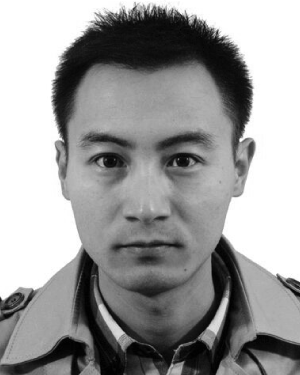 Xianglei Jia合作论文数Hangzhou Dianzi Univ, Sch Automat, Hangzhou 310018, Zhejiang, Peoples R China17
 Shang Shi (石尚)合作论文数College of Artificial Intelligence and Automation, Hohai University17
 Tongwen Chen (陈通文)合作论文数School of Electrical Engineering, Shandong University;Department of Electrical and Computer Engineering, University of Alberta;Donadeo Innovation Centre for Engineering, University of Alberta17
 Feng Li合作论文数16
 Qunxian Zheng合作论文数Anhui Polytech Univ, Sch Elect Engn, Wuhu 241000, Anhui, Peoples R China15
 Maojiao Ye (叶茂娇)合作论文数School of Automation, Nanjing University of Science and Technology15
 Huiling Xu (徐慧玲)合作论文数School of Mathematics & Statistics, Nanjing University of Science and Technology15
 Frank L. Lewis合作论文数Department of Electrical Engineering, University of Texas at Arlington15
 Dongsheng Du合作论文数Faculty of Automation, Huaiyin Institute of Technology15
 Jianwei Xia (夏建伟)合作论文数Department of Mathematics, School of Mathematical Sciences, Liaocheng University15
 Jun Chen (陈军)合作论文数School of Materials Science and Engineering, Nanjing University of Science and Technology14
 Baozhu Du (杜宝珠)合作论文数School of Information and Communication Engineering, Hainan University14
 Huijun Gao (高会军)合作论文数School of Astronautics, Harbin Institute of Technology14
 Wojciech Paszke合作论文数University of Zielona Gora14Chengwu Yang合作论文数13weimin chen合作论文数13
 Jiali Ma合作论文数School of Automation, Nanjing University of Science and Technology, Nanjing, China13Ze Li (李泽)合作论文数13
 Zhan Shu合作论文数Department of Mechanical Engineering, The University of Hong Kong13
 Guangming Zhuang合作论文数12
 Vincent Cocquempot合作论文数Universite de Lille12
 Lihua Xie (谢立华)合作论文数Centre for Advanced Robotics Technology Innovation, Nanyang Technological University;School of Electrical & Electronic Engineering, Nanyang Technological University12
 He Zhang (张合)合作论文数School of Mechanical Engineering, Nanjing University of Science & Technology11
 Yi Dong (董怡)合作论文数Department of Control Science and Engineering, College of Electronic and Information Engineering, Tongji University;Shanghai Research Institute for Intelligent Autonomous Systems, Tongji University;Lab of Agent-based Interactive Learning and Autonomous Decision-making, Tongji University11
 Guobao Liu (刘国宝)合作论文数NARI School of Electrical and Automation Engineering, Nanjing Normal University11
 Eric Rogers合作论文数Department of Electronics and Computer Science, University of Southampton11
 June Feng (冯俊娥)合作论文数School of Mathematics, Shandong University11




