The recently emerged hybrid mechanism-data driven KalmanNet can improve the accuracy of data fusion in the presence of model mismatch by implicitly extracting hidden priori information through learning from data. However, KalmanNet only learns the Kalman gain from data, while a substantial amount of hidden information remains unexploited. Besides the Kalman gain, the accuracy of the process model is also a critical factor affecting the performance of the filter. Unfortunately, in many practical applications, obtaining accurate process models by relying solely on mechanism modeling remains challenging. To further improve the filter performance, this paper proposes an enhanced KalmanNet that simultaneously learn both the Kalman gain and the unmodeled effects of the process model, thereby enabling more effective exploitation of the implicit information in the data. The experiment of vehicle localization on real data from public dataset demonstrates that the proposed method significantly improves the estimation accuracy compared to KalmanNet.
Anomaly detection is critical for ensuring the reliability of industrial cyber-physical systems. Identifying anomalies based on data distribution is regarded as a promising approach. However, inherent noise in data collection and complex dependencies within the underlying structure can lead to class ambiguity. This ambiguity obscures the boundary between normal data and anomalies, thereby degrading the accuracy of distribution modeling. To address this issue, we shift the distribution modeling from the data space to a latent space to mitigate ambiguity and then propose a label free anomaly detection network, named ALDM. In ALDM, a contrastive-based methods is designed to facilitate the construction of a latent space, where the margin between normal data and anomalies has been expanded. Anomalies are then discerned through embeddings using a flow-based process. Recognizing the importance of distance metrics in contrastive-based methods, we propose an adaptive approach to obtain the optimal distance metric during network training instead of presetting a fixed formula. Furthermore, to accommodate anomalies of varying durations, we propose another event-wise performance index for evaluation. Extensive evaluations on three widely used benchmarks and a newly constructed dataset demonstrate that ALDM achieves state-of-the-art detection performance across both conventional metrics and our proposed index. Note to Practitioners-Accurately detecting faults (anomalies) in industrial systems, such as factories or power grids, is vital to prevent costly downtime. However, noisy data and complex interactions make it challenging. Our solution, ALDM, tackles this by learning a clearer representation of system's data where normal and abnormal patterns are easier to distinguish. ALDM employs an adaptive projection to aid in anomaly detection, which minimizes expert tuning and enhances uptime. This approach improves detection accuracy, leading to enhanced system reliability and fewer unplanned stoppages. Although ALDM requires sufficient training data for reliable detection, its label-free methodology provides a practical solution for more robust monitoring in industrial systems.
Physics-Informed Neural Networks (PINNs) have emerged as promising surrogate models by integrating the physical consistency of first-principles models with the flexibility of data-driven approaches. However, existing PINN methods, whether based on soft or hard constraints, exhibit significant limitations when applied to process systems contaminated with measurement noise, which is a common challenge in practical applications. To overcome this issue, this paper proposes a novel Noise-Robust Hard-constrained Physics-Informed Neural Network (NR-hPINN). By integrating the Lagrange multipliers method, the model obtains an analytical solution for the constraint layer that effectively combines prior physical knowledge with noise characteristics. This formulation allows the NR-hPINN to mathematically enforce linear equality constraints during both training and inference, thereby setting it apart from soft-constrained PINNs, which cannot guarantee constraint satisfaction at the inference stage. Notably, the proposed approach avoids the need for supplementary online optimization, thereby preserving computational efficiency on par with conventional soft-constrained PINNs. Numerical experiments on three different process system scenarios, including the ethylbenzene synthesis unit, the Van de Vusse reaction unit, and the DME-DEE synthesis plant, illustrate the superiority of NR-hPINN over other baseline models in noisy data environments.
Accurate pose estimation often relies on Bayesian filters, whose performance is heavily dependent on precise process models. Establishing a process model that can cover all working conditions is essential. By fusing simple models, such as kinematic and dynamics models, which are tailored to different typical working conditions, the interactive multiple model (IMM) filter can effectively expand the scenario coverage and enhance its applicability. However, the performance of this filter is limited by the preset hyperparameters and scalar fusion weight representation. To further enhance the applicability of the filter, we propose a data-driven weight learning mechanism guided by working conditions, eliminating the limit of preset hyperparameters. Additionally, a physically realistic multidimensional weight representation is designed for point-to-point fusion, expanding the weight search space. The proposed method is validated through experiments on the real vehicle, demonstrating its effectiveness in improving filter applicability under various working conditions.
Predictive energy management strategies (PEMS) for fuel cell hybrid electric vehicles (FCHEVs) have shown promise in enhancing safety and energy efficiency. To improve speed prediction accuracy and balance multiple objectives in speed and energy co-optimization, a PEMS based on driving behavior identification is proposed for FCHEVs in car-following scenarios. Firstly, a hybrid model combining support vector machine and recurrent neural network is established to identify driving behavior more accurately. Secondly, considering the strong correlation between driving behavior and speed, a long short-term memory-based model is designed for accurate speed prediction of preceding vehicle. Thirdly, based on prediction results, to achieve a tradeoff among multi-objective, multi-objective cost function with weight factors is established into the model predictive control-based PEMS. Simulation results show the proposed strategy reduces speed variation by 1.55%, equivalent fuel consumption cost by 12.16%, and power source degradation cost by 27.1% compared to baseline models.
Trajectory planning for autonomous driving requires safe, robust and efficient algorithms in complex, dynamic environments where multiple vehicles interact. Constrained Dynamic Games (CDG) provide a unifying framework to model such multi-agent interactions, with solutions corresponding to Generalized Nash Equilibria (GNE). Existing solving methods of CDG can be divided into the open-loop strategies, which is computational-efficient but lack robustness to disturbances, and the feedback strategies, which offer adaptability but often struggle to guarantee real-time performance when handling hard constraints. To address these limitations, we introduce ADMM-iCLQG, a solver of CDG tailored for planning a feedback trajectory in real-time. We iteratively approximate the nonlinear CDG with a linearly Constrained Linear Quadratic Game (CLQG). By leveraging the Alternating Direction Method of Multipliers (ADMM), the solver efficiently manages constraints while computing feedback strategies that converge to GNE. We demonstrate the algorithm effectiveness through extensive simulations, showing its superiority in computational efficiency and reliability. Furthermore, physical experiments confirm the approach's potential of real-time implementation, achieving a planning frequency exceeding 40 Hz for up to six vehicles.
Accurate pose information is fundamental for intelligent vehicle trajectory planning and control. Pose estimation often relies on Bayesian-based filters, where accurate process models are crucial for estimator performance. This paper proposes a modeling method that combines physical models with neural networks, using the data-driven model to capture unmodeled characteristics which include unknown input characteristics and unmodeled dynamics that are difficult for physical models to handle, thereby enhancing modeling accuracy. This paper presents a systematic methodology for designing data-driven models, which incorporates both neural network architecture selection and input feature optimization. The method is validated using the public dataset, and the results demonstrate that, compared to the physical model and Gaussian process regression based model, the proposed approach based on sequence neural networks can capture the unmodeled characteristics and compensate for them, thus enhancing the accuracy of intelligent vehicle pose estimation.
In recent years, the widespread application of Automatic Guided Vehicles (AGVs) in industrial transportation has significantly propelled the modernization of industrial production. However, traditional AGVs’ reliance on pre-laid magnetic tracks for navigation poses several limitations, including vulnerability to damage, inconvenience in construction and path modification, and potentially high manufacturing costs. To address these challenges, this paper proposes an innovative LiDAR-based positioning scheme. Firstly, this scheme breaks free from the constraints of traditional magnetic track laying and utilizes landmarks as key information sources to provide AGVs with accurate position data. This innovative approach not only improves positioning accuracy but also enables AGVs to navigate in more complex industrial environments. Secondly, based on these precise location data, we can calculate the virtual path that the AGV traverse. This step significantly simplifies the process of landmark layout and accelerates the layout speed, thereby enhancing the practical convenience of the system. Finally, experiments have been conducted to verify and analyse the effectiveness of the proposed method. The results demonstrate that the approach not only achieves coordinate positioning and path visualization for AGVs on open paths, but also offers an ideal positioning and path planning solution for industrial transportation.
Fusion of multiple sensors emerges as a pragmatic approach to enhancing the accuracy of intelligent vehicle localization. The accuracy relying on exteroceptive sensors fluctuates on ever-changing environments, which are inherently unpredictable. To address this challenge, an interactive fusion method is deployed to dynamically update the sensor weights, thereby improving localization precision. However, the implementation of existing methods relies on the assumption that Markov transition probabilities are exactly known. In practice, obtaining accurate transition probabilities in advance is often difficult or even impossible. This paper proposes an adaptive interactive fusion approach (AIF) for online adjustment of the transition probabilities, without requiring pre-precise settings. Furthermore, we implement a strategy to discard large error measurements in the likelihood function to enhance accuracy. Experimental results on the public UrbanNav dataset have demonstrated the effectiveness of the proposed method for improving the positioning performance by 23% compared with the method with fixed transition probabilities.
In process industries, dynamic uncertainties necessitate that experienced operators adjust process parameters. This paper tries to mine the decision knowledge of operators and proposes an artificial knowledge-based (AKB) decision approach for process parameter optimization. The methodology comprises three functionally interdependent stages: Data preprocessing, quality prediction, and AKB decision modeling. Data preprocessing includes outlier processing which adopts a sliding-window-based iForest method to detect the outlier caused by batch changeover and data alignment which aligns delayed quality indicators with process variables based on a dynamic-window-based distance correlation. Quality prediction uses temporal convolutional networks with feature processing and temporal attention mechanisms (FP-TCN-TA) to reconstruct the operators' realtime quality assessment references. AKB decision modeling combines one-dimensional convolutional neural network (1D-CNN) for local parameter feature extraction within finite time steps and multilayer perceptron (MLP) for nonlinear adjustment mapping. It emulates operators' decision logic. A case study using real-world operating data collected from the tire tread extrusion line demonstrates the approach's capability to replicate operator decisions for process parameter optimization. The effectiveness of each methodological component is also confirmed by experiments.
Articulated passenger vehicles (APVs) represent a transformative approach to urban public transportation, offering a flexible and scalable solution to meet the increasing demand for high-capacity transit systems. APVs combine the advantages of high-capacity rail-based systems with the cost-effectiveness and flexibility of road-based counterparts, making them ideal for urban environments where conventional transport options may fall short. These vehicles, characterised by multiple articulated joints and segmented vehicle units, face particular challenges in dynamic modelling, stability control, and performance evaluation. Active safety and autonomous functions, such as steering assistance, collision avoidance, and automated driving, are critical to improving safety and efficiency in these systems. This paper reviews the state-of-the-art in modelling, control, and performance assessment of APVs, focussing on key aspects such as stability, path tracking, manoeuvrability, and automation. First-principles and data-driven modelling approaches are explored to address the complex dynamics of APVs. Additionally, control strategies for stability and path tracking are discussed, highlighting the importance of integrating active safety and autonomous functions to prevent accidents and improve operational safety and efficiency. The paper aims to provide a holistic perspective on the challenges and opportunities in the development of APVs, contributing to the advancement of smart and sustainable urban transportation systems.
Autonomous vehicles face significant motion planning challenges in interactive scenarios, particularly when coordinating with dynamic traffic participants. Key issues include vehicle interdependencies, dynamic priority allocation, and real-time interactions, which critically impact traffic safety and efficiency. To address these issues, we propose a Stackelberg game-theoretic motion planning framework incorporating opportunity cost—an economic concept representing the value of the best alternative strategy foregone when making a decision. Firstly, a hybrid path planner is developed to capture the interdependencies among traffic participants. Secondly, road priority during interactions is quantified through a leader-follower model. Thirdly, a Stackelberg game-based speed planner is designed to enable the autonomous vehicle to adapt to interactive environments. The payoff function, which incorporates opportunity costs via reactive speed planning, is validated using the nuPlan dataset, and its parameters are identified accordingly. The framework facilitates decision-making through exploratory planning outcomes, effectively bridging the gap between decision and planning modules. It significantly enhances driving efficiency at intersections and demonstrates strong adaptability across various interactive scenarios in both simulations and real-world experiments.
Millimeter-wave (mmWave) communication systems have large bandwidths and, combined with large-scale antenna arrays and beamforming technology, facilitate higher resolution of angle and delay measurements. This, in turn, provides opportunities for integrated sensing and communication (ISAC). Accurate and reliable estimation of mmWave channel state information is crucial for ISAC. In this paper, we propose a deep learning-based method for estimating channel multipath parameters, tracking, and identifying line-of-sight (LOS) and non-line-of-sight (NLOS) paths. Specifically, we leverage a network named “you only look once (YOLO)”, a highly efficient object detection network in computer vision, to detect the angles of arrival (AOAs) and angles of departure (AODs) of multipaths from received radio frequency signals. Moreover, we use a tracking-by-detection algorithm, ByteTrack, to track the variation of each path's AOA and AOD under a mobile scenario. Thanks to these vision-based channel estimation approaches, we reveal that LOS and NLOS paths exhibit different trajectory properties, allowing us to precisely identify LOS and NLOS paths, a challenge originally in the context of ISAC. We validate the proposed estimation, tracking, and identification methods on real measurement data and demonstrate that the proposed estimation method shows better performance compared to existing methods.
Motion planning directly in the spatiotemporal dimension can generate trajectories of higher quality compared to decoupled methods for autonomous driving. However, it requires a greater amount of computational resources. This paper proposes an efficient motion planning method based on convolution in the spatiotemporal dimension, which takes into account the uncertainty of localization and obstacle intention. Firstly, a three-dimensional probability occupancy grid map with uncertainty is constructed based on prediction results. Secondly, convolution kernels are generated considering the contour, heading angle and localization uncertainty of the ego vehicle. Thirdly, single-channel multi-output convolutions are performed between the probability occupancy grid map and the kernels to generate the four-dimensional feature map. Finally, a collision avoidance algorithm based on the feature map is proposed to obtain the optimal trajectory, which uses the hybrid A* algorithm. The chance constraint and the vehicle kinematics are taken into account in the motion planning. In simulation experiments, the safety performance, computational efficiency and rationality of the motion planning are compared and analyzed, and the proposed method performs superiorly. In addition, real-world experiments verify the feasibility of the proposed method.
Through-the-road-coupled hybrid electric vehicles, comprising a forward-driving internal combustion engine (ICE) and two rear-mounted hub motors, have been attracting increasing attention for their energy efficiency and excellent road passability. However, real-time energy allocation in the ICE and motors is challenging because of complex road scenarios, nonlinear characteristics of components, and the requirement of real-time executability of energy management strategies (EMSs). This study developed an online EMS with an equivalent factor (EF) which is timely updated through the offline rule extraction and online parameter feedback based on real-time driving scenarios. Initially, the utilization of a global dynamic programming approach aims at delineating the potential switching boundary, thus substantially mitigating the computational burden on the controller. Subsequently, an innovative Model Predictive Control-based Equivalent Fuel Consumption Strategy (MPC-ECMS) is introduced. This method integrates real-time velocity prediction with State of Charge (SOC) feedback to enhance fuel efficiency. Notably, the efficiency factor (EF) within ECMS undergoes optimization through a genetic algorithm, with adaptive corrections based on driving condition recognition outcomes. Consequently, the EF is continuously adjusted to ensure convergence of actual SOC towards the reference SOC within the MPC time frame. Through rigorous Hardware in Loop experimentation, the efficacy of the proposed EMS is validated. The outcomes demonstrate its superiority over traditional charge-depleting mode-charge sustaining mode strategies, yielding a notable 13.3 % reduction in total fuel consumption during high power demand scenarios. Furthermore, the method's feasibility within embedded systems is convincingly affirmed.
Vehicle orientation detection is essential for autonomous driving. L-Shape fitting is a crucial step for model-based vehicle detection and tracking. This paper proposes a novel method to determine the critical edge from the point cloud of a vehicle. The critical edge is used to estimate the vehicle orientation. An edge merging pre-process is proposed to generate a simplified convex hull of the point cloud, which can improve the performance of the proposed method. Simulations conducted on the KITTI dataset demonstrate the accuracy and efficiency of the proposed method. Comparisons with previous methods indicate that the proposed method produces lower mean absolute errors while meeting real-time requirements.
Current LiDAR-only 3D detection methods are limited by the sparsity of point clouds. The previous method used pseudo points generated by depth completion to supplement the LiDAR point cloud, but the pseudo points sampling process was complex, and the distribution of pseudo points was uneven. Meanwhile, due to the imprecision of depth completion, the pseudo points suffer from noise and local structural ambiguity, which limit the further improvement of detection accuracy. This paper presents SQDNet, a novel framework designed to address these challenges. SQDNet incorporates two key components: the SQD, which achieves sparse-to-dense matching via grid position indices, allowing for rapid sampling of large-scale pseudo points on the dense depth map directly, thus streamlining the data preprocessing pipeline. And use the density of LiDAR points within these grids to alleviate the uneven distribution and noise problems of pseudo points. Meanwhile, the sparse 3D Backbone is designed to capture long-distance dependencies, thereby improving voxel feature extraction and mitigating local structural blur in pseudo points. The experimental results validate the effectiveness of SQD and achieve considerable detection performance for difficult-to-detect instances on the KITTI test.
This paper investigates lane-changing mechanisms for autonomous vehicles by employing a decision model based on fuzzy logic, trajectory planning via a quintic polynomial, and a hybrid PSO-LQR algorithm for tracking control. The efficacy of these methodologies was validated through an integrated simulation using Simulink and CarSim, thereby improving safety and efficiency in lane-changing maneuvers.
Different engineering structures, e.g., long-span bridges, bundled conductors, and cable-supported photovoltaic modules, exhibit various frequency relationships among different degrees of freedom (DOFs). Despite extensive research, the initiation mechanisms of flutter remain somewhat ambiguous for a 3-DOF system considering heaving-lateral-torsional motions, especially when frequencies are close among different DOFs. This study introduced an explicit eigenvalue solution framework for tackling the 3-DOF linear flutter problem by utilizing matrix perturbation methods, enabling the extraction of modal damping and frequency solutions for all possible frequency scenarios. These solutions explicitly clarified the influence mechanism of all flutter derivatives (aerodynamic damping and stiffness), structural frequencies, and mechanical dampings. Important flutter derivatives, flutter risk level, and sensitivity level to mechanical damping and to frequency detuning were summarized in a table for all frequency scenarios, providing a panoramic perspective on flutter instability and the coupling mechanism. Numerical studies were conducted on a thin plate, the Akashi Kaikyo Bridge, and an eightbundled conductor to examine the proposed explicit solutions. The results showed that approaching frequencies can amplify the coupling effect among different DOFs by half an order, but this does not necessarily mean the system is more prone to flutter. A system where the torsional frequency approximates the heaving/lateral frequency is expected to face a higher flutter risk if given significant torsional-related aerodynamic stiffness (H & lowast;3, P & lowast;3). Evidently, this high risk exhibits insensitivity to mechanical damping and small frequency-detuning. Though usually ignored in bridge flutter analysis, drag force and lateral motion could exert noticeable influence in a minority of cases, e.g., more than 10 m/s decrease of critical wind speed for the Akashi Kaikyo Bridge at large angles of attack. The proposed explicit solution framework provides a systematic view and new insights into the flutter initiation mechanism, serving as a reference in the design and studies of various engineering structures with different frequencies and coupling features.
 Mengxuan Song (宋梦譞)合作论文数School of Energy and Materials, Shanghai Polytechnic University29
 Yafeng Guo (郭亚锋)合作论文数College of Electronic and Information Engineering, Tongji University14
 Yihuan Zhang (张怡欢)合作论文数Intelligent Connected Vehicle Center, Tsinghua University Automotive Research Institute, Suzhou12
 Geng Yang (杨耕)合作论文数Department of Automation, Tsinghua University11
 Xing Zhang (张兴)合作论文数Institutes of Engineering Thermal Physics, Department of Engineering Mechanics, School of Aerospace Engineering, Tsinghua University;Key Laboratory for Thermal Science and Power Engineering of Ministry of Education, Tsinghua University10
 Qiu Fang (方遒)合作论文数College of Electrical and Information Engineering, Hunan University10
 Xiaonian Wang (王晓年)合作论文数同济大学电子与信息工程学院控制科学与工程系9
 Chunqiu Wan (万春秋)合作论文数9
 Qingnian Wang (王庆年)合作论文数Department of Automotive Engineering, College of Automotive Engineering, Jilin University8
 Qin Lin (林勤)合作论文数Department of Engineering Technology, Cullen College of Engineering, University of Houston7
 Qi Gong合作论文数Department of Applied Mathematics and Statistics, School of Engineering, University of California, Santa Cruz7Chaojie Zhang合作论文数6Yi Wen合作论文数6
 Pengyu Wang (王鹏宇)合作论文数College of Automotive Engineering, Jilin university6
 Timothy Gordon合作论文数School of Engineering, University of Lincoln6
 Liang Wang (王亮)合作论文数School of Mechanical Engineering, Tongji University5
 John M. Dolan合作论文数Institute for Complex Engineered Systems, Carnegie Mellon University;The Robotics Institute, School of Computer Science, Carnegie Mellon University;Vision and Autonomous Systems Center, Carnegie Mellon University5
 Huajie Gu (顾华杰)合作论文数4
 Sicco E. Verwer合作论文数Intelligent Systems, Faculty of Electrical Engineering, Mathematics and Computer Science, Delft University of Technology4
 Xiaohua Zeng (曾小华)合作论文数College of Automotive Engineering, Jilin University4Yinghao Hu合作论文数3chaocheng li合作论文数3Xiaolan Li合作论文数3
 Han Zhu (朱晗)合作论文数College of Architecture and Urban Planning, Tongji University3
 Nan Wang合作论文数Coll Life Sci, Qingdao Agr Univ3Li Li合作论文数3
 Shaolong Shu (舒少龙)合作论文数同济大学电子与信息工程学院3
 Jing Yao (姚静)合作论文数Department of Control Science & Engineering, College of Electronic and Information Engineering, Tongji University;Lab of Vehicle Control and Networking, Tongji University3
 David A. Wilson合作论文数Arizona Neurosurgery & Spine Specialists3
 Argyrios Zolotas合作论文数Sch Engn, Univ Lincoln3Siwei Ma合作论文数2
 Shuiwen Shen合作论文数2
 Yufei He合作论文数2
 Chengfeng Zhao合作论文数Department of Control Science, and Engineering, Tongji University2
 Yujian Mo合作论文数2
 Junqiao (John) Zhao (赵君峤)合作论文数Department of Computer Science and Technology, School of Computer Science and Technology, Tongji University2Weiting Qiao合作论文数2Bin Duan合作论文数2
 Dong Xue (薛栋)合作论文数School of Aeronautics, Northwestern Polytechnical University2
 David Crolla合作论文数Department of Automotive Engineering, Cranfield University2
 Yaonan Wang (王耀南)合作论文数College of Electrical and Information Engineering, Hunan University2
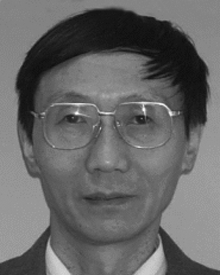 Wenli Xu合作论文数2
 Feng Lin合作论文数Department of Electrical and Computer Engineering, College of Engineering, Wayne State University2
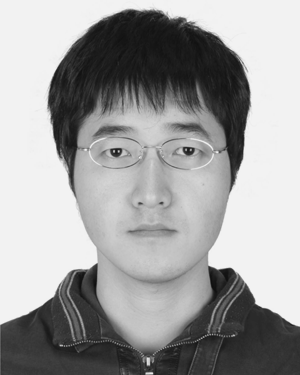 Honglin Zhou合作论文数Molecular Oncology, Genentech2David a Wilson合作论文数2G.D. Halikias合作论文数2Zhumu Fu (付主木)合作论文数1Yiyang Sun合作论文数1




