传统翼伞系统的航迹规划主要考虑落点精度及逆风着陆等指标,而当空投区域环境较为复杂,在翼伞系统归航路径上存在障碍时,如何规避这些障碍也成为翼伞系统航迹规划所必须要考虑的因素.针对翼伞空投过程有可能遇到高山或者高大建筑物阻碍的问题,提出了一种复杂环境下翼伞系统的组合式航迹规划策略.该方法将翼伞空投的区域分为障碍区和着陆区,在障碍区中采用快速搜索随机树(RRT)算法进行可行路径搜索,考虑到RRT算法生成的轨迹包含棱角,导致路径不够平滑的问题,结合翼伞系统质点模型的运动特性,对其进行了适用性改进,以使规划的航迹满足实际翼伞空投需求.为了解决RRT算法搜索方向随机,难以满足逆风着陆的问题,当翼伞系统进入着陆区后采用分段归航的方式设计航迹,并借助遗传算法(GA)求解目标参数,实现翼伞系统能量控制及逆风着陆.提出的复杂环境下翼伞系统的组合式航迹规划策略求解速度较快,能够同时满足翼伞系统避障、能量控制及逆风着陆要求,得到的参考航迹较为平滑.
为了能够有效地控制翼伞的飞行状态并获取翼伞飞行时的相关参数,设计一套翼伞空投测控系统,基于该系统进行了实地的空投实验.通过分析空投实验获取的有效数据,得到翼伞的实际飞行轨迹、左右操纵绳的下拉量、操纵绳的受力大小等结果.基于上述实验结果,计算出翼伞的盘旋半径以及实际飞行时的滑降比大小.
As a non-destructive testing technology, γ-photon imaging technology has a good application prospect in the industrial field. However, due to the γ-photon scattering problem caused by high-density metal and the rapid industrial detection requirement, γ-photon imaging technology has not been effectively applied in industrial detection. Thus, this paper proposed a compensatory single scatter simulation (C-SSS) and combined it with the 3D ordered subset expectation maximization (3D-OSEM) image reconstruction algorithm for optimization to solve the above problems. To verify the effectiveness of the C-SSS algorithm, this paper compared C-SSS with the single scatter simulation by two types of phantoms and the inner cavity detection of industrial components. The comparison results proved that C-SSS can effectively improve the measurement accuracy and reduce the scanning time. In addition, after the algorithm code was optimized and accelerated by the graphic processing unit, the execution time of C-SSS was ∼4 min and a single iteration of 3D-OSEM took ∼3 min, basically satisfying the requirements of rapid industrial detection. Simulation and experiment results show the potential of the proposed algorithm in industrial detection.
The powered parafoil system is obtained by adding the propeller thrust to the unpowered parafoil system, and has coupling and nonlinear characteristics, which make its precise control more difficult than that of the unpowered parafoil system. To achieve the trajectory tracking control of the powered parafoil system in the field of precision airdrop, a mathematical model of the 6-DOF of the powered parafoil system is established first. Then, a new trajectory tracking strategy is proposed, which can overcome the limitations of the traditional guidance-based trajectory tracking strategy. We design lateral, longitudinal, and velocity controllers on the basis of the motion characteristics of the powered parafoil system. Then, we adopt the widely used PID control strategy in engineering. In response to the difficult of the PID controller parameter tuning of the powered parafoil system, we achieve the PID controller parameter tuning with the ecosystem particle swarm optimization (ESPSO) of the swarm intelligence optimization algorithm. The effectiveness of the algorithm is verified by simulation experiments. Results show that the proposed algorithm can obtain high trajectory tracking accuracy even when a deviation in the initial state and a random gust wind disturbance in the outside world occur regardless of the method of the multiphase homing or the optimal control homing adopted. The proposed trajectory tracking strategy also has strong robustness and adaptability.
This study investigates the application of positron annihilation techniques to the interior of dense metal cavities for Three-dimensional (3D) imaging and extraction of contour features inside the cavities. A feature extraction algorithm based on a 3D anisotropic convolutional operator is proposed for profile feature extraction in low-resolution, low-contrast, and low-signal-to-noise positron image. First, aiming at the problem of positron image noise caused by inconsistent detectors and metal scattering effects, an image preprocessing algorithm combining filtering and full pixel correction is proposed. A 3D anisotropic convolution operator is then designed to extract contour features. To solve the contour feature discontinuity in the extracted contour feature, a 3D path search algorithm is proposed to obtain the centroid coordinate set of the contour feature, and then the centroid coordinate set is subjected to 3D curve fitting to obtain a smooth and continuous contour feature. The study is carried out on the raw 16-bit Digital Imaging and Communications in Medicine (DICOM) data of the positron image, and the data are processed from a 3D perspective, taking full advantage of the correlation between slices in the 3D positron image. In the actual testing, positron images with different kinds of foreign objects in the cavity are extracted using a 3D anisotropic convolution operator, and the contour feature extraction resolution reaches 2 mm.
结构体内表面缺陷的检测是常规检测手段难以实现的难题,利用γ光子很强的穿透性和PET检测技术实现了对工业件内腔表面的检测和成像.为了实现对复杂结构件内表面缺陷的自动检测判定,提出了一种利用结构体点云与检测点云数据融合的方法,实现复杂结构内表面缺陷的检测与判定.首先利用灌注法对工件进行探测,得到结构件内腔三维检测图像并转换成检测点云,然后基于PCA-ICP算法实现检测点云和待检测工件内腔模型点云配准,最后利用配准结果判定是否存在缺陷.通过仿真与试验,验证了该方法的有效性,在对三通模型实际检测试验中,该方法的配准误差为0.69 mm,耗时11.299 s.
传统最优控制航迹规划一般以逆风精确着陆、控制能量小为优化目标,但传统最优控制的操纵过程一般是一条连续变化的曲线,工程上不易实施;与之相比,传统分段航迹规划操纵简单,工程上容易实施,能实现逆风精确着陆的目标,但控制能耗大.为了兼顾逆风精确着陆、能耗低和控制操作简单等目标,提出了一种基于梯度下降法的翼伞最优分段航迹规划方法.该方法将控制变量参数化,将逆风精确着陆、控制能耗小、能实现避障等多目标优化问题转化为加权单目标优化问题,并通过梯度下降法求解得到分段常值最优归航航迹.所提算法与基于伪谱法的最优控制规划航迹和基于遗传算法的分段规划航迹进行了对比,算法仿真结果表明本文提出的最优分段航迹规划法既可以实现着陆精度高、控制能量小、逆风着陆和避障的优化目标,同时规划的航迹又由分段常值实现控制,工程上容易实施,兼顾了最优控制航迹规划和分段航迹规划的优点.
Hypersonic vehicles (HSVs) exhibit significant advantages over other vehicles, including the wide range of velocity and large airspace types, and these features have contributed to the rapid development of HSVs in the last 20 years. Moreover, hypersonic technologies have become a multidisciplinary research topic in the fields of aerodynamics, propulsion, structure, material, and control. Different types of re-entry gliding, air-breathing cruise, and aerospace vehicles have been designed to realize ambitious tasks, which in turn influenced the technological advancements and process change in the military. This paper summarizes the control-oriented integrated design of HSVs. First, the status of current research on the distinct characteristics and technique issues of HSVs is introduced. Then, the progresses made on complex modeling, guidance and control, and trajectory optimization are elaborated to exhibit the significant research interest in hypersonic technologies. The control-integrated design of HSVs is emphasized to solve the multidisciplinary design problems associated with the model and its control and trajectory. Various strategies regarding the multidisciplinary optimization design are also proposed to solve the integrated design problem. Finally, suggestions are provided for the control-oriented integrated design of HSVs.
For air-breathing hypersonic vehicle, there exits significant aerodynamic/propulsion/structure couplings due to the integrated design, which requires detailed performance limitation analysis during the concept design phase. Aerodynamic derivatives are important parameters for hypersonic vehicle while open-loop performance affects the achievable closed-loop performance, there is mutual relationship between aerodynamic derivatives and the open-loop performance, the changes of aerodynamic derivatives under different flight conditions will directly affect the performance of the open loop. In this paper, the waverider model like X-43A is established and linearized, then aerodynamic derivatives will extract from the model state and control matrices, nine aerodynamic derivatives are considered in this paper. In addition, three kinds of open-loop performance are introduced including the deflection of elevator, the lag of path-attitude response, and the right half plane zero bandwidth constraints, which are obtained from aerodynamic derivatives. Finally, by analyzing them under different flight conditions, the best flight condition range is obtained.
The inversion design approach is a very useful tool for the complex multiple-input-multiple-output nonlinear systems to implement the decoupling control goal, such as the airplane model and spacecraft model. In this work, the flight control law is proposed using the neural-based inversion design method associated with the nonlinear compensation for a general longitudinal model of the airplane. First, the nonlinear mathematic model is converted to the equivalent linear model based on the feedback linearization theory. Then, the flight control law integrated with this inversion model is developed to stabilize the nonlinear system and relieve the coupling effect. Afterwards, the inversion control combined with the neural network and nonlinear portion is presented to improve the transient performance and attenuate the uncertain effects on both external disturbances and model errors. Finally, the simulation results demonstrate the effectiveness of this controller.
 Min Zhao (赵敏)合作论文数College of Automation Engineering, Nanjing University of Aeronautics and Astronautics7
 Min Yao (姚敏)合作论文数College of Automation Engineering, Nanjing University of Aeronautics and Astronautics5
 Zenghao Zhao合作论文数4
 Ruipeng Guo (郭瑞鹏)合作论文数College of Automation Engineering, Nanjing University of Aeronautics and Astronautics4
 Tong Sun合作论文数3
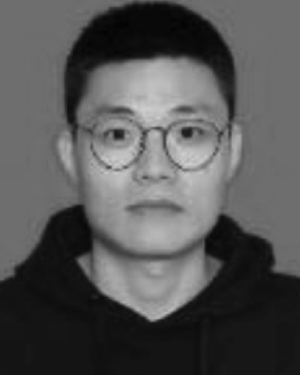 Tao Jiang (姜涛)合作论文数3
 Yanbin Liu (刘燕斌)合作论文数College of Astronautics, Nanjing University of Aeronautics and Astronautics3
 Haidong Shen (沈海东)合作论文数College of Astronautics, Nanjing University of Aeronautics and Astronautics2HE Ziyang (何紫阳)合作论文数2
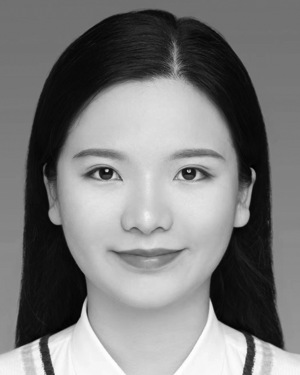 Chen Boyi合作论文数Nanjing Univ Aeronaut & Astronaut, Coll Astronaut, Nanjing 210016, Jiangsu, Peoples R China2
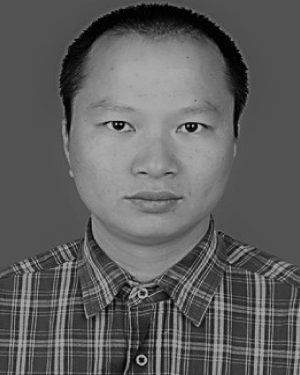 Qi Chen合作论文数2
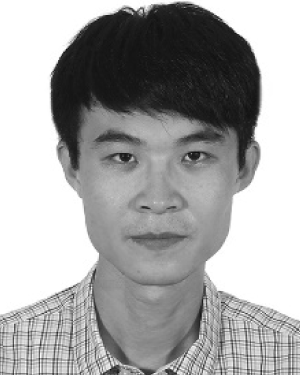 Xiao Hui合作论文数1Wang Songsong (王松松)合作论文数1Feiteng Jin合作论文数1




