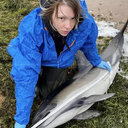
A study of the levels of persistent organochlorine pesticides (OCPs) in marine mammals of the Black Sea in 2018–2022 revealed a statistically significant relationship of the accumulation levels with the sex of the animals (males were more contaminated than females) and with the age group (adults and adolescents were more contaminated than calves and newborns). The location of tissue sampling for analysis was also an important factor: OCPs accumulated more in dorsal than in caudal blubber. In blubber of Black Sea harbor porpoises and common dolphins, the mean concentrations of OCPs decreased in the order p, p'-DDE > β-HCH > p, p'-DDD > p, p'-DDT; in the common bottlenose dolphin, they decreased in the order p, p'-DDE > p, p'-DDD > β-HCH > p, p'-DDT. The most widespread and highly concentrated metabolite was found to be p, p'-DDE. The concentration of p, p'-DDD was markedly lower; significant tissue concentrations of p, p'-DDT were observed much less frequently than all other metabolites and were among the lowest of all metabolites. Based on an analysis of variations in the mean concentrations of the sum of DDT metabolites in Black Sea harbor porpoise tissues, as reported in literature sources, we can claim that there is currently a significant decrease in the concentrations of these toxicants.
Accumulation of persistent organochlorine pesticides (OCP) in fat tissue was examined for the mammals found released ashore along the Crimean coast of the Black Sea in 2018–2022. This group of animals is positioned at the top of food chain in the local marine ecosystem. Statistically significant dependence of the accumulation on sex (males are more contaminated than females) and age (adults and juveniles are more contaminated than calves and neonates) is found. Besides, the pesticides concentration in fat from dorsal tissue is generally higher than in fat from caudal stem, but the difference is not significant. In the tissue of harbor porpoises and common dolphins, the mean OCP concentration decreased in the order: p,p′-DDE > β-HCH > p,p′-DDD > p,p′-DDT, whereas bottlenose dolphins had the order: p,p′-DDE > p,p′-DDD > β-HCH > p,p′-DDT. The most common metabolites were DDE, and their accumulation was the highest. The concentration of DDD was considerably lower, and significant accumulation of DDT was observed rarely, so the mean concentration of these group of metabolites was the lowest.
The term "epimeletic" ("caregiving") is used to represent a range of cetacean behavioural patterns directed at dead or distressed conspecifics, including accompanying, lifting to the surface, and protecting from apparent threats.This behaviour has been described in the literature for various cetacean species; however, such reports have not yet involved members of the Phocoenidae family.The Black Sea harbour porpoise (Phocoena phocoena relicta Abel, 1905) is an endangered subspecies that is endemic to the Black Sea.Despite the proximity of its habitats to the coast, many aspects of its biology, including behaviour, remain poorly studied.In this paper, we present the first report of epimeletic behaviour in a wild Black Sea harbour porpoise towards a dead calf.The observation took place during the marine mammal stranding network operation off the Crimean coast in July 2018.A recently deceased harbour porpoise calf was found floating on the water surface close to the shore, where it was escorted by a live adult porpoise.We performed a physical examination and an autopsy of the calf, which revealed pulmonary edema, esophagitis, and enteritis.Milk was present in the stomach, indicating recent feeding.We assume that the adult individual could be a lactating female.This observation is probably the only indication to date of the possibility of wild harbour porpoises showing epimeletic behaviour towards dead calves, which emphasizes the importance of conducting wider in-depth studies on their behavioural characteristics and social interaction.
В рамках работы сети регистрации и мониторинга выбросов китообразных были получены данные о 225 животных, обнаруженных на черноморском побережье Крыма или в прибрежной акватории. В ходе мониторинга участка побережья Юго-Восточного Крыма было обнаружено 8 животных. От местного населения и отдыхающих было получено 172 сообщения о 217 животных (из них 10 животных были обнаружены живыми). Среди упомянутых 217 животных преобладали морские свиньи (75,1%), также были обнаружены афалины (11,5%) и белобочки (6,5%). Наибольшее количество животных было зафиксировано в Севастопольском районе (42%) и ЮгоВосточном Крыму (21%). Причинами этого, по нашему мнению, являются высокая концентрация отдыхающих в местах обитания локальных популяций китообразных и интенсивное рыболовство в летний сезон в этих районах. Пик обнаружения выброшенных животных пришелся на июль. Среди обнаруженных морских свиней (всего 163 животных) почти 30% составляли детеныши. Интенсивное рыболовство в местах обитания морской свиньи повышает вероятность гибели в орудиях лова пар самка-детеныш в критический сезон выкармливания новорожденных: июнь – июль. Для сокращения гибели требуется оценка распределения локальных стад и ограничение рыболовства в местах обитания животных в этот период. Интеграция данных об обнаруженных 10 погибших животных на побережье и в акватории Судакского района с данными о работе рыболовецких судов с учетом временных показателей позволяют предположить гибель животных в тралах. Нами предложена гипотеза об отсутствии внешних признаков гибели в результате прилова в ряде случаев попадания китообразных в трал. Дальнейшее развитие РИМСсети (регистрация – исследования – мониторинг – спасение) в Крыму наиболее эффективно в случае объединения компонентов регистрации данных от населения и мониторинга контрольных участков; при этом оба компонента должны сопровождаться проведением комплексных исследований выброшенных животных.
Представлены данные о содержании хлорорганических пестицидов (ХОП) и полихлорированных бифенилов (ПХБ) в подкожном жировом слое черноморских дельфинов - афалин, белобочек и морских свиней (азовок), выброшенных на крымское побережье в 2017 г. Во всех исследованных пробах обнаружены α-, β- и γ-ГХЦГ в интервале концентраций от 0,003 до 0,264 (∑ГХЦГ от 0,036 до 0,319); гексахлорбензол – от 0,12 до 8,14; п,п’-ДДТ и его метаболиты п,п’-ДДЭ и п,п’-ДДД – от 0,08 до 146,95 (∑ДДТ от 1,27 до 163,18); а также шесть конгенеров полихлорбифенилов (по IUPAC: 28, 52, 101, 138, 153 и 180) – от 0,004 до 11,28 (∑ПХБ6 от 0,42 до 27,04) мкг·г–1 липидной массы. Доля п,п’-ДДЭ составляла от 44 до 90% суммы ХОП и достигала 146,95 мкг·г–1 липидной массы. Максимальная концентрация ХОП и ПХБ зафиксирована в пробах подкожного жира белобочек.