Safety-critical autonomous driving requires reliable decision-making in a highly interactive, safety-critical urban driving scenario. Although learning-based methods are attractive for such problems, unconstrained trial-and-error exploration can readily produce unsafe actions during training and lead to unreliable closed-loop behavior. This paper considers an unprotected left-turn task at a signal-free intersection and proposes a safety-guided reinforcement learning (RL) framework in which a Control-Barrier-and-Lyapunov-Function-based Quadratic Program (CBLF-QP) serves as a guidance mechanism for policy learning rather than as a hard safety shield. The framework is built on an affine kinematic vehicle model, and higher-order control barrier function constraints are used to encode geometric safety requirements, including collision avoidance and lane keeping. At each state, the CBLF-QP computes a minimum-intervention safe reference action together with a barrier-violation indicator. The reference action is incorporated into policy learning through a mean-squared imitation loss, progressively reshaping the policy distribution without the discontinuities caused by hard action replacement. A primal-dual adaptive weighting mechanism further modulates the guidance strength according to the violation level, balancing task performance and safety regularization during training. Simulations under different traffic-density levels and real-vehicle experiments with virtual surrounding traffic demonstrate improved training stability, reduced collision-related safety cost, and practical feasibility while maintaining competitive efficiency.
Trajectory tracking of autonomous vehicles in open-road environments is inherently subject to unpredictable uncertainties, external disturbances, and nonholonomic system constraints. To rigorously address these challenges, this paper proposes an observer-based robust model predictive control (MPC) with theoretically guaranteed robustness and tracking performance. First, a linear parameter-varying (LPV) system representation is formulated by embedding the time-varying tire cornering stiffness and longitudinal velocity into a unified polytopic structure. Then, to enable real-time estimation of the vehicle sideslip angle, a quadratic-boundedness-based robust observer with offline gain computation is designed. The estimation error set is updated online by computing the minimal admissible bound on the observation error. Next, the observer-based robust min-max MPC problem is systematically formulated via constructing tractable linear matrix inequalities (LMIs). Closed-loop stability is guaranteed by incorporating the terminal invariant set. Phase-plane-based vehicle stability region and control barrier function (CBF)-based safety constraints are integrated into the robust MPC framework in a manner that rigorously preserves Lyapunov stability. Subsequently, an offline solution is devised to alleviate the online computational burden and facilitate real-time deployment. Finally, hardware-in-the-loop (HIL) experiments and real-vehicle tests with recent benchmark methods validate the effectiveness and superiority of the proposed approach.
This paper develops a fuzzy game-theoretic tube model predictive control (MPC) framework for coordinated vehicle lateral motion control using active front steering (AFS) and direct yaw moment control (DYC). The vehicle dynamics are represented by a discrete-time Takagi-Sugeno fuzzy model to capture operating-condition dependence and parametric uncertainty, while a common-feedback tube MPC structure is employed to guarantee robust constraint satisfaction through an offline-designed invariant tube and terminal set. On this basis, the nominal control problem is formulated as a two-player finite-horizon Nash game, allowing AFS and DYC to optimize individual performance objectives under shared state dynamics and constraints. To enable real-time implementation, two fixedcomplexity online Nash solvers are considered: a best-response (BR) iteration scheme and a variational inequality (VI) formulation solved by an extragradient method. The closed-loop analysis establishes recursive feasibility under bounded disturbances and finite-iteration online equilibrium computation. In addition, a practical input-to-state stability result is derived, in which the effect of inexact online Nash solutions is explicitly captured through a practical-descent framework. Compared with the BR solver, the VI-based solver provides a more direct residual-based interpretation of equilibrium approximation accuracy and its relation to closed-loop stability margins. Hardware-in-the-loop experiments under multiple driving maneuvers verify that the proposed framework is computationally tractable and effective in real time, while achieving robust tracking performance, constraint satisfaction, and coordinated actuator usage.
Realistic faults and failures often occur probabilistically in the lane-keeping system of autonomous electric vehicles, reducing system reliability and posing significant challenges to driving safety. To enhance the system resilience, this paper proposes a novel robust fuzzy fault-tolerant control strategy that incorporates the adaptive event-trigger (AET) mechanism to realize stable, reliable, and precise lane-keeping control in the presence of multiple system uncertainties and probabilistic faults. First, to capture the uncertain and time-varying nature of tire cornering stiffness, an effective Takagi-Sugeno (T-S) fuzzy tire model is developed. Then, by employing the distribution-based probabilistic approach, two sets of unrelated random variables, random sensor and actuator faults in the control system, are modeled. Next, to improve communication efficiency and address ineluctable network-induced delays, an AET control framework with a well-designed triggering condition is established. Subsequently, a robust fuzzy output feedback fault-tolerant lane-keeping controller that satisfies the H infinity performance is designed by using the Lyapunov-Krasovski functional method. Furthermore, the mean-square exponential stability of the closed-loop system is rigorously guaranteed. Finally, real-time simulations based on Carsim/Simulink co-simulation platform under dynamic driving conditions demonstrate the feasibility and effectiveness of the proposed control strategy.
As typical cyber-physical systems (CPSs), modern vehicles are exposed to multiple disturbances, with computational resources being a key factor that limits global optimization. To effectively handle system disturbances while reducing computational demand, this article proposes an event-triggered robust tube model predictive control (MPC) scheme for vehicle lateral stability control. A lateral control model incorporating phase-plane stability constraints is first established. An invariant-set-based event-triggered tube MPC algorithm is then developed, where the triggering condition is constructed using the current system state and buffered predicted trajectory. A fixed tolerant invariant set is employed to reduce online computation, and a feedback control policy with quadratic boundedness performance is designed to suppress state deviations and improve triggering accuracy. Recursive feasibility is rigorously established, and closed-loop input-to-state stability is guaranteed via Lyapunov-based analysis. Moreover, the feedback gain, invariant sets, and terminal ingredients are precomputed offline, enabling real-time implementation. Extensive hardware-in-the-loop experiments and real-vehicle tests are conducted to validate robustness under uncertainties and diverse operating conditions. Comparative results demonstrate the effectiveness and superior performance of the proposed method.
Establishing an adaptive cruise strategy which can have an outstanding performance under various pavement types is extremely necessary to decision making for intelligent vehicles. However, existing research for tyre-road friction coefficient (TRFC) estimation ignore the influence of state mutation and noise uncertainty, which will lead to unsatisfactory estimation precision. To address these problems, adaptive strong tracking square-root cubature Kalman filter (ASTSCKF) is proposed to guarantee the precision for TRFC estimation, which is composed of Sage-Husa noise estimator and strong tracing filtering. Simulation and vehicle testing based on the simulator platform indicate that ASTSCKF is capable of estimating TRFC more accurately than extended Kalman filter (EKF) and unscented Kalman filter (UKF), showing strong anti-interference to different pavement types. The proposed cruise scheme also displays an excellent tracking performance on the leading vehicle, which verifies the feasibility of the cruise scheme.
Despite remarkable achievements have been obtained for the connected and automated vehicles (CAVs) in last decades, various of realistic problems still exist, which exactly block the large-scale application of CAVs. Against this backdrop, this paper proposes a novel stochastic cooperative adaptive cruise control (CACC) strategy to realize the stable control of nonhomogeneous vehicle platoon system with simultaneously suffering from the on-board sensor data distortion, random wind disturbance, and communication delay. First, the dynamics model of the nonhomogeneous platoon with variant vehicle masses and lengths is built based on the predecessor-leader following (PLF) communication topology. Then, the simplified characteristic of sensor data distortion resulting from the limited sensing range is depicted in line with the variation of headway spacing. Thereafter, the random wind velocity is treated as the Gaussian white noise and incorporated into the platoon system via employing the Ito stochastic differential. The varying road slope and communication delay are also accommodated in unison. Next, the distributed robust H infinity controller is generated via the stochastic Lyapunov-Krasovskii functional approach. Moreover, the condition for string stability is derived with the defined stochastic L-2 stability criterion. Finally, numerical simulations and real-time hardware in loop (HiL) experiment demonstrate the feasibility of the proposed approach.
Ensuring robustness and adaptability of vehicle stability control under dynamic driving conditions is highly challenging, particularly when multiple performance objectives must be simultaneously satisfied in practical engineering applications. To this end, this article proposes an event-driven control framework for distributed-driven electric vehicles (DDEVs) to enhance the system performance and balance the steerability, stability, and energy efficiency. First, the event-oriented control strategy set is created corresponding to the performance-based driving event library. Each event-driven strategy is implemented by a specific combination of active front steering (AFS), direct yaw moment control (DYC), and torque allocation (TA) under a hierarchical control structure. Next, a novel division criterion of the stability region is developed by the combination of theoretical analysis and physical mappings via using projections on the phase plane for maximum linear points of yaw rate growth versus steering angle. Then, the event-driven principle is established based on the normalized stability factor that is also being as the coordination factor for the upper interaction of AFS and DYC and the lower balance between optimal adhesion utilization (OAU) and minimization of motor power loss. Finally, comparative hardware-in-the-loop (HIL) experiments in extreme conditions demonstrate the feasibility and superiority of the proposed strategy.
This article aims to address the realistic path tracking control problem toward high-system performance for commercial autonomous ground vehicles (AGVs) with simultaneously guaranteeing the tracking accuracy, yaw and roll stability under limited vehicle network resources in global position system temporarily unavailable environments. In such conditions, the vehicle full state information and road topography might not be accessible in real time. To this end, this article proposes an effective adaptive event-trigger (AET)-based robust path tracking control strategy with introducing the reliable Takagi-Sugeno (T-S) fuzzy state observer for practical implementation. First, the vehicle yaw and roll coupled dynamics is incorporated into the vehicle-road system model, with modeling the tire cornering stiffness uncertainty by the T-S fuzzy technique and resolving the system disturbances as unknown inputs. Then, the fuzzy observer structure is established with unmeasurable premise variables which are handled by norm-bound method. Next, a well-designed AET control framework is constructed to reduce the real-time network occupation rate and economize the communication bandwidth resources. Besides, the input constraint and rollover prevention are handled using the robust set invariance. After that, the parallel distributed compensation (PDC) controller and observer are co-designed through solving the effective linear matrix inequalities (LMIs). In addition, the close-loop stability and $H\infty$ performance are ensured by means of the delay dependent Lyapunov-Krasovski method. Finally, the validity and superiority of the proposed control strategy have been verified by Carsim-Simulink co-simulations in different dynamic scenarios with high-fidelity full vehicle model.
The accurate estimation of crucial state parameters, such as sideslip angle and tire cornering stiffness, plays a vital role in ensuring the efficacy of active safety technology and motion control for distributed drive electric vehicles. To address the challenges posed by missing measurements from multiple sensors and dynamic model mismatch during the estimation process, this article proposes a novel robust adaptive fault-tolerant estimator (RAFTE). Based on the four-wheel nonlinear vehicle model, the model parameters from the RAFTE are continuously adjusted by adaptive forgetting factor recursive least squares, which provides a more accurate dynamic model. Huber's robust M-estimation theory is integrated into the standard cubature Kalman filter, which adjusts the measurement noise covariance and innovation covariance to mitigate the effects of missing data. Then, an optimal adaptive factor is introduced to alleviate the issues of model mismatch and unmodeled dynamic characteristics that arise from the strong coupling nonlinear system. Finally, simulations and experiments are conducted to validate the estimation accuracy, convergence, and robustness of the proposed algorithm.
Active steering control is the key technology to improving vehicle safety and driver comfort, and its performance is largely affected by the uncertainties of human-machine interaction. To this end, this paper proposes a robust cooperative game based active steering control strategy considering the human-machine interaction characteristic to ensure the steering stability of the vehicle. The driver-vehicle system is modeled based on the T-S fuzzy structure to describe the uncertainty of the vehicle’s longitudinal velocity. Then the human-machine shared steering control is represented by a dynamic game process, in which the driver and the active steering control system are regarded as the participants. The cooperative game theory is introduced to decide the interaction control level. Such a design can achieve a better overall performance of agents through modeling the human-machine interaction process. Finally, a robust H ∞ compensation control method is proposed to improve the anti-interference performance of the system, thus ensuring vehicle stability. The MATLAB/Carsim joint simulation platform is established to verify the effectiveness of the proposed controller. The results show that the proposed human-machine cooperative control framework can guarantee the dynamic interactive performance while improving the vehicle handling performance. Furthermore, the hardware-in-the-loop (HIL) tests based on the LabVIEW-RT system also prove the feasibility.
针对虚假消息注入攻击下多车队列系统纵向稳定性控制问题,采用加性不确定方法量化攻击对队列系统的影响,采用等效时滞、网络诱导时滞等方法,将通信时滞与数据丢包、车载传感器数据离散化特性等因素整合到队列中,构建了网络攻击与信息延迟下的队列模型.基于李雅普诺夫-克拉索夫斯基稳定性理论和H∞鲁棒控制,提出了一种弱保守性分布式鲁棒抗干扰控制方法,并给出了队列系统保持稳定性的条件.仿真结果表明,所提出的鲁棒H∞控制方法在保证队列内稳定需求的同时,能兼顾队列稳定性.与常规队列干扰抑制控制方法相比,对于队列内相邻车辆之间的间距误差控制以及跟随车辆与领航车之间的速度跟踪控制效果更好.
Realistic uncertainties and disturbances cannot be ignored when striving towards high-performance autonomous driving. Meanwhile, advanced vehicular sensing technology enables more and more self-driving techniques to come out. Against this backdrop, this paper aims to holistically address the system uncertainties and disturbances in the path tracking control of autonomous vehicles (AVs) by the preview control theory to achieve superior control performance. First, unmeasureable multi-uncertainties and the external disturbance are considered simultaneously into the robust gain-scheduling framework with variable longitudinal velocity. Then, by the equivalent delay approach, ineluctable time-varying system delays are effectively handled. Next, the physical constraints of the steering system and direct yaw moment control (DYC) system are considered for practical implementation through robust set invariance theory. The parallel distributed compensation (PDC) technique and auxiliary feedback matrices approach are introduced for reducing design conservatism. After that, by incorporating the road curvature into the augmented system state, the path tracking preview control problem can be solved without online optimization. Thereafter, the closed-loop system stability and guaranteed performance have been proved through the Lyapunov- Krasovski approach. The proposed controller design is finally reformulated as the optimization problem based on linear matrix inequalities (LMIs) via specific convexification techniques. Finally, to verify the validity of the proposed controller, Software in Loop (SIL) tests with Carsim full-vehicle model under different dynamic conditions have been implemented.
This study addresses the problem of distributed robust control resistance to vehicle parametric uncertainty and hybrid attacks in heterogeneous vehicular platoon systems. First, an invaded heterogeneous vehicular platoon system is modeled accompanied by the technique of inverse model compensation to deal with the problem of non-linearities in longitudinal dynamics, a nominal vehicle mass is introduced to tackle the problem of heterogeneity and variability of vehicle masses. Besides, we quantize the effects of false-data injection (FDI) and message-delay (MD) attacks and integrate them into the proposed heterogeneous platoon system. Additionally, to obtain the desired inner-vehicle stability of a heterogeneous platoon, an inner-vehicle ${H}_\infty $ distributed robust stable controller is presented based on Lyapunov-Krasovskii functional. Finally, a ${\mathcal{L}}_2$ -based string stability criterion is put forward to weaken the attacks' effects when they propagate along with the platoon. To explain the superiority of the derived theory more directly, simulations with two different control methods about the heterogeneous platoon under hybrid attacks are provided. The results show that, compared to regular platoon control method, the proposed robust controller performs better in achieving the desired inter-vehicle spacing tracking and can maintain string stability of the platoon.
This study addresses the path tracking problem of autonomous distributed driven electric vehicles (ADDEVs) simultaneously with time-varying system delays, vehicle dynamic uncertainties and disturbances. To this end, this paper proposes a discrete-time robust preview feedback controller to achieve stable, accurate, smooth, and computationally efficient path tracking for highly automated vehicles. A robust gain scheduling framework is exploited to deal with high uncertainties, external disturbances, and time-varying longitudinal speed. The path tracking issue is formulated as the cost-guaranteed problem by augmenting the disturbance, i.e., the road curvature, within a finite preview window into the system state vector. To reduce the design conservatism, the parallel distributed compensation (PDC) technique is applied. The time-varying system delays have been solved with the delay dependent analysis approach based on Lyapunov- Krasovski theorem. High-fidelity Carsim-Matlab simulations have been conducted to validate the effectiveness of the proposed controller under dynamic condition.
Direct yaw moment control is a key technology to improve vehicle stability and driving comfort, and its performance has a great impact on vehicle active safety control. For solving the problems of model uncertainty and system robustness in vehicle active safety control, a direct yaw moment control formwork based on sliding robust control is proposed. It makes the state of the control system slide along the sliding surface by switching the control quantity, which can ensure the invariance of the control system under external disturbance and parameter perturbation. To describe the drivability of the vehicle under the tire nonlinear conditions, a vehicle dynamics model based on the Fiala method is established in the controller design. Meanwhile, a correction model of the reference yaw rate and reference sideslip angle based on the road adhesion coefficient is designed to ensure the tracking accuracy of the vehicle to the stability index. We established the control model of Simulink for co-simulation with Carsim. Meanwhile, a hardware simulation-in-the-loop(HIL) platform for yaw moment based on the NI-Lab VIEW system is established. The experiment shows that the formwork can further ensure the vehicle's stability by providing yaw moment when the vehicle is driving, and improving the vehicle's handling performance.
Complex traffic scenarios pose a challenge to the cooperation control of connected and automated vehicles (CAVs). Conventional platoon control or advanced driver-assistance systems only provide an isolated solution due to their inadequacies in systematic perspective. To this end, a multi-agent system (MAS) based distributed control architecture together with a hierarchical controller is proposed for the CAVs cooperation control system. The upper layer considers the potential states of a CAV in the platoon evolution (i.e., vehicle-cruising maneuver and vehicle-following maneuver) and elaborates the transition rules for discrete maneuvering behaviors. The lower layer includes the corresponding motion controller for each CAV. Artificial potential field (APF) combined with the distributed model predictive control algorithm is adopted to realize the integrated longitudinal, lateral and yaw motion control of CAVs. Next, inspired by the Pareto-optimal method for tackling the MAS-cooperation system, an optimal solution strategy is introduced to solve the CAVs cooperation problem from the viewpoint of the control theory. Furthermore, multi-constraints are designed to ensure a safety inter-vehicle spacing between CAVs, while the vehicle stability can also be guaranteed. The simulation results demonstrate that the MAS-based hierarchical control architecture can effectively handle the cooperation control of CAVs in the typical traffic scenarios. The real-time implementation of the proposed controller also proves the feasibility.
In this study, we present a novel discrete event-triggered scheme (DECS) based stochastic stable control protocol to address the stability of vehicle platoon under limited computing power and communication load. The influence of delays and air resistance on the vehicle platoon is studied under the system parameter of external interferences and equivalent information delays. In addition, to guarantee the vehicle platooning stability, the distributed controller is proposed according to the stability theory of stochastic system and $H_{\infty}$ control. Additionally, simulation studies are offered to confirm the effectiveness of our suggested controller. As demonstrated, the proposed robust event-triggered control method can achieve the vehicle platoon's stability with a lower computing burden.
为了实现智能汽车安全、高效地行驶,该文论述了智能汽车运动规划与控制理论与方法的研究现状,分析了国内外智能汽车路径规划、轨迹规划与横、纵向运动控制技术.研究表明,当前的运动规划多以简化车辆模型和约束为前提,较少考虑真实环境约束(如通讯损失、信息安全及混合交通);当前的运动控制多集中在横、纵向独立控制,未深入考虑系统非线性特性、时滞现象与随机不确定性.因此,该文提出智能汽车运动规划与控制的重要发展方向是:基于多源感知信息融合与先进通信技术,进一步提升运动规划与控制能力,实现复杂动态场景下兼顾车辆横、纵向动力学的多目标综合协同控制,达到智能汽车行驶安全性、经济性以及舒适性的最优实现.
This paper focus on the control strategy of the four-wheel independent driving (4WID) electric vehicle. Through the control strategy driving and power distribution, 4WID electric vehicle has the advantages of high efficiency, low energy consumption and so on. It can also realize the compound control of each hub motor easily, save energy and improve the vehicle dynamic performance at the same time. To optimize the control strategy of general working conditions, according to the theory of proportion adjustment of the yaw-moment feedback control, the vehicle model with 7 DOF and the wheel model were presented. The strategies of speed control, moment redistribution, and feedback adjustment were designed modularly. The result of CarSim-MATLAB/Simulink co-simulation validates the feasibility and effectiveness of the control strategy under the condition when low requirements for vehicle adaptability, the variation of kinetic parameters or road adhesion information can be ignored.
 Guodong Yin (殷国栋)合作论文数Jiangsu Engineering Research Center for Intelligent Eletrified Mobility, School of Mechanical Engineering, Southeast University18
 Jiwei Feng合作论文数10
 Liwei Xu合作论文数Southeast University10
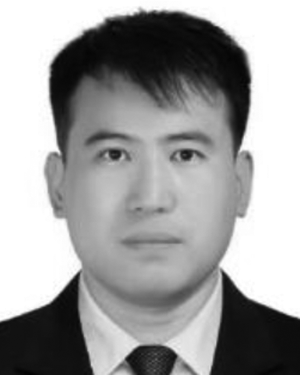 Jinhao Liang合作论文数6
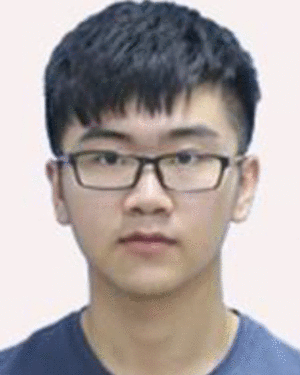 Ying Liu合作论文数5
 Yanbo Lu合作论文数4
 Haoji Liu合作论文数School of Mechanical Engineering, Southeast University2
 Tong Shen合作论文数2
 Fengjun Yan (闫凤军)合作论文数School of Transportation Science and Engineering, Beijing University of Aeronautics and Astronautics2
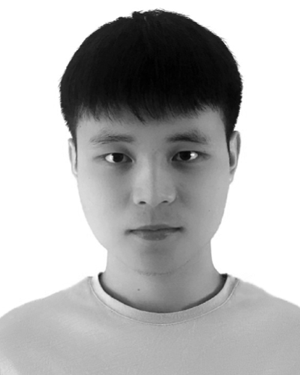 Fanxun Wang合作论文数1
 Chaobin Zhou合作论文数1
 Yanjun Ren (任彦君)合作论文数1
 Yan Wang (王雁)合作论文数School of Intelligence Science and Engineering, College of Artificial Intelligence, Harbin Institute of Technology, Shenzhen1
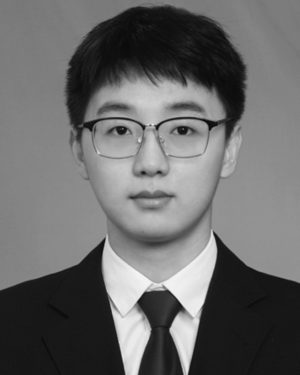 Mingzhuo Zhao合作论文数1
 Zhenwu Fang合作论文数School of Mechanical Engineering, Southeast University1
 Pai Peng合作论文数Nanjing Univ Sci & Technol, Dept Mech Engn, Nanjing, Jiangsu, Peoples R China1
 Yanjun Li合作论文数Southeast Univ, Sch Mech Engn, Nanjing, Jiangsu, Peoples R China1
 Chen Sun合作论文数University of Waterloo, Waterloo, Canada1
 Chao Yin合作论文数Southeast Univ, Acad Mech Engn, Nanjing 211189, Jiangsu, Peoples R China1
 Ran Shi合作论文数Dept. of Electron. Eng., Tsinghua Univ.;c;Dept. of Electron. Eng., Tsinghua Univ.1
 Xiaoyuan Zhu (祝小元)合作论文数School of Mechanical Engineering, Southeast University1
 Weichao Zhuang (庄伟超)合作论文数Department of Automotive Engineering, School of Mechanical Engineering, Southeast University1
 Dawei Pi (皮大伟)合作论文数School of Mechanical Engineering, Nanjing University of Science & Technology1
 Jinxiang Wang (王金湘)合作论文数School of Mechanical Engineering, Southeast University1




