Mesh subdivision is a fundamental operation for converting coarse, editable meshes into high-resolution surfaces, with broad applications in digital asset creation. Classical rule-based schemes rely on fixed local refinement rules and often produce over-smoothed surfaces. Recent neural subdivision methods improve detail synthesis, but remain constrained by local modeling and exhibit limited generalizability. We present SubdivAR, a neural mesh subdivision framework based on our proposed Mesh Autoregressive Representation (MAR). MAR arranges meshes at different subdivision levels into an ordered scale sequence, reformulating subdivision as autoregressive next-scale prediction. To support this formulation, we introduce a Hybrid Topology-Aware Transformer that combines global semantic attention with topology-constrained local feature aggregation. SubdivAR adopts a next-scale coordinate prediction paradigm, regressing vertex offsets at each refinement stage to preserve subdivision topology while recovering fine-grained geometric details. To enable reliable learning, we construct FII-40K, a curated dataset of nearly 40,000 high-quality meshes with multi-level subdivision supervision. Experiments show that SubdivAR outperforms state-of-the-art baselines, reducing Hausdorff Distance and Chamfer Distance by 18.8
Embodied World Models (EWMs) have emerged as a scalable and risk-free paradigm for advancing embodied intelligence, enabling the safety-critical evaluation of Vision-Language-Action systems. However, their reliability as evaluation benchmarks and foundational simulators is often hindered by the representation gap between low-dimensional actions and high-dimensional video synthesis. This gap results in a lack of geometric correspondence, manifesting as accumulated trajectory drift and inconsistent robot-object interactions during long-horizon rollouts. To bridge this gap, we propose ViPSim, a framework that achieves consistent long-horizon generation through the synergistic collaboration of Visual and Parameter Spaces. We define the Visual Space as a domain of explicit spatial priors, integrating pixel-aligned projections of end-effector pose, camera perspectives, depth-informed scene geometry, and robotic morphological masks to provide dense structural grounding. Concurrently, the Parameter Space serves as a domain of numerical drivers, injecting raw action sequences and camera matrices to provide precise motion guidance. By unifying these two spaces, ViPSim ensures that the generated states are simultaneously anchored by geometric boundaries and steered by numerical commands. Extensive experiments demonstrate that ViPSim is backbone-agnostic and significantly enhances trajectory consistency. Notably, our approach exhibits emergent capabilities in generating complex interactions with deformable objects (e.g., cloth folding) and maintains robust performance in out-of-distribution and cross-embodiment scenarios, providing a high-fidelity foundation for the automated evaluation and predictive control of embodied agents.
Video Large Language Models (Video-LLMs) have demonstrated strong performance on video understanding, yet their reliance on costly human supervision and susceptibility to hallucination hinder continual adaptation and reliability in dynamic real-world settings. In response, we present EvoCap, a fully automated framework that enables Video-LLMs to self-evolve and adapt to evolving data distributions and diverse video domains, without requiring external annotations. EvoCap operates in a closed loop: it generates captions, evaluates them through semantic consistency checks, and retrains the model with refined outputs, enabling knowledge consolidation from unlabeled videos. This self-supervised process progressively improves caption quality, scaling beyond the limitations of Supervised Fine-Tuning (SFT). Across multiple Video-LLMs, EvoCap delivers consistent gains, correcting failure cases unresolved by SFT and even outperforming on certain models. Analyses further reveal rapid early error correction, steady refinement of complex scenarios, and improvements in completeness and hallucination, establishing EvoCap as a practical paradigm for autonomous and scalable video captioning in real-world settings.
Recent studies have explored Vision-Language Models (VLMs) for food analysis. However, most existing methods rely primarily on supervised fine-tuning (SFT), which often limits reasoning and generalization capabilities. Moreover, high-quality large-scale nutritional annotations remain scarce. To address these issues, we introduce CalorieBench-80K, a large-scale benchmark with curated calorie labels and dietary advice annotations. To the best of our knowledge, it is the first food image benchmark to incorporate Chain-of-Thought (CoT) annotations for calorie reasoning. We also propose Food-R1, a unified food VLM trained in a multi-task learning paradigm to equip the model with broad capabilities. Food-R1 undergoes CoT-based cold-start instruction tuning, followed by reinforcement fine-tuning (RFT) using Group Relative Policy Optimization (GRPO) to improve reasoning and performance. Experiments on CalorieBench-80K and representative benchmarks show that Food-R1 consistently outperforms strong baselines across food-related tasks. The code, model weights, and benchmark annotations are available at the project repository.
Motion reasoning serves as the cornerstone of multi-object tracking (MOT), as it enables consistent association of targets across frames. However, existing motion estimation approaches face two major limitations: (1) instability caused by noisy or probabilistic predictions, and (2) vulnerability under occlusion, where trajectories often fragment once visual cues disappear.To overcome these issues, we propose a collaborative reasoning framework that enhances motion estimation through joint inference among multiple correlated objects. By allowing objects with similar motion states to mutually constrain and refine each other, our framework stabilizes noisy trajectories and infers plausible motion continuity even when target is occluded.To realize this concept, we design HyperSSM, an architecture that integrates Hypergraph computation and a State Space Model (SSM) for unified spatial–temporal reasoning. The Hypergraph module captures spatial motion correlations through dynamic hyperedges, while the SSM enforces temporal smoothness via structured state transitions. This synergistic design enables simultaneous optimization of spatial consensus and temporal coherence, resulting in robust and stable motion estimation.Extensive experiments on four mainstream and diverse benchmarks(MOT17, MOT20, DanceTrack, and SportsMOT) covering various motion patterns and scene complexities, demonstrate that our approach achieves state-of-the-art performance across a wide range of tracking scenarios.
Symbolic logical reasoning is a critical yet underexplored capability of large language models (LLMs), providing reliable and verifiable decision-making in high-stakes domains such as mathematical reasoning and legal judgment. In this study, we present a systematic analysis of logical reasoning under controlled increases in logical complexity, and reveal a previously unrecognized phenomenon, which we term **Logical Phase Transitions**: rather than degrading smoothly, logical reasoning performance remains stable within a regime but collapses abruptly beyond a critical logical depth, mirroring physical phase transitions such as water freezing beyond a critical temperature threshold. Building on this insight, we propose **Neuro-Symbolic Curriculum Tuning**, a principled framework that adaptively aligns natural language with logical symbols to establish a shared representation, and reshapes training dynamics around phase-transition boundaries to progressively strengthen reasoning at increasing logical depths. Experiments on five benchmarks show that our approach effectively mitigates logical reasoning collapse at high complexity, yielding average accuracy gains of +1.26 in naive prompting and +3.95 in CoT, while improving generalization to unseen logical compositions.
Logical reasoning is a fundamental capability of large language models (LLMs). However, existing studies largely overlook the interplay between logical complexity and semantic complexity, limiting their robustness under abstract propositions, ambiguous contexts, and conflicting stances, which are central to human reasoning. We propose **LogicAgent**, a semiotic-square–guided framework that jointly addresses these two axes of difficulty. The semiotic square provides a principled structure for multi-perspective semantic analysis, and LogicAgent integrates automated deduction with reflective verification to manage logical complexity across deeper reasoning chains. To evaluate reasoning under coupled semantic and logical complexity, we introduce **RepublicQA**, a benchmark that contains abstract propositions with systematically constructed contrary and contradictory forms, providing a semantically rich setting for assessing logical reasoning in LLMs. Experiments show that LogicAgent achieves state-of-the-art performance on RepublicQA with a 6.25% average gain, and generalizes well to four mainstream logical reasoning benchmarks with an additional 7.05% improvement, highlighting the effectiveness of our semiotic-grounded multi-perspective reasoning in boosting LLMs’ logical performance.
Recent attempts to combine low-rank adaptation (LoRA) with mixture-of-experts (MoE) for multi-task adaptation of Large Language Models (LLMs) often replace whole attention/FFN layers with switch experts or append parallel expert branches, undermining parameter efficiency and limiting task specialization. We introduce **LoRA-Mixer**, a modular MoE framework that routes task-specific LoRA experts into the core projection matrices of the attention module (input/output linear layers), rather than primarily targeting FFN blocks. The design delivers fine-grained token-level specialization by fully exploiting the attention mechanism, while remaining drop-in compatible with Transformers and state-space models (SSMs) as the linear projection layers are ubiquitous. To train robust routers from limited data while promoting stable, selective decisions and high expert reuse, **LoRA-Mixer** employs an adaptive **Routing Specialization Loss (RSL)** that jointly enforces global load balance and input-aware specialization via an entropy-shaping objective. The framework supports two regimes: (i) joint optimization of adapters and router with a differentiable hard–soft top-k routing scheme, and (ii) plug-and-play routing over frozen, pre-trained LoRA modules sourced from public repositories. Across 15 benchmarks—including MedQA, GSM8K, HumanEval, and GLUE—RSL-optimized LoRA-Mixer outperforms state-of-the-art routing and LoRA-MoE baselines while using 48% of their trainable parameters, with gains of +3.79%, +2.90%, and +3.95% on GSM8K, CoLA, and ARC-C, respectively. Cross-model transfer and adapter reuse experiments further demonstrate the approach’s versatility and data efficiency.
In this paper, we study whether an off-the-shelf LLM can be adapted into a discrete, variable-length token compressor and decompressor for long-context processing. To this end, we design a self-expressive autoencoding framework that fine-tunes a pretrained LLM with lightweight LoRA adapters to map long texts into compact sequences of learned latent codes, termed Z-tokens, and to decode them back into natural language or task outputs. The resulting representation is content-adaptive: less predictable or information-dense segments can receive more Z-tokens, while redundant regions can be represented more compactly through a budget-aware length regularizer. Our method is evaluated on long-context datasets such as Wikipedia, CNN/DailyMail, HotpotQA, and QuALITY, showing that it preserves reconstruction quality and downstream performance while reducing effective context length, generation-stage memory usage, and end-to-end latency. This simple design supports both direct decoding from compressed contexts and autoregressive generation in the Z-token space, providing a practical interface for efficient long-context inference.
Constructing a 4D language field that supports open-vocabulary queries is essential for semantic perception and interaction in dynamic environments. Existing 4D Gaussian-based approaches face two major challenges. First, the assumption of a static identity per Gaussian leads to semantic inconsistency, as motion fields warp Gaussians across object boundaries over time, causing oscillating identity assignments. Second, current methods typically model dynamic semantics as a set of discrete, predefined state prototypes, which fail to capture dynamic continuity and delineate fine-grained temporal boundaries. To address these issues, we propose LangField4D, a novel 4D Gaussian framework that jointly models spatio-temporal identity and semantics in a unified and continuous representation. We introduce an Identity-Adaptive Gaussian Grouping module that assigns each Gaussian a learnable adaptation feature to dynamically capture its object affiliation, ensuring consistent semantic tracking across time. Building upon this affiliation structure, we further design a Continuous Spatio-Temporal Semantic Learning mechanism based on a Tetraplane representation, which encodes both time-invariant and time-varying semantics within a continuous latent space. Extensive experiments on dynamic scene benchmarks demonstrate that we achieve state-of-the-art performance on both time-agnostic and time-sensitive open-vocabulary query tasks.
In this paper, we introduce LATO, a novel topology-preserving latent representation that enables scalable, flow matching-based synthesis of explicit 3D meshes. LATO represents a mesh as a Vertex Displacement Field (VDF) anchored on surface, incorporating a sparse voxel Variational Autoencoder (VAE) to compress this explicit signal into a structured, topology-aware voxel latent. To decapsulate the mesh, the VAE decoder progressively subdivides and prunes latent voxels to instantiate precise vertex locations. In the end, a dedicated connection head queries the voxel latent to predict edge connectivity between vertex pairs directly, allowing mesh topology to be recovered without isosurface extraction or heuristic meshing. For generative modeling, LATO adopts a two-stage flow matching process, first synthesizing the structure voxels and subsequently refining the voxel-wise topology features. Compared to prior isosurface/triangle-based diffusion models and autoregressive generation approaches, LATO generates meshes with complex geometry, well-formed topology while being highly efficient in inference.
Instruction-driven editing of 3D human motion requires precise spatiotemporal localization, rich semantic grounding, and strict preservation of unmodified content. Existing methods either resort to training-free adaptation of generative models or rely solely on triplet supervision; however, adaptation often yields suboptimal control, and manually curated triplet datasets remain severely limited in scale and semantic diversity. To overcome this bottleneck, we ground motion editing directly within text-to-motion generation across data, architecture, and inference. At the data level, we develop a closed-loop synthesis-and-verification pipeline that produces Omni-MoEdit, a large-scale dataset spanning body-part, amplitude, temporal, action, and style edits. At the architectural level, we introduce UniMoFlow, a unified latent flow-matching model that shares broad semantic and kinematic knowledge between generation and editing. At the inference level, SAFE (Source-Anchored Flow Editing) complements UniMoFlow with controllable, source-anchored refinement. Furthermore, we augment standard evaluations with semantics-aware metrics to account for valid edits that inherently deviate from a single ground-truth reference. Extensive experiments demonstrate improved target-text alignment, edit effectiveness, and cycle consistency, while maintaining competitive source fidelity and text-to-motion generation quality.
Compressed sensing (CS) enables the acquisition of signals at a sampling rate substantially lower than the Nyquist sampling rate, thereby reducing data volume and analog-to-digital conversion (ADC) costs, which makes it highly promising for resource-constrained Internet of Things (IoT) devices. However, to fully realize this potential, the acquired CS measurements must be efficiently compressed under the stringent low-complexity constraints of IoT edge nodes. Since the spatial correlation in the pixel domain is broken by CS sampling process, traditional prediction coding methods, which rely on spatial correlation, fail to adapt effectively for encoding the CS measurements. To overcome this limitation, we introduce a measurement-domain sub-image estimation (MSE) scheme specifically designed for measurement coding under block CS (BCS) framework. This scheme can approximately estimate a low-resolution sub-image in the measurement domain. Building on this, we further propose a MSE based prediction coding (MSEPC) algorithm to compress the CS measurements efficiently. Specifically, MSEPC algorithm first estimates the CS measurements using the estimated low-resolution sub-image and then encodes the residuals into bits. These residuals not only exhibit a reduced dynamic range but also possess lower entropy, making them more amenable to compression compared to the original CS measurements. As a result, the proposed method achieves a significant improvement in rate-distortion (R-D) performance. Experimental results demonstrate that our scheme outperforms state-of-the-art CS-based approaches in R-D performance while maintaining encoding complexity significantly lower than that of JPEG2000.
Flow matching over carefully designed latent representations has recently emerged as a powerful paradigm for topology-aware mesh generation. Existing approaches, however, model vertices and connectivity jointly in a joint latent space, entangling continuous vertex geometry with discrete combinatorial structure; this complicates flow learning and manifests as drifting vertices and broken surfaces. We present LATO.2, a factorized flow matching framework that decomposes mesh generation into a vertex flow followed by a connectivity flow conditioned on the realized vertices, with both stages anchored to a shared coarse voxel scaffold. Dedicated VAEs underpin the two stages, recovering vertices at sub-voxel precision and embedding discrete connectivity into a continuous latent space. We demonstrate two advantages unique to this factorization: (i) part-wise generation, in which the scaffold is partitioned and each part synthesized at full latent capacity, yielding substantially higher-resolution meshes than a monolithic latent permits; and (ii) topology-adaptive editing, in which manipulating first-stage vertices induces the corresponding connectivity without re-optimization. Experiments show that LATO.2 surpasses state-of-the-art topology-aware mesh generators in geometric fidelity and connectivity quality.
Recent advances in self-evolution video understanding frameworks have demonstrated the potential of autonomous learning without human annotations. However, existing methods often suffer from weakly controlled optimization and uncontrolled difficulty progression, as they lack structured guidance throughout the iterative learning process. To address these limitations, we propose CurEvo, a curriculum-guided self-evolution framework that introduces curriculum learning into self-evolution to achieve more structured and progressive model improvement. CurEvo dynamically regulates task difficulty, refines evaluation criteria, and balances data diversity according to model competence, forming a curriculum-guided feedback loop that aligns learning complexity with model capability. Built upon this principle, we develop a multi-dimensional adaptive QA framework that jointly evolves question generation and answer evaluation across perception, recognition, and understanding dimensions, ensuring coherent and measurable curriculum progression. Through this integration, CurEvo transforms weakly controlled self-evolution into a more structured learning process for autonomous video understanding. Across seven backbones, CurEvo consistently improves both benchmark accuracy and evaluator-based semantic score on four VideoQA benchmarks, validating the effectiveness of curriculum-guided self-evolution for video understanding.
Social network simulation aims to model collective opinion dynamics in large populations, but existing LLM-based simulators mainly focus on aggregate dynamics while largely ignoring individual internal states. This limits their ability to capture opinion reversals driven by gradual individual shifts and makes them unreliable in long-horizon simulations. We propose MF-MDP, a social simulation framework that tightly couples macro-level collective dynamics with micro-level individual states. MF-MDP explicitly models per-agent latent opinion states with a state transition mechanism, combining individual Markov Decision Processes at the micro level with a mean-field collective framework at the macro level. This allows individual behaviors to change internal states gradually rather than trigger instant reactions, enabling the simulator to distinguish agents that are close to switching from those that are far from switching, capture opinion reversals, and maintain accuracy over long horizons. Across real-world events, MF-MDP supports stable simulation of long-horizon social processes with up to 40,000 interactions, compared with about 300 in the baseline MF-LLM, while reducing long-horizon KL divergence by 75.3
Recent advances in generative models have democratized the creation of high-quality static 3D assets, yet animating these meshes remains a labor-intensive bottleneck. Traditional pipelines fracture this process into sequential stages—rigging, skinning, and motion synthesis—ignoring the inherent coupling between morphological structure and motor function. To bridge this gap, we introduce ACT, a unified generative framework that reformulates rigging and animation not as independent tasks, but as complementary views of a single hyper-kinematic process. Our key insight is to model the joint distribution of skeletal topology and temporal motion within a shared latent space. ACT utilizes a Vision Language Model (VLM) to extract semantic topological priors from arbitrary meshes, which then condition a Diffusion Transformer (DiT) backbone. By treating static rest poses and dynamic trajectories as a unified sequence, our model employs a task-aware masking strategy to flexibly perform zero-shot rigging, text-guided motion generation, and motion completion within a single end-to-end architecture. Furthermore, a geometry-guided decoder ensures that surface deformations are tightly coupled with the generated kinematics. Extensive experiments demonstrate that ACT generalizes robustly to diverse, non-humanoid characters without retraining. By replacing brittle cascaded pipelines with a holistic prior, our method enables novel applications such as semantic-driven topology editing and generative in-betweening, offering a versatile and efficient solution for automating 3D character animation.
The ability to extrapolate dynamic 3D scenes beyond the observed timeframe is fundamental to advancing physical world understanding and predictive modeling. Existing dynamic 3D reconstruction methods have achieved high-fidelity rendering of temporal interpolation, but typically lack physical consistency in predicting the future. To overcome this issue, we propose ParticleGS, a physics-based framework that reformulates dynamic 3D scenes as physically grounded systems. ParticleGS comprises three key components: 1) an encoder that decomposes the scene into static properties and initial dynamic physical fields; 2) an evolver based on Neural Ordinary Differential Equations (Neural ODEs) that learns continuous-time dynamics for motion extrapolation; and 3) a decoder that reconstructs 3D Gaussians from evolved particle states for rendering. Through this design, ParticleGS integrates physical reasoning into dynamic 3D representations, enabling accurate and consistent prediction of the future. Experiments show that ParticleGS achieves state-of-the-art performance in extrapolation while maintaining rendering quality comparable to leading dynamic 3D reconstruction methods.
Unifying the complementary strengths of diverse Vision Foundation Models (VFMs) into a single efficient model is highly desirable but challenged by the negative transfer inherent in monolithic distillation. To address these feature conflicts, we introduce \textbf{PRISM}, a novel dual-stream Mixture-of-Experts (MoE) framework that synergizes VFMs via modular specialization. We propose a two-stage paradigm: (1) expertise deconstruction, where a teacher-conditional router guides experts to specialize in distinct representational subspaces to mitigate interference, followed by (2) dynamic recomposition, where the router learns to assemble these experts into tailored computational pathways for downstream tasks. Experiments on PASCAL-Context and NYUD-v2 show that \textbf{PRISM} establishes a new state of the art, validating that sparse, emergent specialization is a scalable approach for integrating diverse visual knowledge.
Meshes serve as a primary representation for 3D assets. Autoregressive mesh generators serialize faces into sequences and train on truncated segments with sliding-window inference to cope with memory limits. However, this mismatch breaks long-range geometric dependencies, producing holes and fragmented components. To address this critical limitation, we introduce MeshRipple, which expands a mesh outward from an active generation frontier, akin to a ripple on a surface.MeshRipple rests on three key innovations: a frontier-aware BFS tokenization that aligns the generation order with surface topology; an expansive prediction strategy that maintains coherent, connected surface growth; and a sparse-attention global memory that provides an effectively unbounded receptive field to resolve long-range topological dependencies.This integrated design enables MeshRipple to generate meshes with high surface fidelity and topological completeness, outperforming strong recent baselines.
 Zikai Song (宋子恺)合作论文数School of Computer Science & Technology, Huazhong University of Science and Technology36
 Junqing Yu (于俊清)合作论文数School of Computer Science and Technology, Huazhong University of Science and Technology33
 Jingyi Yu (虞晶怡)合作论文数School of Information Science and Technology, ShanghaiTech University;Virtual Reality and Visual Computing Center, ShanghaiTech University;Dgene Inc26
 Lan Xu (许岚)合作论文数School of Information Science and Technology, ShanghaiTech University15
 Qixuan Zhang合作论文数ShanghaiTech University9
 Yawei Luo (罗亚威)合作论文数School of Software Technology, Zhejiang University9
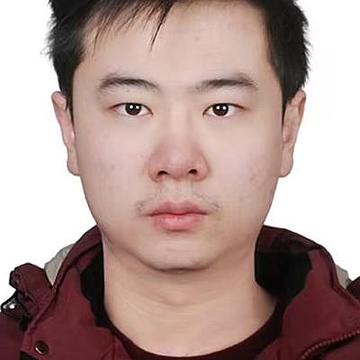 Yuteng Ye合作论文数Huazhong University of Science and Technology7
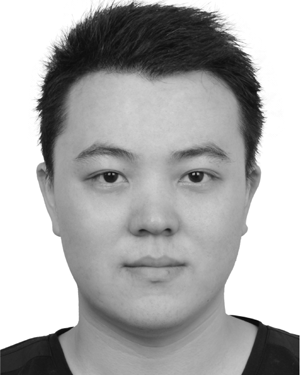 Zhang Ying-Liang (张颖靓)合作论文数ShanghaiTech University7
 Longwen Zhang (张龙文)合作论文数School of Information Science and Technology, ShanghaiTech University7
 Youjia Zhang合作论文数6
 Yuesong Wang合作论文数School of Computer Science and Technology, Huazhong University of Science and Technology6
 Run Luo (罗润)合作论文数University of Chinese Academy of Sciences5
 Hang Zhou合作论文数5
 Yu Ji (季雨)合作论文数LightThought5
 Tao Guan (管涛)合作论文数School of Computer Science & Technology, Huazhong University of Science and Technology5Jiale Cai合作论文数4
 Luoyuan Xu合作论文数School of Computer Science & Technology, Huazhong University of Science & Technology4
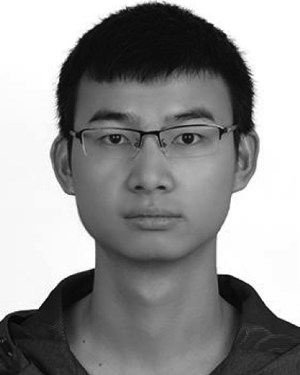 WenKai Liu合作论文数Huazhong Univ Sci Technol, Sch Comp Sci & Technol, Wuhan, Hubei, Peoples R China4
 Jinwei Ye合作论文数Louisiana State University
Baton Rouge4Chenxing Gao合作论文数3QIwei Qiu合作论文数3
Jinwei Ye合作论文数Louisiana State University
Baton Rouge4Chenxing Gao合作论文数3QIwei Qiu合作论文数3 Haiting Lin合作论文数Univ Delaware3
 Zhong Li (李众)合作论文数Apple Inc.3
 Teng Xu合作论文数Department of Oral and Maxillofacial Surgery, Nanjing Medical University3Lintao Ma合作论文数Ant Group3
 Matthias Nießner合作论文数Department of Informatics, Technical University of Munich;Visual Computing Lab, Technical University of Munich;Synthesia Technologies;SpAItial AI3
 Phoebe Chen合作论文数Department of Computer Science and Computer Engineering, La Trobe University, Melbourne Australia.3
 Junle Wang合作论文数Tencent3Zijun Zhao合作论文数2Hongyang Lin合作论文数2Zhaojie Zeng合作论文数2
 Bo Zhang合作论文数2Peihong Yu合作论文数2
 Haimin Luo合作论文数School of Information Science and Technology, ShanghaiTech University, Shanghai, China2Anqi Pang合作论文数ShanghaiTech Univ, Sch Informat Sci & Technol, Shanghai Engn Res Ctr Intelligent Vis & Imaging, Shanghai, Peoples R China2
 Ziyu Wang合作论文数School of Information Science and Technology, ShanghaiTech University, Shanghai, China2
 Di Xiao (肖迪)合作论文数College of Computer Science, Chongqing University2
 Min Yang (杨敏)合作论文数Shenzhen Key Laboratory for High-Performance Data Mining, Shenzhen Institute of Advanced Technology, Chinese Academy of Sciences;University of Chinese Academy of Sciences;Large Language Models Center, Faculty of Computer Science and Artificial Intelligence, Shenzhen University of Advanced Technology2
 Sing Bing Kang合作论文数Zillow2Xinglang Zhang合作论文数Intelligent Media Computing and Network Security Lab, Huazhong University of Science and Technology1
 Yunyao Zhang (张云耀)合作论文数The Intelligent Media Computing and Cybersecurity Laboratory, School of Computer Science and Technology, Huazhong University of Science and Technology1
 Tianhao Zhao (赵天豪)合作论文数School of Computer Science and Technology, Huazhong University of Science and Technology1Ying Tang合作论文数School of Computer Science and Technology, Huazhong University of Science and Technology1
 Jinsheng Quan (权金升)合作论文数School of Software Technology, Zhejiang University1Junkai Lin合作论文数Huazhong University of Science and Technology1
 Yichao Xu合作论文数School of Software and Technology, Zhejiang University1Wenbing Li合作论文数Huazhong University of Science and Technology1Qingcheng Zhao合作论文数1




